
In the Australian Curriculum, negative numbers first appear in Year 6, where children place them on a number line and use them as coordinates in all four quadrants. Year 7 adds and subtracts them. Multiplying and dividing negatives is Year 8. Victoria follows the same order and adds negative fractions and decimals on the number line in Year 7. NSW introduces them in Stage 3 and teaches all four operations together in Stage 4 (Years 7 and 8).
So a Year 5 child who has never seen −3 is right on schedule, and “two negatives make a positive” is not primary school maths at all. What does happen early is the damage: a rule learnt in Year 2, “you can’t take a bigger number from a smaller one”, is the first thing negative numbers have to undo. This page sets out what each year teaches, the five wrong answers that turn up most often, four questions to find where your child is, and twenty minutes of practice with a weather map.
What the curriculum asks for, year by year
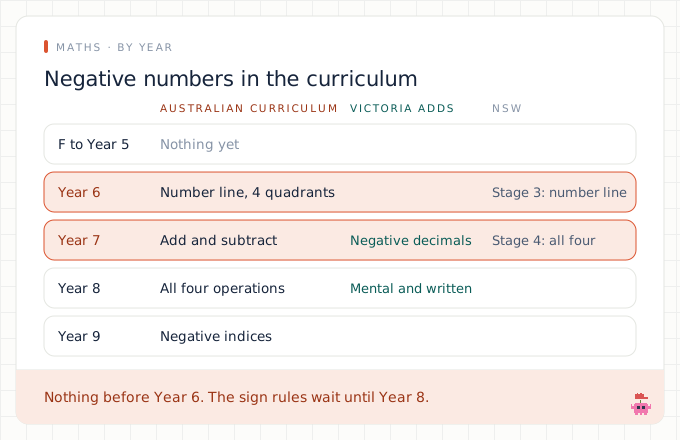
The Australian Curriculum descriptors, quoted from ACARA:
- Foundation to Year 5: no negative numbers. Year 5 builds a grid with coordinates (AC9M5SP02), but on a grid that starts at zero, so every coordinate is positive.
- Year 6, AC9M6N01: “recognise situations, including financial contexts, that use integers; locate and represent integers on a number line and as coordinates on the Cartesian plane”. The same year asks children to “locate points in the 4 quadrants of a Cartesian plane” (AC9M6SP02), which is where coordinates like (−2, 3) first appear. There is no calculating with negatives yet.
- Year 7, AC9M7N07: “compare, order and solve problems involving addition and subtraction of integers”. This is the year 5 − 8 gets an answer.
- Year 8, AC9M8N04: “use the 4 operations with integers and with rational numbers, choosing and using efficient strategies and digital tools where appropriate”. Multiplying and dividing negatives, and the sign rules, live here.
- Year 9, AC9M9A01: exponent laws “with integer exponents”, which means negative powers such as 10−2. The idea keeps stretching.
Where Victoria differs (the VCAA wording is paraphrased here, not quoted). Levels 6, 7 and 8 carry the same three steps (VC2M6N01, VC2M7N08, VC2M8N04), with two small additions. At Level 7, VC2M7N03 asks for positive and negative fractions, decimals and mixed numbers on a number line, so a Victorian Year 7 should be able to place −2.5 and −¾; the national Year 7 descriptor only says rational numbers. At Level 8, VC2M8N04 asks for mental and written strategies and estimates alongside digital tools, so a calculator is not meant to carry the sign rules.
Where NSW differs (the NESA wording is paraphrased). The NSW Mathematics K–10 Syllabus meets integers in Stage 3, inside “Represents numbers B”: placing negative whole numbers on a number line, using the word integer, reading integers in everyday contexts, and recognising that a subtraction can give a negative answer. We read every Stage 2 and Stage 3 maths content page; that is the only one that mentions negatives. Everything else happens in one Stage 4 outcome, compares, orders and calculates with integers (MA4-INT-C-01), whose content runs from ordering to multiplying, dividing and the order of operations with integers. A NSW school can teach all of it in Year 7.
Five wrong answers to listen for
1. “−8 is bigger than −3” (Year 6)
The child compares the digits and ignores the sign: 8 beats 3, so −8 must beat −3. It is the most common error with negatives and the easiest to fix, because children already know the answer in context. Ask “which is colder, minus 8 degrees or minus 3?” and almost every child says minus 8. Colder means smaller. Draw the number line vertically, like a thermometer, and say “further down is smaller”.
2. “5 − 8 is 3” or “you can’t do it” (Years 6 and 7)
This one was taught. In the early years, children subtract only smaller numbers from bigger ones, and many hear a rule along the way: you can’t take 8 from 5, so swap them. The rule held for six years, which is why it is so stubborn. NSW names the repair in Stage 3: a subtraction can give a negative answer. Start on 5 on the number line, walk 8 steps down, and you land on −3. If your child says “but my teacher said you can’t”, they are right about Year 2 and wrong about Year 7, and it is worth saying so out loud. If subtraction itself is shaky, start with our page on place value by year.
3. “−3 + 5 is −8” (Year 7)
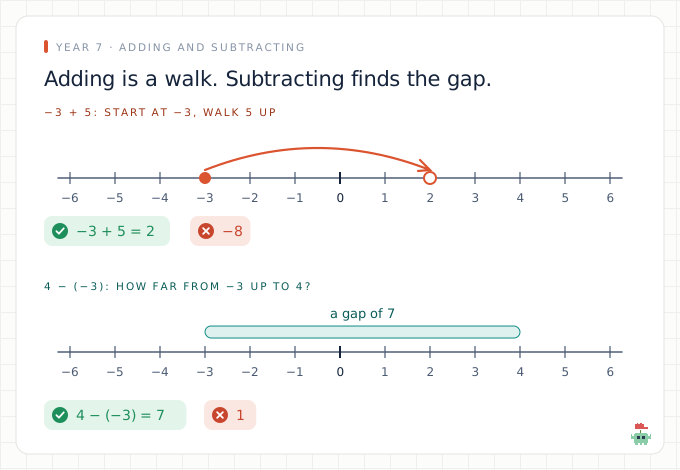
The child sees a 3, a 5 and a minus sign, adds the sizes and keeps the sign. The fix is to make every addition a walk along the line: start at −3, take 5 steps up, land on 2. Temperature does the same work. It is minus 3 at dawn and warms up 5 degrees; what is it now? Nobody says minus 8 degrees.
4. “4 − (−3) is 1” (Year 7)
The child drops the second minus sign, or treats both as one. Subtracting a negative is the hardest idea in Year 7, and memorising “two minuses make a plus” before understanding it is how wrong answer 5 starts. A better reading: subtraction finds the gap. How far is it from −3 up to 4? Three steps to zero, four more to 4: seven. So 4 − (−3) is 7. The temperature version: today is 4 degrees, this morning was minus 3; how much did it warm up? Seven degrees.
5. “−2 × −3 is −6”, and “−2 + −3 is 5” (Year 8)
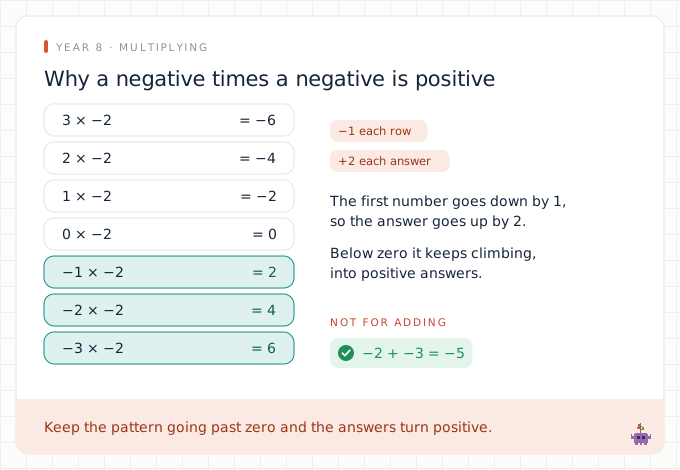
These are two halves of one mistake. A child who learnt “two negatives make a positive” as a slogan applies it to the wrong operation (so −2 + −3 becomes 5) or forgets which way round it goes (so −2 × −3 becomes −6). The slogan is about multiplying and dividing only; adding two negatives just walks further down, to −5. For the multiplication, show the pattern rather than the rule: 3 × −2 is −6, 2 × −2 is −4, 1 × −2 is −2, 0 × −2 is 0. Each answer goes up by 2. Keep going and −1 × −2 has to be 2, and −3 × −2 has to be 6. NSW’s Stage 4 content asks for exactly this, multiples of negative integers as repeated addition, before the rule.
Four questions to find where your child is
Pen and paper, no calculator. Stop at the first one that goes wrong; that is where to start.
- Year 6. “Put these in order, coldest first: 2 degrees, minus 5 degrees, minus 1 degree, 0 degrees.” Right: −5, −1, 0, 2. Putting −1 before −5 is wrong answer 1.
- Year 6. “On a grid with both axes running from −5 to 5, mark the point (−3, 2).” Right: three left of the centre, two up. Going three right means the sign was read as decoration; going two down means the order of the coordinates is muddled, which is a Year 5 grid problem, not a negatives one.
- Year 7. “Work out 5 − 8, then −3 + 5, then 4 − (−3).” Right: −3, 2 and 7. Answers of 3, −8 and 1 are wrong answers 2, 3 and 4.
- Year 8. “Work out −2 × −3, then −2 + −3, then −12 ÷ 4.” Right: 6, −5 and −3. Mixing up the first two is wrong answer 5.
A Year 5 child who cannot do question 1 is not behind: integers are Year 6 (Stage 3 in NSW). A Year 7 child who cannot do question 4 is not behind either, outside NSW; multiplying negatives is Year 8.
Want practice set in their own world? Sprout writes a lesson on AC9M7N07 or VC2M7N08 around what your child loves, from footy ladders to game scores. Try it free.
Twenty minutes with a weather map
You need a weather page that shows overnight minimums (winter in Canberra, the alpine towns or any overseas city works well), a strip of paper and a pen.
- Five minutes: build a thermometer. Draw a vertical line on the strip from −10 at the bottom to 10 at the top, with zero in the middle. Read four overnight minimums aloud and mark each one. This is all of Year 6 on one strip of paper.
- Five minutes: coldest to warmest. Pick five temperatures, some below zero, and order them. Say it as “further down is colder, and colder is smaller”. Wrong answer 1 cannot survive the strip.
- Five minutes: overnight changes. For three places, find the change from the minimum to the maximum by counting steps on the strip. Write each as a sum (−4 + 9 = 5) and as a gap (5 − (−4) = 9). That is the Year 7 pair.
- Five minutes: the pattern (Year 8 and up). Write the × −2 column from 3 down to −3 and let your child fill in the answers by following the pattern before you name the rule.
What is not the problem
- No negative numbers before Year 6. If your Year 5 child has not met them at school, that is the curriculum. In NSW, integers sit in the “B” half of a Stage 3 topic, so a Year 5 child may or may not have met them yet.
- Not knowing the sign rules in Year 7. Outside NSW, multiplying and dividing negatives is Year 8.
- Saying “minus five”. It is common and harmless once the idea is secure. While it is new, “negative five” helps keep the number apart from the operation.
Where this sits
Negative numbers sit in the Number strand and lean on the number line children built for decimals and fractions. If your child is moving into Year 7 in Victoria next year, our page on starting Year 7 sets out what else arrives with them. For the whole picture of a year level, see what a Year 6 student should know, and for every maths code in a year, the teacher-facing Year 6 maths codes page. If you are not sure which curriculum applies, start with which curriculum your state uses, and if you are worried more broadly, our guide to whether your child is behind in maths shows how to check the year first.
The short version
- Nothing before Year 6. Year 6: integers on a number line and in all four quadrants.
- Year 7: adding and subtracting integers; Victoria adds negative fractions and decimals on the line.
- Year 8: multiplying and dividing, and the sign rules.
- NSW: integers on the number line in Stage 3, all four operations in Stage 4.
- The fix for most errors: a vertical number line, adding as a walk and subtracting as a gap.
Sprout makes a lesson on the exact code your child is working on, with questions in their own interests. Start free.
How this page was checked
The Australian Curriculum descriptors are quoted from our copy of version 9.0, which matches AC9M7N07 on the Australian Curriculum website; we searched every Foundation to Year 10 maths descriptor for integers and negative numbers. The Victorian codes are from the Victorian Curriculum F–10 version 2.0. The NSW findings come from the NSW Mathematics K–10 content pages, all 40 Stage 2 and Stage 3 pages and the Stage 4 integers page, read on 22 October 2026. Victorian and NSW wording is paraphrased. Checked 22 October 2026.
Australian Curriculum content descriptions are © Australian Curriculum, Assessment and Reporting Authority (ACARA) 2010 to present, licensed under CC BY 4.0, and quoted here unmodified. ACARA does not endorse any product that uses the Australian Curriculum. Victorian Curriculum codes reference the Victorian Curriculum F–10 Version 2.0 © VCAA, paraphrased; the VCAA does not endorse this product. NSW outcome codes reference the NSW syllabuses © NSW Education Standards Authority (NESA) for and on behalf of the Crown in right of the State of New South Wales, paraphrased, available at curriculum.nsw.edu.au; NESA does not endorse this product.
FAQ
What year do kids learn negative numbers in Australia?
Year 6. In the Australian Curriculum and the Victorian Curriculum, Year 6 places integers on a number line and uses them as coordinates in all four quadrants of the Cartesian plane (AC9M6N01, AC9M6SP02). There is no calculating with negatives until Year 7. In NSW, integers first appear in Stage 3, which covers Years 5 and 6.
When do kids learn to add and subtract negative numbers?
Year 7. AC9M7N07 asks students to compare, order and solve problems involving addition and subtraction of integers; the Victorian Level 7 descriptor is the same. In NSW, adding and subtracting integers sits in the Stage 4 outcome MA4-INT-C-01, alongside multiplying and dividing them.
When do kids learn that a negative times a negative is positive?
Year 8 in the Australian and Victorian curricula, which put all four operations with integers in one Year 8 descriptor (AC9M8N04, VC2M8N04). NSW teaches it in Stage 4, Years 7 and 8, and its content asks students to see multiples of a negative as repeated addition first. The clearest way to show it is a pattern: 2 × -2 is -4, 1 × -2 is -2, 0 × -2 is 0, so -1 × -2 has to be 2.
Why does my child say 5 take away 8 is 3?
Because for six years it was true that you cannot take a bigger number from a smaller one, and many children learnt to swap the numbers. From Year 7, 5 - 8 has an answer: start at 5 on the number line, walk 8 steps down, and you land on -3. NSW names this in Stage 3: a subtraction can give a negative answer.
Why does my child think -8 is bigger than -3?
Because they compare the digits and ignore the sign. Ask which is colder, minus 8 degrees or minus 3, and most children get it right at once. Colder means smaller. Draw the number line vertically like a thermometer and say further down is smaller.