
Before anything else: check whether the thing your child cannot do has actually been taught yet. Most of the time it has not. Parents test their children on division with remainders in Year 4, the area formula in Year 4, percentages in Year 4, and letters standing for numbers in Year 6, and every one of those is a year or more early.
This page is the method. How to tell the difference between a genuine gap and a topic that is simply not due, what to do about each, and where to look up your child’s year properly.
When it is actually due
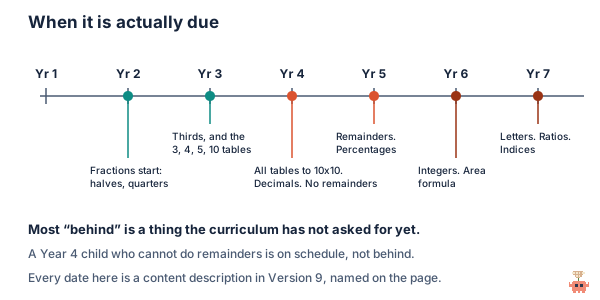
The six that catch people out most often, with the code so you can check us:
- All the times tables: Year 4, AC9M4A02, capped at 10 x 10. Year 3 is only the 3s, 4s, 5s and 10s. The elevens and twelves are nowhere.
- Division with remainders: Year 5, AC9M5N07. Year 4 is explicitly limited to division “where there is no remainder”, in those words.
- Percentages: Year 5, AC9M5N04.
- Adding fractions with unrelated denominators: Year 6, AC9M6N05. A half plus a quarter is Year 5; a third plus a quarter is Year 6.
- The formula for the area of a rectangle: Year 6, AC9M6M02. Length times width is two years after most parents expect.
- Letters standing for numbers: Year 7, AC9M7A01 to A03. There is no algebra with letters anywhere in primary.
Also worth knowing: no written algorithm is ever mandated. Not the stacked multiplication, not long division, not in any year. What the curriculum actually says about long division is considerably less than almost everyone assumes.
The three questions that sort it out
- Is it in their year at all? Look it up before you worry. The year-by-year pages below take two minutes. If the answer is no, you are done, and you have your evening back.
- Is it one strand or the whole subject? A child who is fluent with number and lost with measurement is normal, and it is not the same situation as a child who is behind across the board. Ask their teacher which strand, not whether.
- Is it the maths or the reading? A great many “maths problems” in Years 3 to 6 are comprehension problems wearing a maths costume. If your child can do 24 divided by 4 and cannot do the word problem that contains it, the gap is not arithmetic.
What behind actually looks like
There is a real version of this, and it has a different shape from the false alarms. Signals worth acting on:
- A foundation skill from two or more years ago is missing. Not the current topic: the one underneath it. A Year 5 child who cannot recall 7 x 8 is carrying a Year 4 gap into everything.
- They can follow a procedure and cannot estimate. A child who gets 300 minus 148 wrong by a hundred and does not notice has no sense of size, which is a deeper problem than any single topic.
- It is not moving. One hard term is ordinary. Three terms on the same wall is information.
- The teacher has raised it. They see thirty children the same age every day, which is a comparison you cannot make and they can.
What is not a signal: being slower than a cousin, forgetting over the holidays, finding a brand new topic hard in week one, or being unable to do something you remember doing at that age in a different curriculum three decades ago.
Working below year level is not the same as behind
Worth separating, because the words get used interchangeably and they are not the same thing. A child can be working at a lower level in one strand while sitting comfortably in their year for everything else, and in Victoria the curriculum is written as Levels on a continuum precisely because that is expected. What that means, and what it does not mean is its own page.
If there is a real gap
- Name it as a code, not a feeling. “Struggling with fractions” is not actionable. “Cannot find an equivalent fraction with a related denominator” is. The year pages below give you the vocabulary.
- Go back to the year it was taught, not the year they are in. Practising Year 5 content on a Year 4 gap produces a frustrated child and no progress.
- Twenty minutes, most days, same time. Short and frequent beats long and occasional, and the spacing is doing more work than the content.
- Ask questions rather than explain. The two study techniques with the strongest evidence behind them are being tested and being tested again a few days later. Neither involves a parent talking.
- Talk to the teacher before you buy anything. They will tell you the strand for free, and it is the piece of information every paid option will ask you for anyway.
Look up your child’s year
What each year actually asks for, read from the curriculum rather than summarised:
- Year 3, Year 4, Year 5 and Year 6
- Which times tables are due in which year
- Fractions by year, and the related-denominator rule
- The decimal misconception that looks like being behind
If your child is in Victoria or New South Wales, the document is different. Victoria runs Version 2.0 of its own curriculum and New South Wales organises by stage rather than year. The sequence is broadly similar; the codes are not.
The short version
Most “behind” is a topic the curriculum has not asked for yet. All the times tables are Year 4, remainders and percentages are Year 5, integers and the area formula are Year 6, and letters standing for numbers are Year 7. No written algorithm is required in any year.
Ask three things. Is it in their year at all. Is it one strand or the whole subject. And is it the maths or the reading, because a lot of Year 3 to 6 maths trouble is comprehension in disguise.
Real gaps look different: a foundation skill from two years back is missing, there is no sense of whether an answer is the right size, it has not moved in three terms, or the teacher has raised it. If that is where you are, name the gap as a code, go back to the year it was taught, and do twenty minutes most days.
Sprout Lessons builds curriculum-aligned lessons for Foundation to Year 10, with the code on every lesson, so a gap you can name becomes a lesson you can teach tonight. Start free. If you are in Victoria, Sprout Tutor is in public beta for Years 1 to 9 and free on every tier while it is in beta.
Codes and descriptor wording checked 25 September 2026 against our copy of the Machine Readable Australian Curriculum Version 9, accessed 2026-06-24, not written from memory. Read the official text at the Australian Curriculum mathematics pages. Australian Curriculum content © ACARA, licensed under CC BY 4.0. This page is general guidance and not an assessment: if you have a real concern about your child’s progress, their classroom teacher has information no website can give you. Victoria and New South Wales run their own curriculum documents.
FAQ
How do I know if my child is behind in maths?
Check three things before anything else. Is the topic in their year at all, because most parental worry is about content that is a year or more early. Is it one strand or the whole subject, since a child fluent in number and lost in measurement is normal. And is it the maths or the reading, because many Year 3 to 6 maths problems are comprehension problems in disguise. A real gap looks different: a foundation skill from two years back is missing, there is no sense of whether an answer is the right size, it has not shifted in three terms, or the teacher has raised it.
What maths should my child know by each year in Australia?
In Version 9 of the Australian Curriculum: fractions start in Year 2 with halves and quarters; thirds and the 3, 4, 5 and 10 times tables arrive in Year 3; all tables to 10 x 10 and decimals are Year 4, where division is explicitly limited to no remainder; remainders and percentages are Year 5; integers and the formula for the area of a rectangle are Year 6; and letters standing for numbers, ratios and indices are Year 7.
Should my Year 4 child be able to do division with remainders?
No. AC9M4N06 asks for strategies for multiplication and division where there is no remainder, in those words. Interpreting a remainder is AC9M5N07, in Year 5. A Year 4 child who divides 24 by 4 without hesitating and stalls on 23 divided by 4 is exactly on schedule.
Is working below year level the same as being behind?
No, and the words get used interchangeably when they should not. A child can work at a lower level in one strand while sitting comfortably in their year for everything else. The Victorian Curriculum is written as Levels on a continuum precisely because students are expected to be spread along it, so a Level below the year is what the document anticipates rather than a verdict.
Is my child behind if they cannot do long division?
Almost certainly not, because no written algorithm is mandated anywhere in the Australian Curriculum, for any operation, in any year. The curriculum asks for efficient strategies and for students to explain their reasoning. A child who can divide reliably by a method they can explain has met the requirement, whatever the method looks like on paper.
What should I do if there really is a gap?
Name it as a specific content description rather than a feeling, go back to the year that content was taught rather than the year your child is in, and do twenty minutes most days at the same time rather than a long session occasionally. Ask questions instead of explaining. And talk to the classroom teacher before buying anything, because they will tell you which strand for free and every paid option will ask you for that anyway.