
Your child has not got a bad memory. Forgetting is what memory does, and the only thing that reliably beats it is meeting the same idea again a few days later. The uncomfortable part is that almost nothing in a normal week is set up to bring anything back.
This matters more than it used to, because the tool most children now reach for when they are stuck is a chatbot, and a chatbot keeps nothing you can revisit. It answers, the conversation scrolls away, and on Thursday there is no record that Tuesday happened.
What the research actually recommends
In 2013 Dunlosky and colleagues reviewed ten common study techniques in Psychological Science in the Public Interest and rated each one for how well it generalises across ages, subjects and situations. Highlighting, rereading, summarising and the keyword mnemonic all came out low or moderate. Only two were rated high utility: practice testing and distributed practice.
Those are the two least popular things in the house. Practice testing means being asked rather than reading. Distributed practice means spreading the same material over days instead of doing it in one go. Neither feels productive at the time, which is exactly why neither happens without a system.
A chatbot is the opposite of both. Your child reads an explanation rather than producing an answer, and the session leaves nothing behind that could be spread over anything. That is not a flaw in the chatbot. It is a conversation, and conversations are not designed to be revisited by topic.
What a session has to leave behind
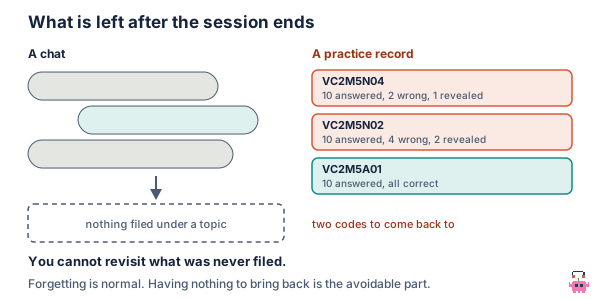
For distributed practice to be something you can actually do, a session has to end with a list of things, not a transcript. Specifically:
- The curriculum code, so “he struggled with fractions” becomes VC2M5N04 and stops being a vibe.
- The question, and what your child actually answered, because the wrong answer usually tells you which misconception it was.
- Whether they took a hint, which is the difference between nearly knowing it and not knowing it.
- Whether they gave up and revealed the answer, which is the single most useful signal in the whole record and the one most products throw away.
With those four things, Thursday has something to work with. Without them you are relying on a ten-year-old’s self-report, and the honest summary of that is a score that contains everything they were told.
How Sprout Tutor handles it, including what it does not do
Sprout Tutor went into public beta on 22 September 2026. It covers the Victorian Curriculum only, Years 1 to 9, and while it is in beta it is free on every tier, including the free one. If you are outside Victoria, the rest of this section is about the shape of the thing rather than something you can use today.
Every question a child answers is stored against its VC2 code with the outcome, whether a hint was used and whether the answer was revealed. The adult view then does one thing with that: it lists every code your child has got at least one question wrong on, under a heading that says “Needs a hand”, and each one is a single click away from building a lesson on that exact code.
What it does not do, and this matters: it does not automatically schedule the forgotten code to come back in four days. There is no spaced repetition queue. The engine moves through a pathway ten questions at a time and the revisit is an adult decision, made from a list.
We would rather say that than imply otherwise, and there is a case for it as well as an admission. Every study in this field that found a durable gain had an adult who could see the work, and none has yet shown durable gains for children left alone with an AI tutor. A list that tells you what to do next is more useful than an algorithm that quietly does something you cannot see.
What to actually do at home
- Ask instead of explaining. The highest-utility technique in the review is being tested, and you can do it for free at the kitchen table. One question about last week’s topic, cold, before you help with this week’s.
- Space it on purpose. Same idea Monday and Thursday beats the same idea twice on Monday. It will feel worse and it works better, which is the whole finding.
- Write down the topic, not the feeling. “Equivalent fractions” on a sticky note is enough. The point is that Thursday inherits something.
- Treat a revealed answer as information, not as cheating. It marks the exact point where your child ran out of road, and a child who is punished for revealing simply stops revealing and starts guessing.
- Twenty minutes, most nights. The wider plan for doing this without a tutor is its own page, and it is mostly about the schedule rather than the content.
What is not the problem
- Forgetting between sessions is not a red flag. It is the normal operation of a memory that has met something once. Judge the second meeting, not the first.
- Getting it right in the lesson and wrong a week later is not inconsistency. It is the standard result, and it is precisely what distributed practice exists to fix.
- It is rarely an attention problem. A child who can recall every detail of a game they played on Saturday has a working memory. What they lack is a reason to retrieve Tuesday’s fractions, and retrieval is the thing that has to be practised.
Where to go next
- The difference between a chatbot and a tutor, in general
- How the tutor decides what comes next, with the real thresholds
- What it means when a child works below their Year level
- When the problem is willingness rather than memory
The short version
Forgetting is the default, and the review evidence says the two techniques that beat it are practice testing and distributed practice: being asked, and being asked again a few days later. Both are unpopular because neither feels productive while you are doing it.
A chatbot does neither. Your child reads instead of retrieving, and the session leaves a scrollback rather than a list of topics. You cannot revisit what was never filed.
What a record needs is the curriculum code, the question, the answer they gave, whether they took a hint and whether they revealed. Sprout Tutor keeps all four and surfaces every code with a wrong answer on it, and it is honest that the revisit is still your call rather than an automatic queue.
Sprout Lessons builds curriculum-aligned lessons for Foundation to Year 10, with the code on every lesson. Start free.
Checked 24 September 2026. The learning-technique ratings are from Dunlosky et al., Improving Students’ Learning With Effective Learning Techniques, Psychological Science in the Public Interest, 2013; the publisher’s own site blocks automated fetches from our tooling, so PubMed is linked and the article opens normally in a browser. The tutor behaviour described here was read from the code rather than from marketing copy: attempts are stored per curriculum code with hint and reveal flags, and the “Needs a hand” list is every code with at least one incorrect answer. Sprout Tutor is in public beta, covers the Victorian Curriculum only for Years 1 to 9, and is free on every tier while in beta.
FAQ
Why does my child forget what they learn so quickly?
Because forgetting is what memory does after a single exposure. It is the normal result, not a warning sign, and the thing that changes it is meeting the same idea again a few days later. Judge the second meeting rather than the first. A child who can recall every detail of Saturday’s game has a working memory; what is missing is a reason to retrieve Tuesday’s fractions.
What are the best study techniques for children?
Dunlosky et al. reviewed ten techniques in 2013 for Psychological Science in the Public Interest and rated exactly two as high utility: practice testing and distributed practice. Highlighting, rereading, summarising, the keyword mnemonic and imagery all rated lower. Practice testing means being asked rather than reading; distributed practice means spreading the same material across days instead of doing it in one go.
Why does using a chatbot not help my child remember?
Two reasons. Your child reads an explanation rather than producing an answer, so no retrieval happens, and retrieval is what practice testing means. And the session leaves a scrollback rather than a list of topics, so there is nothing indexed that a later session could revisit. That is not a flaw in the chatbot: a conversation is simply not designed to be returned to by topic.
What should a practice record contain?
Four things. The curriculum code, so that struggled with fractions becomes a specific outcome. The question and what your child actually answered, because the wrong answer usually identifies the misconception. Whether they took a hint, which separates nearly knowing it from not knowing it. And whether they revealed the answer, which is the single most useful signal and the one most products discard.
Does Sprout Tutor automatically bring back a topic my child got wrong?
No, and it is worth being clear about that. Every question is stored against its Victorian Curriculum code with hint and reveal flags, and the adult view lists every code with at least one wrong answer under a Needs a hand heading, each one a click away from building a lesson on that code. But there is no spaced repetition queue: the engine moves through a pathway ten questions at a time and the revisit is an adult decision made from a list. Every study that found a durable gain had an adult who could see the work.
Is getting it right in the lesson and wrong a week later a problem?
No, it is the standard result and it is exactly what distributed practice exists to address. Performance during a lesson is a poor predictor of what survives the week, which is also why a tool that lifts performance while it is on the screen is not necessarily teaching anything.