
Ask a chatbot a math question and it gives you the answer. That is not a flaw in the chatbot. That is the entire product working exactly as designed. It is also the reason a general assistant makes a poor tutor, and why the distinction matters more now that your child probably has one on their school account.
The two things get talked about as though they are the same category at different quality levels, as if a tutor were a better chatbot. They are not. They are built around opposite assumptions about who is supposed to be doing the thinking.
The four differences that actually matter
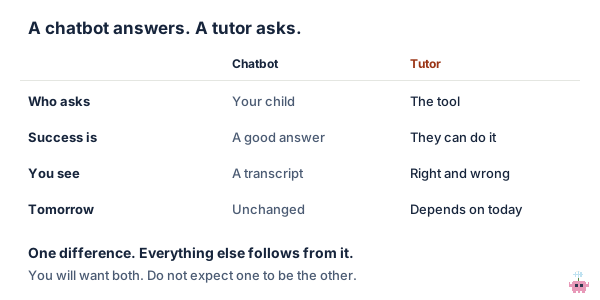
1. Who asks the question
A chatbot waits to be asked. A tutor asks. That sounds small and it is the whole thing, because a child who has to produce an answer is doing retrieval, and a child who receives one is doing reading.
It also decides who has to know what. To use a chatbot well your child must already know what they do not understand, which is precisely the skill a struggling learner does not have. The child who most needs help is the one least able to ask for it.
2. What counts as success
A chatbot has succeeded when its answer is good. A tutor has succeeded when the child can now do it. Those come apart constantly, and the gap is invisible in a transcript full of excellent explanations.
3. What an adult can see afterwards
This is the practical one, and it follows from the architecture rather than from anybody’s privacy policy.
An open assistant will answer anything, so a conversation has no expected shape. There is nothing to summarize except the conversation itself, which is why the only real visibility is a transcript, and why getting hold of a transcript is its own problem.
A practice tool asked the question, so it already knows what the question was, what the right answer was, and what your child chose. It can report that without anyone reading a chat log. That is not better ethics, it is a different data model.
4. Whether anything happens next
A chatbot conversation ends. Nothing about tomorrow changes because of what happened today, and the tool has no opinion about what your child should do next, because it has no idea what they can already do.
A tutor is a sequence. The next question depends on the last one, and that dependency is the product.
Where chatbots are genuinely better
A comparison that cannot name the other side’s strengths is marketing. Three things a general assistant does that a structured tutor cannot touch:
- Answering the strange question. Why is the sky blue, what is a quasar, how do you say this in Japanese. Unbounded curiosity needs an unbounded tool, and a curriculum-shaped one will refuse or flounder.
- Explaining the same thing five different ways. If your child is stuck on one specific idea and needs another analogy, and another, a conversation is exactly the right shape for that.
- Working on whatever is in front of them. A photo of the actual worksheet, the actual essay, the actual assignment. A structured tutor works on its own material, not yours.
The honest summary of that list: a chatbot is a good explainer and a poor assessor. Use it as a reference book that talks, and do not expect a reference book to teach.
What to watch for, either way
Two failure modes come up repeatedly and neither is exotic.
The answer arrives before the thinking does. If your child can produce finished work and cannot explain a line of it, the tool did the work. This is not detectable in the tool, it is detectable at your kitchen table, by asking them to talk you through one step.
Confident and wrong. Both kinds of tool produce errors, and the fluent register makes them hard to spot. A structured tool has a narrower surface to be wrong on, and a deterministic marker either matched the answer or it did not, but neither is infallible and neither should be treated as such.
Is either of them any good? The honest answer
As of August 2026, the effectiveness of personalized-learning chatbots has not been independently established, and very few rigorous studies have been run. That is the actual state of the evidence and anyone telling you otherwise, in either direction, is ahead of it.
The one finding that keeps recurring is about the adult rather than the software: how involved a human is appears to be a key factor in whether AI-assisted tutoring works. Which is an argument for choosing tools that make it easy for you to stay involved, and a reason to be skeptical of anything sold as hands-off.
How to tell which one you are looking at
Five questions. They work on any product, including ours.
- Does it ask my child questions, or only answer theirs?
- Can I see the actual questions and the actual answers? Not a score, not a summary. The questions.
- Does what it shows tomorrow depend on what happened today? If not, it is a content library with a chat box.
- Is it tied to a curriculum I recognize? Your state or your country’s standards, with codes, or generic “grade 4 math”.
- What stops it just giving the answer? There should be a mechanism, and it should be describable in one sentence.
Where we sit, declared
We are building a tutor, so read the above knowing that. Sprout Tutor is in development: the child works behind a PIN, the tool asks the questions rather than waiting to be asked, every question is tied to a code in their own curriculum, and the adult sees the literal questions they got right and wrong. It is deliberately not open-ended chat, which means it is deliberately no use for why the sky is blue.
Both things are true and you will probably want both. The mistake is expecting one of them to be the other.
The short version
A chatbot answers; a tutor asks. From that one difference everything else follows: what success means, what an adult can see afterwards, and whether tomorrow depends on today.
Chatbots are genuinely better at unbounded curiosity, at re-explaining one idea five ways, and at working on the actual worksheet in front of your child. They are poor assessors, and they cannot tell you what your child cannot do.
Neither category has strong evidence behind it yet. The finding that does keep coming up is that an involved adult is what makes AI tutoring work, so pick the tool that makes staying involved easy, and ask the five questions above before you believe anyone’s marketing, including ours.
Sprout Lessons builds standards-aligned lessons for grades K–12, around whatever your child is actually into. Start free.
Checked 15 September 2026. The state of the research on personalized-learning chatbots is from The Christian Science Monitor, 7 August 2026. This is a fast-moving field and a page about it ages quickly: treat the evidence position as of this date, not as settled.
FAQ
What is the difference between an AI chatbot and an AI tutor?
The direction of the question. A chatbot waits to be asked and then answers; a tutor asks the child and then responds to what they did. Everything else follows from that: a chatbot succeeds when its answer is good while a tutor succeeds when the child can now do it, a chatbot conversation ends while a tutor is a sequence where the next question depends on the last, and a chatbot can only be reported as a transcript while a tutor already knows what it asked and what your child chose.
Can my child just use ChatGPT or Gemini as a tutor?
For some things, yes, and better than a structured tool. General assistants are genuinely better at unbounded curiosity, at explaining one idea five different ways when your child is stuck, and at working on the actual worksheet or essay in front of them. What they are poor at is assessment: they cannot tell you what your child cannot do, because they never asked. Treat one as a reference book that talks, and do not expect a reference book to teach.
Why can I see what happened in a tutor but not in a chatbot?
Architecture rather than policy. An open assistant will answer anything, so conversations have no expected shape and the only faithful report is the whole transcript. A practice tool asked the question, so it holds the question, the correct answer and your child’s response as structured data, and can show you which topics went badly without anyone reading a chat log. Getting hold of a school chatbot transcript is a separate and harder problem.
Do AI tutors actually work?
The honest answer as of 2026 is that nobody has established it. The effectiveness of personalized-learning chatbots has not been independently established and very few rigorous studies have been run, which is the reported state of the evidence as of August 2026. The finding that does keep recurring is about the adult rather than the software: how involved a human is appears to be a key factor in whether AI-assisted tutoring works, which argues for choosing tools that make staying involved easy.
What should I watch out for with either type?
Two failure modes, neither exotic. First, the answer arriving before the thinking: if your child produces finished work and cannot explain a line of it, the tool did the work, and you detect that at the kitchen table by asking them to talk you through one step rather than by inspecting the software. Second, confident and wrong: both kinds produce errors and the fluent register makes them hard to spot. A structured tool has a narrower surface to be wrong on, but neither is infallible.
Does my child need both?
Probably, and the mistake is expecting one to be the other. An open assistant is the right shape for curiosity, for re-explaining a stuck idea, and for working on the specific thing in front of them. A structured tutor is the right shape for practice that accumulates, for coverage of an actual curriculum, and for telling an adult what is going wrong. Use each for what it is built for and neither disappoints you.