
The AI writes the question. It does not choose it. In Sprout Tutor, which topic your child works on next and how hard the next question is are decided by a short list of fixed rules, written as ordinary code, that runs before any language model is involved. The model’s job starts after that decision: it writes a question for the topic and difficulty the rules picked.
This page sets out those rules with their actual numbers, because “adaptive” on its own tells a parent nothing. By the end you should be able to predict what the tutor will do after any run of answers, and argue with it if you think it got your child wrong.
Checked against the Sprout Tutor source code on 23 September 2026, the day after the public beta opened. The thresholds are marked in the code as deliberately conservative starting points, so if they change, this page changes with them.
What the beta covers
Sprout Tutor went into public beta on 22 September 2026. It follows the Victorian Curriculum F–10 Version 2.0 only, for Years 1 to 8, in English, maths and science. Other curricula are not covered yet. While it is in beta it is free on every Sprout plan, including the free one. Everything below applies to that version.
Two jobs, split on purpose
Every question involves two decisions. What should this child see next is a sequencing decision: which curriculum code, at what difficulty. What exactly should the question say is a writing decision: the wording, the numbers, the options, the hint.
A language model is good at the second job and a poor judge of the first. Ask one whether a child is ready for harder work and you get a plausible sentence, and ask again and you may get a different one. So Sprout Tutor keeps sequencing out of the model entirely. The engine is a set of pure functions: the same run of answers always produces the same next step, and nothing about it depends on a model’s mood that day. Marking is fixed code as well, checked against a stored answer key that is never sent to your child’s screen.
Three tiers inside every Year
Every question sits at one of three difficulty tiers within your child’s working Year: support, core and stretch. A new pathway starts at core unless the adult who set it up chose otherwise. Four rules move a child between tiers and topics:
- Three right in a row moves up a tier. Support to core, core to stretch.
- Five wrong in a row moves down a tier. Stretch to core, core to support. Note the asymmetry: it takes more evidence to make work easier than to make it harder, so one bad patch does not send a capable child backwards.
- Ten questions finishes a topic. After ten questions on one curriculum code, the tutor moves to the next code in the Victorian Curriculum’s own order, whatever happened on those ten. The tier travels with the child, so a child who needed support on one topic starts the next one at support rather than being thrown back in at core.
- Streaks reset on a new topic. A run of right answers on fractions says nothing about readiness for measurement, so the count starts again.
Rule 3 was added after the first version, and the reason is worth knowing. Without it, the only way to leave a topic was a long unbroken run at the hardest tier, which a child who is genuinely being stretched rarely manages. Children sat on one code indefinitely. Ten questions is what a single sitting already was, so a sitting now finishes a topic.
Revealing the answer counts as not knowing it
When your child gives up and asks to see the answer, the engine treats that exactly like a wrong answer. It breaks a run of right answers and counts towards the five that drop a tier. This is deliberate. If a reveal cost nothing, a child could press it until the work got easy, and the difficulty would be tracking how often they gave up rather than what they know.
Hints are treated differently. Using a hint is recorded against the question, and you can see it on the dashboard, but it does not move the tier. A child who reads a hint and then gets the answer right has got it right. Whether that should count for less is a fair argument, and the record is there so the adult can make it.
Moving between Years
The tiers handle small adjustments. Two more rules handle the big one, which is moving the Year your child is working in:
- Up a Year: three right answers at the stretch tier. They do not have to be in a row. The child moves to the first topic of the Year above, at core.
- Down a Year: five wrong answers in a row at the support tier. The child moves to the first topic of the Year below, at stretch, because struggling with the easiest work in Year 4 maps onto the hardest work in Year 3, not the easiest.
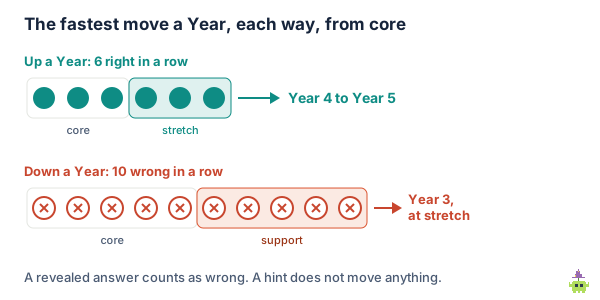
Put the rules together and you get the numbers in the figure. From core, the quickest route up a Year is six right answers in a row: three to reach stretch, three more at stretch. The quickest route down is ten wrong answers in a row: five to drop to support, five more at support. Any right answer at support resets the count towards a drop. The effect is that the tutor is quicker to conclude a child is ready than that they are not, and the second conclusion is the one that costs a child more if it is wrong.
Two edges are fenced. The beta covers Years 1 to 8, so a child at the top of Year 8 who clears stretch moves on to the next topic rather than into Year 9, and a child struggling in Year 1 stays at Year 1 support rather than dropping out of the range. And if a strand has no content in the Year above or below, the move simply does not happen. Why a child can end up working in a different Year from their class, and what that does and does not mean, is its own page.
A sitting, traced
Here is a real run through the rules, a Year 4 child starting fresh on the first maths topic at core:
- Right, right, right. Three in a row: up to stretch.
- Wrong. The run of right answers resets.
- Reveals the answer. Counts as wrong; still at stretch.
- Right, right. Two right at stretch.
- Right. The third right answer at stretch: up to Year 5, first topic, core.
Eight questions, one move up a Year, and every step of it is on the dashboard: each question as written, the answer given, whether the hint was used, and a dated record of the move itself.
What the rules do not do
Being clear about the limits is part of the point of rules you can read.
- They do not know why an answer was wrong. A slip, a misread question and a genuine misconception all count once. The pattern over several questions is what the rules trust, which is why no single answer moves anything.
- A lucky guess counts. On a multiple-choice question a guess can be right, and three of them can move a tier. Several of the question types (ordering, matching, sorting into categories, spotting the error, estimating within a range) are much harder to guess, which is one reason the mix of types matters.
- They do not read effort or mood. A tired child on a Friday gets the same rules as a fresh one on a Monday. The adult is the one who knows it was Friday.
- They are not evidence that the tutor works. Whether personalised AI tutoring improves learning has not been independently established, and very few rigorous studies exist. Rules you can inspect are a precondition for checking, not a result. If you already use a human tutor, our piece on AI tutors against human tutors sets out where each one is stronger.
How to check it yourself
You do not have to take this page’s word for any of it. Sit with your child for one sitting and keep a tally of right, wrong and revealed. Then open the dashboard and compare: the tier and topic it shows should be exactly what the rules above predict from your tally. If it is not, something is wrong and we want to hear about it.
It is also worth checking the Victorian codes the dashboard names against the Victorian Curriculum itself, and against what your child’s school says they are working on this term. The tutor walks the codes in the curriculum’s own order, which is not always the order a school teaches them in.
The short version
Sprout Tutor’s next question is chosen by fixed rules and written by a model. Three right in a row moves up a tier and five wrong moves down, ten questions finishes a topic, and revealing the answer counts as wrong while a hint does not. Three right at stretch moves up a Year and five wrong in a row at support moves down one, so from core the fastest move up is six answers and the fastest move down is ten. The beta covers the Victorian Curriculum, Years 1 to 8, and is free on every plan while it lasts.
Create a free account, add your child, and switch the tutor on from their Tutor page, where you also set the subject and Year. Then run the tally check above on the first sitting.
How this page was checked: every threshold and behaviour above was read from the Sprout Tutor engine on 23 September 2026 and confirmed by running the engine on the answer sequences described, not paraphrased from our own marketing. Curriculum codes and their order come from the Victorian Curriculum F–10 Version 2.0 © VCAA, which does not endorse this product; read it at f10.vcaa.vic.edu.au.
FAQ
Does the AI decide how hard my child's next question is?
No. In Sprout Tutor the topic and difficulty of the next question are chosen by fixed rules written as ordinary code, which run before any language model is involved. The model only writes the question for the topic and difficulty the rules picked. The same run of answers always produces the same next step, and marking is also fixed code checked against a stored answer key.
What makes Sprout Tutor move my child up or down?
Within a Year there are three tiers: support, core and stretch. Three right answers in a row moves up a tier and five wrong in a row moves down one. Ten questions on one curriculum code finishes that topic and moves to the next, with the tier carried over. Three right answers at stretch, not necessarily in a row, moves up a Year, and five wrong in a row at support moves down a Year, landing at stretch in the Year below.
What happens if my child keeps revealing the answer?
A revealed answer is treated exactly like a wrong answer. It breaks a run of right answers and counts towards the five that drop a tier, so a child cannot make the work easier by pressing reveal. Using a hint is different: it is recorded and shown to the adult, but it does not move the tier.
How fast can Sprout Tutor change my child's Year?
Starting from the core tier, the fastest move up a Year is six right answers in a row: three to reach stretch and three more at stretch. The fastest move down is ten wrong answers in a row: five to drop to support and five more at support, and any right answer at support resets that count. Every move is recorded with its date on the dashboard.
Which curriculum does Sprout Tutor follow?
Sprout Tutor went into public beta on 22 September 2026 and follows the Victorian Curriculum F-10 Version 2.0 only, for Years 1 to 8, in English, maths and science. Other curricula are not covered yet. While it is in beta it is free on every Sprout plan, including the free one.