
Year 5 is the year the answers stop being tidy. In Year 4 a division comes out even, an angle gets a name, and a decimal stops at hundredths. In Year 5 the remainder has to be dealt with, the angle has to be measured in degrees, and the decimal keeps going. Nothing new arrives out of nowhere. Everything a Year 4 student met gets one step less forgiving.
That makes Year 5 the easiest year to check at home, because each new idea has an obvious Year 4 partner. If the Year 4 half is solid, the Year 5 half is usually a matter of practice. If it is not, you know exactly where to go back to.
Year 5 by the numbers
Three learning areas, three counts, read from Version 9 of the Australian Curriculum rather than estimated. These are content descriptions, the unit a teacher plans from.
- Maths: 24 content descriptions. Number 10, Measurement 4, Space 3, Statistics 3, Algebra 2, Probability 2. Number is the biggest strand by a distance, which is where the decimals, fractions, percentages and remainders all sit.
- English: 24. Literacy 10, Language 9, Literature 5. Down from 28 in Year 4, and the descriptors get longer as the count falls.
- Science: 12. Science Inquiry 6, Science Understanding 4, Science as a Human Endeavour 2. Half of Year 5 science is still about how you find things out rather than what you find.
Four places Year 5 picks up where Year 4 stopped
This is the useful way to read the year. Each pair below is a Year 4 content description and the Year 5 one that finishes the job.
- Division: from “no remainder” to “what does the remainder mean”. AC9M4N06 ends with the words “where there is no remainder”. AC9M5N07 asks students to “interpret any remainder according to the context and express results as a whole number, decimal or fraction”. Twenty-two people and buses that seat eight is three buses, not two and three quarters, and the same arithmetic shared as pizza is two and three quarter pizzas each. Deciding which is the Year 5 skill.
- Angles: from naming them to measuring them. AC9M4M04 is estimating and comparing angles with names: acute, obtuse, straight, reflex, revolution. AC9M5M04 asks students to “estimate, construct and measure angles in degrees, using appropriate tools including a protractor”. It is the only content description in the whole of Foundation to Year 10 that names a protractor, so Year 5 is the year the tool is taught, and the figure below is the mistake it produces.
- Decimals: from hundredths to “more than 2 decimal places”. AC9M4N01 stops at tenths and hundredths. AC9M5N01 asks students to compare and order numbers with more than 2 decimal places, including numbers greater than one, and put them on a number line. This is the year the “longer means bigger” misconception gets properly tested, because 0.5 against 0.125 is a Year 5 comparison, and the fix sits in Year 4 decimal place value.
- Time: from am and pm to the 24-hour clock. AC9M4M03 works with am and pm. AC9M5M03 asks students to compare 12- and 24-hour time and convert between them. Only one other content description in the curriculum mentions 24-hour time, and it is in Year 8, so this is the year it is taught.
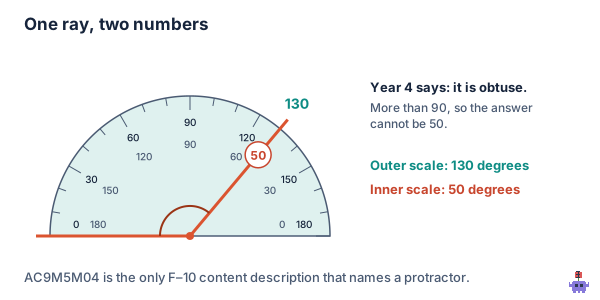
That figure is the best argument for the order the curriculum uses. A child who can say “that is obtuse” before picking up the protractor catches the wrong-scale reading on their own, because 50 cannot be an obtuse angle. A child who skipped the naming step has no way to know which of the two printed numbers is theirs. When a Year 5 student gets angle questions wrong by exactly the right amount (50 for 130, 20 for 160), it is almost always the scale, not the measuring.
The one idea that is genuinely new
Percentages first appear in Year 5. AC9M5N04 asks students to “recognise that 100% represents the complete whole and use percentages to describe, represent and compare relative size”, and to connect familiar percentages to their decimal and fraction equivalents. No content description in Foundation to Year 4 mentions a percentage at all.
Notice what the Year 5 descriptor does not ask for: finding a percentage of a quantity. Twenty-five percent off a $60 jacket is AC9M6N07, Year 6. Year 5 is about knowing that 25%, 0.25 and one quarter name the same amount of a whole, which is why a hundred-square is the right tool and a calculator is not.
Seven things a Year 5 student should manage by December
- Divide, and decide what the remainder means. AC9M5N07. Round up, round down, or keep it as a fraction or decimal, depending on the question.
- Multiply larger numbers by one- or two-digit numbers, and check the answer is sensible. AC9M5N06. The descriptor asks for efficient strategies and a reasonableness check, and AC9M5N08 makes estimation its own content description, including with money.
- Compare and order fractions with related denominators, and add and subtract them. AC9M5N03 and AC9M5N05. One half plus one quarter is Year 5; one third plus one quarter waits until Year 6, because “related denominators” is the load-bearing phrase.
- Know that 100% is the whole. AC9M5N04, as above.
- Measure and draw angles in degrees with a protractor. AC9M5M04, as above.
- Solve practical perimeter and area problems in metric units. AC9M5M02. Note “practical”: the formula for the area of a rectangle is not established until Year 6 (AC9M6M02), so a Year 5 student counting or partitioning square centimetres is on track, not behind.
- Read a line graph showing change over time. AC9M5ST02 is the only content description in primary maths that names a line graph, and it asks students to discuss the relationships and conclusions, not just read off a value.
English and science: the two descriptions worth knowing
AC9E5LA02 is the one to read aloud. It asks students to “understand how to move beyond making bare assertions by taking account of differing ideas or opinions and authoritative sources”. That is the step from “dogs are better than cats” to “dogs are better than cats because, although cats need less time, a dog...”. It is the ancestor of every persuasive essay your child will write, and you can practise it at dinner. The same year adds dialogue punctuation to written work (AC9E5LY06) and commas around prepositional phrases (AC9E5LA09).
In science, AC9S5U04 is the surprise. It asks students to explain the properties of solids, liquids and gases “by modelling the motion and arrangement of particles”. Ten-year-olds are expected to explain why a liquid takes the shape of its container using a model of particles. Particles do not come back until Year 7, so this is the first and, for two years, the only time. The other three science understanding descriptions cover adaptations for survival in a habitat, weathering and erosion, and light travelling in straight lines, reflecting and refracting.
A word on NAPLAN
Year 5 is a NAPLAN year. NAPLAN is sat in Years 3, 5, 7 and 9 and has been held in March since 2023, across reading, writing, conventions of language and numeracy. March is only a few weeks into the school year, so in practice most of what your child has been taught by test day is Year 4 content. The Year 4 halves of the pairs above matter more for NAPLAN than the Year 5 halves do. Our guide to preparing without the stress covers the rest.
The five-minute check
Four questions. Listen to the reasoning rather than marking the answer.
- “Twenty-two people, and each car takes four. How many cars?” Six. Five and a half cars, or five cars, means the arithmetic is fine and the remainder has not been read against the question. That is AC9M5N07 exactly.
- Draw an obtuse angle and ask them to measure it. Ask first whether it is more or less than 90 degrees. If they say more and then read an acute number off the protractor, you have found the two-scale mistake in the figure.
- “Which is bigger, 0.5 or 0.125?” 0.5. If they pick 0.125 because it has more digits, fix decimal place value before anything else in the Number strand, because AC9M5N01 builds on it directly.
- “What time is 1900?” Seven in the evening. Listen for the subtract-twelve step, and for whether they know 0700 is morning.
If something is missing
- Go back to the Year 4 partner, not forward. Every item on the checklist above has one. A child who cannot measure angles can almost always name them, and naming first is the fix.
- Use real remainders. Cars, egg cartons, teams at a party. The decision about the remainder only makes sense when the leftover is a person or an egg.
- Make percentages physical. A hundred-square coloured in, then the same amount written three ways. Leave percentage-of-an-amount for next year.
- Short and often beats a holiday blitz. The plan for doing this at home without a tutor is its own page.
A note on which curriculum applies to you
Everything above is Version 9 of the Australian Curriculum, which most states and territories use. Victoria does not. Victorian schools follow the Victorian Curriculum F–10 Version 2.0, which has its own codes, and the differences are set out here. New South Wales runs its own K–10 syllabuses, where Year 5 sits in Stage 3 alongside Year 6, covered in our NSW explainer. Check your state before you check your child.
Where to go next
- Year 5 maths, all 24 content descriptions
- Year 5 English, all 24
- Year 5 science, all 12
- The same page for Year 4
- The same page for Year 6, if you want to see what is coming
The short version
Year 5 is 24 maths content descriptions, 24 English and 12 science. Most of it finishes a job Year 4 started: remainders get interpreted, angles get measured in degrees, decimals go past hundredths, and time goes to the 24-hour clock. The one genuinely new idea is the percentage, and in Year 5 that means knowing 100% is the whole, not finding a percentage of an amount.
Check four things: 22 people in cars of four, the size of an obtuse angle before and after the protractor, 0.5 against 0.125, and what time 1900 is. When something is missing, go back to its Year 4 partner.
Sprout Lessons builds curriculum-aligned lessons for Foundation to Year 10, with the code on every lesson, so an AC9M5M04 lesson can be about the angles on your child’s skateboard ramp. Start free.
Codes, counts and descriptor wording checked 23 September 2026 against our copy of the Machine Readable Australian Curriculum Version 9, accessed 2026-06-24, not written from memory. NAPLAN year levels and timing checked the same day against nap.edu.au. Read the official text at the Australian Curriculum Year 5 mathematics page. Australian Curriculum content © ACARA, licensed under CC BY 4.0. This material was not modified, and ACARA does not endorse any product that uses the Australian Curriculum. Counts are of content descriptions and exclude achievement standards and elaborations.
FAQ
What should a Year 5 student know in maths?
Year 5 is 24 maths content descriptions in Version 9 of the Australian Curriculum: Number 10, Measurement 4, Space 3, Statistics 3, Algebra 2, Probability 2. By December a Year 5 student should divide and interpret the remainder in context, multiply larger numbers by one- or two-digit numbers and check the answer is reasonable, compare and add fractions with related denominators, know that 100% represents the whole, measure angles in degrees with a protractor, solve practical perimeter and area problems in metric units, and interpret a line graph showing change over time.
When do Australian students start percentages?
Year 5. AC9M5N04 asks students to recognise that 100% represents the complete whole and use percentages to describe, represent and compare relative size, connecting familiar percentages to their decimal and fraction equivalents. No maths content description from Foundation to Year 4 mentions a percentage. Finding a percentage of a quantity, such as a discount, is Year 6 at AC9M6N07.
When do children learn to use a protractor in Australia?
Year 5. AC9M5M04 asks students to estimate, construct and measure angles in degrees using appropriate tools including a protractor, and it is the only content description from Foundation to Year 10 that names a protractor. Year 4 comes first with AC9M4M04, which estimates and compares angles using names such as acute, obtuse, straight, reflex and revolution. Knowing the name first is what stops a child reading the wrong one of the protractor's two scales.
Does Year 5 NAPLAN test Year 5 content?
Mostly not. NAPLAN is sat in Years 3, 5, 7 and 9 and has been held in March since 2023, which is only a few weeks into the school year, so in practice most of what a Year 5 student has been taught by test day is Year 4 content. It covers reading, writing, conventions of language and numeracy.
Does this apply in Victoria and New South Wales?
Not directly. Victoria follows the Victorian Curriculum F-10 Version 2.0, which is derived from the Australian Curriculum but has its own codes. New South Wales runs its own K-10 syllabuses organised by stage, and Year 5 sits in Stage 3 with Year 6. The sequence is broadly similar in both, but the codes and exact wording differ, so check the document your state uses.