
In the Australian Curriculum, maps and position start in Foundation with words like behind and next to. Year 1 gives and follows directions, Years 2 and 3 read and draw simple maps, Year 4 uses grid references such as B3, and Year 5 switches to coordinates such as (3, 2). Year 6 extends the grid into all four quadrants with negative numbers, and Year 7 moves shapes around it. Symmetry and moving shapes run alongside: line and rotational symmetry in Year 4, slides, flips and turns in Year 5, tessellations in Year 6.
The step that catches most children is Year 4 to Year 5. A grid reference names a square; a coordinate names a point where two lines cross. They look alike on paper and they are not the same idea, and a child who has not noticed the difference puts dots in the middle of squares all through Year 6. This page sets out what each year asks for, five mistakes that show exactly where your child is, a two-minute check with a sheet of paper, and a twenty-minute routine built on maps your child already uses.
What the curriculum asks for, year by year
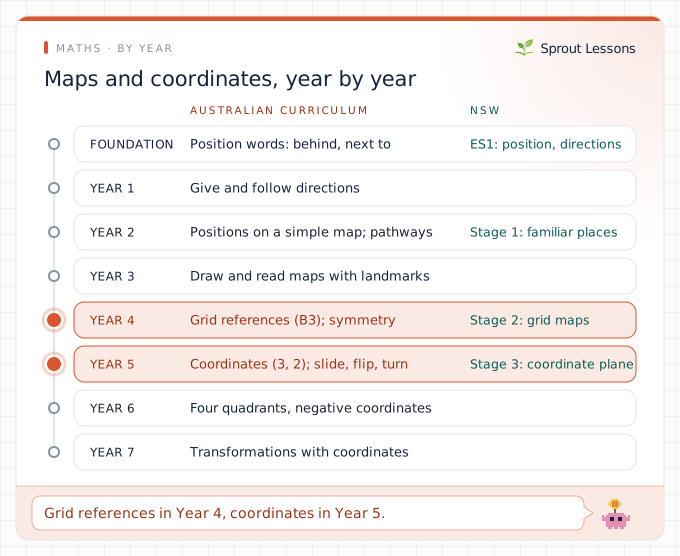
Position, maps and moving shapes all sit in the Space strand of the Australian Curriculum. The descriptors, quoted from ACARA:
- Foundation, AC9MFSP02: “describe the position and location of themselves and objects in relation to other people and objects within a familiar space”. Under the table, behind the couch, next to Dad.
- Year 1, AC9M1SP02: “give and follow directions to move people and objects to different locations within a space”. Three steps forward, turn towards the door.
- Year 2, AC9M2SP02: “locate positions in two-dimensional representations of a familiar space; move positions by following directions and pathways”. The first map: a bird’s-eye drawing of the classroom or the backyard. Year 2 also meets quarter, half and full turns (AC9M2M05), which the directions use.
- Year 3, AC9M3SP02: “interpret and create two-dimensional representations of familiar environments, locating key landmarks and objects relative to each other”. Now your child draws the map, not just reads it.
- Year 4, AC9M4SP02 and AC9M4SP03: “create and interpret grid reference systems using grid references and directions to locate and describe positions and pathways”, and “recognise line and rotational symmetry of shapes and create symmetrical patterns and pictures, using dynamic geometric software where appropriate”. Grid references are letter-and-number squares, the way a street directory or a Battleship-style game labels them.
- Year 5, AC9M5SP02 and AC9M5SP03: “construct a grid coordinate system that uses coordinates to locate positions within a space; use coordinates and directional language to describe position and movement”, and “describe and perform translations, reflections and rotations of shapes, using dynamic geometric software where appropriate; recognise what changes and what remains the same, and identify any symmetries”. Translation, reflection and rotation are the formal names for slide, flip and turn.
- Year 6, AC9M6SP02 and AC9M6SP03: “locate points in the 4 quadrants of a Cartesian plane; describe changes to the coordinates when a point is moved to a different position in the plane”, and “recognise and use combinations of transformations to create tessellations and other geometric patterns, using dynamic geometric software where appropriate”. The four quadrants need negative numbers, which arrive in the same year (AC9M6N01).
- Year 7, AC9M7SP03: “describe transformations of a set of points using coordinates in the Cartesian plane, translations and reflections on an axis, and rotations about a given point”. The Year 5 slides, flips and turns, now described with numbers. Year 8 adds position in three dimensions (AC9M8SP03), and Year 9 adds enlargement (AC9M9SP02).
Where Victoria differs (the VCAA wording is paraphrased here, not quoted). The Victorian Curriculum follows the same path level by level, with two things to know. At Level 4 the codes shift by one, because Victoria has an extra shape descriptor first: grid references are VC2M4SP03 and symmetry VC2M4SP04. And at Level 7, Victoria limits rotations to turns about the origin, the point (0, 0), where the Australian Curriculum says any given point (VC2M7SP03). Everything else, from position words at Foundation to four quadrants at Level 6, matches.
Where NSW differs (the NESA outcomes are paraphrased). The NSW Mathematics K–10 syllabus has one position outcome per stage. Kindergarten describes position and follows simple directions (MAE-GM-01). Stage 1, Years 1 and 2, represents and describes where things are in familiar places (MA1-GM-01). Stage 2, Years 3 and 4, uses grid maps and directional language to find positions and follow routes (MA2-GM-01). Stage 3, Years 5 and 6, locates and describes points on a coordinate plane (MA3-GM-01). Two things to watch on a NSW report: none of the K–6 outcome statements names symmetry, reflections or rotations, so ask the school where they are taught; and the Stage 2 outcome about “transformations” (MA2-2DS-02) means combining and splitting shapes, not flips and turns.
Five mistakes that tell you where your child is
1. Your left or my left (Foundation to Year 2)
Ask a six-year-old facing you to point to your left hand, and many point to the hand on their left side, which is your right. Giving and following directions (AC9M1SP02) depends on realising that left and right belong to whoever is facing the way. The fix is to stand side by side, facing the same way, before you give a direction, then try it face to face and ask “whose left?”. A turn is the same idea: a quarter turn to the right is the same movement for everyone, but only if they turn from where they are standing. Our page on angles by year covers turns properly.
2. Putting the dot in the middle of the square (Years 5 and 6)
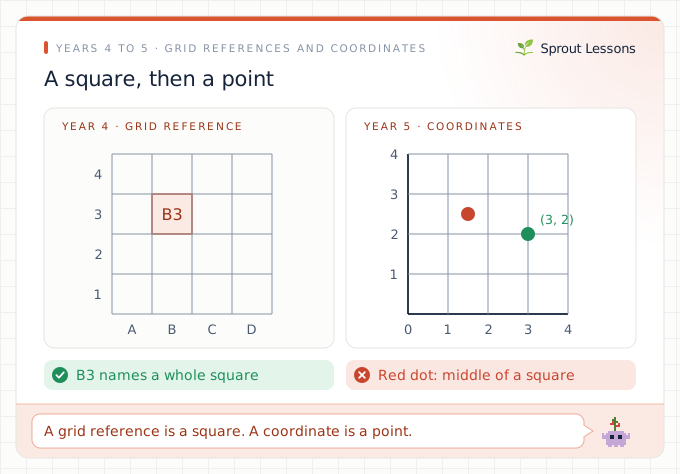
In Year 4 the labels sit in the middle of each column and row, and a grid reference such as B3 means the whole square. In Year 5 the numbers move onto the lines, and (3, 2) means the exact point where the line 3 across meets the line 2 up. A child who carries the Year 4 habit forward draws the dot in the middle of a square and is told it is wrong without knowing why.
The fix is to say what the label is attached to. Put a finger on the line marked 3 and run it up; put another finger on the line marked 2 and run it across. The dot goes where the fingers meet. Then ask why the grid starts at 0: with squares there is no square 0, but with lines there is a line 0, which is where the measuring starts.
3. (3, 2) and (2, 3) are the same place (Years 5 and 6)
The second number up the side is no harder to read than the first, so many children read whichever they see first. (3, 2) and (2, 3) are different points, and a treasure map that does not care about order sends you to the wrong square. A rhyme many teachers use is “along the corridor, then up the stairs”: across first, then up. Ask your child to plot both points on the same grid and see that they land in different places. That single picture settles it faster than any rule.
4. “A rectangle has four lines of symmetry” (Year 4)
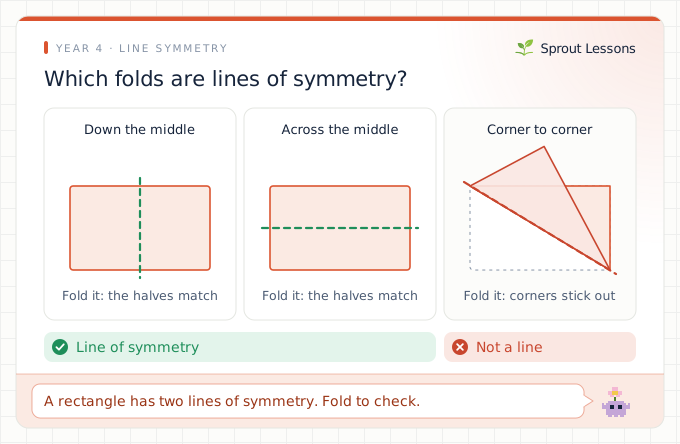
Line symmetry is Year 4 (AC9M4SP03), and the rectangle is the classic trap. A diagonal cuts a rectangle into two identical triangles, so it feels like a line of symmetry. It is not: fold along it and the corners stick out past each other, because the two halves are mirror images only if one lands exactly on the other. A rectangle that is not a square has two lines of symmetry; a square has four. The fix is paper. Cut a rectangle from a cereal box, fold it every way your child suggests, and let the corners settle the argument. Do the same with a square and a parallelogram, which has none.
5. Getting lost below zero (Year 6)
In Year 6 the axes keep going past 0, into four quadrants (AC9M6SP02). A child who is solid on (3, 2) often plots (−3, 2) at (3, 2), or goes left for the second number. The coordinate rule has not changed, only the direction: across first, and negative means left; then up or down, and negative means down. The fix is to draw a big plus sign on paper, label the four directions, and play the corridor-and-stairs rule out loud with a toy car before writing anything. If negative numbers themselves are shaky, start with negative numbers by year.
A two-minute check with a sheet of paper
Stop at the first question that goes wrong. Each one maps to a year.
- Foundation: Put a toy behind the cup, then next to it. Where is the toy now?
- Year 1: Give me directions from the couch to the fridge. Then follow mine.
- Year 2 and 3: Draw a map of your bedroom from above. Mark where the bed is.
- Year 4: Draw a 4 by 4 grid, letters along the bottom, numbers up the side. Shade C2. Now tell me the reference of a square I point to.
- Year 4: How many lines of symmetry does a rectangle have? (Two. Watch for four.)
- Year 5: Draw axes numbered 0 to 5. Plot (3, 2) and (2, 3). (Two different points, both on line crossings.)
- Year 6: Extend the axes past 0. Plot (−3, 2) and (2, −3).
- Year 7: Reflect the point (2, 3) in the x axis. Where does it land? (At (2, −3): the first number stays, the second changes sign.)
The first question that goes wrong is the place to start. A Year 6 child who drew the Year 5 dots in the middle of squares has a quick gap to close, and it is worth closing before negative coordinates pile on top.
Want practice set in their world? Sprout writes a maths lesson on AC9M4SP02 or AC9M5SP02 around what your child loves, from a footy ground plan to a Minecraft map. Try it free.
Twenty minutes a week, built on real maps
- Five minutes: directions out loud. On a walk or in the car, your child gives the directions home: left at the shop, second right. From Year 2, add quarter turns.
- Five minutes: a grid-reference game. From Year 4, each of you hides three ships on a lettered grid and takes turns calling squares. From Year 5, number the lines instead and call points.
- Five minutes: a real map. A street directory, a theme park map or a printed map of your suburb all use grid references. Find your house, then the park, then say how to get from one to the other.
- Five minutes: fold, slide, flip, turn. Cut a shape from card. Slide it, flip it, turn it a quarter turn, and ask what changed and what stayed the same. The answer, that the shape and size never change, is the whole of the Year 5 idea.
What is not the problem
- Not knowing north, south, east and west by Year 4. The descriptors ask for directions, and many schools use compass points, but left, right and landmarks count too.
- Never having heard “Cartesian plane”. It is the Year 6 name for the four-quadrant grid. The idea matters, not the word.
- Getting lost in a real car park. Spatial sense in a big real space is a different skill from reading a grid. Practise both, but one does not predict the other.
Where this sits
Maps lean on turns, which are in angles by year, and symmetry leans on shape names, which are in shapes by year. Year 6 coordinates need negative numbers, and plotting the rule of a pattern in Year 7 is in patterns and algebra by year. For the whole picture of the year grid references start, see what a Year 4 student should know, or the teacher-facing Year 4 maths codes and Year 5 maths codes. If you are not sure which curriculum applies, start with which curriculum your state uses.
The short version
- Foundation to Year 3: position words, directions, then reading and drawing simple maps.
- Year 4: grid references name a square (B3). Line and rotational symmetry.
- Year 5: coordinates name a point where lines cross ((3, 2), across then up). Slides, flips and turns.
- Year 6: four quadrants with negative coordinates; Year 7 describes moves with coordinates.
- NSW covers position in one outcome per stage, with coordinates in Stage 3.
- If your child draws dots in the middle of squares, start with mistake 2. It is a five-minute fix.
Sprout makes a lesson on the exact code your child is working on, set around what they love. Start free.
How this page was checked
The Australian Curriculum descriptors are quoted from our copy of version 9.0, which matches AC9M5SP02 on the Australian Curriculum website; we read every Foundation to Year 9 descriptor on position, maps, symmetry and transformations. The Victorian codes are from the Victorian Curriculum F–10 version 2.0. The NSW outcomes are from the NSW Mathematics K–10 Syllabus outcomes, Early Stage 1 to Stage 3. Victorian and NSW wording is paraphrased. Checked 5 November 2026.
Australian Curriculum content descriptions are © Australian Curriculum, Assessment and Reporting Authority (ACARA) 2010 to present, licensed under CC BY 4.0, and quoted here unmodified. ACARA does not endorse any product that uses the Australian Curriculum. Victorian Curriculum codes reference the Victorian Curriculum F–10 Version 2.0 © VCAA, paraphrased; the VCAA does not endorse this product. NSW outcome codes reference the NSW syllabuses © NSW Education Standards Authority (NESA) for and on behalf of the Crown in right of the State of New South Wales, paraphrased, available at curriculum.nsw.edu.au; NESA does not endorse this product.
FAQ
When do kids learn grid references in Australia?
Year 4. The Australian Curriculum descriptor AC9M4SP02 asks students to create and interpret grid reference systems using grid references and directions. Before that, Foundation to Year 3 cover position words, giving and following directions, and reading and drawing simple maps. In Victoria the same content is VC2M4SP03; in NSW it is part of the Stage 2 outcome MA2-GM-01.
What is the difference between a grid reference and a coordinate?
A grid reference such as B3 names a whole square, with the labels in the middle of each column and row (Year 4). A coordinate such as (3, 2) names a single point where two grid lines cross, with the numbers on the lines and the grid starting at 0 (Year 5, AC9M5SP02). Children who carry the Year 4 habit forward put coordinate dots in the middle of squares.
Which number comes first in a coordinate?
The across number, then the up number: (3, 2) is 3 across and 2 up. A rhyme many teachers use is "along the corridor, then up the stairs". (3, 2) and (2, 3) are different points, and plotting both on one grid is the quickest way to show it.
How many lines of symmetry does a rectangle have?
Two: one down the middle and one across the middle. The diagonals are not lines of symmetry, because folding along one makes the corners stick out past each other. A square has four lines of symmetry. Line symmetry is Year 4 content (AC9M4SP03).
When do kids learn negative coordinates?
Year 6. AC9M6SP02 asks students to locate points in all four quadrants of the Cartesian plane, which needs the negative numbers introduced in the same year (AC9M6N01). In NSW, coordinates are part of the Stage 3 outcome MA3-GM-01.