
From Term 1 2027, Victorian schools can use a new Reading Assessment F–8 for students from Prep to Year 8. It is optional for schools, and it is not a test your child studies for. It is a set of very short tasks, most of them one minute long and done one-on-one with the teacher: naming letters, splitting words into sounds, reading made-up words, reading a passage aloud, and from Year 2 a three-minute pick-the-missing-word task done as a class. In Prep to Year 2 it adds a story your child listens to or reads and then retells. The whole thing takes a few minutes per child, and its job is to show the teacher which part of reading needs work.
This page explains what each task looks like from your child’s side, which tasks fall in which year, why some of them are timed and use nonsense words, how results are usually reported, and what to ask the school. It is built from the Department of Education’s assessment policy, the VCAA’s description of the assessment, and the published manual for DIBELS, the reading measures it is built on.
What is changing in 2027
In 2026, government schools could use an optional Foundation Assessment – Literacy with their Prep students. The Department’s assessment policy says that in Term 1 2027 it “is expanding to become the Reading Assessment F–8”, for Foundation to Level 8, to support assessment of the “Big 6” elements of reading and to monitor progress over time. It runs on the VCAA’s Insight Assessment Platform, the same system that hosts other Victorian classroom assessments.
According to the VCAA’s description, it has two parts:
- DIBELS, from Foundation to Level 8, covering phonemic awareness, phonics, fluency and comprehension.
- CUBED-3 Narrative Language Measures, from Foundation to Level 2, covering oral language, fluency, vocabulary and comprehension.
Between them that is the “Big 6” Victoria’s approach to reading is built around: oral language, phonemic awareness, phonics, vocabulary, fluency and comprehension. Note what that means for older children: from Year 3, the narrative part drops away, so oral language and vocabulary are no longer measured directly.
Two things this is not. It is not compulsory: the policy calls the Foundation assessment optional, and a school decides whether to use the new one. And it does not replace the two checks that are compulsory in government schools: the Year 1 Phonics Check in weeks 4 to 6 of Term 3, and the Year 1 Numeracy Check, mandatory from 2027.
What your child will actually be asked to do
DIBELS 8th Edition, the current edition from the University of Oregon, has six tasks. The VCAA page names DIBELS but not the edition, so take the detail below as how the current version works. Five tasks are one minute long and done one-on-one; the sixth is three minutes and done as a group.
- Letter naming (Prep and Year 1). A page of 100 capital and lower-case letters in random order. Your child names as many as they can in a minute.
- Sound segmenting (Prep and Year 1). The teacher says a word aloud, such as “sat”, and your child says its sounds: /s/ /a/ /t/. Nothing is written down. This is the phonemic awareness task.
- Made-up words (Prep to Year 3). A page of nonsense words like “hap” or “sig”. Your child can read the whole word or sound it out letter by letter, and gets credit either way.
- Word reading (Prep to Year 3). A list of real words, including tricky ones like “the”, “was” and “of”. Only whole words count.
- Reading aloud (Year 1 to Year 8). Your child reads a passage aloud for one minute. Skipped or swapped words, and pauses longer than three seconds, count as errors. A word fixed within three seconds counts as right.
- Maze (Year 2 to Year 8). A passage where every seventh word has been replaced with a choice of three. Your child picks the word that fits, for three minutes, usually with the whole class. The score is correct choices minus half the wrong ones, so random guessing does not pay.
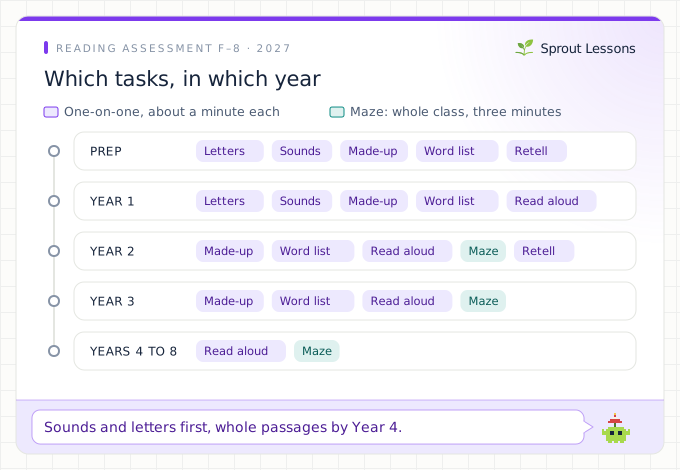
The DIBELS manual gives the time per child: about 4 to 6 minutes one-on-one in Prep, 5 to 7 in Year 1, 4 in Years 2 and 3, and 2 in Years 4 to 8, plus 5 minutes for the group task from Year 2. The story part adds a few more minutes in Prep to Year 2. Its publisher describes it as listening and reading retells, with comprehension questions that probe vocabulary and inference: your child hears or reads a short story, tells it back, and answers a few questions about it.
Why made-up words, and why a timer
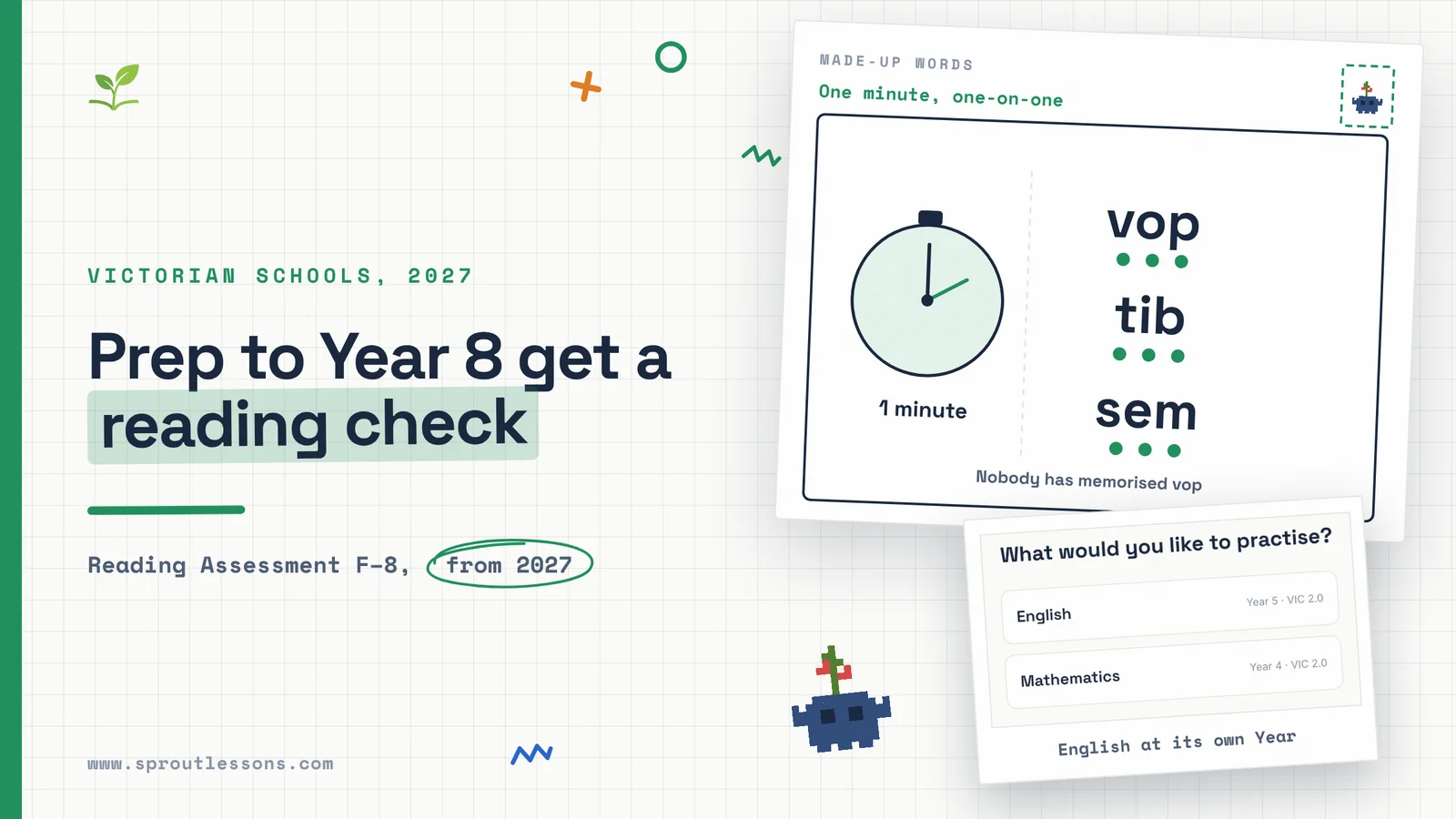
Made-up words are the part that surprises parents most. The DIBELS manual calls the nonsense word task a “pure” measure of decoding, because “vocabulary and sight word knowledge cannot play a role in recognizing nonsense words”. A child who has memorised “cat” can read it without knowing the sounds. Nobody has memorised “vop”. So this task shows whether your child can turn letters into sounds on a word they have never seen, which is exactly what they will need for every new word in every book. The same idea is behind the made-up words in the Year 1 Phonics Check.
The timer is deliberate too. The manual says that because the tasks are timed, “efficiency in reading skills is considered as well as accuracy”. A child who reads every word correctly but very slowly has to spend so much effort on the words that little is left for meaning. That is why reading aloud for one minute is the one task that runs all the way from Year 1 to Year 8: it is a quick check on whether reading has become automatic. A slow, accurate result is useful information, not a failure.
How results are likely to be reported
DIBELS itself sorts each score into four colour bands, and many reports use them. In the DIBELS manual’s terms:
| Band | DIBELS name | What it means |
|---|---|---|
| Blue | Core support, negligible risk | Above an ambitious goal. Very secure. |
| Green | Core support, minimal risk | At or above the benchmark. Usual classroom teaching should serve them well. |
| Yellow | Strategic support, some risk | Below the benchmark. Some targeted help and closer watching. |
| Red | Intensive support, at risk | Well below the benchmark. The most help, and checked often. |
The red cut-off is designed to catch most children who later score in the bottom fifth on a broader reading test, so red is a signal to act, not a diagnosis. The manual also notes some of these tasks are used to screen for risk of word reading difficulties including dyslexia, which is why a red result in made-up words or sound segmenting is worth a direct conversation.
One caution. DIBELS benchmark scores are set for each year at the beginning, middle and end of the year, from American data. Victoria has not said whether its reports will use those benchmarks unchanged, so we have not printed the numbers here. If your child’s school uses the assessment, ask what the colours on its report are measured against.
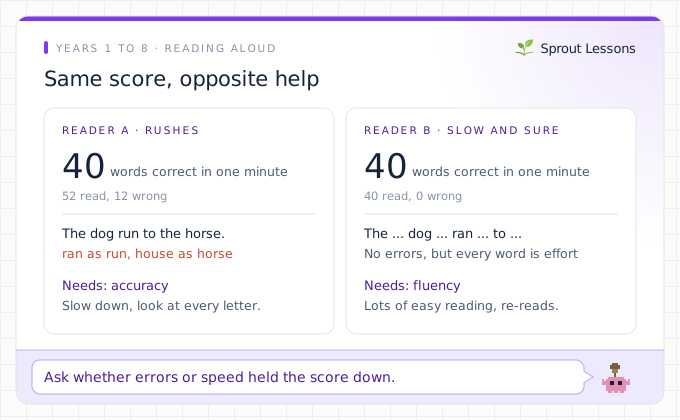
That figure is the main reason the result is more useful than a single reading level. A child who rushes and guesses needs to slow down and look at every letter. A child who is accurate but slow needs more reading of easy text so the words become automatic. Ask which one your child is.
Want short reading practice at the right level? Start free and give your child Sprout Tutor English on the Victorian Curriculum, free while in beta.
Questions to ask the school
- Is our school using the Reading Assessment F–8 in 2027, and in which term?
- Will we see the results, and are the colours measured against DIBELS benchmarks or something else?
- On reading aloud, was my child’s score held down by errors or by speed? (See the figure above.)
- In Prep to Year 3, how did they go on the made-up words compared with the real words? A big gap either way tells you whether they are decoding or relying on memory.
- If a result is yellow or red, what support is planned, and when will it be checked again?
What not to do
- Do not drill nonsense word lists. The task works because the words are new. Practise sounding out real words in books, and the made-up words take care of themselves.
- Do not time your child’s reading at home. A stopwatch teaches rushing, which is the opposite of what a fast-but-inaccurate reader needs.
- Do not compare it with NAPLAN or PAT. They are different tests on different scales for different jobs. Our pages on reading a NAPLAN report and PAT Reading results explain those.
What helps at home
- For Prep to Year 2, play with sounds out loud (“what are the sounds in ship?”), and after a story, ask your child to tell it back to you in order: who, where, what went wrong, how it ended. That is the oral language the story retell looks for. Our phonics by year page shows what should be secure by when.
- For Years 1 to 8, listen to your child read aloud from a book that is a little easy for them, a few times a week. Re-reading a favourite passage is fine. Fix wrong words gently; do not fix slow ones.
- For Years 3 to 8, ask questions that need the text: “what does that word mean here?” and “how do you know?”. Our reading comprehension by year page covers what each year adds.
Sprout Tutor, which we build, follows the Victorian Curriculum in English, maths and science from Foundation to Year 10. Foundation students get a listen button that reads each question aloud, and your parent dashboard shows each question your child answered and the answer they gave. It does not run DIBELS or produce a benchmark colour, and like all personalised-learning software its effectiveness has not been independently established. For how the reading assessment fits with the rest of the year, see the 2027 Victorian term dates page.
How this page was checked
Checked 3 November 2026 against the Department of Education’s assessment of student achievement and progress policy, the VCAA’s Insight Assessment Platform assessment tools page (which says schools can use the Reading Assessment F–8 from Term 1 2027 and lists its two parts), the University of Oregon’s DIBELS 8th Edition Administration and Scoring Guide (2026 update) for the tasks, timings and risk bands, its Australasian version terminology table (Foundation for kindergarten, Year 1 for grade 1 and so on), and Language Dynamics Group’s description of the CUBED-3 Narrative Language Measures. The Department’s own Reading Assessment F–8 page sits on its Arc site, which we could not read as text. The VCAA notes that during the state election caretaker period, from 3 November until the election on 28 November 2026, its website is updated only within the caretaker conventions, so more detail may appear after that. We are not affiliated with the Department, the VCAA, the University of Oregon or Language Dynamics Group. Sprout Tutor is in public beta, follows the Victorian Curriculum only, and is free on every plan while in beta.
Want to hear how your child reads before the school does? Start free and try a short Victorian Curriculum English session together this week.
FAQ
What is the Reading Assessment F–8 in Victoria?
It is an optional reading assessment Victorian schools can use from Term 1 2027 for students from Foundation (Prep) to Year 8, on the VCAA's Insight Assessment Platform. It expands the 2026 Foundation Assessment – Literacy and combines DIBELS (Foundation to Level 8: phonemic awareness, phonics, fluency and comprehension) with the CUBED-3 Narrative Language Measures (Foundation to Level 2: oral language, fluency, vocabulary and comprehension).
Is the Reading Assessment F–8 compulsory?
No. The Department of Education describes the Foundation assessment it grows out of as optional, and each school decides whether to use the new one. The checks that are compulsory in Victorian government schools are the Year 1 Phonics Check, held in weeks 4 to 6 of Term 3, and the Year 1 Numeracy Check, mandatory from 2027.
Why is my child asked to read made-up words?
Because a made-up word cannot be memorised. The DIBELS manual calls nonsense word reading a pure measure of decoding, since vocabulary and sight word knowledge cannot help. It shows whether a child can turn letters into sounds on a word they have never seen, which they need for every new word they meet. Do not drill nonsense word lists at home; practise sounding out real words in books instead.
How long does the Reading Assessment F–8 take?
Most DIBELS tasks are one minute each, done one-on-one. The DIBELS manual gives about 4 to 6 minutes per child in Prep, 5 to 7 in Year 1, 4 in Years 2 and 3 and 2 in Years 4 to 8, plus a 3-minute Maze task done as a group from Year 2. The story retell adds a few minutes in Prep to Year 2.
What do the colours on a DIBELS result mean?
DIBELS sorts scores into blue (negligible risk), green (at or above benchmark, minimal risk), yellow (below benchmark, some risk, strategic support) and red (well below benchmark, at risk, intensive support). Red is a signal to act, not a diagnosis. DIBELS benchmarks come from American data, so ask your school what its report measures against.