
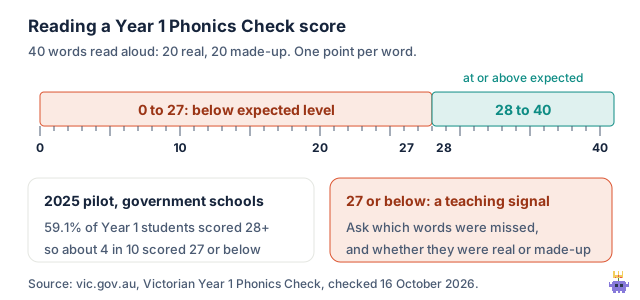
The Victorian Year 1 Phonics Check is scored out of 40, one point per word read correctly. A score of 28 to 40 is “at or above expected level”, and 0 to 27 is “below expected level”. A score of 27 or below does not mean your child has a reading disorder. It means some letter-sound patterns are not automatic yet, and the useful question for the teacher is which words were missed.
2026 is the first year the Check has been compulsory in every Victorian government school. Year 1 students sat it between 3 and 21 August, and the results are reaching families now, at parent-teacher interviews and in end-of-year reports. This page explains what the number means, what it does not mean, the five questions worth asking the teacher, and a ten-minute check you can run at the kitchen table to find exactly where the gap is. (Many Victorian schools still say Grade 1 and Prep. The curriculum and the Check say Year 1 and Foundation.)
What the Check is
Checked 16 October 2026 against the Victorian Government’s Year 1 Phonics Check guide for parents and the Department of Education’s assessment policy:
- Who: every Year 1 student in a Victorian government school, other than those unable to complete it. The policy says government schools are required to run it with Year 1 students only.
- When: Weeks 4 to 6 of Term 3. In 2026 that was 3 to 21 August.
- What: your child reads 40 words aloud to their teacher, one to one. Twenty are real words and twenty are made-up words.
- How long: usually 5 to 7 minutes.
- The cut-off: 28 to 40 is “at or above expected level”. 0 to 27 is “below expected level”, and teachers then decide how best to help.
- How you hear about it: through the school’s regular reporting, such as parent-teacher meetings.
The Check replaced the English Online Interview, a one-to-one test the Premier’s office says averaged about 40 minutes per student, and it is part of a wider shift. Victorian government schools now teach early reading through systematic synthetic phonics, and the Department’s phonics guide for parents describes it plainly: sounds are taught in a set order, then blended to read words and split apart to spell them. The Check is how a school finds out whether that teaching has stuck by the second half of Year 1.
What a score of 27 or below means, and what it does not
It is common. In the 2025 pilot, 84.9% of Victorian government school Year 1 students took part and 59.1% scored 28 or more. So roughly four children in ten were below the line in the first year. New South Wales uses the same cut-off (28 or more of 40 items), and in its government schools 60% met it in 2024, up from 59% in 2023, according to the NSW Department’s 2024 results report. A Victorian child on 24 is in very large company.
It is a screen, not a diagnosis. The Check tells the school who needs a closer look. It does not measure comprehension, vocabulary, spelling, writing or love of books, and it cannot tell you on its own whether a child has dyslexia. A low score plus reading that is hard work across the board, every day, is a reason to talk to the teacher about further assessment. A low score in a child who is otherwise reading and enjoying books usually means one or two patterns are missing.
The score is less useful than the words. 26 out of 40 tells you almost nothing about what to do on Monday. “She read every short word but missed nearly all the words with ai, ee and oa” tells you exactly what to do. That is the information to ask for.
Why half the words are made up
The made-up words are the point of the Check, and they explain the most common surprise: “but she reads really well at home.” A child can read said, the or their favourite dinosaur name from memory, from the picture, or from the first letter and a good guess. None of that works on a word they have never seen. A made-up word can only be read by turning each letter or letter group into its sound and blending them, which is exactly the skill the Check is measuring.
So a child who scores well on the real words and badly on the made-up ones is usually reading by memory and guessing. That works in a Year 1 reader with a picture on every page. It stops working in Year 2 and 3, when the words get longer, the pictures go, and every page has words the child has never met. Catching it now is the point.
The giveaway at home: your child reads a made-up word as a real one. Show them frib and they say “fib” or “crib”. They are not careless. They are matching to the nearest word they know instead of decoding.
Five questions to ask the teacher
- “Which words did they miss?” The teacher hears every word, so ask for the list, or at least the pattern.
- “Were the misses real words or made-up words?” Mostly made-up points to guessing from memory. Both points to missing letter-sound knowledge.
- “Which sounds or patterns does that point to?” Digraphs like sh and ch, vowel teams like ee and oa, or a split digraph like a_e each need different practice.
- “What extra teaching are they getting, and how often?” The parent guide says teachers decide the best way to help. It is reasonable to ask what that is in minutes per week and whether it is in a small group.
- “Will they do the Year 2 Reassessment?” It is optional for the school (more on it below), so ask rather than assume.
If the interview has already happened and you came away with only the number, a short email with questions 1 and 3 is enough. Most teachers would rather answer it than not.
A ten-minute check you can do at home
The Check itself is not public, and you should not try to rehearse its words. You do not need them. Write these made-up words on cards, tell your child they are “silly words” that are not meant to make sense, and ask them to read each one. Stop at the first row where two words go wrong.
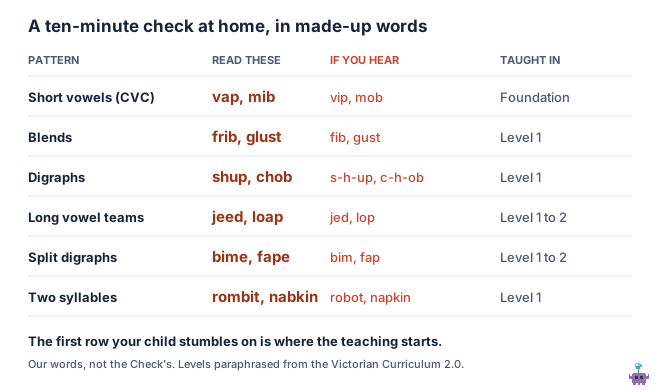
What each wrong reading tells you:
- vap read as “vip”: the short vowel sounds are not secure. This is Foundation work, and everything else is built on it. Start here even if your child is fine on the harder rows by luck.
- glust read as “gust”: a sound inside the blend is being dropped. The fix is oral first: say the word slowly, tap one finger per sound (g-l-u-s-t is five), then read it.
- shup read as “s-h-up”: your child does not yet see sh as one sound. Underline digraphs in books and say “two letters, one sound”.
- jeed read as “jed”: the vowel teams (ee, ai, oa, igh) have not been learnt as units. This is the single most common gap in the second half of Year 1, because the Victorian Curriculum spreads these patterns across Levels 1 and 2.
- bime read as “bim”: the split digraph, where the e at the end changes the vowel. Write bim and bime side by side and let your child hear the difference.
- nabkin read as “napkin”: the decoding is there, but your child is jumping to a real word they know. Ask them to point under each part as they read: nab, kin.
If every row is fine at home and the score was still low, ask the teacher which words were missed. Some children read differently with an unfamiliar adult, or rushed, or were having a bad day. That is worth knowing too, and the Year 2 Reassessment exists partly for it.
Want practice aimed at the exact pattern? Sprout builds a Level 1 English lesson from the code your child is working on (vowel teams, digraphs, blends), set around whatever they are into, with the code on every page. Try it free.
What to do next: fifteen minutes a day
Phonics gaps close with short, frequent practice on one pattern at a time, not with long sessions or more home readers. For the next six weeks:
- Pick the first row that went wrong in the home check and work only on that pattern until it is quick, then move down a row.
- Three minutes of sounds, no letters. Say a word and ask for its sounds (“sheep?” “sh-ee-p”), then reverse it (“sh-ee-p?” “sheep”). This is blending and segmenting, the two skills the parent guide names.
- Five minutes of reading words with the pattern, real and made-up mixed: feet, jeed, keep, zeep. Made-up words are allowed at home. They stop guessing.
- Five minutes of writing words with the pattern from dictation. Spelling a pattern fixes it for reading faster than reading alone.
- Read a decodable book that uses the pattern, then any book they love, read to them. Ask the school which decodable series they use, so home and school match.
Keep it light. A Year 1 child who dreads the cards will learn less than one who plays a two-minute game of “silly word or real word?” in the car. If reading still feels like hard work across the board after a term of this, go back to the teacher and ask about a fuller reading assessment.
What happens in Year 2
- The Phonics Check Reassessment. Schools can choose to reassess Year 2 students who scored below 28 in Year 1, or who missed the Check (for example, through absence). It uses the same assessment, in the same Weeks 4 to 6 of Term 3. It is optional for the school, which is why question 5 above matters.
- A new reading assessment from 2027. The Department’s policy says the optional Foundation literacy assessment expands in Term 1 2027 into a Reading Assessment for Foundation to Level 8, covering the wider set of reading skills, not just phonics.
- A Year 1 Numeracy Check. It is being piloted in 2026 and the policy makes it mandatory in all Victorian government primary schools from 2027. If your child is in Foundation now, they will likely sit both checks next year. Our guide to the Year 1 Numeracy Check covers what is known so far.
Catholic, independent and homeschooled children
The requirement in the Department’s policy is written for government schools. Catholic and independent schools decide their own assessments, and many use a phonics check, so ask the school what it uses and what the result means on its scale.
Home-educated children do not sit the Victorian Check. If you homeschool and want an outside benchmark around the middle of Year 1, our guide to teaching reading at home in Australia covers the free national check families can run at home and how to record the result in a VRQA learning plan.
Where this sits in the Victorian Curriculum
The Check measures a slice of the Literacy strand of Victorian Curriculum 2.0 English. In plain terms (the VCAA wording is paraphrased here, not quoted):
- Foundation, VC2EFLY05 and VC2EFLY06: know all the letters and their most common sounds, and read and spell three-letter consonant-vowel-consonant words like vap.
- Level 1, VC2E1LY03: blend, segment and swap sounds in words, including blends at the start and end and words of more than one syllable.
- Level 1, VC2E1LY04 and VC2E1LY05: use short vowels, common long vowels, blends and digraphs to read and write one- and two-syllable words, and know that one letter can stand for more than one sound.
- Level 2, VC2E2LY04: vowel digraphs, less common long vowel patterns and silent letters, in words of one or more syllables.
So the Check lands in the middle of Level 1, and a child who is secure on the Foundation and Level 1 rows of the home check is on track even if some Level 2 vowel teams are still shaky. If you are unsure which curriculum your school follows, our Victorian Curriculum explainer sets out how the levels work, and what “working at a different level” means on a report and how to read a Victorian school report help with the rest of the end-of-year report.
The short version
28 to 40 is at or above expected level; 27 or below is below it. About four in ten Victorian Year 1 students were below the line in the 2025 pilot, and a low score is a teaching signal, not a diagnosis.
Ask the teacher which words were missed and whether they were real or made-up. Run the ten-minute home check to find the first pattern that is not secure, then spend fifteen minutes a day on that one pattern: sounds out loud, reading real and made-up words, writing them, and a matching decodable book.
Sprout Lessons turns any Victorian Curriculum English code into a lesson built around what your child loves, with the code in the footer. Start free.
How this page was checked
The Check’s format, timing, cut-off, reporting, Reassessment and 2025 pilot results were checked on 16 October 2026 against the Victorian Government’s parent guide (updated 28 July 2026) and the Department of Education’s Assessment of Student Achievement and Progress policy (updated 13 October 2026), both linked above. The NSW comparison is from the NSW Department of Education’s Centre for Education Statistics and Evaluation report on the 2024 check. The home-check words are our own and are not taken from the Check. Rules and dates can change, so check with your school before relying on them.
Curriculum codes reference the Victorian Curriculum F–10 Version 2.0 © VCAA. The descriptions above are paraphrased, not reproduced. The Victorian Curriculum F–10 and related content can be accessed directly at f10.vcaa.vic.edu.au (accessed 2026-07-13). The VCAA does not endorse this product.
FAQ
What is a good score on the Year 1 Phonics Check in Victoria?
The Check has 40 words, one point each. A score of 28 to 40 is "at or above expected level" and 0 to 27 is "below expected level", according to the Victorian Government's parent guide (checked 16 October 2026). In the 2025 pilot, 59.1% of Year 1 students in government schools scored 28 or more.
My child scored below 28. Does that mean they have dyslexia?
No. The Check is a short screen of phonics decoding, not a diagnosis, and about four in ten Victorian Year 1 students scored below 28 in the 2025 pilot. It shows that some letter-sound patterns are not automatic yet. Ask the teacher which words were missed. If reading is hard work across the board every day, ask about a fuller reading assessment.
Why does the Year 1 Phonics Check use made-up words?
Twenty of the 40 words are made up so that a child cannot read them from memory, from a picture or by guessing from the first letter. The only way to read a made-up word is to turn the letters into sounds and blend them, which is the skill the Check measures. A child who scores well on real words but poorly on made-up ones is usually reading by memory.
Will my child do the Phonics Check again in Year 2?
Possibly. Victorian government schools can choose to run the Phonics Check Reassessment with Year 2 students who scored below 28 in Year 1 or missed the Check, using the same assessment in Weeks 4 to 6 of Term 3. It is optional for the school, so ask whether your child's school will do it.
Do Catholic and independent schools in Victoria do the Phonics Check?
The Department of Education's requirement is written for government schools. Catholic and independent schools choose their own assessments and many use a phonics check, so ask the school what it uses. Home-educated children do not sit the Victorian Check.