
Each subject on a Victorian government school report gets a level score (such as 3.5), the score from the last report, and a five-point rating from “well below” to “well above expected level”. The score is the teacher’s actual judgement. The rating is worked out from it. At the end of Year 4, “at expected level” means a score of 3.5 or 4.0.
Semester 2 reports reach Victorian families before Term 4 ends on Friday 18 December 2026, and from Semester 1 2027 every government school’s report has to follow the Department of Education’s new model reports. This page covers how to read each number, why “at expected level” is wider than it sounds, what an unchanged score is telling you, what changes next year, and five questions worth taking to the parent-teacher meeting. (Plenty of schools still say Prep and Grade 3. The report and the curriculum say Foundation and Year 3.)
What every report has to show
Checked 16 October 2026 against the Department of Education’s Reporting Student Achievement and Progress policy (updated 4 August 2026) and its guidance on scores and scales. For a government school:
- How often: a written report, on paper or online, at least twice a year, for every enrolled student, however late they enrolled and whatever their attendance.
- Against what: the achievement standards of the Victorian Curriculum F–10 Version 2.0. An achievement standard describes what a student can consistently do by the end of a level.
- For every subject taught that semester, three things: a teacher judgement (a score such as Level 3.5), progress since that subject was last reported, and a rating on a five-point scale.
- In plain English, and with a chance for parents to discuss the report with the teacher or a school leader before the holidays start.
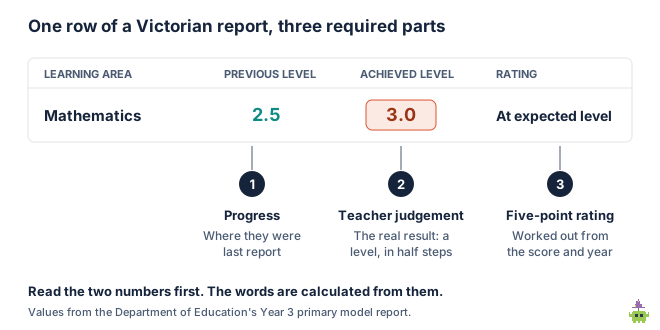
How to read the score
The score is a place on the Victorian Curriculum, which is written as levels rather than years (our plain-English guide to the Victorian Curriculum explains the structure). Level 3 is roughly what most Year 3 students learn, and the Department’s report explainer puts it simply: a score of 3.5 means your child has achieved the Level 3 standard and is making progress towards Level 4.
- Whole numbers (3.0) mean the level’s standard has been shown consistently, not once.
- Halves (3.5) mean your child is past one level and partway into the next. The guidance says a half can stay put across two reports if the new skills are not yet consistent.
- F is Foundation. Levels A to D sit before Foundation and are used for students working towards it, often students with disability.
- 10.5 and 11 are for students who have finished Level 10 and are on an advanced program.
- PT (“progressing towards”) means not yet at the lowest level that subject reports on. DNP (“did not participate”) means there was not enough evidence to judge, and the policy allows it for only five reasons, such as late enrolment or serious illness.
The score is an on-balance judgement. The teacher gathers evidence over the semester from tasks, tests and observation, then checks their judgements against colleagues’ (“moderation”). It is not an average of test marks.
“At expected level” is a window, not a point
For English, Mathematics and Science, schools must use the age-expected scale. The rating is not written by the teacher: reporting software looks it up from the score and the time of year in a matrix the Department publishes. We read that matrix line by line, and it follows one rule:
At the end of Year N, “at expected level” is a score of N−0.5 or N. The two half-steps above that window are “above”, and the two half-steps under it are “below”. Further out either way is “well above” or “well below”. In June, the whole window sits half a level lower.
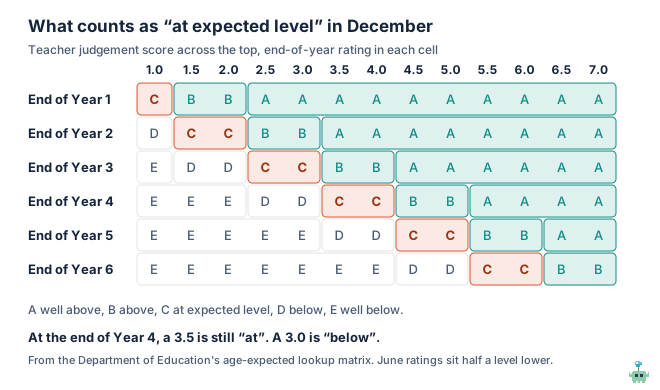
Three things follow from that window that the rating on its own hides:
- “At expected level” includes a child half a level under their year. A Year 4 student on 3.5 in December is rated at expected level, and so is one on 4.0. Same word, half a year of maths apart. If the score is the bottom of the window, the next report has no slack.
- “Below” is close. A Year 4 student on 3.0 in December is rated below expected level. That is half a level, about one semester, short of the window. It is a reason to ask questions, not a reason to panic.
- “Well below” is not close. It means a score at least two levels under the year number, so at the end of Year 4, 2.0 or lower. That is the rating that warrants a plan, in writing, with the school.
The other letters you may meet are the same scale. The federal rule every Australian school reports under, section 59 of the Australian Education Regulations 2023, requires reports for Years 1 to 10 to be easy to understand, given at least twice a year, and to rate each subject A to E or on an equivalent five-point scale. In the Department’s matrix, A is well above, B above, C at, D below and E well below expected level.
Progress: compare the two numbers, not the two words
The previous level on each row is there so you can see progress. Expected pace is half a level a semester, one level a year, which is exactly how fast the window moves. So a child who reads “at expected level” on every report is learning a year’s worth each year, and the rating will not change.
The catch is the reverse. A score that stands still can keep the same rating for one report and then drop:
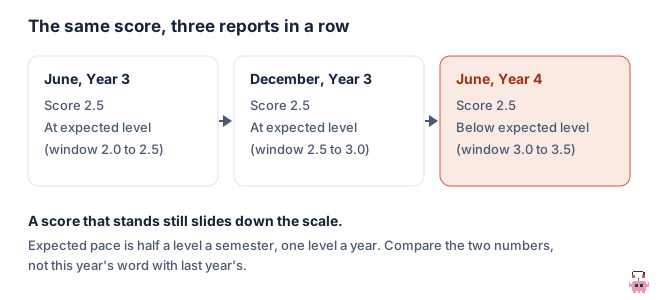
The Department’s own Year 8 model report has this case in it. Science shows a previous level of 8 and an achieved level of 8, rated “at expected level”. By the same matrix, that 8 would have read “above expected level” in June. The words went down, the score did not move, and neither tells the whole story alone.
Two cautions before you read too much into one unchanged score. The report explainer says a child can make meaningful progress inside a level without the score moving, because the score only moves in halves. And a jump of a whole level in one semester, like the Music row in the Year 3 model report (2.5 to 3.5), is possible but not the norm. Two reports in a row with no movement in English or Maths is the pattern to ask about.
The rest of the report
- Effort and conduct. The model reports rate two things, “makes their best effort” and “interacts well with other students”, as Always, Usually or Rarely. Primary reports give one overall rating; secondary reports give one per subject. “Usually” is not a criticism.
- English is three rows. Speaking and Listening, Reading and Viewing, and Writing are scored separately. A gap between them is common and useful: Writing half a level behind Reading is a very different problem from Reading behind everything.
- Capabilities. Critical and Creative Thinking, Ethical, Intercultural and Personal and Social are scored on the same levels when they are taught.
- Other scales. Students learning English as an additional language cannot be rated on the age-expected scale and are usually rated on a progress scale, and students with disability may be rated on a progress or learning-objectives scale. If your child’s report uses one, the words mean something different, so ask which scale it is.
What changes in 2027
The policy says schools must align their reports with the Department’s model reports for the Semester 1, 2027 reporting period (Semester 1, 2028 for specialist schools). The model reports and the Department’s guidance on them point to a shorter report:
- Primary: one short summary comment of around 100 words for the whole report, not a paragraph per subject.
- Secondary: no written comments recommended at all, with effort and conduct rated per subject instead.
- Comment banks and long written comments are now advised against.
- Online portals that show marks during the term can continue, but the policy says they complement the semester report rather than replace it, and the overall judgement against the curriculum is made once a semester.
For parents that means the two numbers carry even more of the message from next year. The conversation with the teacher is where the detail now lives.
Five questions for the parent-teacher meeting
- “Is that score the top or the bottom of the window?” A 3.5 and a 4.0 at the end of Year 4 both read “at expected”, and only the teacher can tell you which side of the line next semester looks like.
- “Which part of the achievement standard is not consistent yet?” A half score means some of the next level is showing. Ask what, specifically, is missing.
- “In Maths, which strand?” One Mathematics score covers number, algebra, measurement, space, statistics and probability. “Below” is very often one strand, usually number, and our page on what working at a different level means shows how that looks.
- “What is the school doing about it, and how often?” For a below or well below rating, ask what extra teaching is planned, in minutes per week, and whether it is small-group.
- “What can we do at home over the holidays?” One focus, named precisely (“subtracting across a zero”, “paragraphs with a topic sentence”), is worth more than a workbook.
The Department’s guidance on parent-teacher conferences asks teachers to lead with evidence, avoid jargon and record any follow-up actions. If the meeting has passed, a short email with questions 1 and 2 usually gets a useful answer.
Putting the report next to NAPLAN and the class
The report is a semester of evidence against the Victorian Curriculum. NAPLAN is one morning in March against a national scale, and PAT is a single test against a national norm. When they disagree, the report is usually the better guide to what is being taught, and the test is the better guide to how your child performs cold. Our page on the three rulers parents measure a child against lays the report, NAPLAN and the classroom side by side, and PAT Maths results explained covers the test many schools use alongside the report. If the report says below in maths and you want to check for yourself, is my child behind in maths? has a short home check by year.
Got a “below” in one strand? Sprout builds a lesson from the exact Victorian Curriculum code your child is working on, set around whatever they are into, with the code in the footer so you can show the teacher. Try it free.
Catholic, independent and homeschooled children
The Department’s policy and model reports are written for government schools. Catholic and independent schools set their own report formats, but they are still bound by the federal rule above: at least two reports a year, plain English, and an A to E or equivalent five-point rating for each subject. Many use the same Victorian Curriculum levels. If the report does not say what its ratings are measured against, ask.
Home-educated children do not get a school report. If you homeschool in Victoria, the record that matters is the one you keep for the VRQA, which our guide to homeschooling in Victoria covers.
The short version
Read the two numbers on each row before the words. The score is the teacher’s judgement on the Victorian Curriculum; the rating is calculated from it. At the end of Year N, “at expected level” is N−0.5 or N, so it covers half a year of difference, and a score that has not moved in a semester will slip down the scale on the next report.
If the rating is below or well below, ask which part of the standard and which strand, and pick one precise thing to practise over the summer. Our guide to learning over the Victorian summer holidays has a plan that fits around a real family summer. If the school has raised repeating the year, read what the policy on repeating a year says before the meeting: it cannot happen without your agreement.
How this page was checked
Report requirements, scores, the half-level rule, DNP and PT, effort and conduct, and the 2027 changes were checked on 16 October 2026 against the Department of Education’s Reporting Student Achievement and Progress Foundation to 10 policy (updated 4 August 2026), its guidance pages (updated 4 August to 9 September 2026), the primary and Year 8 model reports and explainers, and the age-expected lookup matrix, which we read for every year level from Foundation to Year 10. The federal requirement is section 59 of the Australian Education Regulations 2023, compilation 6 (25 August 2026). Term dates are from vic.gov.au. Reporting rules can change, so check with your school before relying on a detail.
Reporting requirements are paraphrased from the Department of Education’s Policy and Advisory Library, © State of Victoria (Department of Education), at www2.education.vic.gov.au (accessed 2026-10-16). Curriculum levels refer to the Victorian Curriculum F–10 Version 2.0 © VCAA. Neither the Department nor the VCAA endorses this product.
FAQ
What does 3.5 mean on a Victorian school report?
It means your child has achieved the Level 3 standard of the Victorian Curriculum and is making progress towards Level 4. Scores move in half levels. Whether 3.5 is "at expected level" depends on the year and the time of year: at the end of Year 4 it is at expected level, at the end of Year 5 it is below.
What does "at expected level" mean on a Victorian school report?
For English, Mathematics and Science it is worked out from the score using the Department of Education's lookup matrix. At the end of Year N, a score of N minus 0.5 or N is at expected level, so at the end of Year 4 that is 3.5 or 4.0. In June the window is half a level lower. It covers half a year of difference, so ask the teacher which end your child is at.
My child got the same score as last semester. Is that bad?
Not on its own. Scores move only in halves, and the Department says a child can make real progress inside a level without the score changing. But expected pace is half a level a semester, so an unchanged score will slip down the five-point scale on the next report. Two reports in a row with no movement in English or Maths is worth raising with the teacher.
Are Victorian school reports changing in 2027?
Yes, for government schools. From Semester 1 2027 reports must follow the Department of Education's model reports: one short summary comment of about 100 words in primary, no written comments recommended in secondary, effort and conduct rated Always, Usually or Rarely, and the same level score, previous level and five-point rating for every subject. Checked 16 October 2026.
What do A, B, C, D and E mean on a school report?
Australian schools must rate each subject A to E or on an equivalent five-point scale, under section 59 of the Australian Education Regulations 2023. In the Victorian Department of Education's matrix, A is well above expected level, B above, C at expected level, D below and E well below. A C is not a poor result: it means your child is where the curriculum expects for their year.