
Victorian students finish Term 4 on Friday 18 December 2026 and government school students go back on Thursday 28 January 2027: 40 days off, 28 of them weekdays. That is short enough that a child who does nothing will mostly be fine, and long enough that maths facts and procedures will be rusty in Week 1. The research on “summer slide” is far less settled than the headlines suggest, but the one finding that has held up for thirty years points at a small, specific fix: a few minutes of retrieval practice on what was learned this year, a few days a week. Not a holiday program, not next year’s content, and not every day.
This page sets out what the evidence actually says, what is worth doing in a Victorian summer, and how to do it with Sprout Tutor, which is ours, free while in beta, and built on the Victorian Curriculum. It also says what we would not do.
The dates
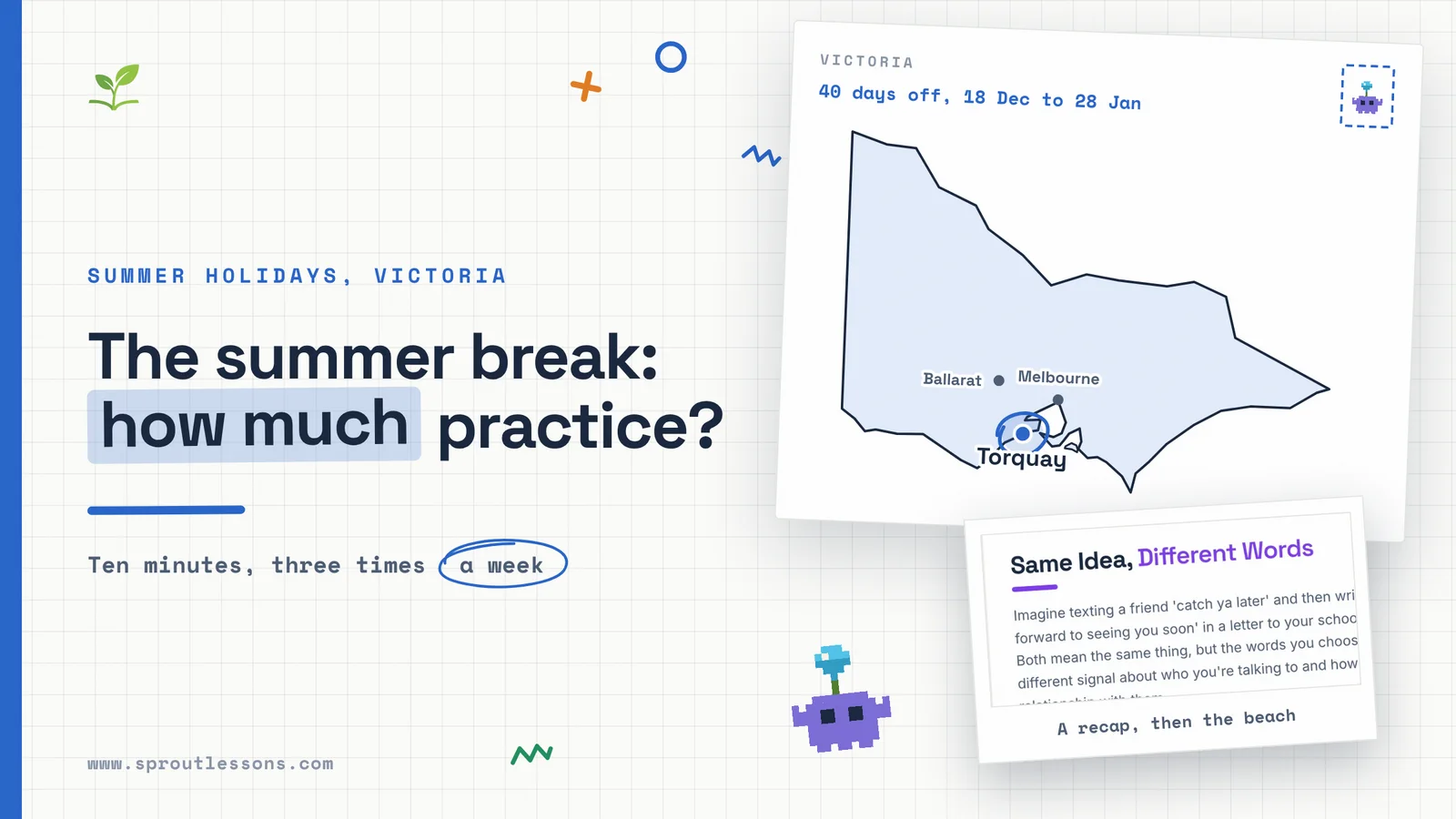
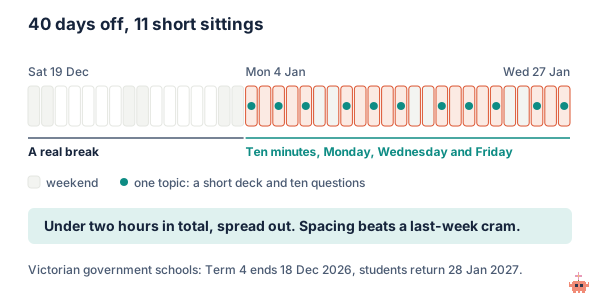
From the Victorian Government’s school term dates page: Term 4 2026 ends on Friday 18 December. Term 1 2027 starts on Wednesday 27 January, with students in government schools starting on Thursday 28 January. Catholic and independent schools set their own first days, so check yours. Counted from Saturday 19 December to Wednesday 27 January, the break is 40 days, 28 of them weekdays, including the public holidays.
What the research actually says about summer slide
The classic finding is modest, and it is about calculation. The most cited review, Cooper and colleagues’ 1996 meta-analysis of summer vacation and test scores, found an average loss of about one month of grade-level equivalent, or a tenth of a standard deviation, over a US summer. It found the loss larger in maths than in reading, and largest in maths computation and spelling: the skills that are factual and procedural, and that fade without practice.
The dramatic version does not replicate. You may have read that children lose two months of maths every summer, or that summer explains most of the gap between rich and poor students. A 2023 paper by Workman, von Hippel and Merry, “Findings on Summer Learning Loss Often Fail to Replicate, Even in Recent Data”, compared three large US datasets from the 2010s and found that “summer losses looked substantial on some tests but not on others”, and that most patterns did not generalise beyond a single test.
And all of it is American. Those studies measure US summers of ten weeks or more. A Victorian summer is under six. We could not find an Australian study of summer learning loss worth citing, and we are not going to borrow a US number and pretend it is local.
So the honest reading is: some forgetting over the break is normal, it is concentrated in the practised-until-automatic skills (times tables, number facts, the steps of a written method, spelling), and it comes back quickly with practice. That is not a reason to panic. It is a reason to keep those particular skills warm.
What is worth doing: retrieval, spaced, on this year’s content
The study-technique review that most of this rests on, Dunlosky and colleagues (2013), rated only two techniques as high utility: practice testing and distributed practice. In plain terms: answering questions, not rereading notes, and spreading the sessions out rather than cramming them. My child forgets what they learn goes through that evidence in detail. Applied to six weeks off, it gives three rules:
- Practise the year just finished, not next year. The skills that fade are the ones your child already learned. Next year’s content will be taught from Term 1 by the teacher, in order, and pre-teaching it at home risks teaching it a different way.
- Short and spread out beats long and bunched. Ten minutes three times a week for four weeks does more for recall than a two-hour catch-up the weekend before school.
- Questions, not worksheets of examples. Getting an answer out of memory, and finding out straight away whether it was right, is the practice. A page of worked examples to read is not.
And take a real break first. Nothing in this evidence says the first fortnight of the holidays needs any practice at all.
How to do it with Sprout Tutor
Sprout Tutor went into public beta on 22 September 2026. It follows the Victorian Curriculum F–10 Version 2.0 only, in English, maths and science, for Years 1 to 10, and it is free on every Sprout plan while in beta, including the free one. A topic is a short teaching deck on one curriculum code followed by ten marked questions, which is about ten to fifteen minutes. That is close to exactly the dose above. How Sprout Tutor works walks through a session.
- Leave the Year where it is over summer. If your child finished Year 4, keep maths at Year 4 until school goes back. The tutor’s own rules move up a Year if three answers at the top tier say they are ready, and move down if they are struggling, and both moves are logged for you.
- Pick the stream that fades. In maths that is usually Number, where the facts and written methods live. Your child can pick it on the subject screen; it is one tap.
- Use the theme. Footy, netball or animals change the wrapper on the question and not the maths. In January that is not nothing.
- Read the needs-a-hand list once, in mid-January. If the same code keeps coming up wrong, that is the one thing worth ten minutes of your time at the table, and the one thing worth mentioning to the new teacher.
Want a holiday routine that marks itself? Create a free account, set each subject at the Year your child just finished, and ask for one topic three times a week from early January.
When school goes back: one setting to change, and one to think about
In the first week of Term 1, change each subject to the new school Year, so practice follows what the class is now being taught. One thing to know first: reassigning a subject’s Year resets the working Year to what you choose, overriding any move the tutor made on its own. If the tutor had dropped maths a Year because your child was struggling, moving them straight up to the new school Year discards that signal. In that case keep the lower Year for a few weeks and let the climb rule bring them up. Why working below the class Year is normal, and not a failure, is in working at a different level.
What we would not do
- Not a daily target. The evidence is for spacing, and a child who resents the tablet by 2 January has gained nothing. Three times a week is plenty.
- Not next year’s content as a head start. The new teacher will start where the curriculum starts. A child who has half-learned a method a different way can find Term 1 harder, not easier.
- Not a paid holiday program on the strength of “summer slide”. Evidence for Learning’s toolkit entry on summer schools rates them +3 months on average, +2 in maths, with evidence it calls low in security, and notes they are uncommon in Australia. The bigger effects it reports are for intensive small-group or one-to-one teaching. If your child’s report showed a real gap, that is a reason to look at help aimed at that gap; see is my child behind in maths. If it did not, the holiday is for being a child.
- Not a promise. The effectiveness of personalised-learning software like ours has not been independently established, and very few rigorous studies of it exist. What the practice gives you is a record, and the record lets you check.
The short version
The 2026–27 Victorian summer break runs from Friday 18 December to Thursday 28 January for government school students: 40 days. Some forgetting is normal, mostly in number facts, written methods and spelling, and the scarier summer-slide figures are American and do not reliably replicate. Take a real break, then from early January do about ten minutes of questions on this year’s content, three times a week. Leave the Year where it is until school goes back, then move it up unless the tutor has a reason not to.
Start free; Sprout Tutor is in public beta for Years 1 to 10 on the Victorian Curriculum. For ideas away from the screen, see helping with maths at home without a tutor.
Checked 11 October 2026. Term dates are from the Victorian Government’s school term dates page. The Cooper et al. (1996) findings are from the paper’s abstract in the Review of Educational Research (the publisher’s page may ask you to sign in); the Workman, von Hippel and Merry (2023) quote is from the open-access paper in Sociological Science. Summer school figures are from Evidence for Learning’s Teaching and Learning Toolkit. Sprout Tutor facts were checked against our own code the same day. We build Sprout Tutor and say so above.
FAQ
When do Victorian school holidays start and end this summer?
Term 4 2026 ends on Friday 18 December. Term 1 2027 starts on Wednesday 27 January, and students in government schools start on Thursday 28 January. Catholic and independent schools set their own first days. Counted from 19 December to 27 January, the break is 40 days, 28 of them weekdays.
Is summer slide real?
Partly. Cooper and colleagues' 1996 meta-analysis found an average loss of about one month of grade-level equivalent over a US summer, larger in maths than reading and largest in maths computation and spelling. But a 2023 paper by Workman, von Hippel and Merry found that summer losses looked substantial on some tests and not others, and the larger claims do not reliably replicate. All of this research is on US summers of ten weeks or more; a Victorian summer is under six.
How much should my child practise over the summer holidays?
Take a real break first. Then, from early January, about ten minutes of questions on the year just finished, around three times a week, is enough to keep number facts, written methods and spelling warm. Spacing short sessions out beats a long catch-up the week before school.
Should my child learn next year's work over the holidays?
We would not. The skills that fade are the ones your child already learned, so practise those. The new teacher will teach next year's content from Term 1 in order, and a method half-learned a different way at home can make it harder, not easier.
Are holiday programs or summer schools worth paying for?
Evidence for Learning rates summer schools at +3 months on average, +2 in maths, with evidence it calls low in security, and notes they are uncommon in Australia. Bigger effects come from intensive small-group or one-to-one teaching aimed at a real gap. If your child's report did not show one, a light routine at home is enough.