
Kumon costs $160 a month per subject plus a $100 enrolment fee, which is $2,020 for the first year of maths alone. What it sells is a daily habit of 15 to 30 minutes, on its own sequence of worksheets, marked by you at the kitchen table. The habit is the valuable part, and it is the part you no longer have to pay for. This page sets out what Kumon actually is, from its own pages, what it does that nothing free does, and where it parts ways with the Victorian Curriculum your child is taught at school in McKinnon, Bentleigh and Bentleigh East.
We build Sprout Tutor, which is free while it is in beta, so this is an interested comparison. Every Kumon fact below is from Kumon Australia’s own site or brochure, read on 9 October 2026, and every Sprout Tutor claim is a rule we checked in our own code the same day.
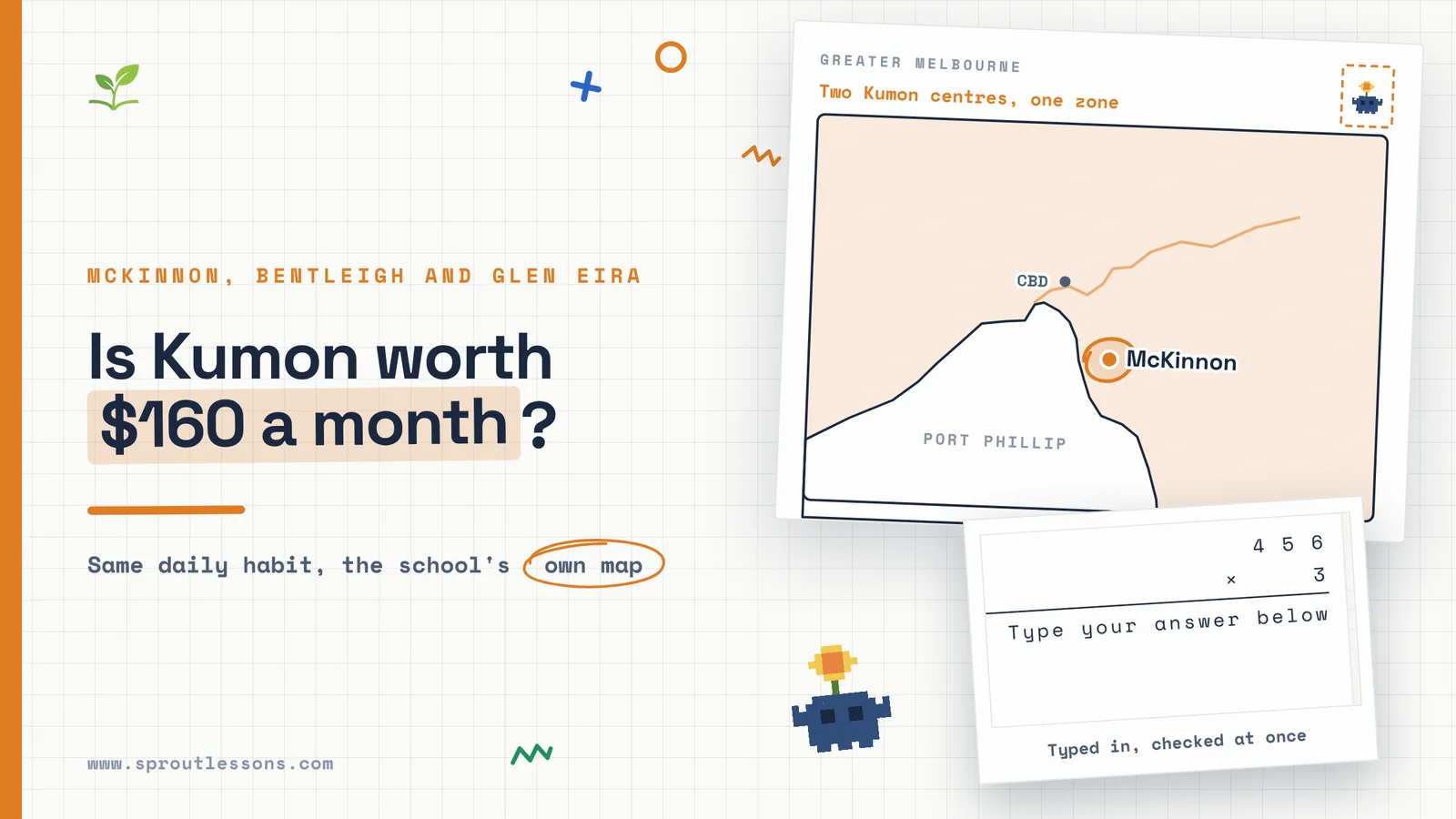
Kumon around McKinnon and Bentleigh
Kumon’s centre finder lists a McKinnon centre at 191 McKinnon Road and a Bentleigh East centre at 671 Centre Road, with Carnegie, Brighton and Oakleigh close by. There is no centre listed in Bentleigh itself, Ormond or Moorabbin, so a family in Bentleigh is choosing between those.
The demand is easy to understand. McKinnon Secondary College is one of the largest government schools in the state, about 3,000 students in 2025, and its own site says the Department has placed it under “enrolment pressure”, with a plan that restricts out-of-zone enrolments. Its 2025 annual report puts 94.2% of Year 7 students at Strong or Exceeding in NAPLAN numeracy, against 65.6% across Victoria. In a cohort like that, a child who is simply at expected level can feel behind. Behind, or just in a strong class? is the check to run before paying anyone.
What Kumon costs, from its own fee page
- Kumon Australia’s fee page lists $160 per subject per month and a $100 enrolment fee, GST included, and says fees are not refundable “in part or in full under any circumstances”.
- Fees are paid a month in advance. To stop, you must tell the instructor by the 15th, or the next month is due in full.
- So one subject for twelve months is $1,920, plus $100 to start. Maths and English together is $3,840 a year.
Worth knowing: the fee page carries no effective date and still contains placeholder text from a template, so confirm the figure with the centre before enrolling.
What Kumon actually is
Kumon is unusually clear about its method, and it is worth reading in its own words.
- Its own sequence. The maths programme is “20 Levels, from Level 6A through to Level O”, 4,420 worksheets from preschool to high school maths. Kumon calls this “a selective curriculum” and says “all Kumon topics appear in the Australian curriculum”. It does not mention the Victorian Curriculum, and it does not map its Levels to school Years.
- An easy starting point. A free diagnostic test, judged on “accuracy and time taken”, places your child. Kumon’s FAQ says “we emphasise an easy starting point”, and that a child who starts behind in class generally takes “12 months” to begin advanced material.
- Repetition to a bar. Work is corrected “until 100 percent is achieved”, and completion times are recorded. The US Department of Education’s What Works Clearinghouse described it as students not progressing “before completing an assignment within a set amount of time and with close to 100% accuracy”.
- Daily, and you mark it. 15 to 30 minutes a day at home (“ideally no more than 30 minutes per subject per day”), 30 to 45 minutes per subject at the centre. At home, “parents then mark and grade the completed worksheets” and record the results.
- Instructing, not teaching. That is Kumon’s own heading. Instructors must be university qualified, pass maths and English tests and hold a Working with Children Check. The worksheets do the teaching; the instructor plans the path.
Where Kumon and the classroom part ways
The important difference is not quality. It is whose map. Kumon follows its own Levels in its own order, starting easy and building calculation fluency. Your child’s class follows the Victorian Curriculum, one content description at a time, across number, algebra, measurement, space, statistics and probability. Those overlap a great deal in arithmetic and much less elsewhere. A Year 5 child can be deep in Kumon’s division worksheets in the same term the class is doing angles, chance and data displays.
That is fine if what you want is fast, accurate calculation, which Kumon is genuinely good at. It is a mismatch if what you want is help with what the report said.
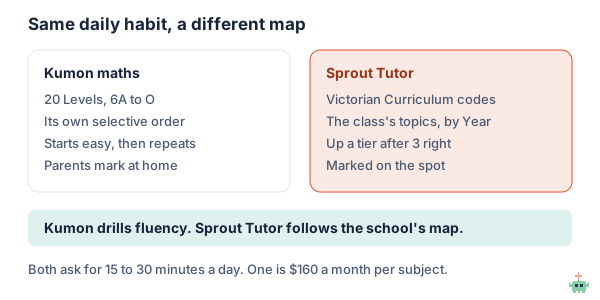
Kumon vs Sprout Tutor, side by side
| Kumon, $160 a month per subject | Sprout Tutor | |
|---|---|---|
| Sequence | Kumon’s 20 maths Levels, 6A to O. Topics “appear in” the Australian Curriculum. | The Victorian Curriculum 2.0, Years 1 to 10, by content description code. |
| Where it starts | An “easy starting point”, set from a diagnostic judged on accuracy and time. | The Year you set, per subject. Maths can sit at Year 4 while English stays at Year 5. |
| How it moves | Repeat until close to 100% accuracy within a set time. | Three right in a row up a tier, five wrong down; three right at the hardest tier climbs the working Year, five wrong at the easiest drops it. Each Year change logged with a date. |
| Question types | Paper or tablet worksheets, mostly written calculation. | Ten types, including ordering, matching, categorise, spot-the-error and estimate-in-range. |
| Who marks | You, at home. The instructor checks corrections at the centre. | Marked instantly. A revealed answer counts as wrong. |
| What you see | Scores and times on a record sheet, plus instructor updates. | The literal question, the answer given, hints and reveals, and up to eight codes ranked by wrong answers. |
| A year | $1,920 per subject, plus $100 enrolment. Non-refundable. | Free on every plan while in beta. Not on the pricing page. |
Keep the daily fifteen minutes, swap the map: ten questions a day on the strand your child’s report named, marked for you, with the wrong answers on a dashboard. Start free. Sprout Tutor is free on every plan while it is in beta.
What Kumon does better
Said plainly, because a comparison that cannot do this is not worth reading.
- An adult watches twice a week. At the centre, a trained instructor sees your child work, checks corrections and adjusts the path. Sprout Tutor has no person in it.
- Calculation fluency, drilled hard. Repetition to near 100% accuracy against a time is very good at making arithmetic automatic. The Teaching and Learning Toolkit notes that mastery approaches work best with a high bar, usually 80% to 90%. Kumon’s bar is higher than ours.
- Paper and an outside appointment. A worksheet folder and a centre visit make the habit stick for some children in a way a screen at home does not.
- Reading and English, and decades of practice. Kumon runs an English reading programme and has been doing this for over sixty years.
What the evidence says, about both of us
Two honest findings, and they cut both ways.
- The What Works Clearinghouse reviewed five Kumon maths studies in 2009 and found none met its standards, so it was “unable to draw any conclusions” about whether Kumon works or not. That is not evidence that it fails. It is the absence of rigorous evidence either way.
- The Toolkit, published in Australia by Evidence for Learning, puts mastery learning at about five months of additional progress, but says the approach appears “much less effective when students work at their own pace”. Kumon is self-paced. So is Sprout Tutor. Both work best tied to what the class is learning, which is the argument for practising the school’s content rather than a separate sequence.
And our own limit: the effectiveness of personalised-learning software like ours has not been independently established, and very few rigorous studies of it exist.
Three things to do before you enrol
- Read the report, then ask the school. McKinnon Secondary’s 2025 annual report lists literacy and numeracy support programs for students with learning gaps. If the report shows your child below expected level, ask the teacher what the school already runs.
- Run three weeks of free practice on the school’s content. Ten questions a day, at the Year you set, then read the needs-a-hand list on the dashboard. What the dashboard shows explains every number.
- If the list says calculation, Kumon is a reasonable buy. If it names fractions, measurement or data, a sequence that starts easy and works through its own Levels may take months to reach it. A tutor with the list in hand, or help at home, gets there sooner.
The short version
Kumon in McKinnon and Bentleigh East costs $160 a month per subject plus $100 to enrol, non-refundable: $2,020 for a first year of maths. It sells a 15 to 30 minute daily habit on its own 20-Level sequence, starting easy, repeating to near 100%, marked by you. It is good at calculation fluency and gives your child an adult to answer to twice a week. Sprout Tutor keeps the daily habit and changes the map to the Victorian Curriculum your child’s class follows, marks every answer for you and shows you the wrong ones by code, free while in beta.
Keep the habit. Choose the map. Start free; Sprout Tutor is in public beta for Years 1 to 10 on the Victorian Curriculum. For the days between any paid sessions, see what to do between tutoring sessions.
Checked 9 October 2026. Kumon facts are from Kumon Australia’s fee, enrolment FAQ, maths, worksheets and instructor pages, its 2026 student brochure, and its centre finder; prices are as listed, not quotes, and Kumon is a registered trade mark of its owner. The What Works Clearinghouse quotes are from its Kumon Math intervention report of March 2009. McKinnon Secondary College facts are from its own zone page and its 2025 annual report. Toolkit quotes are from Evidence for Learning. Sprout Tutor claims were checked against our own code the same day. We build competing software and say so above.
FAQ
How much does Kumon cost in Australia?
Kumon Australia's fee page lists $160 per subject per month and a $100 enrolment fee, GST included, paid a month in advance and not refundable. To stop you must notify the instructor by the 15th of the month or the next month is due. Twelve months of one subject is $1,920 plus enrolment; maths and English together is $3,840 a year. Confirm the current fee with your centre.
Where are the Kumon centres near McKinnon and Bentleigh?
Kumon's centre finder lists a McKinnon centre at 191 McKinnon Road and a Bentleigh East centre at 671 Centre Road, with Carnegie, Brighton and Oakleigh nearby. As at 9 October 2026 it listed no centre in Bentleigh itself, Ormond or Moorabbin.
Does Kumon follow the Victorian Curriculum?
No. Kumon follows its own sequence: the maths programme is 20 Levels from 6A to O, which Kumon calls a selective curriculum, and it says all Kumon topics appear in the Australian Curriculum. It does not mention the Victorian Curriculum or map its Levels to school Years. Children start at an easy starting point set by a diagnostic test and repeat work until it is accurate and fast.
Is Kumon worth it?
It depends on what your child needs. Kumon is good at calculation fluency, drilled to near 100% accuracy against a time, and gives a child an adult to answer to at the centre. The US What Works Clearinghouse found no study rigorous enough to judge its effectiveness either way. If your child's report names fractions, measurement or data rather than calculation, a sequence that starts easy and follows its own order may take months to reach it.
What is a free alternative to Kumon in Victoria?
Sprout Tutor keeps the daily habit, about ten questions a topic, and follows the Victorian Curriculum 2.0 for Years 1 to 10 by content description code, starting at the Year you set for each subject. Every answer is marked instantly, a revealed answer counts as wrong, and the parent dashboard shows the literal questions and up to eight codes ranked by wrong answers. It is in public beta and free on every plan while in beta.