
A child can be near the bottom of a strong class and still be exactly where the Victorian Curriculum expects them to be. In Doncaster that happens often enough to be worth checking before you pay to fix it. There are three rulers a parent can hold a child against: the class, the school report and NAPLAN. Only one of them changes when you change suburbs, and it is the one that does the most worrying.
This page covers what each ruler actually measures, how to read them together, what to do when they disagree, and where personalised practice helps once you know which situation you are in.
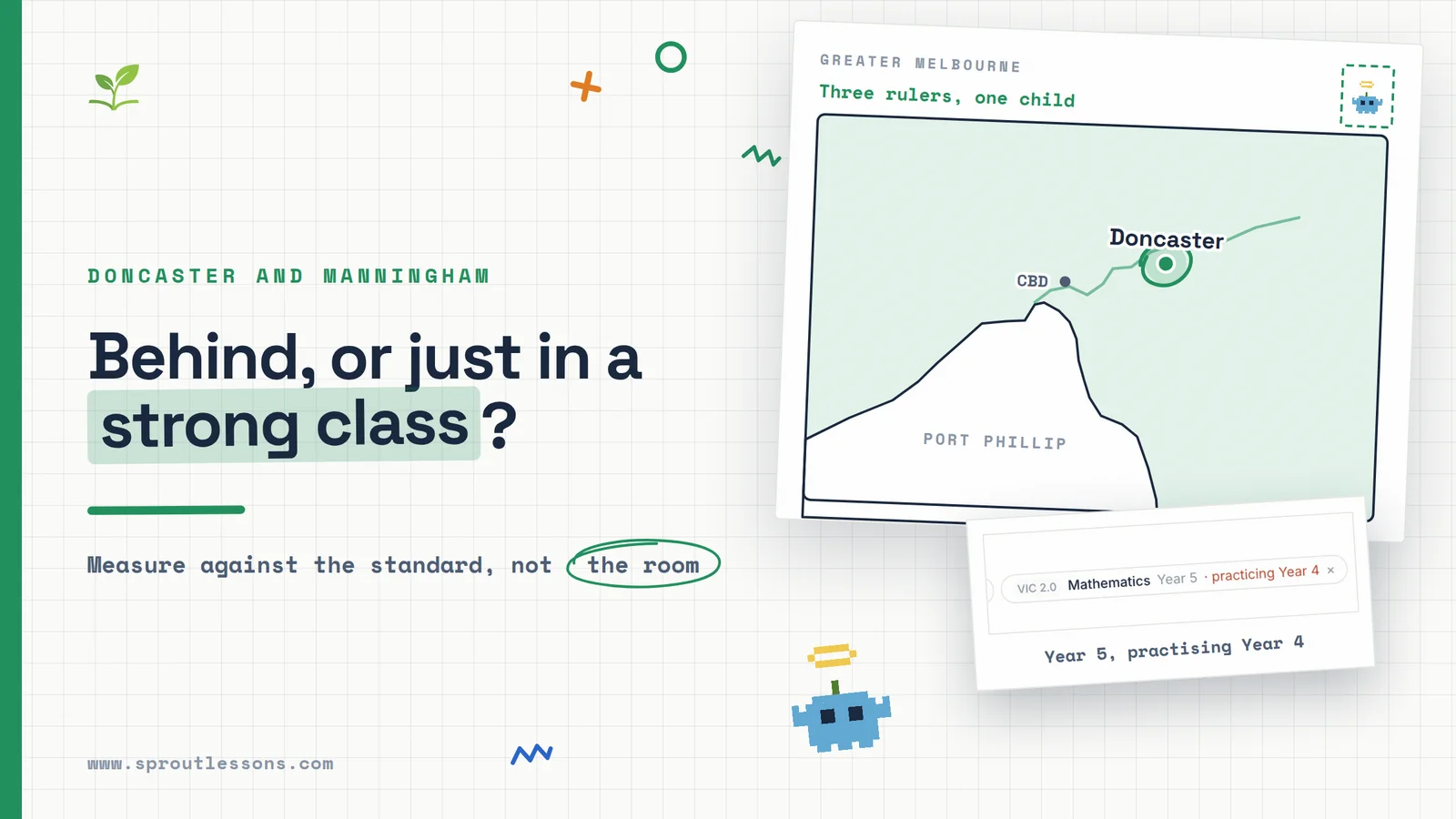
Why this question is sharper in Manningham
Several primary and secondary schools around Doncaster and Doncaster East publish NAPLAN averages well above the national figure. You can look up your own school on My School, which also compares it with schools serving similar students. When the whole room sits above the national line, and some classmates are also doing extra work outside school, a child who is perfectly on track can still be on the easier worksheet, in the middle reading group, or the last to finish the times tables test.
Children read the room, not the curriculum. “I’m the worst at maths” from a nine-year-old is usually a true statement about the table they sit at. Whether it is a true statement about maths is a different question, and the other two rulers answer it.
Ruler one: the class
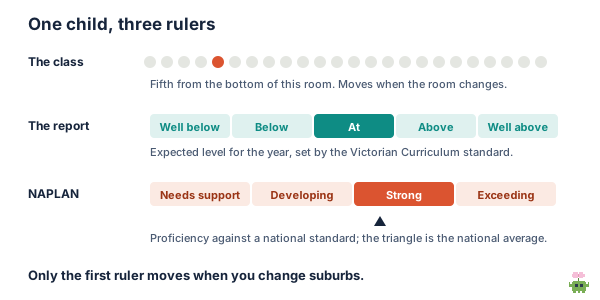
Rank in the class is a relative measure. It tells you where your child sits among 25 other children who happen to live nearby, and nothing else. Move the same child to a school where the cohort sits lower and they could be in the top group without learning anything new.
It is still useful. It tells you how your child feels about maths, which matters a great deal, and it tells you the pace the teacher has to set for the room. It just cannot tell you whether your child is behind, because “behind” needs a fixed line, and the class does not have one.
Ruler two: the school report
Victorian government school reports give two things for English, maths and science, and both are fixed lines. The first is a teacher judgement score against the Victorian Curriculum achievement standards, on a range from A to 11.0, in half steps. The second is a five-point rating: well below, below, at, above or well above expected level.
The department’s reporting guidance says the age-expected scale rates performance against what is expected of a student at the time of reporting, based on their year level. It gives an example: by the end of Semester 1 in Year 3, scores of 2.0 and 2.5 are both “at expected level”, and by the end of Semester 2, 2.5 and 3.0 are. The rating is looked up from the score and the year, so it is the same in every Victorian government school, whatever the suburb.
So “at expected level” on a Doncaster report means what it means in Mildura. It is not “average for this class”. A child can be at expected level and fifth from the bottom of the room at the same time, and neither fact is wrong.
Non-government schools write their own reports, and many use similar scales; ask the school what its ratings are measured against if the report does not say.
Ruler three: NAPLAN
NAPLAN runs in March of Years 3, 5, 7 and 9. Since 2023 results are reported against four proficiency levels: Exceeding, Strong, Developing, and Needs additional support. The VCAA’s guide for parents describes the standards as “a challenging but reasonable level expected for the student at the time of NAPLAN testing”.
Look at what the report draws. Your child’s result is a black dot. The black triangle is the national average for their year, and the shaded band is the middle 60% of students in the country. Neither is your child’s class or school. It is a snapshot from one morning, every two years, so it cannot replace the teacher’s judgement, but it is the only ruler here drawn against every child in Australia.
Reading the three together
Lay out the latest report and the latest NAPLAN report next to what your child says about class:
- Low in the class, at expected level, Strong on NAPLAN. Your child is not behind. The room is ahead. What they may need is confidence and a reason to like the subject again, not acceleration to keep up with classmates who are being tutored a year ahead.
- Low in the class, below expected level, Developing on NAPLAN. This is a real gap, and it is worth acting on. It is usually one strand, often Number, rather than the whole subject. Ask the teacher which one.
- The report and NAPLAN disagree. NAPLAN is one morning; the report is a semester of evidence. Ask the teacher what they saw that the test did not, or the other way round, before trusting either alone.
- Fine in the class, below expected on the report. Rarer, and worth a conversation straight away, because it means the child is keeping pace with the room on something the standard counts differently.
Most “behind” turns out to be a topic the curriculum has not asked for yet, which is the whole subject of is my child behind in maths?. And if the report says “below” in one area, what Victoria’s levels mean explains why working at a different Level is something the curriculum expects rather than a failure.
Sprout builds a lesson on any Victorian Curriculum code in about thirty seconds, at the Level your child is actually working at, with the code on the lesson. Once the teacher has named the strand, start free.
If the room is the problem, not the maths
The hardest case is the first one, because nothing needs fixing and a child still feels behind. Three things help more than extra content:
- Show them the report rating, not the rank. “Your teacher says you are where a Year 4 should be” is a sentence most children have never heard about themselves.
- Practise at the level they are working at, so it feels easy. Success at the right level rebuilds the belief that maths is something they can do. Practice pitched at the class above them does the opposite.
- Make it about something they care about. A child who has decided maths is not for them will still work out how many goals their team needs. Why that works, and why the curriculum outcome never moves, is in teaching maths through interests.
Where Sprout Tutor fits
Straight facts, since this is our product:
- Sprout Tutor is in public beta and follows the Victorian Curriculum, Years 1 to 10, in maths, English and science.
- It keeps two Years apart: the one you assign and the one your child is working at. The parent page shows both, as in “Mathematics, Year 5, practicing Year 4”. Five wrong answers in a row at the easiest tier move the working Year down one; three right answers at the hardest tier move it up one. Every move is logged, so you can see when a gap closed rather than guess.
- A child picks a flavour each session: Classic, Footy, Netball or Animals. The maths underneath does not change.
- You see the actual questions, the answer given, and whether a hint was opened or the answer revealed. What the dashboard shows covers every number on it.
- While it is in beta it is free on every plan, including the free one. It is not on the pricing page, so there is no price to quote.
What it cannot do is sit next to a child who has decided they are the worst in the class and change their mind. A teacher, a tutor or a parent does that. And the honest position on software like ours is that the effectiveness of personalised-learning chatbots has not been independently established, and very few rigorous studies of them exist.
A plan for this term
- Find the last report and the last NAPLAN report and write down the rating and the proficiency level for maths and English.
- If both say at expected and Strong or Exceeding, stop looking for a gap. Work on confidence and enjoyment instead.
- If either says below or Developing, ask the teacher which strand, and a code if they have one.
- Practise that one strand for about twenty minutes most nights for three weeks, at the Level your child is working at, then give a short cold check with no warm-up.
- If you do bring in a tutor, give them the report and the NAPLAN result first, and keep practice going between sessions. See what to do between tutoring sessions.
The short version
Rank in the class is relative and moves with the suburb. The Victorian report rating is set against the curriculum standard for the year and means the same thing in every government school. NAPLAN proficiency is set against a national standard, and the triangle on the report is the national average. In a strong Doncaster class, a child can be near the bottom of the room and at expected level; check the two fixed rulers before you buy a fix for the moving one.
Sprout builds Victorian Curriculum lessons around your child’s interests at the Level they are working at, and Sprout Tutor is in public beta for Years 1 to 10 and free on every plan while it is in beta. Start free.
Checked 3 October 2026. The reporting rules and the Year 3 example are from the Department of Education’s Policy and Advisory Library guidance on reporting student achievement, updated 9 September 2026. The proficiency level definitions and what the NAPLAN report shows are from the VCAA’s 2025 information for parents and carers, which quotes ACARA. School results are on My School; we have not quoted any one school’s figures. We build competing software and say so above.
FAQ
What does at expected level mean on a Victorian school report?
Victorian government school reports rate English, maths and science on an age-expected five-point scale, from well below to well above expected level. The rating is looked up from the teacher judgement score, which is set against the Victorian Curriculum achievement standards, and the student’s year and semester. By the end of Semester 1 in Year 3, for example, scores of 2.0 and 2.5 are both at expected level. It is the same in every government school, not a ranking within the class.
Can my child be at expected level and still be bottom of the class?
Yes. Rank in the class is a relative measure against the other children in the room, while the report rating and NAPLAN proficiency are set against fixed standards. In a high-achieving class, a child can be at expected level on the report, Strong on NAPLAN and still near the bottom of the room. Only the class ruler changes when you change suburbs.
What do the NAPLAN proficiency levels mean?
Since 2023 NAPLAN reports four levels: Exceeding, Strong, Developing and Needs additional support. Strong means the result meets challenging but reasonable expectations at the time of testing. On the report, the black dot is your child, the black triangle is the national average for their year, and the shaded band is the middle 60% of students nationally, not their class or school.
Should I get a tutor if my child feels behind their classmates?
Check the report rating and NAPLAN level first. If both say at expected and Strong or Exceeding, your child is not behind and the room is ahead; confidence and enjoyment matter more than acceleration. If either says below or Developing, ask the teacher which strand, practise it for three weeks, and bring in a tutor if a short cold check shows it did not stick.
How does Sprout Tutor handle a child working below their year?
Sprout Tutor keeps the assigned Year and the working Year apart, and the parent page shows both, such as Mathematics, Year 5, practicing Year 4. Five wrong answers in a row at the easiest tier move the working Year down one; three right answers at the hardest tier move it up one, and every move is logged. It follows the Victorian Curriculum for Years 1 to 10, is in public beta and is free on every plan while it is in beta.