
Melbourne Cup Day is Tuesday 3 November 2026, a public holiday across Victoria except where a regional council has swapped it for a local day. It falls in Week 5 of Term 4, so for most families it is a three or four day break in the middle of the busiest term of the year, with end-of-year reports six weeks away. You do not need a plan for it. If you want one, two or three ten-minute sessions on what this term has covered, plus one bit of race-day maths on the couch, is plenty.
This page sets out the dates (including who is not off), what is worth practising this far into Term 4, a race-day maths ladder from Foundation to Level 8 with the Victorian Curriculum code for each rung, and how to do the practice part with Sprout Tutor, which is ours, free while it is in beta, and built on the Victorian Curriculum. It also says what we would not bother with.
The dates, and who is not off
Melbourne Cup Day is a Victorian public holiday on the first Tuesday in November, which this year is Tuesday 3 November 2026. Term 4 runs from Monday 5 October to Friday 18 December, according to the Victorian Government’s school term dates page, which makes Cup Day the Tuesday of Week 5, with six and a half weeks of school after it.
- Most families: three days. Saturday, Sunday, then Monday at school and Tuesday off. Plenty of parents take the Monday as leave, which is where the “Cup long weekend” comes from.
- Some families: four days. Some schools make Monday 2 November a curriculum day (a pupil-free day), so students are home from Saturday to Tuesday. Check your school’s newsletter or app, because it is a school-by-school decision.
- Some regional families: none. A council outside metropolitan Melbourne can ask to replace Cup Day with a local holiday, and the swap replaces the day rather than adding one. Greater Geelong’s holiday was Geelong Cup day, Wednesday 21 October, and parts of Hindmarsh Shire took theirs in October for the Rainbow and Nhill shows (the shire published its arrangements). Business Victoria keeps the full list of non-metropolitan holidays. If your council swapped, Tuesday is an ordinary day and this page is for the weekend only.
Why the middle of Term 4 is a good time for ten minutes
A long weekend is too short for anything to be forgotten, so this is not about “holiday slide”. That is a summer question, and the evidence for it is weaker than most people think; our summer holidays page goes through it. The case for a little practice now is different, and it is about timing.
- This term’s topics are fresh but not yet secure. Five weeks in, your child has been taught most of what Term 4 holds. A quick go at it from memory, a few days after the lesson, is the kind of practice that makes it stick: the effort of recalling is the point.
- The end-of-year report is coming. Victorian government school reports give each subject a curriculum level and rate it against where a child of that age is expected to be in December. If something has not clicked yet, the Cup weekend is the earliest cheap moment to find out, with six weeks left to fix it rather than reading about it in the report. Our school report guide explains how to read the level and the rating.
- Short beats long. Ten minutes on Saturday and ten on Tuesday morning does more than forty minutes on Monday night, and it costs the weekend nothing.
A plan that fits around the weekend
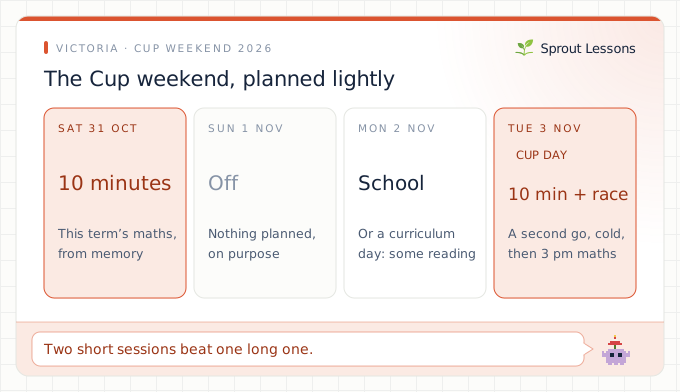
- Saturday, ten minutes: find out what this term has covered. Ask your child what they are learning in maths and English right now, then check the school newsletter or class page. You are looking for one topic in each, for example “fractions on a number line” or “persuasive writing”. Then do ten minutes on the maths one.
- Sunday: nothing. A long weekend that is all practice teaches a child that long weekends are bad. Leave a whole day empty on purpose.
- Monday: school, or a free day. If your school has a curriculum day, the English topic is a good fit for the morning: ten minutes of reading aloud, or one paragraph written in the style the class is practising.
- Tuesday, ten minutes in the morning, then the race. A second go at Saturday’s topic, cold, before anyone looks at the notes from last time. Whatever goes wrong this time is the thing to mention to the teacher. Then the race-day maths below, which does not feel like practice at all.
Race-day maths, Foundation to Level 8
The Cup is an unusually good maths prop: one fixed distance, a field capped at 24 horses and a race that takes a little over three minutes. The race record is Kingston Rule’s 3 minutes 16.3 seconds over 3200 metres, set in 1990 and still standing. Pick the rung that matches where your child is, and go one rung up if it is easy. Each one names the Victorian Curriculum code it practises (the VCAA wording is paraphrased).
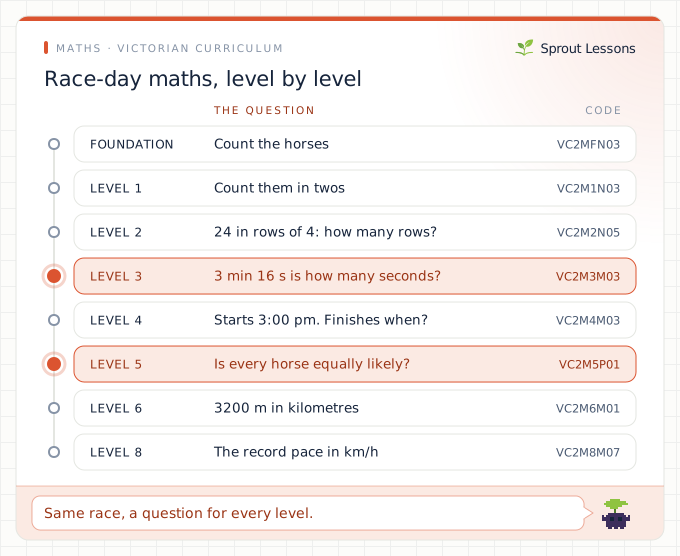
- Foundation (VC2MFN03, counting and comparing collections to 20 and beyond): count the horses as they line up, or count the silks on a printed field. Are there more horses wearing blue or wearing red? The same Foundation level asks children to sequence parts of the day (VC2MFM02): is the race in the morning or the afternoon?
- Level 1 (VC2M1N03, counting large collections by making equal groups): 24 horses is a lot to count one by one. Count them in twos instead. How many pairs?
- Level 2 (VC2M2N05, multiplying and dividing with groups and arrays): draw the 24 horses as dots in rows of 4. How many rows? Now rows of 8. Why is it still 24?
- Level 3 (VC2M3M03, the relationship between minutes and seconds): the record is 3 minutes and 16 seconds, near enough. How many seconds is that? (3 × 60 = 180, plus 16 is 196.) Then time the race on a phone and compare.
- Level 4 (VC2M4M03, duration with am and pm and converting between units of time): if the race starts at 3:00 pm and takes 3 minutes 20 seconds, what time is it when they cross the line? If the first race of the day starts at 10:30 am, how long is it until the Cup?
- Level 5 (VC2M5P01, equally likely and not equally likely outcomes): run a family sweep with no money in it. Write every horse on a slip and draw from a hat. Is every horse equally likely to be drawn? (Yes, 1 in 24 each.) Is every horse equally likely to win? (No.) That gap is the whole Level 5 idea, and our chance and probability by year page shows where it goes next.
- Level 6 (VC2M6M01 converting metric units, and VC2M6P01 probability from 0 to 1): 3200 metres is how many kilometres? (3.2.) The chance of drawing a given horse from the hat is 1 in 24: is that closer to 0 or to 1, and roughly what percentage? (About 4%.)
- Level 8 (VC2M8M07, distance and time at a constant speed): Kingston Rule ran 3200 metres in 196.3 seconds. What is that in metres per second, and in kilometres per hour? (About 16.3 metres per second, which is about 59 km/h, as fast as a car on a suburban main road.)
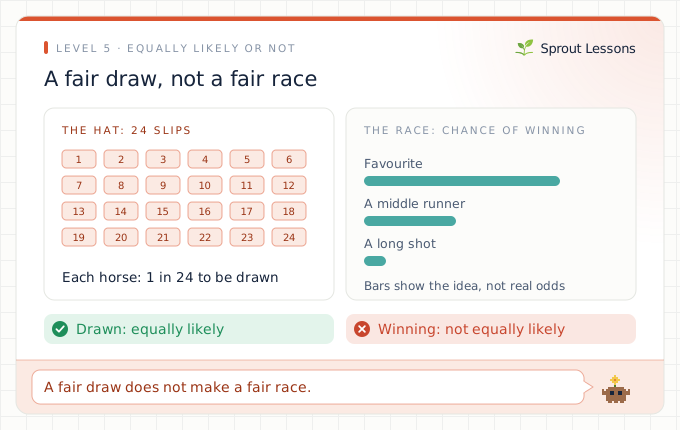
A note on the sweep. Keep it a draw from a hat with nothing riding on it, winners get first pick of the snacks, and leave the betting odds out of the maths. They are a bookmaker’s prices, not plain probabilities, and they are not the lesson a ten-year-old needs on a public holiday.
Doing the ten minutes with Sprout Tutor
Sprout Tutor is practice on the Victorian Curriculum F–10, Foundation to Year 10, in English, maths and science. It went into public beta on 22 September 2026 and while it is in beta it is free on every Sprout plan, including the free one. It covers the Victorian Curriculum only. For a long weekend it does three things the plan above needs:
- Your child can pick this term’s strand. After the PIN, they choose a subject and then a stream, which is the curriculum’s own strand: in maths that is Number, Algebra, Measurement, Space, Statistics or Probability. “Just Measurement, because that is what we are doing at school” is one tap.
- It recaps before it asks. Each sitting on a topic starts with a short teaching deck on that exact curriculum code, then ten marked questions. On Saturday that is a reminder; on Tuesday it is the second go.
- You see the wrong answers, as questions. Every answer lands on your dashboard, with the question text. If the same kind of question goes wrong on Saturday and on Tuesday, you have the sentence to say to the teacher.
There are four themes: Classic, Footy, Netball and Animals. There is no horse racing theme, so the race stays on the TV and the practice stays practice. The theme changes the wrapper on the questions and never the maths. The whole loop is in how Sprout Tutor works.
Want ten minutes on this term’s topic before the race? Create a free account, switch the tutor on for your child and set a PIN. It is free while it is in beta.
If your child is mad about horses, a regular Sprout lesson can do what the tutor will not: write a maths or English lesson on the exact code they are working on, built around horses, jockeys and the Cup. That is the main product, and how it works is in teaching maths through interests.
What we would not bother with
- A workbook marathon. More than twenty minutes a day on a long weekend has a cost, mostly in goodwill, and nothing in the research says it pays it back.
- Next term’s or next year’s content. The topics that slip are the ones already taught. Practise those. A new method half-learned at home, a different way from the classroom, can make the next lesson harder.
- Practice on a day your child is genuinely tired. Week 5 of Term 4 is a long way into the school year. Skipping a session is fine; turning it into a fight is not.
Where this sits
For the bigger break, see summer holidays learning in Victoria. For what your child’s December report will say and how to read it, see the Victorian school report explained, and if your child is in Prep, the end of Prep checklist. If the maths above was too easy or too hard, it may be that your child works at a different level in one subject, which is common and covered in working at a different level. The race-day questions at Levels 3 and 4 lean on telling the time by year.
The short version
- Melbourne Cup Day is Tuesday 3 November 2026, Week 5 of Term 4. Some regional councils swapped it for a local day.
- Some schools add a curriculum day on Monday 2 November. Check yours.
- Two or three ten-minute sessions on this term’s topics, a day off in the middle, and no new content.
- The race is a free maths lesson at every level, from counting the field to the record pace in km/h.
- Keep any sweep money-free: a fair draw does not make a fair race.
How this page was checked
Term 4 dates are from the Victorian Government’s school term dates page, read on 30 October 2026. The public holiday arrangements are from Hindmarsh Shire Council’s published notice and Business Victoria’s non-metropolitan holiday list, linked above. The record time and distance are from the Victoria Racing Club’s fastest Cup finishers, and the 24-horse field limit from published race guides. The Victorian Curriculum codes are from the Victorian Curriculum F–10 version 2.0, and the Sprout Tutor details were checked against our own code. Checked 30 October 2026.
Victorian Curriculum codes reference the Victorian Curriculum F–10 Version 2.0 © VCAA, paraphrased; the VCAA does not endorse this product. Sprout Lessons is not affiliated with the Victoria Racing Club or the Melbourne Cup.
FAQ
When is Melbourne Cup Day 2026?
Tuesday 3 November 2026. It is a public holiday across Victoria, except in non-metropolitan council areas that have replaced it with a local holiday, such as Greater Geelong, whose holiday was Geelong Cup day on Wednesday 21 October 2026.
Is the Monday before Melbourne Cup a school day in Victoria?
For most students, yes. Monday 2 November 2026 is not a public holiday. Some schools choose it as a curriculum day (a pupil-free day), which gives their students a four-day weekend, so check your school's newsletter or app.
Are schools open on Melbourne Cup Day?
Where Cup Day is the public holiday, Victorian schools are closed on Tuesday 3 November. Where a regional council has swapped it for a local holiday, Cup Day is an ordinary working day, so check with your school if you live outside metropolitan Melbourne.
Should my child do schoolwork over the Cup long weekend?
They do not need to. If you want to, two or three ten-minute sessions on what this term has covered, with a whole day off in the middle, is plenty. Five weeks into Term 4, a short go at recent topics from memory shows what has not stuck yet, with six weeks left before the end-of-year report.
What maths can kids do on Melbourne Cup Day?
Count the field (Foundation), group 24 horses into rows (Level 2), turn the 3 minute 16.3 second race record into seconds (Level 3), work out the finishing time from a 3:00 pm start (Level 4), compare a fair draw with an unfair race in a money-free family sweep (Level 5), convert 3200 m to 3.2 km (Level 6) and work out the record pace, about 59 km/h (Level 8).