
In the Australian Curriculum, chance starts in Year 3, with words: likely, unlikely, certain and impossible. Year 4 orders events by how likely they are, Year 5 lists equally likely outcomes, and Year 6 is the first year probability becomes a number, between 0 and 1 or 0% and 100%. Calculating probabilities from a list of outcomes is Year 7, and tree diagrams are Year 8. Victoria matches this year by year. NSW starts earlier, with chance in Stage 1 (Years 1 and 2).
So a Year 2 child in Brisbane who has never been asked whether rain is likely tomorrow is right on track, and so is a Year 2 child in Sydney who has. The more useful thing to know is where children go wrong, because chance is the one part of primary maths where a child’s everyday instincts are often the problem rather than the starting point. This page sets out what each year asks for, the five mistakes worth listening for (one of them adults make too), a two-minute check with a pair of dice and a twenty-minute routine.
What the curriculum asks for, year by year
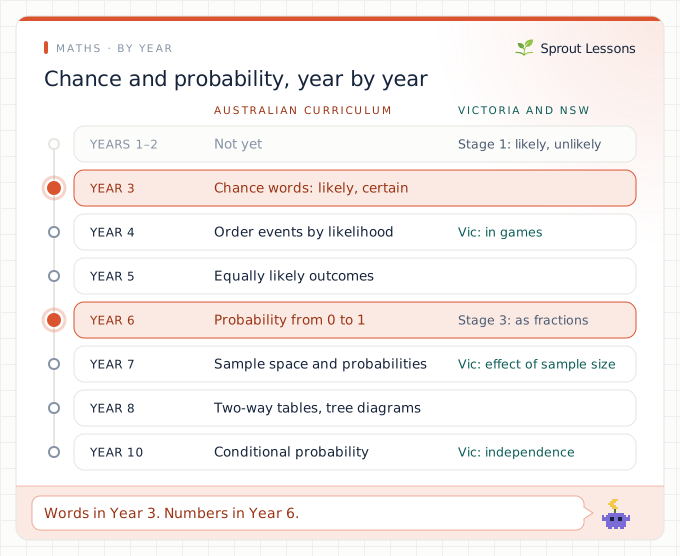
The Australian Curriculum has two probability descriptors in every year from Year 3 to Year 7, three in Years 8 and 9 and two in Year 10, and none before Year 3. Quoted from ACARA:
- Year 3, AC9M3P01: “identify practical activities and everyday events involving chance; describe possible outcomes and events as ‘likely’ or ‘unlikely’ and identify some events as ‘certain’ or ‘impossible’ explaining reasoning”. AC9M3P02 adds repeated experiments and noticing that results vary.
- Year 4, AC9M4P01: “describe possible everyday events and the possible outcomes of chance experiments and order outcomes or events based on their likelihood of occurring; identify independent or dependent events”. That last clause is the idea behind mistake 2 below.
- Year 5, AC9M5P01: “list the possible outcomes of chance experiments involving equally likely outcomes and compare to those which are not equally likely”. AC9M5P02 uses frequency (how often something happened) to estimate likelihood.
- Year 6, AC9M6P01: “recognise that probabilities lie on numerical scales of 0 – 1 or 0% – 100% and use estimation to assign probabilities that events occur in a given context, using common fractions, percentages and decimals”. This is the first year chance is a number. AC9M6P02 runs simulations with more and more trials.
- Year 7, AC9M7P01: “identify the sample space for single-stage events; assign probabilities to the outcomes of these events and predict relative frequencies for related events”. One die, one spinner, one draw from a bag.
- Year 8, AC9M8P01 and AC9M8P02: complementary events “have a combined probability of one”, and all combinations for two events using “two-way tables, tree diagrams and Venn diagrams”.
- Years 9 and 10: compound events with and without replacement (AC9M9P01), then conditional probability, in the language of “if .... then”, “given” and “knowing that” (AC9M10P01).
Where Victoria differs (the VCAA wording is paraphrased here, not quoted). The Victorian Curriculum matches level by level from Level 3 to Level 8 (VC2M3P01 to VC2M8P03), with three small changes. Level 4 sets its chance experiments in games. Level 6 says outright that probabilities are described with fractions, decimals and percentages. And Level 7 adds the effect of sample size on results, which is the point of mistake 5. The differences grow at the top: Level 9 works with two-step experiments, Level 10 adds three-step experiments and the idea of independence, and Level 10A brings in counting principles and factorial notation.
Where NSW differs (the NESA wording is paraphrased). The NSW Mathematics K–10 Syllabus has a Chance outcome in Stage 1 (MA1-CHAN-01), so Years 1 and 2 already describe everyday events as likely or unlikely, and compare events as more or less likely. Stage 2 (MA2-CHAN-01) uses the word outcome, predicts how many times each result might come up and then tests it, and looks at whether one event affects another. Stage 3 (MA3-CHAN-01) uses the word probability, writes probabilities as fractions with denominators of 2, 3, 4, 5, 6, 8 and 10, establishes that the probabilities of all outcomes add to one, and talks about whether simple games are fair. Stage 4 and Stage 5 have their own probability outcomes (MA4-PRO-C-01, MA5-PRO-C-01), with conditional probability on a Stage 5 path.
Five mistakes that tell you where your child is
1. “Unlikely means it won’t happen” (Year 3, or Stage 1 in NSW)
Ask a Year 3 child whether it is likely to rain in Melbourne tomorrow and they will give you an answer. Ask what “unlikely” means and many will say “it won’t happen”. The four words are a scale, not two pairs: impossible and certain are the ends, and unlikely and likely are the long stretches in between, where things do sometimes happen. NSW Stage 3 even asks children to discuss how imprecise everyday chance words are, which is worth doing at home: is “probably” more or less likely than “likely”? The fix is a line drawn on paper, with impossible at one end and certain at the other, and events placed along it.
2. “Tails is due” (Year 4)
A coin lands heads five times in a row, and your child is sure the next one will be tails. It is the most famous mistake in probability, adults make it at the pokies, and Year 4 is when the curriculum takes it on, by asking children to identify independent events (AC9M4P01). A coin has no memory: each flip is a fresh half chance of heads. The fix is to test it. Flip a coin until you get three heads in a row, then write down what the next flip is. Do it ten times. The “due” tails turn up about half the time, which is exactly how often tails turns up anyway.
3. Every total on two dice is equally likely (Year 5)
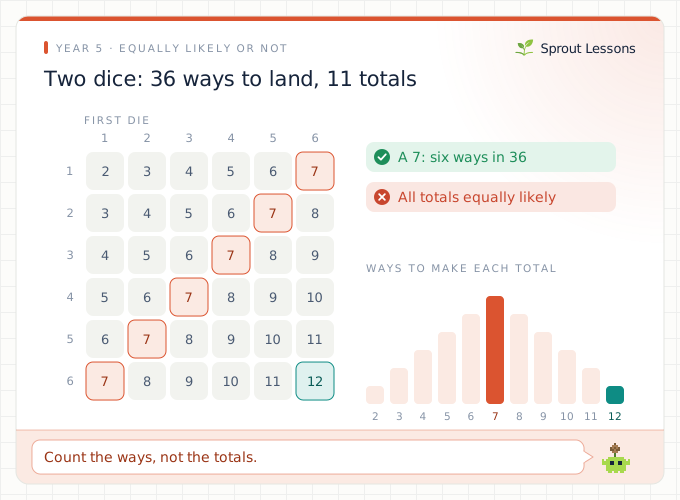
Roll two dice and add them. The totals run from 2 to 12, so a child reasons that each total is one of eleven equally likely results. It sounds right and it is wrong, and it is exactly the comparison AC9M5P01 asks for: outcomes that are equally likely against outcomes that are not. The 36 ways the two dice can land are equally likely. The eleven totals are not, because a 7 can be made six ways (1 and 6, 2 and 5, 3 and 4, and the same three the other way round) and a 12 only one way. The fix is to draw the six-by-six grid together and count. Then roll the dice 36 times and tally the totals: the 7s pile up in the middle.
4. “The probability of an even number is 3” (Year 6)
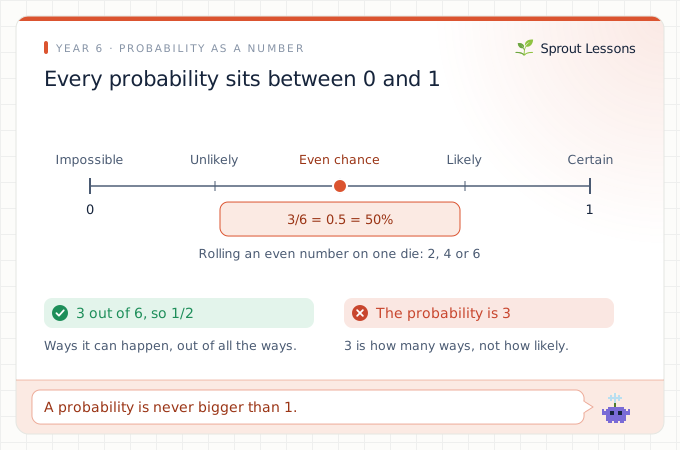
Asked for the probability of rolling an even number, a child who has listed 2, 4 and 6 correctly writes 3. They have counted the favourable outcomes and stopped. The probability is 3 out of 6 possible outcomes, so 3/6, which is 1/2, or 0.5, or 50%. Year 6 is where this matters, because AC9M6P01 puts every probability on a scale from 0 to 1, and a probability of 3 would be off the end of it. NSW Stage 3 names the same distinction: the frequency of an outcome is how many times it happens, the probability is how likely it is. The quick test is the one in the takeaway: if your child’s probability is bigger than 1, something has gone wrong. Our fractions by year page covers the fraction skills this leans on.
5. “We got four 6s in ten rolls, so the chance is 4 in 10” (Year 6 and Year 7)
Your child rolls a die ten times, gets four 6s, and concludes either that the die is loaded or that the chance of a 6 is 4 in 10. Ten rolls is far too few to tell, and that is the point of AC9M6P02 and AC9M7P02, which ask children to run experiments with more and more trials and compare the results with what they expected. The expected chance of a 6 is 1 in 6, about 17%. In ten rolls, four 6s is unusual but not strange. In 600 rolls, the share of 6s will usually sit close to one in six. The fix is a simulation: most spreadsheet apps can roll a die a thousand times in a second, and watching the share of 6s settle as the rolls pile up teaches this better than any explanation.
A two-minute chance check
You need one coin and two dice. Stop when one goes wrong. Each question maps to a year.
- Stage 1 in NSW, Year 3 elsewhere: Is it certain, likely, unlikely or impossible that a dropped coin lands on heads? That it lands on its edge and stays there? (Neither likely nor unlikely: an even chance. Very unlikely, but not impossible.)
- Year 4: A coin has landed heads five times in a row. Is tails now more likely? (No. It is still an even chance.)
- Year 5: With two dice, is a total of 7 or a total of 12 more likely, and how do you know? (7, because it can be made six ways and 12 only one.)
- Year 6: What is the probability of rolling an even number on one die, as a fraction, a decimal and a percentage? (1/2, 0.5, 50%.)
- Year 7: If you roll one die 60 times, about how many 6s do you expect, and will it be exactly that? (About 10, and probably not exactly.)
- Year 8: The chance of rain tomorrow is 0.3. What is the chance it does not rain? (0.7, because the two add to 1.)
The first question that goes wrong is the place to start, whatever year your child is in. A Year 6 child who answers 4 correctly but says yes to question 2 has the arithmetic and not the idea, and the idea is the harder thing to fix.
Want practice set in their own world? Sprout writes a maths lesson on AC9M5P01 or AC9M6P01 around what your child loves, from footy finals to board games. Try it free.
Twenty minutes, mostly playing
Chance is the easiest topic in primary maths to practise without a worksheet, because every board game is already a chance experiment.
- Five minutes: the likelihood line. Draw a line labelled impossible, unlikely, even chance, likely and certain. Take turns writing events on sticky notes (“the dog barks tonight”, “it snows in Darwin”) and arguing about where each goes. From Year 6, put 0 and 1 at the ends.
- Five minutes: the streak test. Flip a coin until you get three heads in a row, then record the next flip. Repeat. Keep a tally across several days, and look at it together at the end of the week.
- Five minutes: two-dice totals. Roll two dice 36 times and tally each total from 2 to 12. Before you start, have your child predict which total will win. Then draw the six-by-six grid and compare.
- Five minutes: is it fair? Invent a game: “I win on a total of 7, you win on a 12.” Is it fair? Let your child change the rules until it is. NSW Stage 3 asks for exactly this, and it is the best test of whether the grid made sense.
What is not the problem
- No chance before Year 3 outside NSW. The Australian and Victorian curricula have no probability content in Foundation, Year 1 or Year 2. In NSW, chance is Stage 1 content.
- Not calculating probabilities in Year 4 or 5. Numbers arrive in Year 6. Before that, the job is words, ordering and listing outcomes.
- Results that do not match the prediction. That is the lesson, not a failed experiment. The curriculum asks children to notice and discuss variation from Year 3.
Where this sits
Probability leans on fractions, decimals and percentages, so if mistake 4 will not shift, look at percentages by year and decimals by year. For the whole picture of a year level, see what a Year 5 student should know, and for every maths code in that year, the teacher-facing Year 5 maths codes page. If you are not sure which curriculum applies, start with which curriculum your state uses.
The short version
- Year 3: chance words (likely, unlikely, certain, impossible). Nothing before that outside NSW.
- Year 4: ordering events by likelihood, and events that do or do not affect each other.
- Year 5: equally likely outcomes, and using how often something happened.
- Year 6: probability becomes a number from 0 to 1, as a fraction, decimal or percentage.
- Year 7: listing all outcomes and assigning probabilities. Year 8: tree diagrams and tables.
- NSW starts in Stage 1. Victoria matches through Level 8, then goes further.
Sprout makes a lesson on the exact code your child is working on, with examples in their own interests. Start free.
How this page was checked
The Australian Curriculum descriptors are quoted from our copy of version 9.0, which matches AC9M6P01 on the Australian Curriculum website; we read every Foundation to Year 10 probability descriptor. The Victorian codes are from the Victorian Curriculum F–10 version 2.0. The NSW findings come from the six Chance content pages in Stage 1 to Stage 3 of the NSW Mathematics K–10 Syllabus, read on 27 October 2026; Stage 4 and 5 are covered at outcome level only. Victorian and NSW wording is paraphrased. Checked 27 October 2026.
Australian Curriculum content descriptions are © Australian Curriculum, Assessment and Reporting Authority (ACARA) 2010 to present, licensed under CC BY 4.0, and quoted here unmodified. ACARA does not endorse any product that uses the Australian Curriculum. Victorian Curriculum codes reference the Victorian Curriculum F–10 Version 2.0 © VCAA, paraphrased; the VCAA does not endorse this product. NSW outcome codes reference the NSW syllabuses © NSW Education Standards Authority (NESA) for and on behalf of the Crown in right of the State of New South Wales, paraphrased, available at curriculum.nsw.edu.au; NESA does not endorse this product.
FAQ
What year do kids learn probability in Australia?
Chance starts in Year 3 of the Australian Curriculum, describing events as likely, unlikely, certain or impossible (AC9M3P01). Probability becomes a number on a scale from 0 to 1 or 0% to 100% in Year 6 (AC9M6P01). Victoria matches this. In NSW, chance is Stage 1 content, in Years 1 and 2.
Is a total of 7 more likely than 12 with two dice?
Yes. Two dice can land 36 equally likely ways. Six of them total 7 (1 and 6, 2 and 5, 3 and 4, and the reverses) and only one totals 12 (6 and 6), so a 7 is six times as likely. Comparing equally likely and not equally likely outcomes is Year 5 content (AC9M5P01).
Why does my child think tails is due after five heads?
It is the gambler's fallacy, and adults make it too. Each coin flip is independent, so the chance of tails is still one half however many heads came before. The Australian Curriculum takes this on in Year 4, which asks students to identify independent and dependent events (AC9M4P01).
Can a probability be bigger than 1?
No. Every probability lies between 0 (impossible) and 1 (certain). A child who writes the probability of rolling an even number as 3 has counted the favourable outcomes but not divided by all six. The answer is 3/6, which is 1/2, 0.5 or 50%.
When do kids learn tree diagrams in Australia?
Year 8. AC9M8P02 asks students to find all combinations for two events using two-way tables, tree diagrams and Venn diagrams. Year 9 extends this to compound events with and without replacement, and Year 10 to conditional probability.