
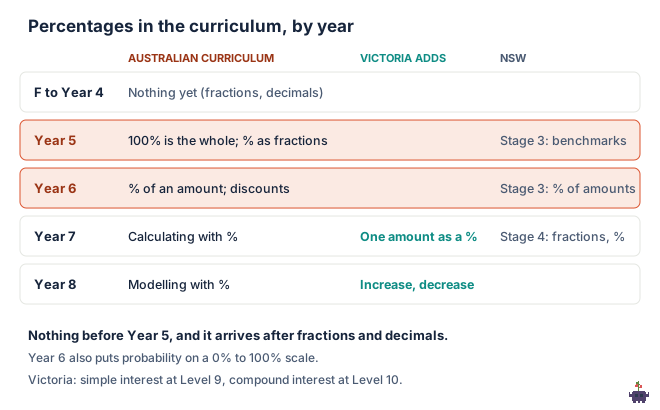
In the Australian Curriculum, percentages start in Year 5, where 100% is the whole and children link familiar percentages to fractions and decimals. Year 6 finds a percentage of an amount, including discounts. Year 7 calculates with percentages in general. Victoria follows the same order to Year 6, then gives two ideas their own year: one amount as a percentage of another in Year 7, and percentage increase and decrease in Year 8. NSW teaches percentages of quantities in Stage 3 (Years 5 and 6).
So there is no percentage work at all before Year 5, and it arrives after two years of fractions and decimals that it depends on. When a child struggles with percentages, the gap is usually in one of those, not in the percent sign. This page sets out what each year teaches, the five wrong answers that turn up most often, four quick questions to find where your child is, and twenty minutes of practice with a supermarket catalogue.
What the curriculum asks for, year by year
The Australian Curriculum descriptors, quoted from ACARA:
- Foundation to Year 4: no percentages. Year 4 connects fractions with decimals (AC9M4N03), which is the step percentages are built on. Our pages on fractions by year and decimals by year cover that ground.
- Year 5, AC9M5N04: “recognise that 100% represents the complete whole and use percentages to describe, represent and compare relative size; connect familiar percentages to their decimal and fraction equivalents”. In practice, familiar means the ones children meet every day: 50%, 25%, 10%, 75% and 100%.
- Year 6, AC9M6N07: “solve problems that require finding a familiar fraction, decimal or percentage of a quantity, including percentage discounts, choosing efficient calculation strategies and using digital tools where appropriate”. This is the “25% off” year. Year 6 also puts probability on a scale from 0% to 100% (AC9M6P01), and estimates answers with percentages in money problems (AC9M6N08).
- Year 7, AC9M7N06: “use the 4 operations with positive rational numbers including fractions, decimals and percentages to solve problems using efficient calculation strategies”. From here, percentages are one of three ways of writing the same number.
- Year 8, AC9M8N05: modelling practical problems with percentages, including financial ones. The national curriculum has no separate descriptor for percentage increase and decrease; it sits inside the Year 7 and 8 problem-solving and modelling descriptors.
Where Victoria differs (the VCAA wording is paraphrased here, not quoted). Levels 5 and 6 match the national descriptors almost word for word (VC2M5N04, VC2M6N07), though Level 6 asks for percentage discounts both with and without digital tools, so a Victorian Year 6 child is expected to manage 25% off $40 without a calculator. Then Victoria splits out two ideas that the national curriculum leaves inside broader descriptors:
- Level 7, VC2M7N07: finding percentages of quantities and expressing one quantity as a percentage of another (18 out of 24 as a percentage, for example), with and without a calculator. The Level 7 modelling descriptor includes best-buy comparisons (VC2M7N10).
- Level 8, VC2M8N05: percentage increases and decreases and percentage error, with profit and loss in the Level 8 modelling descriptor (VC2M8N06). Simple interest follows at Level 9 and compound interest at Level 10.
Where NSW differs (the NESA wording is paraphrased). The NSW Mathematics K–10 Syllabus puts percentages in one Stage 3 outcome (Years 5 and 6): finding percentages of quantities, and the fraction and decimal equivalents of benchmark percentages (MA3-RN-03). Its Stage 3 content includes discounts of 10%, 25% and 50%. In Stage 4 (Years 7 and 8), percentages sit inside one outcome on fractions, decimals and percentages (MA4-FRC-C-01).
Five wrong answers to listen for
1. “0.5 is 5%” (Year 5)
The child moves the digit, not the place value. 0.5 is five tenths, which is fifty hundredths, which is 50%. The mirror error is 0.05 written as 50%. Both come from treating the decimal point as decoration. The fix is the hundred grid: shade 0.5 of it, count the squares, and that count is the percentage. If the decimal itself is shaky, the tenths and hundredths check on our decimals by year page is where to start.
2. “¼ is 4%” (Year 5)
The child reads the bottom number as the percentage. It sounds silly written down, but it is common, and it tells you something precise: they do not yet see a percentage as “out of 100”. A quarter of 100 is 25, so ¼ is 25%. Ask “a quarter of a hundred-square is how many squares?” and the answer arrives on its own.
3. “20% of 60 is 3” (Year 6)
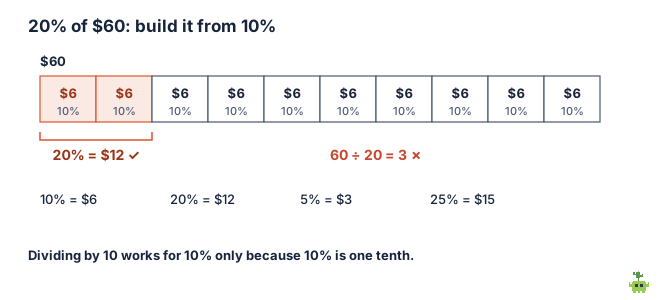
The child knows that 10% means “divide by 10”, so 20% must mean “divide by 20”. The rule worked once, so they stretch it. The trouble is that 10% is a special case: dividing by 10 works because 10% is one tenth. 20% is two tenths, so 20% of $60 is two lots of $6, which is $12. Build every familiar percentage from 10%: double it for 20%, halve it for 5%, add those for 15%, and use a quarter for 25%. This is the efficient calculation strategy AC9M6N07 has in mind.
4. “25% off $40 costs $10” (Year 6)
The child finds the discount correctly and stops. $10 is how much you save, not what you pay; the price is $30. Discount questions have two answers hiding in them, and children give whichever they found first. Ask every time: “Is that what you save, or what you pay?” Then ask whether the answer makes sense: something on sale cannot cost $10 when the original price was $40 and only a quarter came off.
5. “Up 50%, then down 50%, is back where it started” (Years 7 and 8)
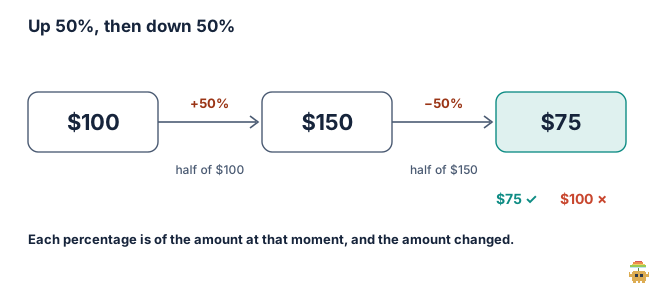
A $100 pair of shoes goes up 50% to $150, then comes down 50%. Most children (and plenty of adults) say $100. It is $75, because the second 50% is half of $150, not half of $100. The idea underneath is that a percentage is always a percentage of something, and the something changes. This is Level 8 content in Victoria (VC2M8N05), and it is the root of later trouble with interest, which is just repeated percentage increases.
Four questions to find where your child is
Pen and paper, no calculator. Stop at the first one that goes wrong; that is where to start.
- Year 5. “Write 50%, 25% and 10% as fractions and as decimals.” Right: ½ and 0.5, ¼ and 0.25, 1⁄10 and 0.1. Writing 0.5 as 5% anywhere is wrong answer 1.
- Year 6. “A $60 game is 20% off. How much do you save, and what do you pay?” Right: save $12, pay $48. $3 is wrong answer 3; giving only $12 is wrong answer 4.
- Year 7. “You got 18 out of 24 on a test. What percentage is that?” Right: 75% (18 out of 24 is ¾). A child who can do questions 1 and 2 but not this one has met percentages of amounts but not one amount as a percentage of another, which Victoria teaches at Level 7.
- Year 8. “An $80 jumper goes up 25%, then the new price comes down 25%. What does it cost now?” Right: $75 ($80 to $100, then $100 to $75). $80 is wrong answer 5.
A Year 4 child who cannot do question 1 is not behind: percentages are Year 5. A Year 6 child who cannot do question 3 is not behind either; in Victoria that is Level 7.
Want practice set in their own world? Sprout writes a lesson on AC9M6N07 or VC2M7N07 around what your child loves, from footy stats to game sales. Try it free.
Twenty minutes with a supermarket catalogue
You need a supermarket or toy catalogue, a pen, and a sheet with a hundred-square grid (draw a 10 by 10 square if you have nothing printed).
- Five minutes: the hundred grid. Shade 50 squares, then 25, then 10, and write each as a percentage, a fraction and a decimal. This is all of Year 5 on one page.
- Five minutes: 10% of everything. Pick five prices from the catalogue and find 10% of each by moving the digits one place. Say it aloud: “10% of $45 is $4.50.”
- Five minutes: build from 10%. For the same five prices, find 20%, 5% and 25%. Each one is built from 10% (or from a quarter). Wrong answer 3 cannot survive this.
- Five minutes: save or pay? Find two items marked down. Work out the saving, then the sale price, and check that the sale price is smaller than the original but not by too much. For Year 7 and up, flip it: “this was $20 and is now $15; what percentage came off?”
What is not the problem
- No percentages before Year 5. If your Year 4 child has not met the percent sign at school, that is the curriculum, not the teacher.
- Using a calculator in Year 6. AC9M6N07 allows digital tools where appropriate. The skill is choosing the method; in Victoria, though, familiar percentages should also work without one.
- Not knowing percentage increase in primary school. In Victoria that is Level 8; nationally it sits in the Year 7 and 8 problem-solving descriptors.
Where this sits
Percentages sit in the Number strand and lean on fractions and decimals; the discount questions also appear on our money by year page. For the whole picture of a year level, see what a Year 6 student should know, and for every maths code in a year, the teacher-facing Year 6 maths codes page. If you are not sure which curriculum applies, start with which curriculum your state uses, and if you are worried more broadly, our guide to whether your child is behind in maths shows how to check the year first.
The short version
- Nothing before Year 5. Year 5: 100% is the whole, and familiar percentages as fractions and decimals.
- Year 6: a percentage of an amount, including discounts.
- Year 7: calculating with percentages; Victoria adds one amount as a percentage of another.
- Year 8 in Victoria: percentage increase and decrease, profit and loss.
- NSW: percentages of quantities in Stage 3, with 10%, 25% and 50% discounts.
- The fix for most errors: find 10% first and build from it, and always ask “of what?”
Sprout makes a lesson on the exact code your child is working on, with questions in their own interests. Start free.
How this page was checked
The Australian Curriculum descriptors are quoted from our copy of version 9.0, which matches AC9M6N07 on the Australian Curriculum website; we searched every Foundation to Year 10 maths descriptor for percentages. The Victorian codes are from the Victorian Curriculum F–10 version 2.0 and the NSW codes from the NSW Mathematics K–10 outcomes, both paraphrased. Checked 20 October 2026.
Australian Curriculum content descriptions are © Australian Curriculum, Assessment and Reporting Authority (ACARA) 2010 to present, licensed under CC BY 4.0, and quoted here unmodified. ACARA does not endorse any product that uses the Australian Curriculum. Victorian Curriculum codes reference the Victorian Curriculum F–10 Version 2.0 © VCAA, paraphrased; the VCAA does not endorse this product. NSW outcome codes reference the NSW syllabuses © NSW Education Standards Authority (NESA) for and on behalf of the Crown in right of the State of New South Wales, paraphrased, available at curriculum.nsw.edu.au; NESA does not endorse this product.
FAQ
What year do kids learn percentages in Australia?
Year 5. In the Australian Curriculum and the Victorian Curriculum, Year 5 learns that 100% is the whole and connects familiar percentages to fractions and decimals (AC9M5N04). Year 6 finds percentages of amounts, including discounts (AC9M6N07). In NSW, percentages are Stage 3 content, in Years 5 and 6. There are no percentages before Year 5.
When do kids learn percentage discounts?
Year 6. AC9M6N07 asks students to find a familiar fraction, decimal or percentage of a quantity, including percentage discounts. The Victorian version asks for this with and without digital tools, so familiar discounts such as 25% off should work without a calculator. NSW Stage 3 content includes discounts of 10%, 25% and 50%.
When do kids learn percentage increase and decrease?
In Victoria, Level 8 (VC2M8N05), alongside profit and loss. The Australian Curriculum has no separate descriptor for it: it sits inside the Year 7 and Year 8 problem-solving and modelling descriptors. Before Year 7, not knowing it is expected.
Why does my child think 20% of 60 is 3?
Because they know 10% means divide by 10 and stretch the rule to divide by 20. Dividing by 10 only works because 10% is one tenth. 20% is two tenths, so 20% of 60 is 2 lots of 6, which is 12. The fix is to find 10% first and build every familiar percentage from it.
Is going up 50% then down 50% back to the start?
No. $100 up 50% is $150, and 50% off $150 is $75, not $100, because the second percentage is of the new, bigger amount. This is Level 8 content in the Victorian Curriculum and the root of later work on interest.