
In the Australian Curriculum, money starts in Year 1 with simple buying and selling, and dollars and cents are formally taught in Year 3. Rounding to check a bill comes in Year 4, percentages in Year 5 and percentage discounts in Year 6. Victoria starts a year earlier, in Foundation, and adds working out change to the nearest 5 cents in Year 4. NSW leaves money to Stage 2 (Years 3 and 4).
There is a catch the curriculum was not written for: many children now rarely see cash. The Reserve Bank’s 2025 Consumer Payments Survey found that about 15% of Australian payments by number were made in cash, compared with about 70% in 2007. A child who has only ever watched a card being tapped has no feel for what $5 buys or what change is, and that shows up in Year 3 and 4 maths. This page sets out what is taught each year, the five wrong answers that turn up most, three quick questions to find where your child is, and how to teach money at home when your wallet is mostly a phone.
What is taught, year by year
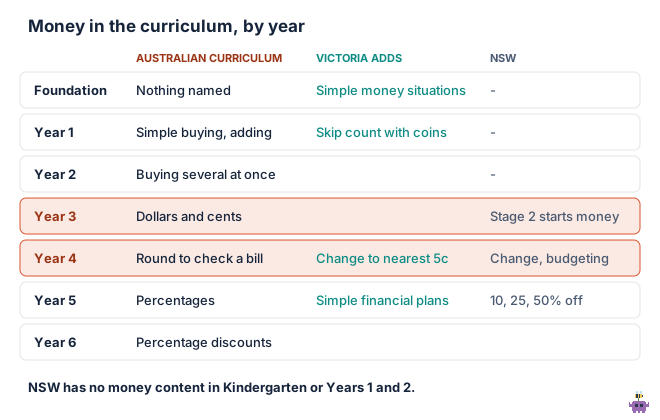
The key Australian Curriculum descriptors, quoted from ACARA:
- Year 1, AC9M1N05: “use mathematical modelling to solve practical problems involving additive situations including simple money transactions”. In practice: playing shop with small whole-dollar or whole-cent prices and adding them up.
- Year 2, AC9M2N06: problems “involving additive and multiplicative situations, including money transactions”. Three toys at $4 each, or how many $2 drinks $10 buys.
- Year 3, AC9M3M06: “recognise the relationships between dollars and cents and represent money values in different ways”. This is the year $3.45 is first written properly, and the year $1 becomes 100 cents. Oddly, the Australian Curriculum files it under Measurement; Victoria files the same idea under Number (VC2M3N07).
- Year 4, AC9M4N07: “choose and use estimation and rounding to check and explain the reasonableness of calculations including the results of financial transactions”. A trolley of six items around $3 each should come to about $18.
- Year 5, AC9M5N04 and AC9M5N08: 100% as the whole, familiar percentages, and checking answers in financial contexts with estimation.
- Year 6, AC9M6N07: “solve problems that require finding a familiar fraction, decimal or percentage of a quantity, including percentage discounts”.
Where Victoria differs (the VCAA wording is paraphrased here, not quoted). Foundation already includes simple money situations acted out with materials (VC2MFN05). Level 1 skip counts by twos, fives and tens using Australian coins among other things (VC2M1A01). And Level 4 has a descriptor the national curriculum does not: VC2M4N08, solving purchase problems and working out change to the nearest 5 cents, with and without a calculator. From Level 5 Victoria talks about simple financial planning, and secondary school runs through best buys in Year 7, profit and loss in Year 8, simple interest in Year 9 and compound interest in Year 10.
Where NSW differs. The NSW Mathematics K–10 Syllabus (2022) has no money content in Early Stage 1 (Kindergarten) or Stage 1 (Years 1 and 2). We read every content page for those stages to check. Money arrives in Stage 2 (Years 3 and 4), inside its Additive relations content: representing money values in different ways, the relationship between dollars and cents, equivalent amounts with different coins and notes, calculating change, and budgeting. Stage 3 (Years 5 and 6) adds discounts of 10%, 25% and 50%. So a NSW child may meet coins in maths lessons two years after a Victorian one.
Five wrong answers to listen for
1. “The 50c is worth the most” (Years 1 and 2)
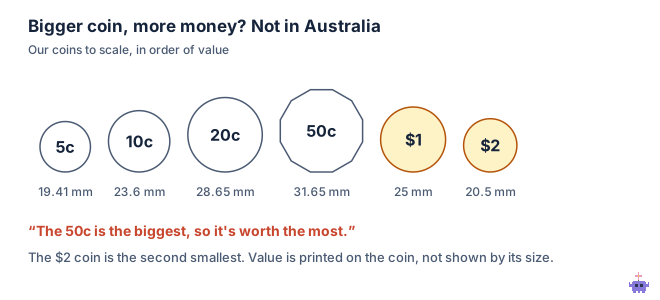
Young children reasonably assume that a bigger thing is worth more. Australian coins break the rule twice: the 50c is the largest coin, and the $2 is the second smallest, according to the Royal Australian Mint’s fact sheets. A child who picks the 50c over a $2 coin is not careless; they are using the only clue they have. The fix is to read the number on the coin, and to sort coins by value, then by size, and notice the two orders are different.
2. “Four coins, so four dollars” (Years 1 to 3)
The child counts coins as objects instead of adding their values. Give them a 20c, a 10c and two 5c coins and ask how much: “four” means they are counting coins. The fix is to skip count in the coin’s value, starting from the biggest: “20, 30, 35, 40 cents”. That is exactly the Level 1 skip counting in Victoria, done with real coins.
3. Writing $3.5 for three dollars and five cents (Year 3)
Cents are hundredths of a dollar, so five cents is $0.05 and three dollars five is $3.05. A child who writes $3.5 is treating the cents as a separate whole number after the point. This is the same misunderstanding that later makes 0.45 look bigger than 0.5, and our decimals by year page shows how money in Year 3 sets up tenths and hundredths in Year 4. Say “three dollars and five cents, so zero ten-cents and five one-cents”, and lay the coins out to match.
4. Change from $5 for a $3.65 sandwich: “$2.65” (Years 3 and 4)
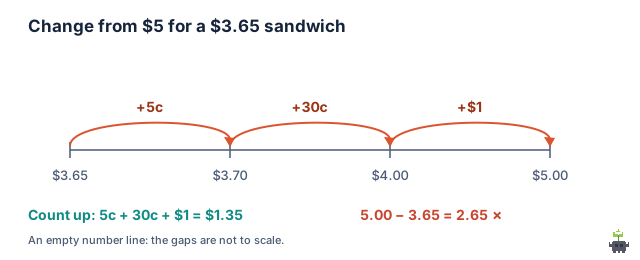
Set out as a written subtraction, 5.00 − 3.65 needs regrouping across two zeros, and a common slip is to take the smaller digit from the larger in every column, which gives 2.65. Counting up avoids the zeros completely: from $3.65 to $3.70 is 5c, to $4.00 is 30c, to $5.00 is $1, so the change is $1.35. Teach counting up first: it is quicker, it is how change is handed over, and it never meets a zero to regroup. If the written method is the problem, our page on place value by year covers the regrouping underneath it.
5. 20% off $45 is “$25” (Year 6)
The child takes away 20 dollars rather than 20 per cent. 20% of $45 is $9 (10% is $4.50, doubled), so the sale price is $36. The habit that fixes it is finding 10% first, by moving each digit one place, then building any familiar percentage from it, and always asking whether the answer is sensible: a discount of a fifth cannot take nearly half off.
Cash rounding, the bit Victoria teaches
Australia has had no 1c or 2c coins since 1992, the Royal Australian Mint’s fact sheets note, so a cash total is rounded to the nearest 5 cents. Cards and phones pay the exact amount. This is the part of VC2M4N08 children find strange, so make it concrete:
- A total ending in 1 or 2 cents rounds down to 0: $7.92 in cash is $7.90.
- Ending in 3 or 4 rounds up to 5: $7.93 is $7.95.
- Ending in 6 or 7 rounds down to 5: $7.97 is $7.95.
- Ending in 8 or 9 rounds up to the next 10: $7.98 is $8.00.
The usual mistake is rounding to the nearest 10 cents ($7.97 to $8.00), or rounding a card payment. Next time you pay cash, let your child predict what the register will ask for.
Three questions to find where your child is
- Put out a $2, a 50c and two 20c coins. “Which is worth the most? How much altogether?” Picking the 50c means coin value is not secure (wrong answer 1). “Four” means they are counting coins (wrong answer 2). $2.90 means Years 1 and 2 are fine.
- “Write three dollars and five cents.” $3.5 or $3.50 means the Year 3 idea of cents as hundredths is not there yet (wrong answer 3). $3.05 is right.
- “A sandwich costs $3.65. You pay with $5. How much change?” $1.35 by counting up is Year 4 secure. $2.65, or a long stall over the written method, means teach counting up (wrong answer 4).
If the first question goes wrong, start with real coins before anything written. If only the third does, your child is where most Year 3 students are, and counting up is a short fix.
Want practice built around the exact step? Sprout writes a maths lesson from the curriculum code your child is on (AC9M3M06 dollars and cents, or VC2M4N08 change), set around whatever they are into, with the code in the footer. Try it free.
Teaching money when you rarely use cash
The RBA survey found around one in four payments under $10 were still made in cash in 2025, so small purchases are your best chance. A few habits that work:
- Keep a jar of real coins at home and play shop with them. Toy money does not have the real sizes, which is the whole lesson in Years 1 and 2.
- Let them pay cash for small things: the canteen, a market stall, an icy-pole. Ask them to predict the change before it is handed over.
- Read a receipt together. Find the most expensive item, estimate the total before you look, then check (Year 4 rounding to check reasonableness).
- Make digital money visible. If pocket money lives in an app, write the balance on paper each week and count it out in coins sometimes, so the number stays attached to something real.
- Hand over a small budget. $10 for the picnic snacks, with a list and a calculator for Years 5 and 6. Discounts on the shelf labels are free percentage practice.
If maths in general feels shaky, not just money, our page on whether your child is behind in maths has a short check for each year. Money also sits close to telling the time: both are everyday measurement children now meet less often in real life than their parents did.
The short version
Simple shopping in Year 1 (Foundation in Victoria), dollars and cents in Year 3, rounding to check a bill in Year 4 (and change to the nearest 5 cents in Victoria), percentages in Year 5 and discounts in Year 6. NSW starts in Stage 2.
Listen for five wrong answers: the biggest coin is worth most, counting coins instead of values, $3.5 for $3.05, $2.65 change from $5 for $3.65, and $25 for 20% off $45. Most are fixed with real coins and counting up, which means letting your child handle cash, even if you rarely do.
How this page was checked
Curriculum content was read from the Australian Curriculum Version 9.0 and the Victorian Curriculum Mathematics Version 2.0 datasets, and the NSW Mathematics K–10 Syllabus (2022) content pages for Early Stage 1 to Stage 3 were read on 16 October 2026. Coin sizes and the 1992 withdrawal of 1c and 2c coins are from the Royal Australian Mint’s fact sheets. Payment figures are from the Reserve Bank of Australia’s Bulletin article on the 2025 Consumer Payments Survey (20 April 2026), linked above.
Australian Curriculum content descriptions are © Australian Curriculum, Assessment and Reporting Authority (ACARA) 2010 to present, licensed under CC BY 4.0, and quoted here unmodified. ACARA does not endorse any product that uses the Australian Curriculum. Victorian Curriculum codes reference the Victorian Curriculum F–10 Version 2.0 © VCAA, paraphrased, available at f10.vcaa.vic.edu.au; the VCAA does not endorse this product. NSW syllabus content references the NSW Mathematics K–10 Syllabus © NSW Education Standards Authority (NESA) for and on behalf of the Crown in right of the State of New South Wales, paraphrased, available at curriculum.nsw.edu.au; NESA does not endorse this product.
FAQ
When do children learn about money at school in Australia?
In the Australian Curriculum, simple money transactions start in Year 1 (AC9M1N05), dollars and cents are formally taught in Year 3 (AC9M3M06), rounding to check a bill in Year 4 (AC9M4N07), percentages in Year 5 and percentage discounts in Year 6 (AC9M6N07). Victoria starts simple money situations in Foundation. The NSW syllabus starts money in Stage 2, Years 3 and 4.
Why does my child think the 50 cent coin is worth the most?
Because it is the biggest. Young children reasonably assume a bigger coin is worth more, and Australian coins break that rule: the 50c is the largest coin and the $2 is the second smallest, at 20.5 mm across. Teach your child to read the number on the coin, and sort coins by value and then by size so they see the two orders differ.
How do I teach my child to give change?
Teach counting up rather than subtraction. For $5 paid on a $3.65 item, count up from the price: 5c to $3.70, 30c to $4.00, $1 to $5.00, so the change is $1.35. This avoids regrouping across the zeros in 5.00, which is where the written method usually goes wrong. It is Year 3 and 4 work, and Victoria names it in VC2M4N08.
How does rounding to 5 cents work in Australia?
Australia has had no 1c or 2c coins since 1992, so a cash total is rounded to the nearest 5 cents. Totals ending in 1 or 2 round down to 0, 3 or 4 round up to 5, 6 or 7 round down to 5, and 8 or 9 round up to the next 10. Card and phone payments are charged the exact amount. Victoria teaches this in Level 4 (VC2M4N08).
How can I teach money if we never use cash?
Keep a jar of real coins for playing shop, let your child pay cash for small things like the canteen or a market stall and predict the change, read receipts together and estimate the total first, and write a digital pocket-money balance on paper each week. The RBA found about one in four payments under $10 were still made in cash in 2025.