
Under the Australian Curriculum, and in Victoria, children are not expected to read a clock until Year 2. Then they learn the hour, the half-hour and the quarter-hour all in that one year, and the nearest minute in Year 3. NSW starts earlier, with o’clock in Kindergarten. So a Victorian Year 1 child who cannot tell the time is exactly where the curriculum puts them.
The rest of the sequence is just as specific: am and pm in Year 4, 24-hour time in Year 5, timetables in Year 6. This page sets out which year each clock skill belongs to, the wrong answer each year tends to produce, and a five-minute check that tells you whether your child is behind or simply not there yet.
What the curriculum asks for, year by year
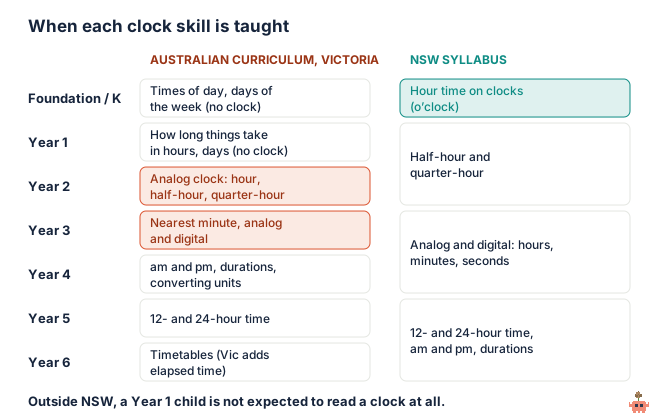
The Australian Curriculum (version 9) is used directly by most states and territories, and Victoria’s own Victorian Curriculum 2.0 follows it almost word for word on time. The descriptors, quoted from ACARA:
- Foundation, AC9MFM02: “sequence days of the week and times of the day including morning, lunchtime, afternoon and night time, and connect them to familiar events and actions”. No clock.
- Year 1, AC9M1M03: “describe the duration and sequence of events using years, months, weeks, days and hours”. Still no clock face anywhere in Year 1.
- Year 2, AC9M2M04: “recognise and read the time represented on an analog clock to the hour, half-hour and quarter-hour”. Three steps in one year. Year 2 also adds calendars (AC9M2M03): the date, and the number of days between events.
- Year 3, AC9M3M04: “describe the relationship between the hours and minutes on analog and digital clocks, and read the time to the nearest minute”. There is no separate five-minute step: the curriculum goes from quarter-hours straight to the minute. AC9M3M03 adds the units themselves: days, hours, minutes and seconds.
- Year 4, AC9M4M03: “solve problems involving the duration of time including situations involving ‘am’ and ‘pm’ and conversions between units of time”. This is where “how long until” becomes real work.
- Year 5, AC9M5M03: “compare 12- and 24-hour time systems and solve practical problems involving the conversion between them”.
- Year 6, AC9M6M03: “interpret and use timetables and itineraries to plan activities and determine the duration of events and journeys”. Victoria’s Level 6 version (VC2M6M03) also names measuring, calculating and comparing elapsed time, which the national one leaves implicit.
NSW is earlier at the start. The NSW Mathematics K–10 syllabus puts reading hour time on clocks in Early Stage 1 (Kindergarten, MAE-NSM-02), half- and quarter-hour time in Stage 1 (Years 1 and 2, MA1-NSM-02), analog and digital time in hours, minutes and seconds in Stage 2 (Years 3 and 4, MA2-NSM-02), and 12- and 24-hour time with am and pm in Stage 3 (Years 5 and 6, MA3-NSM-02). The NSW wording is paraphrased here. If you are in NSW, a Year 1 child who cannot read o’clock is a term or two behind, not on track.
Older worksheets do not match. The previous Australian Curriculum (version 8.4) put telling time to the half-hour in Year 1. Version 9 moved it to Year 2. Plenty of printables and apps are still labelled to the old version, which is why a “Year 1” clock worksheet can look a year ahead of what your child’s class is doing.
Is that late? What the research says
Not by much. Children pick up o’clock informally long before school teaches it. A research synthesis cited by Charles Sturt University researchers Amy MacDonald and Steve Murphy puts it at about 10% of four-year-olds and 45% of five-year-olds reading an o’clock time, and all children by seven. Precision then builds slowly, until most can read an analog clock to the nearest minute by about ten. In their own study of 132 NSW Kindergarten children (International Journal for Mathematics Teaching and Learning, 2020), most children drew at least one real feature of a clock in their first six weeks of school, but only 22.7% clearly drew a short hour hand and a long minute hand, and only 12.1% placed the numerals 1 to 12.
Two things follow. A child who reads o’clock before Year 2 has learnt it at home, not been taught it early. And a Year 3 or Year 4 child still shaky on the minute is common, because nearest-minute reading is a Year 3 descriptor that most children take until around ten to make automatic.
The wrong answers worth knowing
1. Year 2: “quarter to 4” read as “quarter to 3”
At 3:45 the hour hand sits between the 3 and the 4, and your child has just learnt that the hour is the number the hand has passed. That rule is right for “quarter past” and “half past”. “Quarter to” is the exception: it names the hour that is coming. Year 2 asks for half-hour and quarter-hour in the same year, so this collision is built in.
The fix: say it as a question. “Quarter to what? Which hour is the hand heading for?” Then check with the digital: 3:45 is three forty-five, and in 15 minutes it will be 4 o’clock. The opposite mistake, reading 3:55 as 4:55 because the hand is nearly on the 4, is covered in why the clock is genuinely hard.
2. Year 3: the minute hand on the 4 read as “4 minutes past”
The time is 3:20 and your child says 3:04. They read the number the minute hand points at, which is the only way they have ever read a number. The clock face has two scales printed on one set of numerals, and the minute scale (5, 10, 15 and so on) is not printed at all. This is what AC9M3M04 means by “the relationship between the hours and minutes”.
The fix: write the minutes around the outside of a paper clock, 5 next to the 1, 10 next to the 2, all the way to 60 next to the 12. Count by fives round the face until it is quick, then take the paper away. Then count on by ones from the nearest five: 3:20, 21, 22, 23.
3. Year 4: 9:50 to 10:15 is 65 minutes
Your child lines the times up as numbers, 1015 take away 950, and gets 65. It is the reasonable thing to do with two four-digit numbers, and it is wrong because an hour has 60 minutes, not 100. The correct answer is 25.
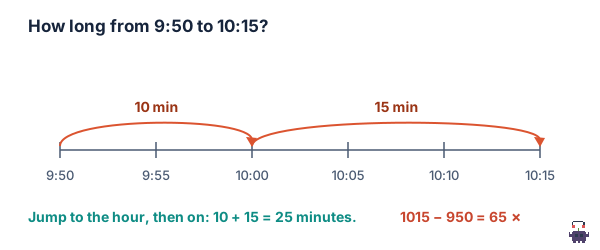
The fix: never subtract times. Jump: from 9:50 to the next o’clock (10 minutes), then on to the end time (15 more). Draw it as a number line until it moves into their head. This is the same “bridge to a friendly number” move children use in mental addition, so it is not a new trick.
4. Year 4: 12:30 am is lunchtime
Am and pm switch at 12, and 12 itself is the confusing one. 12:30 pm is half an hour after midday; 12:30 am is half an hour after midnight. Children (and plenty of adults) get this backwards because “pm” feels like it should start at 1.
The fix: one anchor. “Morning is am, so the minute after midnight is am. After midday, it is pm.” Then use real times from your day: school pick-up, bedtime, the footy start time on the fixture.
5. Year 5: 15:00 is 5 o’clock
Your child sees the 5 in 15 and reads 5 pm. In 24-hour time you take away 12, not 10, so 15:00 is 3 pm. This is the AC9M5M03 conversion, and it is easy to drill once the reason is clear: the clock goes round twice in a day.
The fix: a 24-hour strip, 0 to 23, with the 12-hour time written under each number in a different colour. Then find real 24-hour times in the wild: the V/Line or train timetable, a flight booking, the oven, a phone set to 24-hour.
Want practice set at the right year? Sprout builds a lesson from AC9M2M04, AC9M3M04 or AC9M4M03 around whatever your child is into, with the code on every page. Try it free.
The five-minute check
You need an analog clock with hands you can move (a cheap geared teaching clock, or a paper one with a split pin). The year in brackets is where the Australian Curriculum places the skill, so you know whether a wrong answer is a gap or simply not yet.
- Set 4 o’clock, then half past 4, then quarter past 4. “What time is it?” (Year 2; Kindergarten for o’clock in NSW) All three right means the hour and the fractions of the face are there.
- Set quarter to 5. (Year 2) “Quarter to 4” is wrong answer 1.
- Set 3:20, then 3:37. (Year 3) 3:04 for the first is wrong answer 2. If 3:20 is right and 3:37 is slow, the fives are there and the count-on by ones is not, which is normal well into Year 4.
- “Practice starts at 9:50 and ends at 10:15. How long is it?” (Year 4) 25 minutes. 65 is wrong answer 3.
- “What is 15:00 in normal time?” (Year 5) 3 pm. 5 pm is wrong answer 5.
Stop at the first one that is wrong and is below your child’s year. That is the one to work on. Anything above their year is not a gap.
Ten minutes a day that works
- Put an analog clock where your child can see it, at their eye level, in the room where they eat breakfast. Most homes now have only digital time on a phone or oven, so the face never gets looked at.
- Talk in clock language without testing. “It’s half past seven, we leave at quarter to eight.” Two or three times a day is enough.
- Move the hands together, not just read them. With a geared clock the hour hand creeps as the minute hand goes round, which is the thing that makes “nearly 4” make sense. Set a time, then ask your child to set one.
- From Year 3, read analog and digital side by side. 3:45 and quarter to 4 are the same moment, and AC9M3M04 asks for exactly that connection.
- From Year 4, ask “how long until” questions about real things: the end of the movie, the next bus, the start of the game. Draw the jump if it helps.
What is not the problem
- Not reading a clock in Year 1, in Victoria or any state using the Australian Curriculum. Clocks are a Year 2 descriptor. In NSW, o’clock is Kindergarten and half- and quarter-hour are Years 1 to 2.
- Preferring digital. AC9M3M04 asks for both, and digital is the easier representation. Use it to check the analog reading, not instead of it.
- Needing to count by fives in Year 3. Reading to the nearest minute is the Year 3 target. Instant reading takes until around ten for most children.
- Not knowing 24-hour time before Year 5. It is a Year 5 descriptor nationally and a Stage 3 (Years 5 and 6) outcome in NSW.
Where this sits
The other year-by-year guides for Australian parents:
If you are not sure which version your school follows, which curriculum your state uses sorts it out, and which NSW stage your child is in maps stages to years. For a wider check across maths, is my child behind in maths covers every strand.
The short version
Australian Curriculum and Victoria: no clock until Year 2, then hour, half-hour and quarter-hour in Year 2, the nearest minute in Year 3, am and pm and durations in Year 4, 24-hour time in Year 5, timetables in Year 6. NSW: o’clock in Kindergarten, half and quarter by the end of Year 2.
The wrong answers that tell you most: quarter to 4 read as quarter to 3, 3:20 read as 3:04, 9:50 to 10:15 worked out as 65 minutes, and 15:00 read as 5 pm. Each has a fix: ask which hour the hand is heading for, write the fives round the face, jump to the hour, and take away 12.
Sprout Lessons builds practice around whatever your child is already into, and puts the AC9 code on every lesson. Start free.
How this page was checked
Codes and descriptor wording were checked on 16 October 2026 against our copy of the Machine Readable Australian Curriculum v9 (accessed 2026-06-24), the Victorian Curriculum 2.0 (accessed 2026-07-13) and the NSW Mathematics K–10 syllabus (accessed 2026-08-17), not written from memory. Read the official content description for AC9M2M04 on the Australian Curriculum website. The version 8.4 placement of half-hour time in Year 1 is code ACMMG020. The research figures come from MacDonald and Murphy (2020), linked above, including the synthesis of earlier studies they cite.
Australian Curriculum content descriptions are © Australian Curriculum, Assessment and Reporting Authority (ACARA) 2010 to present, licensed under CC BY 4.0, and quoted here unmodified. ACARA does not endorse any product that uses the Australian Curriculum. Victorian Curriculum codes reference the Victorian Curriculum F–10 Version 2.0 © VCAA, paraphrased, available at f10.vcaa.vic.edu.au; the VCAA does not endorse this product. NSW outcome codes reference the NSW syllabuses © NSW Education Standards Authority (NESA) for and on behalf of the Crown in right of the State of New South Wales, paraphrased, available at curriculum.nsw.edu.au; NESA does not endorse this product.
FAQ
What age should a child be able to tell the time in Australia?
Under the Australian Curriculum and the Victorian Curriculum, reading an analog clock starts in Year 2 (usually age 7 to 8), with the hour, half-hour and quarter-hour in that year and the nearest minute in Year 3. NSW starts earlier: o'clock in Kindergarten, half- and quarter-hour in Years 1 and 2. Research cited by Charles Sturt University researchers suggests most children read an analog clock to the nearest minute by about age 10.
Should my Year 1 child be able to tell the time?
Not under the Australian Curriculum or in Victoria: Year 1 describes how long things take in years, months, weeks, days and hours, with no clock face. Clocks start in Year 2 (AC9M2M04). In NSW, reading o'clock is a Kindergarten outcome and half- and quarter-hour are Stage 1 (Years 1 and 2), so a NSW Year 1 child should know o'clock.
When do children learn quarter past and quarter to?
In Year 2 under the Australian Curriculum and the Victorian Curriculum, together with the hour and the half-hour. In NSW it is Stage 1, which is Years 1 and 2. "Quarter to" is the hardest of the three because it names the coming hour, so a child who reads 3:45 as "quarter to 3" is applying the rule for "past" correctly in the wrong place.
When do children learn 24-hour time in Australia?
Year 5 under the Australian Curriculum (AC9M5M03) and in Victoria, and Stage 3 (Years 5 and 6) in NSW. The common mistake is reading 15:00 as 5 pm; you take away 12, not 10, so it is 3 pm.
How do I help my child work out how long something takes?
Teach them never to subtract times like ordinary numbers, because an hour has 60 minutes, not 100. From 9:50 to 10:15, jump to the next o'clock first (10 minutes), then on to the end time (15 more), for 25 minutes. Subtracting 950 from 1015 gives 65, which is the most common wrong answer. This is Year 4 work in the Australian Curriculum (AC9M4M03).