
Ask your child how many tens there are in 352. If the answer is 5, they can name the digits but they cannot yet rename the number, and renaming is the word the Australian Curriculum actually uses. 352 is 35 tens and 2 ones. It is also 2 hundreds, 15 tens and 2 ones. A child who can only see it one way will get stuck the first time a subtraction needs regrouping.
The curriculum lays place value out year by year with unusual precision: tens and ones in Year 1, renaming and the job of the zero in Year 2, numbers beyond 10 000 and how to write them in Year 3, tenths and hundredths in Year 4. This page walks that sequence, names the wrong answer each year produces, and gives you a five-minute check and a twenty-minute fix.
What the curriculum asks for, year by year
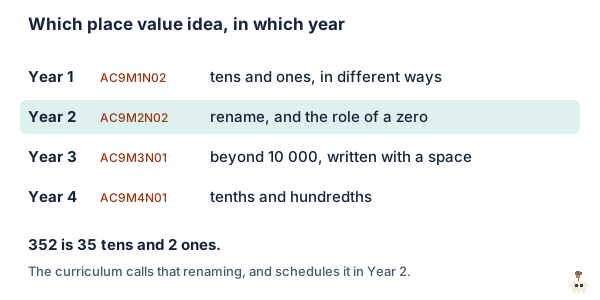
- Year 1, AC9M1N02: “partition one- and two-digit numbers in different ways using physical and virtual materials, including partitioning two-digit numbers into tens and ones”. Note “in different ways”: 47 is 4 tens and 7 ones, and it is also 3 tens and 17 ones, from the very first year.
- Year 2, AC9M2N02: “partition, rearrange, regroup and rename two- and three-digit numbers using standard and non-standard groupings; recognise the role of a zero digit in place value notation”. This is the descriptor the whole page rests on. Standard grouping is 3 hundreds, 5 tens, 2 ones. Non-standard is 35 tens and 2 ones. The curriculum asks for both, by name.
- Year 3, AC9M3N01: “recognise, represent and order natural numbers using naming and writing conventions for numerals beyond 10 000”. The conventions include the thin space Australian schools use between groups of three digits: 12 040, not 12,040.
- Year 3, AC9M3N03: “add and subtract two- and three-digit numbers using place value to partition, rearrange and regroup numbers to assist in calculations without a calculator”. Renaming stops being a game and becomes the tool for 352 take away 180.
- Year 4, AC9M4N01: “recognise and extend the application of place value to tenths and hundredths and use the conventions of decimal notation to name and represent decimals”. The same idea, continued to the right of the decimal point.
The word the curriculum keeps using is not “identify”. It is partition, rearrange, regroup and rename. A child who can point to the tens column has met none of those four verbs. A child who can say “352 is 35 tens and 2” has met all of them, and has the thing that makes written subtraction, mental addition and decimals work later.
The five wrong answers worth knowing
1. “How many tens in 352?” 5.
The digit in the tens column is 5. The number of tens in 352 is 35, because 3 hundreds are 30 tens. A child who says 5 has learnt place value as a labelling exercise, columns with names, and has not yet learnt it as quantity. The Year 2 descriptor’s “non-standard groupings” is precisely this: 35 tens is a non-standard grouping of 352.
The fix: bundles, not columns. Thirty-five bundles of ten and two loose straws on the table is 352, and your child can count the bundles. Then trade ten bundles for a hundreds block, three times, and watch 35 tens become 3 hundreds and 5 tens. Both are the same number. The word for moving between them is renaming.
2. “Write three hundred and five.” 3005.
The child writes what they hear: three hundred, then five. The second half of AC9M2N02, “recognise the role of a zero digit in place value notation”, exists because this error is universal. The zero in 305 is not nothing. It is holding the tens place open so the 3 stays in the hundreds.
The fix: a place value chart with three boxes, and say “how many tens?” out loud before writing. None, so a zero goes in the box. Then do 350, 305 and 35 next to each other and ask which is which.
3. 352 take away 180 is 232.
Hundreds: 3 take 1 is 2. Tens: 5 take 8, cannot, so 8 take 5 is 3. Ones: 2. The answer is 232, and it is wrong by exactly 60 because the tens went backwards. The correct answer is 172, and the route to it is renaming: 352 is 2 hundreds and 15 tens and 2 ones, and 15 tens take 8 tens is 7 tens. That is AC9M3N03, “regroup numbers to assist in calculations”, and a child who never did the Year 2 renaming has nothing to regroup with.
The fix: say the renaming out loud before the subtraction. “I need more tens. Rename 352 as 2 hundreds, 15 tens, 2 ones.” If the words come first, the procedure follows. The same thinking, written out for the long version, is in subtraction with regrouping.
4. “Write twelve thousand and forty.” 1200040.
The Year 3 version of the zero problem, with more places to lose. Twelve thousand is 12 000, and forty fills the tens and ones. The child who writes 1200040 has written twelve, then thousand as three zeros, then forty. The “writing conventions for numerals beyond 10 000” in AC9M3N01 are the fix: four places on the right of the space, read as thousands then the rest.
The fix: a chart with a gap after the thousands. Write the thousands on the left of the gap, 12, then fill every one of the three places on the right: 040. The gap is doing what the zero did in Year 2.
5. “Which is bigger, 0.35 or 0.4?” 0.35.
Because 35 is bigger than 4. This is the Year 4 descriptor, place value extended to tenths and hundredths, and it is the same gap as wrong answer 1 on the other side of the point: the child is reading digits, not quantities. 0.4 is 4 tenths, which is 40 hundredths, which is more than 35 hundredths.
The fix: a hundredths grid, and the renaming habit again: 0.4 is 40 hundredths. The full reteach is on the AC9M4N01 page.
Want practice that asks your child to rename, not just label? Sprout builds a lesson from AC9M2N02, AC9M3N03 or AC9M4N01 with the code on every page, set around whatever your child is into. Try it free.
The five-minute check
Out loud, with something to count if you have it (straws, pasta, Lego). Ask “how do you know?” after every answer. The year in brackets is where the curriculum places the skill, so you know whether a gap is behind or simply not yet.
- “Show me 47. Now show me 47 a different way.” (Year 1) Four tens and seven, then three tens and seventeen. A child who cannot find the second way needs partitioning before anything below.
- “How many tens in 352?” (Year 2) 35. If the answer is 5, go to the bundles.
- “Write three hundred and five.” (Year 2) 305. 3005 is the zero.
- “352 take away 180, and talk me through it.” (Year 3) 172. 232 means the tens went backwards, and the fix is renaming out loud.
- “Write twelve thousand and forty.” (Year 3) 12 040, with the space.
- “Which is bigger, 0.35 or 0.4?” (Year 4) 0.4. If this is the only one wrong, the gap is decimals, not place value.
The twenty-minute reteach
- Make the number, then trade. Bundles of ten and loose ones. Make 47, then trade one bundle for ten ones and count it again. Same number, different grouping. Five minutes a day for a week.
- Play rename it. You say a number, they say it another way. “63.” “5 tens and 13 ones.” “352.” “35 tens and 2.” Swap roles. This is AC9M2N02 as a car game.
- Ask “how many tens?” before writing any number with a zero in it.305, 350, 3050. The question forces the empty place into view.
- Say the renaming before any subtraction that needs it. “I need more tens, so rename.” Write the renamed number above the sum until the words come without prompting.
- Use the space from Year 3 on. 12 040, 100 000. It is the convention Australian schools use, so a child who sees commas at home and spaces at school has one more thing to translate.
- Count in tens past 100. “80, 90, 100, 110, 120.” Most children stop at 100 the first time. The child who can count 35 tens up to 350 has understood why 352 is 35 tens.
What is not the problem
- Needing the straws in Year 2. AC9M1N02 and AC9M2N02 both say “physical and virtual materials”. The materials are the method, not a crutch.
- Not knowing a written subtraction method in Year 2. Regrouping for calculation is Year 3 (AC9M3N03). Renaming for its own sake is the Year 2 job.
- Getting 0.35 and 0.4 wrong in Year 3. Tenths and hundredths are Year 4. A Year 3 child who can rename 352 and subtract 180 from it is on track.
Where this sits
The other year-by-year guides for Australian parents:
- Which times tables, in which year
- Fractions by year
- Long division, and why the curriculum never asks for the algorithm
- AC9M4N01, place value to tenths and hundredths
If your child is in NSW or Victoria, the sequence is close but not identical, and which curriculum your state uses explains what to check. If the gap is wider than place value, helping with maths at home without a tutor is the broader plan.
The short version
The Australian Curriculum sequences place value by year: tens and ones in Year 1, renaming and the zero in Year 2, numbers beyond 10 000 in Year 3, tenths and hundredths in Year 4. The verbs are partition, rearrange, regroup and rename, not identify.
352 is 35 tens and 2 ones. A child who says 5 tens can label columns but cannot yet rename, and renaming is what makes 352 take away 180 come out as 172 instead of 232. 3005 for three hundred and five is the zero’s job not yet learnt.
Bundles and trading, the rename-it game, “how many tens?” before every zero, and the renaming said out loud before every subtraction.
Sprout Lessons builds practice around whatever your child is already into, and puts the AC9 code on every lesson. Start free.
Codes and descriptor wording checked 7 October 2026 against our copy of the Machine Readable Australian Curriculum v9, accessed 2026-06-24, not written from memory. Read the official content description for AC9M2N02 on the Australian Curriculum website. Australian Curriculum content descriptions are © ACARA and licensed under CC BY 4.0. Quoted here unmodified. ACARA does not endorse this product. If your state uses its own syllabus, check it as well: NSW and Victoria sequence some of this differently.
FAQ
How many tens are in 352?
35. The digit in the tens column is 5, but 3 hundreds are 30 tens, so the number of tens in 352 is 35, with 2 ones left over. A child who answers 5 can label columns but cannot yet rename the number, which is what the Year 2 descriptor AC9M2N02 asks for when it says non-standard groupings.
What year do children learn place value in the Australian Curriculum?
It runs across four years. Year 1 (AC9M1N02) partitions two-digit numbers into tens and ones in different ways. Year 2 (AC9M2N02) renames two- and three-digit numbers using standard and non-standard groupings and covers the role of a zero digit. Year 3 (AC9M3N01) extends to numerals beyond 10 000, and Year 4 (AC9M4N01) extends place value to tenths and hundredths.
Why does my child write 3005 for three hundred and five?
They are writing what they hear: three hundred, then five. The second half of AC9M2N02, recognise the role of a zero digit in place value notation, exists for exactly this. The zero in 305 holds the tens place open so the 3 stays in the hundreds. A three-box place value chart and the question how many tens before writing fixes it.
What does rename mean in maths?
Saying the same number with a different grouping. 352 is 3 hundreds, 5 tens and 2 ones, and it is also 2 hundreds, 15 tens and 2 ones, or 35 tens and 2 ones. The Australian Curriculum uses the word in AC9M2N02, and renaming is what a child needs in Year 3 to subtract 180 from 352 without the tens going backwards.
How do I teach place value at home?
With things to bundle: straws, pasta or blocks in tens and ones. Make a number, then trade a ten for ten ones and count it again. Play rename it in the car, where one of you says a number and the other says it another way. Ask how many tens before writing any number with a zero in it, and say the renaming out loud before any subtraction that needs it.