
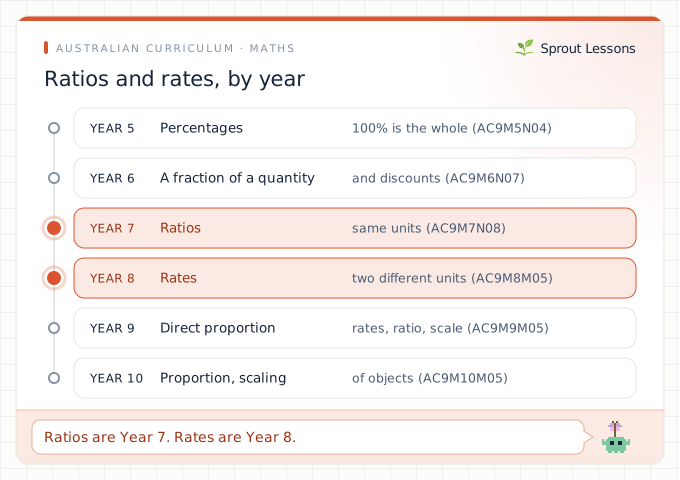
In the Australian Curriculum the word “ratio” first appears in Year 7 and the word “rate” in Year 8. Year 9 joins them up as direct proportion and scale, and Year 10 applies proportion to scaling objects. Nothing in primary school is called a ratio, but Years 5 and 6 build the thinking it needs through percentages and fractions of a quantity.
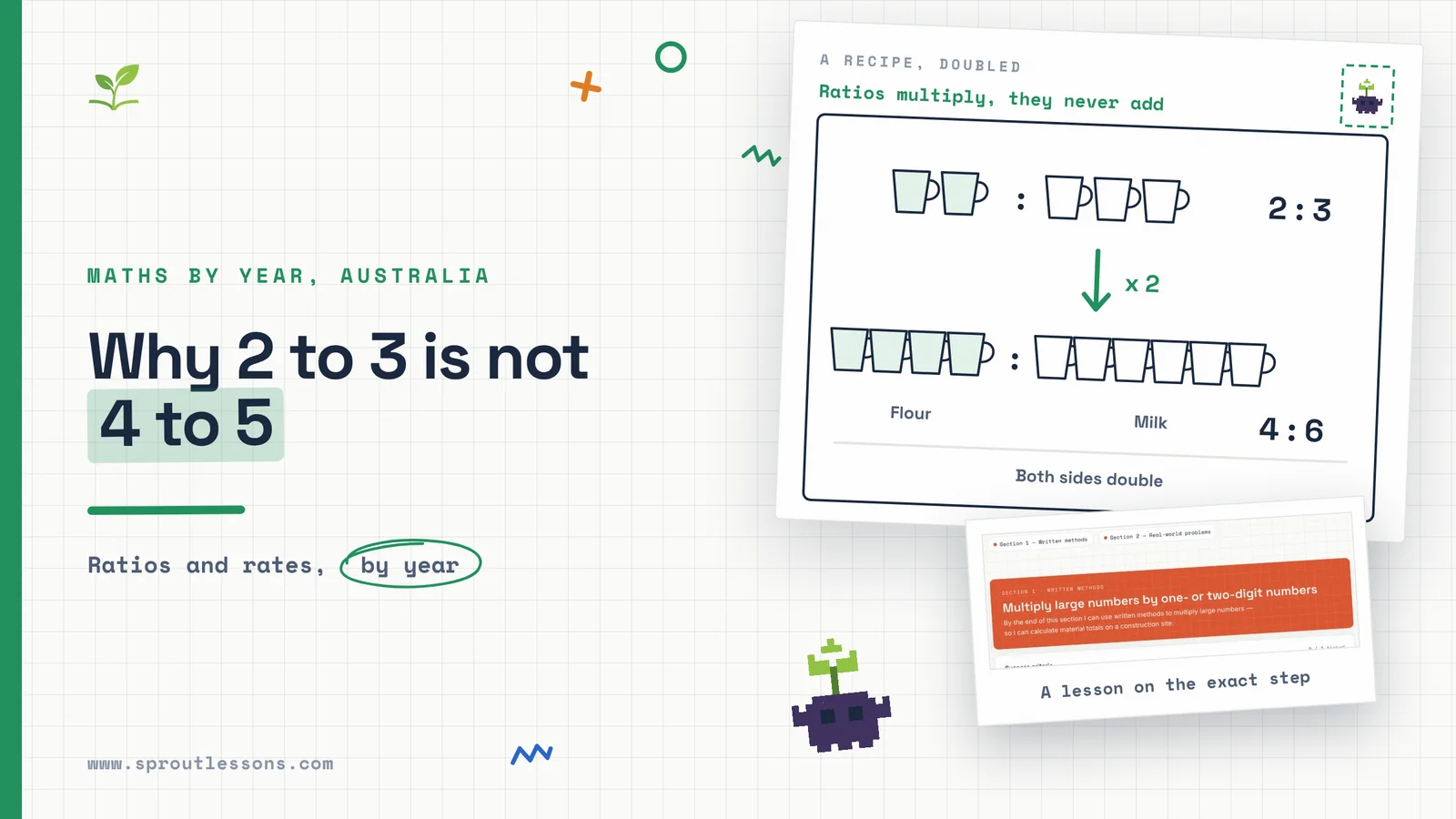
That late start is why ratios feel like a wall in Year 7. A child can arrive with good number facts and still say that a recipe with 2 cups of flour to 3 cups of milk becomes 4 cups to 5. They are adding where the question needs multiplying, and no amount of times tables practice shows up that gap. This page sets out what each year asks, where Victoria and NSW differ, five wrong answers that tell you where your child really is, a two-minute check and twenty minutes in the kitchen.
What the curriculum asks for, year by year
The Australian Curriculum descriptors, quoted from ACARA:
- Year 5, AC9M5N04: “recognise that 100% represents the complete whole and use percentages to describe, represent and compare relative size; connect familiar percentages to their decimal and fraction equivalents”. This is the first time a child compares two amounts by relative size, which is what a ratio does.
- Year 6, AC9M6N07: “solve problems that require finding a familiar fraction, decimal or percentage of a quantity, including percentage discounts, choosing efficient calculation strategies and using digital tools where appropriate”. A quarter of 60 and 25% of 60 are the multiplying moves a ratio problem will reuse.
- Year 7, AC9M7N08 and AC9M7M06: “recognise, represent and solve problems involving ratios”, and “use mathematical modelling to solve practical problems involving ratios; formulate problems, interpret and communicate solutions in terms of the situation, justifying choices made about the representation”. Ratios compare amounts measured in the same unit: cups to cups, students to students.
- Year 8, AC9M8M05 and AC9M8M07: “recognise and use rates to solve problems involving the comparison of 2 related quantities of different units of measure”, and modelling “practical problems involving ratios and rates, including financial contexts”. Kilometres per hour, dollars per kilogram, litres per minute. A rate is a ratio whose two sides have different units.
- Year 9, AC9M9M05: “use mathematical modelling to solve practical problems involving direct proportion, rates, ratio and scale, including financial contexts”. The same year, AC9M9SP01 asks students to “recognise the constancy of the sine, cosine and tangent ratios for a given angle in right-angled triangles using properties of similarity”. Trigonometry is a ratio topic, and a child who is shaky on Year 7 ratios meets the problem again here.
- Year 10, AC9M10M05: “use mathematical modelling to solve practical problems involving proportion and scaling of objects”.
Three things the wording tells you
- There is no ratio in primary. We searched every Foundation to Year 10 maths descriptor in the Australian Curriculum: “ratio” appears in Years 7, 8 and 9 only, and “rate” in Years 8 and 9 only. A Year 6 child who has never seen 3 : 2 has not missed anything.
- “Speed” is not in it. No Australian Curriculum descriptor uses the word. Speed is the standard classroom example of a Year 8 rate, but the curriculum asks for rates in general.
- Neither is inverse proportion. Year 9 names direct proportion only. The more workers, the fewer days kind of question is not required by the national curriculum before Year 10 ends, though Victoria does require it (below).
Victoria and NSW
Victoria follows the same years under its own VC2 codes, and adds detail in four places. At Level 7 the modelling descriptor (VC2M7M06) is specifically about ratios of lengths, areas and volumes, and the financial modelling one (VC2M7N10) names best buys as a context. At Level 8, VC2M8M07 names distance and time problems for travel at a constant speed. And at Level 10, VC2M10M04 and VC2M10A15 require inverse proportion as well as direct. So a Victorian Year 8 student should expect speed questions, and a Victorian Year 10 student should expect inverse proportion.
NSW teaches ratios and rates together in Stage 4, which is Years 7 and 8, under one outcome (MA4-RAT-C-01) that also covers reading distance and time graphs. In Stage 5, direct and inverse variation and rates of change sit on Path outcomes (MA5-RAT-P-01 and MA5-RAT-P-02), so not every Year 9 or 10 student studies them. Whether your child does depends on the maths course their school has placed them in.
Five wrong answers that tell you where your child is
1. “2 cups to 3 cups, so 4 cups to 5 cups”
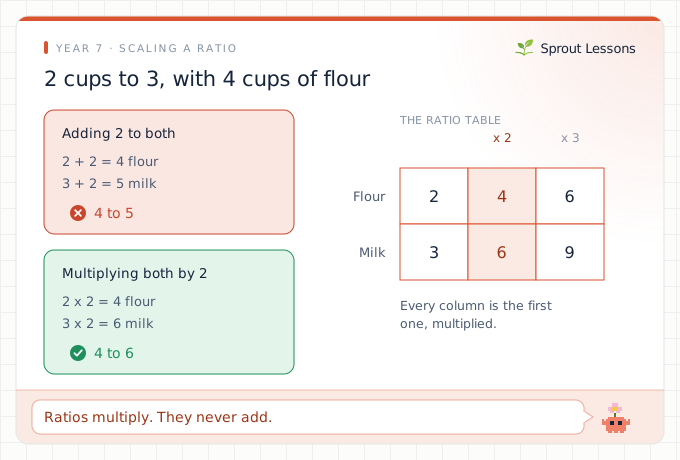
The recipe uses 2 cups of flour for every 3 cups of milk. With 4 cups of flour, how much milk? A child who says 5 added 2 to both sides. The answer is 6, because the flour doubled and so must the milk. This is the most important mistake on the page: it means your child is still comparing by difference, and everything in Years 7 to 10 needs comparing by multiplying. Go back to “how many times as much?” before any ratio notation.
2. “Red to blue is 2 : 3, so two thirds are red”
There are 2 red counters for every 3 blue. What fraction are red? Two thirds is the tempting answer, and it is wrong: there are 5 counters in each group, so two fifths are red. A ratio compares part to part. A fraction compares part to whole. Children who learned fractions well are the most likely to make this one.
3. “Share $40 in the ratio 3 : 5. That is $3 and $5”
Or they divide 40 by 3 and then by 5. The step that is missing is counting the parts: 3 + 5 is 8 parts, each part is $5, so the shares are $15 and $25. Check by adding: 15 + 25 is 40. A child who skips the check will not notice that $3 and $5 leaves $32 on the table.
4. “7 dogs and 4 cats. The ratio of cats to dogs is 7 : 4”
They wrote the numbers in the order they appeared in the sentence. The question asked for cats to dogs, so it is 4 : 7. Order carries the meaning in a ratio, so the right numbers in the wrong order are a wrong answer. Have your child say the ratio aloud with the words in it: “4 cats to 7 dogs”.
5. “The $4 pack is the better buy, because it costs less”
A 500 g pack costs $4.00 and a 750 g pack costs $5.70. The cheaper pack is not the better buy: $4.00 for 500 g is 80 cents per 100 g, and $5.70 for 750 g is 76 cents per 100 g. This is a Year 8 rate question, and the mistake is comparing one quantity when a rate needs two. The fix is always the same move: bring both to the same amount of one unit, then compare the other.
If mistake 1 is the one you heard, your child needs the multiplying idea, not more ratio questions. Sprout builds a short lesson on exactly that step, in a topic they like. Start free.
A two-minute check
Ask these four, in this order, and stop at the first one that goes wrong.
- “What is a quarter of 60? What is 25% of 60?” Year 6 work. Both are 15. A child who can do the first and not the second needs percentages before ratios.
- “Cordial is 1 part to 4 parts water. I pour 250 mL of cordial. How much water?” Year 7. The answer is 1000 mL, or 1 litre. An answer of 254 is mistake 1, adding.
- “There are 12 boys and 18 girls. What is the ratio of boys to girls in its simplest form?” Year 7. It is 2 : 3. An answer of 12 : 18 is right but unfinished, and points to common factors. An answer of 3 : 2 is mistake 4.
- “A car travels 90 km in an hour and a half. What is its speed?” Year 8. It is 60 km per hour. An answer of 135 means they multiplied, because they do not yet read “per” as “divided by”.
If your child is in Year 8 or 9 and question 2 goes wrong, work at question 2. Ratios stack: rates, scale, similarity and trigonometry all assume the multiplying idea, and practising the later topic does not repair the earlier one.
Twenty minutes in the kitchen
Ratios are one of the few secondary topics that are easier at home than in a classroom, because a kitchen is full of them.
- Five minutes: make the cordial. One part cordial to four parts water, using any cup as the “part”. Then make a bigger jug. Ask how many cups of water go with 2 cups of cordial, then 3. Let them pour it and taste it: a 2 to 5 mix made by adding tastes wrong, and that is the lesson.
- Ten minutes: draw the ratio table. Two rows, cordial on top and water underneath: 1 and 4, 2 and 8, 3 and 12. Ask what stays the same in every column (the bottom is always four times the top). Then go backwards: 20 cups of water, how much cordial? Then swap to a recipe on a packet and scale it for twice and for half the people.
- Five minutes: one best buy. Take two sizes of the same thing from the pantry or a catalogue and work out the price per 100 g for each. Most supermarket shelf labels print the unit price, so your child can check their answer next time you shop.
For a Year 8 or 9 child, add a map: on a scale of 1 : 100 000, 1 cm on the page is 1 km on the ground, so a 3 cm walk is 3 km. Maps and coordinates by year has more on scale.
What is not the problem
- Not knowing the colon notation in primary. It is Year 7 content.
- Slow times tables, on their own. A child can know every fact and still add in a ratio. The facts make scaling faster; they do not teach it. If the facts are the gap, times tables by year covers them.
- Not using cross-multiplication. No Australian Curriculum descriptor names a method. A ratio table, a double number line or finding the value of one part are all acceptable, and all three are easier to explain than a rule.
- Inverse proportion in Year 9, outside Victoria. The national curriculum names direct proportion only.
Where this sits
Ratios grow out of fractions and multiplication and division, and they share their Year 7 and 8 lessons with percentages. Best buys and unit prices also appear in money by year. For every maths code in the two years where this topic lands, the teacher-facing Year 7 maths codes and Year 8 maths codes pages list them all.
The short version
- Years 5 and 6: no ratios yet. Percentages, and a fraction or percentage of a quantity.
- Year 7: ratios (AC9M7N08). Year 8: rates (AC9M8M05). Year 9: direct proportion and scale. Year 10: proportion and scaling.
- Victoria names best buys at Level 7, constant speed at Level 8 and inverse proportion at Level 10. NSW teaches ratios and rates together in Stage 4.
- 2 : 3 becoming 4 : 5 means your child is adding. Ratios multiply.
- 2 : 3 is two fifths and three fifths, not two thirds.
- A rate needs two units. For a best buy, bring both to the same amount first.
Sprout makes a lesson on the exact code your child is working on, with examples in their own interests. Start free.
How this page was checked
Every Australian Curriculum descriptor above was read from our copy of the Australian Curriculum version 9.0, and the statements about which years use the words ratio, rate, speed and inverse proportion come from searching all of its Foundation to Year 10 maths descriptors. The Victorian codes are from our copy of the Victorian Curriculum F–10 version 2.0 (the VCAA site was down for maintenance on the day of checking). The NSW outcomes are from the NSW Mathematics K–10 syllabus. Victorian and NSW wording is paraphrased. Checked 15 November 2026.
Australian Curriculum content descriptions are © Australian Curriculum, Assessment and Reporting Authority (ACARA) 2010 to present, licensed under CC BY 4.0, and quoted here unmodified. ACARA does not endorse any product that uses the Australian Curriculum. Victorian Curriculum codes reference the Victorian Curriculum F–10 Version 2.0 © VCAA, paraphrased; the VCAA does not endorse this product. NSW outcome codes reference the NSW syllabuses © NSW Education Standards Authority (NESA) for and on behalf of the Crown in right of the State of New South Wales, paraphrased, available at curriculum.nsw.edu.au; NESA does not endorse this product.
FAQ
What year do children learn ratios in Australia?
Year 7. The Australian Curriculum first uses the word ratio in AC9M7N08, which asks students to recognise, represent and solve problems involving ratios. No Foundation to Year 6 maths descriptor mentions ratios. Years 5 and 6 prepare for it with percentages (AC9M5N04) and finding a fraction, decimal or percentage of a quantity (AC9M6N07).
What year do children learn rates?
Year 8. AC9M8M05 asks students to recognise and use rates to solve problems involving the comparison of 2 related quantities of different units of measure, such as kilometres per hour or dollars per kilogram. In NSW, ratios and rates are taught together in Stage 4 (Years 7 and 8) under outcome MA4-RAT-C-01.
Why does my child say a 2 : 3 recipe becomes 4 : 5?
They added 2 to both numbers. Ratios scale by multiplying, so doubling the 2 means doubling the 3, giving 4 : 6. The mistake shows a child is comparing by difference rather than by how many times as much. A ratio table, with each column the first one multiplied, is the quickest way to show it.
What is the difference between a ratio and a rate?
A ratio compares quantities measured in the same unit, such as 2 cups of flour to 3 cups of milk. A rate compares two quantities with different units, such as 60 kilometres per hour or 80 cents per 100 grams. In the Australian Curriculum ratios are Year 7 content and rates are Year 8 content.
Is inverse proportion in the Australian Curriculum?
Not by name. Year 9 (AC9M9M05) names direct proportion, rates, ratio and scale, and Year 10 (AC9M10M05) names proportion and scaling of objects. The Victorian Curriculum does require inverse proportion at Level 10 (VC2M10M04 and VC2M10A15), and in NSW direct and inverse variation sit on a Stage 5 Path outcome (MA5-RAT-P-01).