
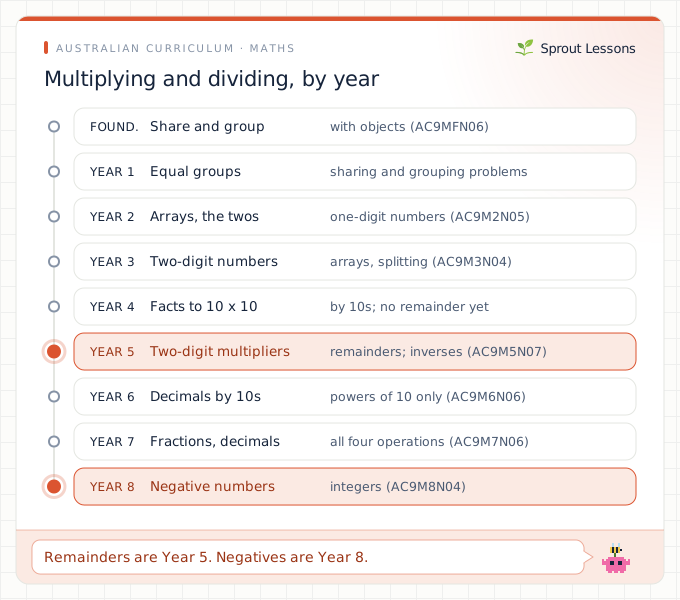
In the Australian Curriculum, multiplying and dividing start as sharing and grouping objects in Foundation, become arrays and the twos in Year 2, one- and two-digit numbers in Year 3, and everything to 10 × 10 in Year 4, where division still has no remainder. Year 5 multiplies by two-digit numbers and meets remainders. Fractions and decimals are Year 7, and multiplying negative numbers waits until Year 8.
The times tables are only the middle of that story, and they have their own page. This one is about the operation itself: what each year asks a child to do with multiplication and division, five wrong answers that tell you which year your child is really working in, a two-minute check and a twenty-minute routine. Victoria and NSW follow the same path with a few differences, set out below.
What the curriculum asks for, year by year
The Australian Curriculum descriptors, quoted from ACARA:
- Foundation, AC9MFN06: “represent practical situations that involve equal sharing and grouping with physical and virtual materials and use counting or subitising strategies”. Both meanings of division are here from the start: sharing 12 strawberries between 3 people, and making groups of 3 from 12.
- Year 1, AC9M1N06: “use mathematical modelling to solve practical problems involving equal sharing and grouping; represent the situations with diagrams, physical and virtual materials, and use calculation strategies to solve the problem”. AC9M1N03 adds counting collections to at least 120 by “partitioning collections into equal groups” and skip counting.
- Year 2, AC9M2N05 and AC9M2A03: “multiply and divide by one-digit numbers using repeated addition, equal grouping, arrays, and partitioning to support a variety of calculation strategies”, and the twos facts with “the related division facts using doubling and halving”. This is the first time the words multiply and divide appear.
- Year 3, AC9M3N04: “multiply and divide one- and two-digit numbers, representing problems using number sentences, diagrams and arrays, and using a variety of calculation strategies”. So 14 × 3 is Year 3 work, done with an array or by splitting 14 into 10 and 4, not with a written algorithm.
- Year 4, AC9M4N05 and AC9M4N06: multiplying or dividing “natural numbers by multiples and powers of 10 without a calculator”, and “develop efficient strategies and use appropriate digital tools for solving problems involving addition and subtraction, and multiplication and division where there is no remainder”. AC9M4A02 completes the facts to 10 × 10.
- Year 5, AC9M5N06, AC9M5N07 and AC9M5A01: “multiplication of larger numbers by one- or two-digit numbers”; division where the child must “interpret any remainder according to the context and express results as a whole number, decimal or fraction”; and “the connection between multiplication and division as inverse operations”. Year 5 is the busiest year on this page.
- Year 6, AC9M6N06: “multiply and divide decimals by multiples of powers of 10 without a calculator”. Only by 10, 100, 1,000 and their multiples: a sum like 3.6 × 4 does not get a descriptor of its own until Year 7.
- Year 7, AC9M7N06: “use the 4 operations with positive rational numbers including fractions, decimals and percentages”. Multiplying and dividing fractions and decimals both land here.
- Year 8, AC9M8N04: “use the 4 operations with integers and with rational numbers”. Year 7 only adds and subtracts integers (AC9M7N07), so a negative times a negative is Year 8.
Two words never appear in any Foundation to Year 10 maths descriptor: “long” and “written”. The Australian Curriculum names no written method for multiplying or dividing at any year. It asks for efficient strategies and lets the school choose them, which is why one Year 5 class uses the area model and the next uses the column method.
Where Victoria differs (the VCAA wording is paraphrased here, not quoted). The sequence is the same, with three changes a parent would notice. At Level 2, Victoria has an extra descriptor (VC2M2A04) that names multiplication as repeated addition and division as repeated subtraction. From Level 4 every calculation descriptor asks for mental and written strategies (VC2M4N06, VC2M5N06, VC2M5N07), so a written method is curriculum content in a Victorian school, and Level 4 adds investigating the multiples of 3, 4, 6, 7, 8 and 9 (VC2M4N02). At Level 7, multiplying and dividing fractions and decimals get a descriptor of their own (VC2M7N05) rather than sharing one with addition.
Where NSW differs (the NESA wording is paraphrased). NSW calls this strand Forming groups in Early Stage 1 and Stage 1 (MAE-FG-02, MA1-FG-01: making equal groups by sharing, then using equal groups for multiplication and sharing or grouping for division) and Multiplicative relations from Stage 2 (MA2-MR-01 and MA2-MR-02 for Years 3 and 4, MA3-MR-01 and MA3-MR-02 for Years 5 and 6). Stage 3 adds the order of operations to multiplicative number sentences. Fractions and decimals are operated on in Stage 4 (MA4-FRC-C-01) and integers in MA4-INT-C-01.
Five wrong answers that tell you where your child is
1. “4 groups of 6” written as 4 + 6 = 10 (Years 1 and 2)
A child who adds the two numbers in a groups problem has not yet seen the groups. They see two numbers and an operation they know. The fix is physical: four plates, six pieces of pasta on each, and counting what is on the table. Then the same picture drawn as dots, and only then the sentence 4 × 6. Year 2 arrays are the bridge: a 4 by 6 rectangle of dots is four rows of six, and turned sideways it is six rows of four, which halves the facts to learn.
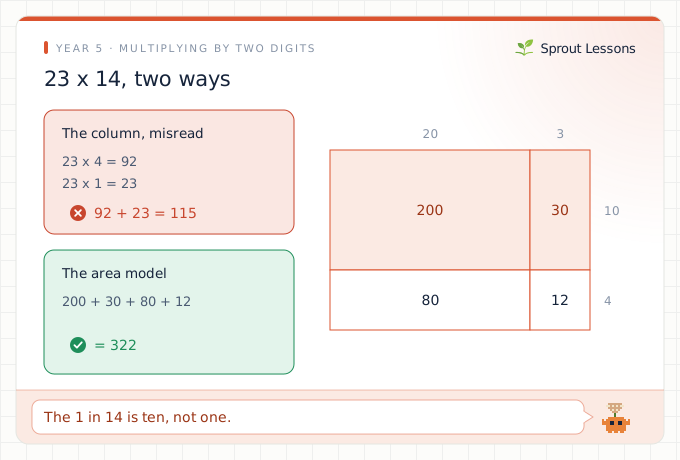
2. 23 × 14 = 115 (Year 5)
The child did 23 × 4 = 92 correctly and then 23 × 1 = 23, and added them. The 1 in 14 is ten, so the second line should be 230 and the answer 322. This is the most common two-digit multiplication error, and it comes from learning the layout of the column method before the meaning of it. The area model fixes it in one drawing: a rectangle split into 20 and 3 along the top and 10 and 4 down the side gives four parts, 200, 30, 80 and 12, which sum to 322. A child who has drawn that once rarely forgets the zero again.
3. 3 ÷ 12 = 4 (Years 5 and 6)
The child divides the bigger number by the smaller one whatever order they are written in, because for five years every division they met came out that way. Read it aloud as a sharing story: 3 pizzas shared between 12 people. Nobody gets 4 pizzas; everyone gets a quarter. This is exactly why Year 5 asks for results “as a whole number, decimal or fraction”: 3 ÷ 12 = ¼ = 0.25. It also matters for fractions, because ¾ is 3 ÷ 4, and a child who swaps them will never connect the two.
4. 6 ÷ ½ = 3 (Year 7)
The child halved 6. They read division only as sharing (“share 6 into halves”), which works for every whole number and breaks on a fraction. The other meaning, grouping, asks how many halves are in 6? Twelve. Both meanings are in the Foundation descriptor, but many children only ever practise sharing, and Year 7 is where the gap shows. Go back to grouping with whole numbers first (how many 3s are in 12?), then with halves of an orange. The same thinking explains why multiplying by ½ makes a number smaller: multiplication does not always make bigger, and Year 7 is where that rule stops being true.
5. −3 × −4 = −12 (Year 8)
The child kept the sign from addition, where two negatives do make a bigger negative. Before Year 8 this is not a gap at all, since the curriculum has not asked for it. In Year 8 the pattern does the teaching: −3 × 3 = −9, −3 × 2 = −6, −3 × 1 = −3, −3 × 0 = 0. Each step adds 3, so −3 × −1 = 3 and −3 × −4 = 12. Our negative numbers by year page covers the rest of the integer path.
One more that belongs to Year 5 and has its own page: 27 children, 4 per car, answered “6 remainder 3” or “6 cars”. The curriculum asks for the remainder to be interpreted in context, and in context the answer is 7 cars.
A two-minute check
Ask these four, in this order, and stop at the first one that goes wrong.
- “Draw 3 rows of 5 dots. How many?” Counting every dot one by one means Year 2 work: skip counting by 5s and arrays. 15 without counting means move on.
- “What is 16 × 3?” Year 3 work. A child who says 48 by doing 10 × 3 and 6 × 3 is exactly where the curriculum wants them. A child who adds 16 three times is right but slow; teach the split.
- “What is 23 × 14?” Year 5. Watch for 115 (mistake 2). Any method that gets 322 and can be explained is fine.
- “Which is bigger, 8 × ½ or 8 ÷ ½?” Year 7. The answer is 8 ÷ ½ (16, against 4). A child who picks the multiplication believes multiplying always makes bigger, and needs the grouping meaning from mistake 4.
Twenty minutes, three pieces
Most of what goes wrong on this page is one of two ideas missing: what the groups are, or what each digit is worth. A twenty-minute session that keeps both visible:
- Five minutes of groups. One real-world question asked both ways: “24 biscuits shared between 4 plates” and “24 biscuits in bags of 4, how many bags?” Same answer, different picture. Ask your child to draw each.
- Ten minutes of one area model. One multiplication at the child’s level (14 × 3 in Year 3, 23 × 14 in Year 5, 2.4 × 3 in Year 7), drawn as a split rectangle, then written however the school writes it. The drawing is the check on the written method, not a replacement for it.
- Five minutes of facts. Only the facts that slowed today’s problem down, not the whole table.
At home, plan on a few weeks per year level for this strand if the earlier year is secure, and longer for Year 5, which has the most new content. If your child is split across years, which is common, start one year below the first check question they got wrong, not at their enrolled year.
Sprout makes a lesson on the exact multiplication or division code your child needs, AC9M5N06 or VC2M3N05 or MA2-MR-01, built around what they care about. Start free.
What is not the problem
- Not knowing the column method in Year 4. No Australian Curriculum descriptor names it. In Victoria a written method is content from Level 4, but which one is the school’s choice.
- No remainders in Year 4. AC9M4N06 deliberately keeps division to answers that come out even.
- A calculator in Year 5. AC9M5N06 and AC9M5N07 both name digital tools “where appropriate”. What matters is that your child checks the answer is reasonable: 23 × 14 is a bit more than 20 × 14 = 280, so 115 cannot be right.
Where this sits
The facts behind every row of this page are on times tables by year, and the written division method on long division in the Australian Curriculum. Multiplying by 10 and the decimal point is covered in decimals by year, and dividing a whole into parts in fractions by year. For every maths code in the busiest year, the teacher-facing Year 5 maths codes page lists them all.
The short version
- Foundation and Year 1: sharing and grouping with objects. Year 2: arrays, twos, one-digit numbers.
- Year 3: one- and two-digit numbers. Year 4: facts to 10 × 10, no remainders yet.
- Year 5: two-digit multipliers, remainders interpreted in context, multiplication and division as inverses.
- Year 7: fractions and decimals. Year 8: negative numbers.
- Victoria names mental and written strategies from Level 4. NSW calls the strand Multiplicative relations.
- 23 × 14 = 115 means the 1 was treated as one. Draw the area model.
Sprout makes a lesson on the exact code your child is working on, with examples in their own interests. Start free.
How this page was checked
The Australian Curriculum descriptors are quoted from our copy of version 9.0, which matches AC9M5N06 on the Australian Curriculum website; we searched every Foundation to Year 10 maths descriptor for multiply, divide, remainder, sharing, grouping, array, long and written. The Victorian codes are from our copy of the Victorian Curriculum F–10 version 2.0 (the VCAA site was down for maintenance on the day of checking). The NSW outcomes are from the NSW Mathematics K–10 syllabus. Victorian and NSW wording is paraphrased. Checked 12 November 2026.
Australian Curriculum content descriptions are © Australian Curriculum, Assessment and Reporting Authority (ACARA) 2010 to present, licensed under CC BY 4.0, and quoted here unmodified. ACARA does not endorse any product that uses the Australian Curriculum. Victorian Curriculum codes reference the Victorian Curriculum F–10 Version 2.0 © VCAA, paraphrased; the VCAA does not endorse this product. NSW outcome codes reference the NSW syllabuses © NSW Education Standards Authority (NESA) for and on behalf of the Crown in right of the State of New South Wales, paraphrased, available at curriculum.nsw.edu.au; NESA does not endorse this product.
FAQ
When do children learn multiplication in the Australian Curriculum?
Equal groups and sharing start in Foundation and Year 1, but the words multiply and divide first appear in Year 2 (AC9M2N05), with arrays and one-digit numbers. Year 3 multiplies and divides one- and two-digit numbers, Year 4 completes the facts to 10 x 10, and Year 5 multiplies larger numbers by one- or two-digit numbers.
Which year do remainders come in?
Year 5. The Year 4 descriptor (AC9M4N06) limits division to problems where there is no remainder. The Year 5 descriptor (AC9M5N07) asks children to interpret any remainder according to the context and express the result as a whole number, decimal or fraction.
Does the Australian Curriculum require long multiplication?
No. The words "long" and "written" do not appear in any Foundation to Year 10 maths descriptor of the Australian Curriculum. It asks for efficient strategies and leaves the method to the school. Victoria differs: from Level 4 its descriptors ask for mental and written strategies, so a written method is curriculum content in Victorian schools.
Why does my child get 23 x 14 = 115?
They multiplied 23 by 4 to get 92, then 23 by 1 to get 23, and added. The 1 in 14 is ten, so the second line should be 230 and the answer 322. Drawing the area model, with 23 split into 20 and 3 and 14 into 10 and 4, shows the four parts 200, 30, 80 and 12 and fixes the error.
When do children multiply negative numbers?
Year 8. In the Australian Curriculum Year 7 only adds and subtracts integers (AC9M7N07), and the four operations with integers are Year 8 (AC9M8N04). A child who says that a negative times a negative is negative in Year 7 has not missed anything yet.