
In a Victorian government school you never have to pay for anything your child needs to learn the curriculum. The “contribution” on your school’s letter is voluntary. Camps and excursions that are not needed for the curriculum can be user-pays, and you can buy books or a device or let the school provide access. If you hold a health care card, the voluntary request does not apply to you at all, and the Camps, Sports and Excursions Fund (CSEF) now pays $400 a year towards camps and excursions.
This matters now because the rules changed. The Department rewrote its Parent Payments policy as the Parent Contributions policy on 15 September 2026, and the new rules apply to the arrangements schools write this year for the 2027 school year. Schools are recommended to send them home at least six weeks before the end of the year, so the letter arriving in November or December is the first one written under them.
Everything below is about Victorian government schools. Catholic and independent schools set their own fees, though CSEF covers their students too.
What changed for 2027
- One number, not a list. A school that asks for voluntary contributions must now give a single suggested amount, not an itemised list of values. The one exception is a tax-deductible building or library fund, which can be shown separately.
- Department templates, with locked wording. Every school must use one of two approved templates: one that invites voluntary contributions, and one that does not and only lists optional activities and materials to buy. Some text in them cannot be edited.
- Approved language all year. Reminders about contributions and notices about the cost of a camp or excursion must use the Department’s approved wording. Words like “fee”, “charge” or “levy” are banned for anything voluntary.
- No devices to buy in primary. From 2027, a school with primary students must not invite or allow families to buy or bring their own device for use at school from Foundation to Year 6. A child already using one can keep it until it needs replacing, at the school’s discretion.
- A price ceiling in secondary. A secondary school running a bring-your-own- device program must offer at least one option that costs no more than $980 including GST. You can buy a dearer one if it meets the school’s requirements.
The device policy also limits screen time in primary from 2027: minimal use in Foundation to Year 2 beyond what the curriculum requires, and a maximum of 90 minutes a day in Years 3 to 6. Students who need a device for disability-related support are exempt from both rules.
The three kinds of payment on the letter
Under the policy, anything a school asks for falls into one of three categories, and each has a different answer to “what happens if I don’t pay?”
| On the letter | Do you have to pay? | If you don’t |
|---|---|---|
| Voluntary contribution, one suggested amount for enhancements to programs or the school environment | No. You decide whether, how much and when | Nothing changes. The school cannot limit subject choice, follow up through your child, or set a payment schedule |
| Extra-curricular items and activities: camps and excursions not needed for the curriculum, instrumental music, yearbook, graduation | Only if your child takes part | The school does not have to provide that activity, but your child still gets the curriculum |
| Learning materials to own: textbooks, stationery, calculators, online subscriptions, a secondary device | No. It is an invitation to buy | The school must give your child access to what the curriculum needs |
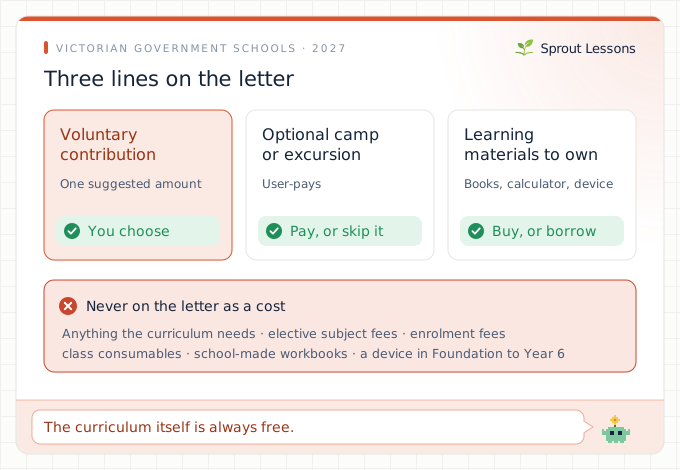
What a school cannot ask you to pay for
This is the list worth keeping next to the letter, because it is where the old habits show up. A government school must not invite you to pay for:
- Elective subject fees, or subject enrolment fees of any kind, including a “materials levy” for food technology or art. Electives are part of free instruction.
- General enrolment fees.
- Classroom consumables the curriculum needs, including food ingredients and art supplies that become something your child takes home. You can be invited to buy extra materials beyond what the school provides, if you choose.
- Things your child does not personally keep, such as class sets of devices, sports equipment or a whole-school subscription.
- Workbooks or exam papers the school produces itself.
- Services, such as device repairs, or hiring or leasing a school-owned device.
- Anything that runs a curriculum program, including accelerated and select-entry programs that deliver the Victorian Curriculum. If your child is in one, see our page on the Victorian High Ability Program.
A school also cannot require you to use a particular supplier for books or devices, cannot mark a user-pays camp as compulsory, cannot ask your child about whether you have paid, and cannot pursue the money as a debt.
Reading your school’s 2027 letter: five checks
- Is the voluntary contribution one figure? If you see an itemised list of amounts (say $60 for ICT, $45 for art, $30 for sport) presented as the contribution, that is the format the 2027 rules removed.
- Does anything voluntary say “fee”, “levy” or “charge”? It should not.
- Is a subject priced? A cost attached to choosing an elective is the most common thing that is not allowed.
- Does a camp say “compulsory” and also cost money? A camp the curriculum needs must be free. A camp that costs money must be optional.
- Is there a booklist with one shop only? The school can recommend a supplier and link to it, but you can buy from anyone, or second hand.
If something does not match, raise it with the school’s nominated Parent Contributions contact first; every school must name one. Most mismatches in the first year of new rules are a template that did not get updated, not an attempt to charge you. If you are still unhappy, speak to the principal, and then the Department’s regional office.
While you are sorting out next year: Sprout builds practice at your child’s actual Victorian Curriculum level, so the summer can be review rather than a gap. Start free.
The Camps, Sports and Excursions Fund: $400 from 2026
CSEF is the Department’s payment towards the extra-curricular line on the letter. From 1 January 2026 it rose to $400 a year for every eligible student, primary or secondary, up from $154 for primary and $256 for secondary. It is paid to the school, not to you, and it applies at government and non-government schools.
Who is eligible
On the first student day of Term 1 or Term 2, you (or a student aged 16 or over in their own name) must hold a financially means-tested concession card, such as a health care card, and it must validate with Centrelink. Disability and Carer cards are not means-tested and do not count. For Veterans’ Affairs cards, only the Gold Card counts. Two groups can apply under special consideration without a card: some asylum seekers and humanitarian visa applicants awaiting a decision, and children in kinship, foster or permanent care.
Home schooled students are not eligible, and neither are children at kindergarten or TAFE.
How to apply, and when
You fill in a form and give it to the school, with your card for the school to sight and copy. In 2026 the window ran from late January to 26 June. You only need a new form if it is your first year, your child changed schools, a sibling started or left, or your details changed; otherwise the school can roll last year’s application over after checking you are still eligible. Several children at the same school go on one form. The 2027 dates were not yet published when this page was checked, so watch the school newsletter in Term 1: schools must advertise the fund there.
What it pays for, and what it does not
| CSEF can pay for | CSEF cannot pay for |
|---|---|
| School camps and trips | Books and stationery |
| Swimming and other school-organised sport programs | Uniforms (Prep and Year 7 get separate help, below) |
| Outdoor education programs | Before and after school care, locker hire |
| Extra-curricular excursions and incursions | Classroom and homework materials |
| Graduations and valedictories | Formals, discos, debutante balls, end-of-year functions |
The money sits as a credit on your family account until you tell the school what to use it on; the school must get your agreement first. Brothers and sisters at the same school can pool their $400s towards one camp. If you already paid for a camp before the payment arrived, you can carry the unspent amount into next year or agree a family credit, but CSEF is never refunded as cash. If your child changes school, unspent CSEF follows them, which matters most in the move from Year 6 to Year 7.
Prep and Year 7: uniforms too
A child starting Prep or Year 7 at a government school whose family is eligible for CSEF automatically gets help with uniforms through State Schools’ Relief. The school applies on your behalf at set times of the year. That is on top of State Schools’ Relief’s year-round Affordable School Uniforms program, which supplies uniforms, shoes, stationery packs and other essentials at no cost to families in serious financial difficulty or crisis. You ask through the principal, assistant principal or student welfare coordinator, and they apply for you.
If your child is starting school next year, our guides to starting Prep in Victoria and starting Year 7 in Victoria cover the rest of the move.
If you cannot pay
The state’s own line is short: your school cannot stop your child from learning the standard curriculum if you cannot pay. Beyond that, schools must have arrangements for families in hardship, which can mean a payment plan for an optional camp, second-hand textbooks or a low-cost device. Ask the nominated contact before the camp deadline, not after it, because the school can only plan help it knows about.
Two things are worth separating. A camp or excursion that is genuinely optional can be skipped without your child falling behind in the curriculum, so a family on a tight year can choose. Anything that teaches the curriculum, including the materials for it, should not be in front of you as a cost at all.
The short version
- The curriculum, electives included, is free in a Victorian government school.
- From 2027 the voluntary contribution is one suggested amount, and it really is voluntary.
- Optional camps and excursions can be user-pays; CSEF pays $400 a year towards them.
- No primary school can ask you to buy a device from 2027.
- Health care card holders are told the contribution request does not apply to them.
For the rest of the 2027 calendar, see Victorian school term dates for 2027, and for what your child will be learning, our guide to the Victorian Curriculum.
Sprout builds lessons and practice at your child’s Victorian Curriculum level, with the curriculum code on every lesson. Start free.
Checked against the current rules as at 12 November 2026: the Department of Education’s Parent Contributions policy (updated 15 September 2026) and Digital Learning policy, and the Camps, Sports and Excursions Fund page (updated 16 July 2026) and help with school costs and fees (updated 21 August 2026) on vic.gov.au. CSEF dates for 2027 had not been published. This is general information about government schools, not financial or legal advice.
FAQ
Do I have to pay the voluntary contribution at a Victorian government school?
No. Under the Department’s Parent Contributions policy you decide whether to contribute, how much and when. The school cannot refuse your child instruction, limit subject choice, ask your child about payment, set a payment schedule or pursue it as a debt. Families with a health care card or other means-tested card, and carers of children in out-of-home care, must be told the request does not apply to them.
What changed in Victorian school contributions for 2027?
The Parent Payments policy became the Parent Contributions policy on 15 September 2026. From the 2027 school year, the voluntary contribution must be one suggested amount rather than an itemised list, schools must use one of two Department templates with locked wording, and reminders must use approved language. Primary schools also cannot ask families to buy or bring a device for Foundation to Year 6.
How much is CSEF in Victoria?
$400 a year for each eligible student, primary or secondary, since 1 January 2026, up from $154 for primary and $256 for secondary. It is paid to the school for camps, school sport, outdoor education, extra-curricular excursions and graduations. You are eligible if you hold a financially means-tested concession card, such as a health care card, that validates on the first student day of Term 1 or Term 2.
Can CSEF be used for uniforms or books?
No. CSEF cannot pay for books, stationery, uniforms, before and after school care, locker hire, classroom materials or social events like formals. Prep and Year 7 students at government schools whose family is eligible for CSEF get separate automatic help with uniforms through State Schools’ Relief, which the school applies for.
Does my child need a laptop for a Victorian primary school in 2027?
No. From 2027 a school with primary students must not invite or allow families to buy or bring their own device for use at school from Foundation to Year 6, although a child already using one can keep it until it needs replacing. Secondary schools with a bring-your-own-device program must offer at least one option costing no more than $980 including GST.