
Every Victorian government secondary school holds its Year 7 Orientation Day on the same date: Tuesday 8 December 2026. Term 1 2027 starts on Thursday 28 January, and Year 7s sit NAPLAN between 10 and 22 March. In maths, the jump that catches children out is not new topics but letters: Year 7 is the year variables arrive.
Placement for 2027 is done (offers went out on 24 June 2026), so this page is for the parent of a Year 6 child who has a school and wants to know what happens next. It covers the dates between now and March, what to do if you have moved or have no placement, what the Victorian Curriculum actually changes between Level 6 and Level 7, a six-question check you can do at home over summer, and the questions worth asking at orientation.
The dates, from April to March
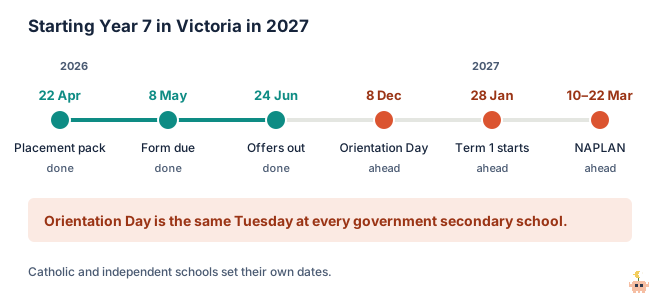
The placement dates come from the Victorian Government’s Moving from primary to secondary school page. Government primary schools handed out the Year 6 to 7 Placement Information Pack on 22 April, forms were due on 8 May, and offers were notified on 24 June. The same page sets Orientation Day: all government secondary schools host Year 6 students on Tuesday 8 December 2026. That shared date is deliberate. Because every school runs it on the same day, no child has to choose between two schools’ orientations, and the primary school can plan the day around the whole class being away.
Catholic and independent schools set their own dates, and some hold orientation earlier in December. If your child is going to a non-government school, the date is in the school’s own letter, not on the government page.
No placement, a new address, or coming from home education
You have moved since June. Your child has a right to a place at their designated neighbourhood school, the government school for the zone you now live in. The Department’s school zones page (updated 13 October 2026) says a child who lives in the zone must be offered a place when seeking enrolment, and points to the Find my School website as the official source of zones. Enter your new permanent address, choose 2027 and secondary, and phone that school. Your old offer does not transfer.
Your application was unsuccessful. The placement page sets out a written appeal to the school, with an Appeals information pack. The zones page says a school should enrol a child if it has a place available, so an out-of-zone school is worth asking again, but the zone school is the guaranteed option.
Your child is home educated. Families outside a government primary school get the placement pack by contacting a government secondary school directly, and that still applies for a late start. Our guide to returning to school after homeschooling covers what to bring and how the school places your child, and registration in Victoria explains how the VRQA registration ends once your child is enrolled.
What changes in maths between Year 6 and Year 7
In the Victorian Curriculum, Level 6 maths has 24 content descriptions and Level 7 has 31. Half of the extra seven are in Algebra, which grows from three descriptions to six. The VCAA wording is paraphrased here, not quoted.
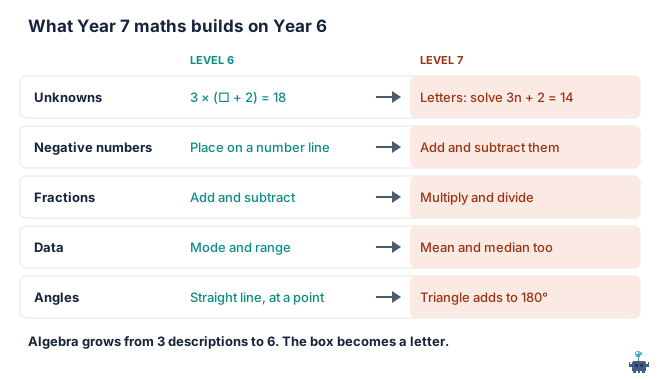
- Letters. At Level 6, children find the missing number in an equation with brackets, such as 3 × (□ + 2) = 18 (VC2M6A02). At Level 7 the box becomes a letter: students use variables in everyday formulas, write expressions with brackets, and solve one-variable equations such as 3n + 2 = 14, checking the answer by substituting it back (VC2M7A01 to VC2M7A03). A child who was confident with the box can be thrown by the letter for a few weeks, because “3n” looks like a two-digit number.
- Negative numbers. Level 6 places integers on a number line and on the Cartesian plane (VC2M6N01). Level 7 adds and subtracts them (VC2M7N08), which is where −3 − 5 = −2 starts appearing in homework.
- Fractions and decimals. Level 6 adds and subtracts fractions using equivalent fractions (VC2M6N05). Level 7 multiplies and divides fractions and decimals (VC2M7N05). Multiplying a decimal by a decimal appears for the first time here, which our decimals by year page explains.
- Data. Level 6 compares data sets by mode, range and shape (VC2M6ST01). Level 7 adds the mean and the median, and dot plots and stem-and-leaf plots (VC2M7ST01, VC2M7ST02).
- Angles and shapes. Level 6 works with angles on a straight line and at a point (VC2M6M04). Level 7 shows that a triangle’s angles add to 180°, works with parallel lines, and works out the area formulas for triangles and parallelograms rather than being handed them (VC2M7M01, VC2M7M04, VC2M7M05). Level 7 is also the first time π appears (VC2M7M03).
English changes less in its shape than in its load. Level 7 has the same three strands (Language, Literature and Literacy) and a similar number of descriptions, but the texts get longer and the writing is marked by several teachers instead of one. For the full list of codes, see the teacher-facing Level 7 maths and Level 7 English pages.
A six-question check for the summer
Every question below is a Level 6 skill that Level 7 builds on straight away. Ask them over a few days, out loud or on paper, with no time limit. A wrong answer is not a problem in December; it tells you which one thing to practise in January.
- “3 × (□ + 2) = 18. What goes in the box?” Right: 4. A child who answers 4 by guessing and checking is fine. A child who says 16 has added instead of thinking about the brackets. This is the skill Year 7 algebra is built on.
- “Which is colder, −3°C or −7°C?” Right: −7. Choosing −3 means “7 is bigger than 3” is still in charge. Draw a vertical number line like a thermometer before Year 7 adds and subtracts these.
- “What is a half plus a third?” Right: five sixths. Two fifths means adding tops and bottoms, the classic fraction error, and our fractions by year page has the reteach. Year 7 multiplies and divides fractions, so this is worth fixing first.
- “What is 3.6 × 100?” Right: 360. “3.600” means the child is adding zeros instead of moving the digits, and every Year 7 decimal topic will wobble until that is fixed.
- “A $40 game is 25% off. What do you pay?” Right: $30. $10 is the discount, not the price, which is a reading slip rather than a maths one. Something like $15 means 25% is not yet linked to a quarter.
- “Two angles sit on a straight line. One is 130°. What is the other?” Right: 50°. A blank look usually means the child does not know a straight line is 180°, which is the fact that Level 7’s triangle rule leans on.
If four or more come back right, your child is ready for Level 7 maths and the summer can be a summer. If two or more go wrong, pick one and spend ten minutes on it a few times a week in January. Our page on what a Year 6 student should know has the full Year 6 picture, and working at a different level explains what happens when a child is behind or ahead in one subject.
Want January practice that does not feel like school? Sprout writes a Level 6 or Level 7 lesson on the exact code, set in your child’s world, from footy stats to Minecraft builds. Try it free.
What your child’s new teachers will and will not know
Your child’s Semester 2 report arrives in December, around the same time as orientation. It shows where they sit against the Victorian Curriculum in each subject, and our guide to the Victorian school report explains how to read the ratings. Do not assume each of your child’s secondary teachers has read it. A primary teacher knew your child across every subject; in Year 7 a maths teacher sees several classes, and an English teacher a different set. If your child has a learning need, a health plan or a history of struggling in one subject, tell the Year 7 coordinator directly in writing.
NAPLAN in March is the first standardised look the secondary school gets at your child. It is not a placement test and there is nothing to study for, as our page on NAPLAN without the stress explains. Some schools also run their own maths and English testing in Term 1, which is worth asking about at orientation.
Questions worth asking at orientation
- Is Year 7 maths taught in mixed classes, or are students grouped by level? When is that decided?
- Does the school run its own Term 1 testing, and do parents see the results?
- How much homework should a Year 7 expect each night, and where does it get set?
- Is there a laptop or device program, and what does the school need us to buy?
- Who is the first person to contact if something goes wrong in the first weeks?
- Is there extra help for students who are behind in maths or reading, and how does a child get it?
The short version
- Orientation Day: Tuesday 8 December 2026, the same day at every government secondary school.
- Term 1: starts Thursday 28 January 2027. NAPLAN: 10 to 22 March 2027.
- Moved since June? Your zone school must offer a place. Check Find my School and phone them.
- Year 7 maths adds letters, negative-number arithmetic, multiplying fractions, the mean and the triangle rule.
- The six questions above tell you which Level 6 skill to tidy up in January.
Sprout makes a lesson on the exact Level 6 or Level 7 code your child needs, built around what they care about. Start free.
How this page was checked
Checked against the current information as at 20 October 2026. The placement dates, Orientation Day, appeals and the route for non-government and home-schooled families come from the Victorian Government’s Moving from primary to secondary school page (updated 29 April 2026). The zone entitlement comes from its school zones page (updated 13 October 2026). The NAPLAN 2027 window is from the NAP key dates page. The Term 1 start is the government school term date published by Virtual School Victoria. The descriptor counts are taken from our copy of the Victorian Curriculum F–10 Version 2.0. These dates apply to government schools; Catholic and independent schools set their own.
Curriculum codes reference the Victorian Curriculum F–10 Version 2.0 © VCAA, paraphrased. The Victorian Curriculum F–10 and related content can be accessed directly at the VCAA website. The VCAA does not endorse this product.
FAQ
When is Year 7 orientation day in Victoria in 2026?
Tuesday 8 December 2026. Every Victorian government secondary school hosts its Year 7 Orientation Day for Year 6 students on that date, according to the Victorian Government's Moving from primary to secondary school page. Catholic and independent schools set their own dates.
When does Year 7 start in Victoria in 2027?
Term 1 2027 starts on Thursday 28 January for Victorian government schools. Year 7 students then sit NAPLAN in the national window of 10 to 22 March 2027.
What if we moved and my child has no Year 7 placement?
Your child has a right to a place at the designated neighbourhood government school for your new address. Find it on the Find my School website, choosing 2027 and secondary, then phone the school. A child who lives in the zone must be offered a place when seeking enrolment.
What is new in Year 7 maths in the Victorian Curriculum?
Level 7 has 31 maths content descriptions against 24 at Level 6, and the biggest change is algebra: letters as variables, expressions with brackets and one-variable equations. Level 7 also adds and subtracts negative numbers, multiplies and divides fractions and decimals, adds the mean and median, and shows that the angles of a triangle add to 180 degrees.
How can I check if my child is ready for Year 7 maths?
Ask six Level 6 questions over a few days: a missing number in 3 x (box + 2) = 18 (answer 4), which is colder, -3 or -7 degrees, a half plus a third (five sixths), 3.6 x 100 (360), 25% off a $40 game ($30), and the angle next to 130 degrees on a straight line (50). Four or more right means ready; pick one wrong answer to practise in January.