
In the Australian Curriculum, area and perimeter both arrive in Year 4, in the same sentence, measured by counting squares and other informal units. Square centimetres and square metres come in Year 5, the length × width formula in Year 6, and triangles and parallelograms in Year 7. Victoria follows the same order. NSW starts area much earlier, in Kindergarten, but does not name perimeter in an outcome until Stage 3 (Years 5 and 6).
That timing explains most of what goes wrong at home. A Year 4 child meets two new ideas at once, both about the same rectangle, and the words sound alike. A Year 5 child who has been taught the formula early by a well-meaning adult can multiply the sides without knowing what the answer counts. This page sets out what is taught each year, the five wrong answers that turn up most often, four questions to find out where your child is, and twenty minutes of practice that fixes the usual mix-up.
What the curriculum asks for, year by year
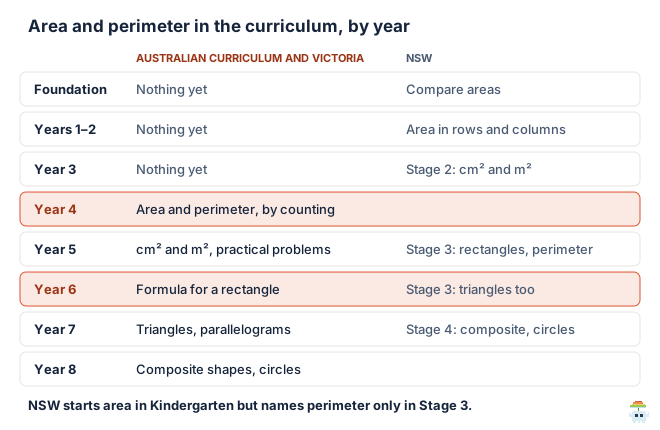
The Australian Curriculum descriptors, quoted from ACARA:
- Foundation to Year 3: no area and no perimeter. Children compare and measure length, first side by side, then with informal units such as paper clips in Year 1 (AC9M1M02), then in centimetres and metres in Year 3 (AC9M3M02). That length work is what perimeter is built on.
- Year 4, AC9M4M02: “recognise ways of measuring and approximating the perimeter and area of shapes and enclosed spaces, using appropriate formal and informal units”. Counting squares on grid paper, covering a book with sticky notes, walking the edge of the playground.
- Year 5, AC9M5M02: “solve practical problems involving the perimeter and area of regular and irregular shapes using appropriate metric units”. This is the year of square centimetres (cm²) and square metres (m²), and of shapes that are not rectangles.
- Year 6, AC9M6M02: “establish the formula for the area of a rectangle and use it to solve practical problems”. Note the word establish: the child is meant to see why rows times columns gives the number of squares, not just be told it.
- Year 7, AC9M7M01: “solve problems involving the area of triangles and parallelograms using established formulas and appropriate units”.
- Year 8, AC9M8M01 and AC9M8M03: area and perimeter of irregular and composite shapes, and the circumference and area of a circle. Surface area of prisms and cylinders follows in Year 9 (AC9M9M01).
There is a quiet bridge that most parents miss. Arrays, the rows of dots used to show multiplication, appear in Year 2 (AC9M2N05) and Year 3 (AC9M3N04). A child who drew 3 rows of 4 dots for 3 × 4 in Year 3 has already drawn the area of a 3 by 4 rectangle. Year 6 is the year someone finally tells them so. If your child is shaky on the facts themselves, our times tables by year page sets out which ones are due when.
Where Victoria differs (the VCAA wording is paraphrased here, not quoted). Levels 4, 5 and 6 match the Australian Curriculum almost word for word (VC2M4M02, VC2M5M02, VC2M6M02). At Level 7, VC2M7M01 asks students to work out the formulas for rectangles, triangles and parallelograms for themselves before using them, where the national version starts from formulas already established. Level 10A, the extension path, adds pyramids, cones and spheres, and the area rule for any triangle.
Where NSW differs (the NESA wording is paraphrased). The NSW Mathematics K–10 Syllabus puts area years ahead of the national order. In Kindergarten, children describe and compare the areas of similar shapes (MAE-2DS-02). In Stage 1 (Years 1 and 2), they measure and compare areas by laying out informal units in rows and columns (MA1-2DS-02). In Stage 2 (Years 3 and 4), they estimate and measure in square centimetres and square metres (MA2-2DS-03). Stage 3 (Years 5 and 6) calculates areas including rectangles (MA3-2DS-02) and gets to the area of parallelograms and triangles by splitting and rearranging shapes (MA3-2DS-03). Perimeter goes the other way: the word first appears in an outcome in Stage 3, as a length to measure (MA3-GM-02). So, going by the outcomes, a NSW child measures area from Kindergarten and meets perimeter by name in Year 5 or 6, while a Victorian child meets both on the same day in Year 4.
Five wrong answers to listen for
1. Area and perimeter swapped (Years 4 to 6)
Asked for the perimeter of a 5 cm by 3 cm rectangle, the child says 15. Asked for the area, they say 16. This is the big one, and it is not carelessness: the two ideas arrived together, both involve the same two numbers, and the child is choosing an operation (add or multiply) rather than picturing what is being measured. Perimeter is a distance you could walk with your finger. Area is space you could colour in. Until a child can show you each with their finger, any formula is a guess with a fifty per cent hit rate.
2. “The perimeter is 8” (Years 4 and 5)
The rectangle has only two sides labelled, 5 cm and 3 cm, and the child adds what they can see: 5 + 3 = 8. They have not yet noticed that a rectangle’s opposite sides match, so the other two sides are also 5 and 3, and the perimeter is 16 cm. Ask them to write the length on every side before adding anything.
3. Counting squares instead of edges (Year 4)
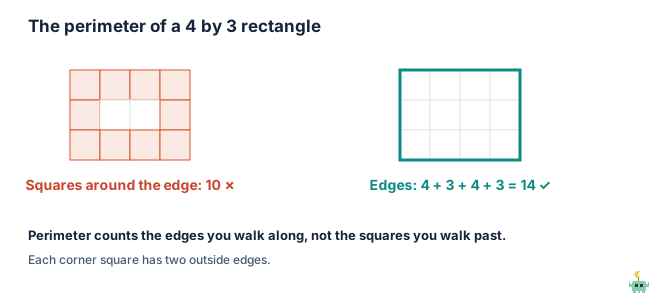
On grid paper, a child finding the perimeter of a 4 by 3 rectangle counts the squares around the edge and gets 10. The answer is 14, because perimeter counts the little edges along the outside, and each corner square has two of them. This error is a good sign in one way: the child knows perimeter is about the outside. Have them trace the boundary with a pencil and make a tick on each edge as they pass it.
4. “Same perimeter, so same area” (Years 5 to 8)
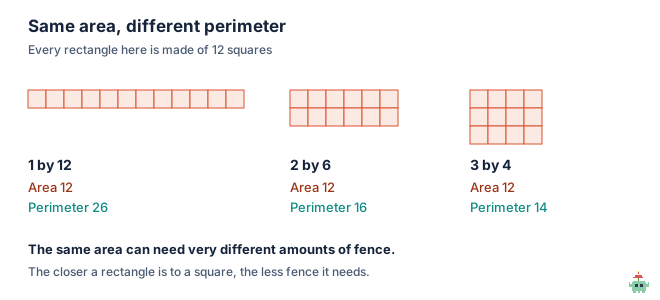
Many children, and plenty of adults, believe that two shapes with the same perimeter must have the same area, or the other way round. Twelve square tiles show that it is false. Laid out as 1 by 12 they need 26 units of fence; as 2 by 6, 16; as 3 by 4, only 14. All three cover 12 square units. This is the idea behind the Year 5 “practical problems”: the farmer with 20 metres of fencing who wants the biggest paddock is asking which rectangle with a perimeter of 20 has the largest area. (A 5 by 5 square, 25 square metres.)
5. Using the slanted side (Years 7 and 8)
For a parallelogram with a base of 6 cm, a slanted side of 5 cm and a height of 4 cm, the child multiplies 6 × 5 = 30. The area is 6 × 4 = 24 cm², because area uses the height measured straight up, at right angles to the base. The fix is the one VC2M7M01 asks for: cut the triangle off one end of a paper parallelogram, slide it to the other end, and watch it become a 6 by 4 rectangle. A child who has done that once rarely uses the slanted side again.
Two smaller slips run through all five: writing cm for an area instead of cm², and mixing units, such as a garden 2 m by 50 cm worked out as 100. Ask “100 what?” every time.
Four questions to find where your child is
Draw each one on paper. Use grid paper for the first two if you have it. Stop at the first one that goes wrong; that is where to start.
- Year 4. Draw a 4 by 3 rectangle on grid paper. “How many squares inside? How far is it around the outside?” Right: 12 squares, 14 units around. Ten for the outside means they are counting squares, not edges (wrong answer 3). Swapped answers mean the two words have not settled (wrong answer 1).
- Year 5. A rectangle with only two sides labelled, 5 cm and 3 cm. “What is the perimeter? What is the area?” Right: 16 cm and 15 cm². An 8 means they are only adding what is written (wrong answer 2). 15 cm with no square sign is nearly there: talk about units.
- Year 5 and 6. “A 1 by 12 rectangle and a 3 by 4 rectangle: which needs more fence? Which has more space inside?” Right: the 1 by 12 needs more fence (26 against 14); the space inside is the same (12 each). “Same fence” or “the long one is bigger inside” is wrong answer 4.
- Year 7. The parallelogram above: base 6 cm, slanted side 5 cm, height 4 cm. Right: 24 cm². Thirty is wrong answer 5.
A Year 4 child who cannot yet do question 2 is not behind: that is Year 5 work. A Year 5 child who gets questions 1 and 2 right by counting rather than multiplying is not behind either, because the formula is Year 6.
Want practice built around something your child cares about? Sprout writes a lesson on AC9M4M02 or AC9M5M02 set in their world, from designing a footy oval to fencing a guinea pig run. Try it free.
Twenty minutes that fixes the mix-up
One session, at the kitchen table, with 12 square things: sticky notes, crackers, Lego plates or paper squares.
- Five minutes: finger and colour. Draw a rectangle. Your child runs a finger around the edge and says “perimeter”, then colours the inside and says “area”. Do three different shapes, including an L shape.
- Ten minutes: twelve tiles. Make every rectangle you can from all 12 tiles (1 by 12, 2 by 6, 3 by 4). For each one, count the squares (always 12), then lay a piece of string around it and count the edges. Write the three perimeters down. Ask which shape a farmer with not much fence would want.
- Five minutes: back to the array. For the 3 by 4, ask how many rows and how many in each row. “3 rows of 4 is 3 × 4.” That is the formula, discovered. For a Year 4 child, stop there; the formula can wait for Year 6.
Over the next week, use the words in real life: the perimeter of the trampoline net, the area of rug you need for a bedroom, the fence around the dog. The aim is that “how far around?” and “how much space?” become questions your child asks before they reach for a calculation.
What is not the problem
- Counting squares in Years 4 and 5. That is what the curriculum asks for. Rushing to length × width early is the usual cause of wrong answer 1.
- Not knowing the area of a triangle in primary school (outside NSW). It is Year 7 in the Australian and Victorian curricula.
- Slow multiplication. It slows area down but does not cause the confusion. Practise the facts separately, and let your child use a times table chart while learning what area is.
Where this sits
Area and perimeter sit in the Measurement strand. The neighbouring by-year guides are which times tables, in which year, decimals by year (which matters once measurements stop being whole numbers) and telling the time by year. For the whole picture of a year level, see what a Year 4 student should know, and if you are not sure which curriculum applies to your child, start with which curriculum your state uses. Worried more broadly? Our guide to whether your child is behind in maths shows how to check the year before you worry.
The short version
- Australian Curriculum and Victoria: area and perimeter both start in Year 4, by counting.
- Square centimetres and metres in Year 5; length × width in Year 6.
- Triangles and parallelograms in Year 7; circles and composite shapes in Year 8.
- NSW: area from Kindergarten, rectangles and triangles in Stage 3, perimeter named in Stage 3.
- The fix for the mix-up is physical: a finger around the edge for perimeter, colour inside for area, then 12 tiles.
Sprout makes a lesson on the exact code your child is working on, with questions in their own interests and the right year’s method. Start free.
How this page was checked
The Australian Curriculum descriptors are quoted from our copy of version 9.0, which matches AC9M6M02 on the Australian Curriculum website. The Victorian codes are from the Victorian Curriculum F–10 version 2.0 and the NSW codes from the NSW Mathematics K–10 outcomes, both paraphrased. The NSW perimeter finding is at the level of outcomes: perimeter is not named in an Early Stage 1, Stage 1 or Stage 2 outcome, though Stage 2 measures length in metres, centimetres and millimetres (MA2-GM-02). Checked 18 October 2026.
Australian Curriculum content descriptions are © Australian Curriculum, Assessment and Reporting Authority (ACARA) 2010 to present, licensed under CC BY 4.0, and quoted here unmodified. ACARA does not endorse any product that uses the Australian Curriculum. Victorian Curriculum codes reference the Victorian Curriculum F–10 Version 2.0 © VCAA, paraphrased; the VCAA does not endorse this product. NSW outcome codes reference the NSW syllabuses © NSW Education Standards Authority (NESA) for and on behalf of the Crown in right of the State of New South Wales, paraphrased, available at curriculum.nsw.edu.au; NESA does not endorse this product.
FAQ
What year do kids learn area and perimeter in Australia?
In the Australian Curriculum and the Victorian Curriculum, both start in Year 4 (AC9M4M02), measured by counting squares and other informal units. Year 5 moves to square centimetres and square metres, Year 6 establishes the length times width formula for a rectangle, Year 7 adds triangles and parallelograms, and Year 8 adds circles and composite shapes. NSW starts comparing areas in Kindergarten and names perimeter in an outcome in Stage 3 (Years 5 and 6).
When is the area formula taught in the Australian Curriculum?
Year 6. AC9M6M02 asks students to establish the formula for the area of a rectangle and use it to solve practical problems. Before that, in Years 4 and 5, children find area by counting squares and by practical measuring, so a Year 4 or 5 child who counts rather than multiplies is doing what the curriculum asks.
Why does my child mix up area and perimeter?
Because the two ideas arrive together in Year 4, in the same curriculum sentence, and both use the same two numbers for a rectangle. A child who chooses an operation (add or multiply) instead of picturing what is measured will swap them. The fix is physical: trace the edge with a finger for perimeter, colour the inside for area, and build rectangles from 12 tiles to see that the same area can have different perimeters.
Do shapes with the same area have the same perimeter?
No. Twelve square tiles laid out as 1 by 12, 2 by 6 or 3 by 4 all have an area of 12 square units, but their perimeters are 26, 16 and 14. The closer a rectangle is to a square, the smaller its perimeter for the same area. This is the idea behind Year 5 fencing problems.
When do kids learn the area of a triangle in Australia?
Year 7 in the Australian Curriculum (AC9M7M01) and in the Victorian Curriculum (VC2M7M01, which asks students to work out the formulas first). NSW is earlier: Stage 3 (Years 5 and 6) finds the area of triangles and parallelograms by splitting and rearranging shapes.