
Ask your child two questions: which is bigger, 0.5 or 0.45, and which is bigger, 0.4 or 0.45? A child who gets both right understands decimal size. A child who gets either one wrong is following a rule that worked for whole numbers, and the two questions catch two different rules. One question on its own misses one of them.
The Australian Curriculum introduces decimals in Year 4 with tenths and hundredths, after money in Year 3. It goes past two decimal places in Year 5, adds and subtracts decimals in Year 6, and leaves multiplying one decimal by another until Year 7. This page walks that sequence, names the wrong answer each year tends to produce, and gives you a five-minute check and a fix for each one. It also draws on one of the largest studies of decimal misconceptions ever run, which tested more than 3,000 Victorian students.
What the curriculum asks for, year by year
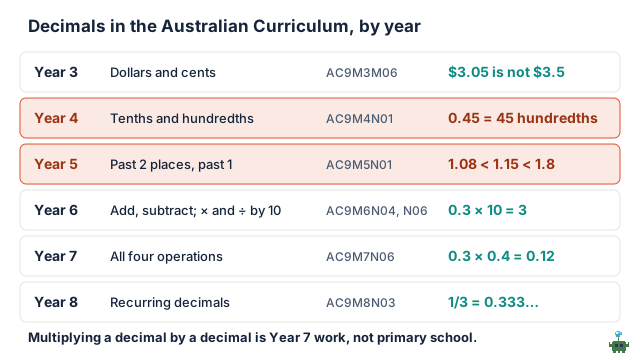
The descriptors, quoted from ACARA:
- Year 3, AC9M3M06: “recognise the relationships between dollars and cents and represent money values in different ways”. Your child writes $3.45 a year before anyone tells them what the 4 and the 5 are worth. Our money by year page covers the rest of the money sequence.
- Year 4, AC9M4N01: “recognise and extend the application of place value to tenths and hundredths and use the conventions of decimal notation to name and represent decimals”. Alongside it, AC9M4N03 asks children to “make connections between fractions and decimal notation”: 3/10 is 0.3, 45/100 is 0.45.
- Year 5, AC9M5N01: “interpret, compare and order numbers with more than 2 decimal places, including numbers greater than one, using place value understanding; represent these on a number line”. AC9M5N04 connects familiar percentages to their decimals (25% is 0.25).
- Year 6, AC9M6N04: “apply knowledge of place value to add and subtract decimals, using digital tools where appropriate; use estimation and rounding to check the reasonableness of answers”.
- Year 6, AC9M6N06: “multiply and divide decimals by multiples of powers of 10 without a calculator, applying knowledge of place value and proficiency with multiplication facts”. So 0.3 × 10 and 4.2 ÷ 100, by hand.
- Year 7, AC9M7N06: “use the 4 operations with positive rational numbers including fractions, decimals and percentages to solve problems using efficient calculation strategies”. This is the first descriptor that covers 0.3 × 0.4.
- Year 8, AC9M8N03: “recognise terminating and recurring decimals, using digital tools as appropriate”.
Two things in that list surprise parents. First, Year 6 adds and subtracts decimals “using digital tools where appropriate”, so a calculator is allowed by the curriculum, but the very next descriptor says “without a calculator” for multiplying and dividing by 10, 100 and 1000. Second, multiplying one decimal by another is not in the primary curriculum at all. If a worksheet asks your Year 5 child for 2.4 × 0.6, it is two years early.
Victoria and NSW. The Victorian Curriculum 2.0 follows the same sequence, and at Level 7 it is more explicit: VC2M7N05 names multiplying and dividing fractions and decimals, with mental and written strategies as well as digital tools. NSW groups years into stages, so decimals to two places sit in Stage 2 (MA2-RN-02, Years 3 and 4) and three places in Stage 3 (MA3-RN-02, Years 5 and 6). The Victorian and NSW wording is paraphrased here. A NSW school may start tenths in Year 3; the national curriculum starts them in Year 4.
How common the wrong rules are
Between 1995 and 1999, Vicki Steinle and Kaye Stacey at the University of Melbourne tested 3,204 students in Years 4 to 10 at 12 Victorian schools, most of them several times, with a 30-item decimal comparison test: pairs like 0.8 and 0.75, which is bigger? The pattern of wrong answers sorts children into the rule they are using (Steinle and Stacey, 2002).
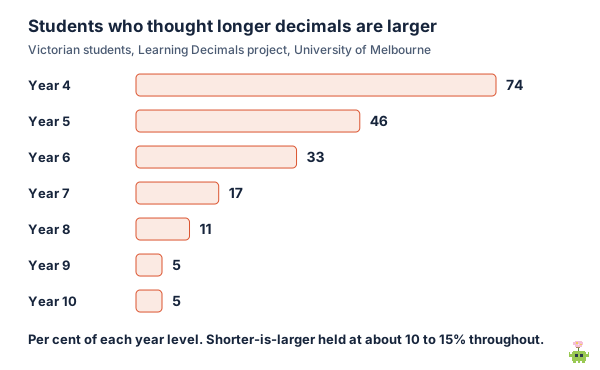
On the project’s incidence table, 74% of Year 4 students and 33% of Year 6 students were in the longer-is-larger group, falling to 5% by Year 10. The other wrong rule, shorter-is-larger, did not fade the same way: it sat around 10 to 15% at every age. And only about two thirds of students were experts by Year 10. In other words, a Year 5 child who gets these wrong is in the majority, and a Year 8 child who still does is not going to grow out of it without help.
The wrong answers worth knowing
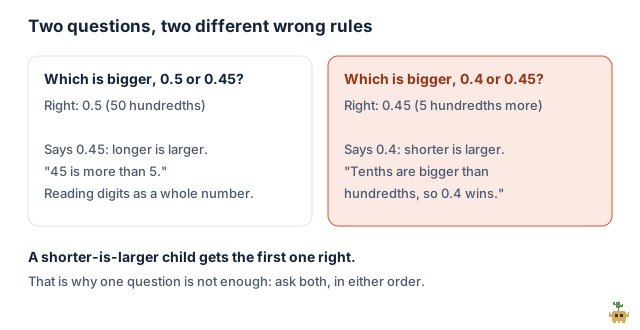
1. Year 4 and 5: “0.45 is bigger than 0.5” (longer is larger)
The child reads the digits after the point as a whole number: 45 is more than 5. This is the rule the Melbourne study found in three quarters of Year 4 students, and it is the natural result of six years of whole numbers, where more digits always means bigger.
The fix: a hundredths grid (a 10 by 10 square). Shade 0.5 as five whole columns and 0.45 as four columns and five squares. Then say both as hundredths: 0.5 is 50 hundredths, 0.45 is 45 hundredths. Writing 0.5 as 0.50 is fine, but only once your child can say why the zero does not change the size. Our guide to AC9M4N01 has the full teaching sequence.
2. Year 4 to 6: “0.4 is bigger than 0.45” (shorter is larger)
This child has learnt something true, that tenths are bigger than hundredths, and stretched it too far: a number that stops at tenths must be bigger than one that goes on to hundredths. Some children get here by analogy with fractions (a tenth is bigger than a hundredth, so 0.4 beats 0.45), others by analogy with negative numbers. It is the dangerous one, because the same child gets 0.5 against 0.45 right, so a single test question reports them as fine.
The fix: the same grid, but compare 0.4 and 0.45 directly. 0.4 is 40 hundredths; 0.45 is 40 hundredths and 5 more. Then place both on a number line from 0 to 1 marked in tenths: 0.45 sits halfway between 0.4 and 0.5.
3. Year 3 to 5: “$3.5 is three dollars and five cents” (money thinking)
Money arrives in Year 3, a year before decimals, and it always has exactly two digits after the point. It is a good model for two places and a poor one for three. The Melbourne researchers found about 4% of students said 8.41 and 8.41253 were equal, and explain it this way: like dollars and cents, those students treat the amounts after the hundredths as not real, perhaps some sort of rounding error.
The fix: money is a good model for tenths and hundredths (10 cents is a tenth of a dollar), so keep it, but name the places out loud: $3.50 is 3 dollars and 5 tenths of a dollar. Then show something money cannot: a measurement like 1.375 kilograms on a kitchen scale, where the third place is real.
4. Year 6: 4.5 + 2.35 = 2.80
The child lines the numbers up on the right, the way they always have, adds 45 and 235 to get 280, and puts the point back two places from the end. The answer is less than one of the numbers being added, which is the giveaway. The correct answer is 6.85.
The fix: estimate first, which AC9M6N04 asks for in so many words: 4 and a bit plus 2 and a bit is about 7. Then line up the points, not the right-hand ends, and write 4.50 so both numbers have the same number of places.
5. Year 6: 0.3 × 10 = 0.30
“To times by 10, add a zero” worked for every whole number your child ever met, and it gives 0.30 here, which is still 0.3. The correct answer is 3. AC9M6N06 says “applying knowledge of place value” precisely so this rule gets replaced.
The fix: a place value chart. Multiplying by 10 moves every digit one place to the left, so the 3 tenths become 3 ones. It is the digits that move, not the point, and saying it that way makes dividing by 100 (4.2 ÷ 100 = 0.042) work the same way in reverse.
6. Year 7: 0.3 × 0.4 = 1.2
3 times 4 is 12, and the child puts a point in to make it look like a decimal. The answer is 0.12: three tenths of four tenths is twelve hundredths. Under it sits a belief that multiplying always makes things bigger, which is why 8 × 0.5 = 4 surprises children. This is Year 7 work in the Australian Curriculum, so a primary school child who cannot do it is not behind.
The fix: estimate in words. “A bit less than half of a bit less than half” must be small, so 1.2 cannot be right. Then count decimal places: one in 0.3, one in 0.4, so two in the answer.
Want practice aimed at the wrong rule your child is using? Sprout builds a lesson from AC9M4N01, AC9M5N01 or AC9M6N04 around whatever your child is into, with the code on every page. Try it free.
The five-minute check
Pen and paper, no calculator. The year in brackets is where the Australian Curriculum places the skill, so you know whether a wrong answer is a gap or simply not yet.
- “Write three dollars and five cents.” (Year 3) $3.05. $3.5 means the places after the point are not secure yet.
- “Which is bigger, 0.5 or 0.45?” (Year 4) 0.5. If they say 0.45, it is longer is larger.
- “Which is bigger, 0.4 or 0.45?” (Year 4) 0.45. If they say 0.4, it is shorter is larger, even if question 2 was right.
- “Put 1.8, 1.08 and 1.15 in order, smallest first.” (Year 5) 1.08, 1.15, 1.8.
- “What is 4.5 + 2.35? Estimate first.” (Year 6) About 7, then 6.85. 2.80 is wrong answer 4.
- “What is 0.3 × 10? And 4.2 ÷ 100?” (Year 6) 3 and 0.042. 0.30 is the add-a-zero rule.
Stop at the first one that is wrong and sits at or below your child’s year. That is the one to work on. If questions 2 and 3 are both right, the size of decimals is secure, and everything later is procedure.
Twenty minutes a week that works
- Say decimals as fractions. Not “zero point four five” but “forty-five hundredths”. The words carry the size; the digits do not.
- Use a hundredths grid until comparing is quick, then a number line from 0 to 1, then from 1 to 2. Number lines are what AC9M5N01 names, and they fix both wrong rules at once.
- Play “which is bigger” with mixed lengths: 0.6 and 0.58, 0.3 and 0.299, 0.07 and 0.1. Include pairs where the longer one wins and pairs where the shorter one wins, so no shortcut survives.
- Measure things. Kitchen scales, a tape measure in metres, a stopwatch. Decimals in real measurements go past two places, which breaks money thinking, and AC9M6M01 asks for decimal measurements in Year 6 anyway.
- Estimate before every calculation from Year 6 on. It catches wrong answers 4, 5 and 6 before they reach the page.
What is not the problem
- Not knowing decimals in Year 3. Year 3 has money, not decimal place value. In NSW, tenths may start in Year 3 because Stage 2 spans Years 3 and 4.
- Using a calculator to add decimals in Year 6. AC9M6N04 says “using digital tools where appropriate”. What matters is whether your child can tell a calculator answer is wrong.
- Not being able to multiply two decimals in primary school. That is Year 7.
Where this sits
The other year-by-year guides for Australian parents:
- Place value by year, which ends at tenths and hundredths, where this page begins
- Fractions by year, the other half of AC9M4N03
- Which times tables, in which year
- Telling the time by year
If you are not sure which curriculum your school follows, which curriculum your state uses sorts it out. If decimals are one of several gaps, is my child behind in maths covers every strand.
The short version
Money in Year 3, tenths and hundredths in Year 4, more places and numbers past 1 in Year 5, adding, subtracting and multiplying by 10 in Year 6, multiplying a decimal by a decimal in Year 7. Years 4 and 5 carry the idea that matters most, which is size.
Ask both questions: 0.5 or 0.45, and 0.4 or 0.45. The first catches longer is larger, which most Year 4 children start with. The second catches shorter is larger, which about one child in ten holds at any age from Year 4 to Year 10. Fix both with a hundredths grid, a number line and the habit of saying decimals as hundredths.
Sprout Lessons builds practice around whatever your child is already into, and puts the AC9 code on every lesson. Start free.
How this page was checked
Codes and descriptor wording were checked on 16 October 2026 against our copy of the Machine Readable Australian Curriculum v9 (accessed 2026-06-24), the Victorian Curriculum 2.0 (accessed 2026-07-13) and the NSW Mathematics K–10 syllabus (accessed 2026-08-17), not written from memory. Read the official content description for AC9M4N01 on the Australian Curriculum website. The incidence figures are from the University of Melbourne Learning Decimals project (Steinle and Stacey), both linked above; the data were collected in 1995 to 1999, before the current curriculum.
Australian Curriculum content descriptions are © Australian Curriculum, Assessment and Reporting Authority (ACARA) 2010 to present, licensed under CC BY 4.0, and quoted here unmodified. ACARA does not endorse any product that uses the Australian Curriculum. Victorian Curriculum codes reference the Victorian Curriculum F–10 Version 2.0 © VCAA, paraphrased, available at f10.vcaa.vic.edu.au; the VCAA does not endorse this product. NSW outcome codes reference the NSW syllabuses © NSW Education Standards Authority (NESA) for and on behalf of the Crown in right of the State of New South Wales, paraphrased, available at curriculum.nsw.edu.au; NESA does not endorse this product.
FAQ
What year do children learn decimals in Australia?
Under the Australian Curriculum, decimal place value starts in Year 4 with tenths and hundredths (AC9M4N01), after dollars and cents in Year 3. Year 5 goes past two decimal places and above 1, Year 6 adds and subtracts decimals and multiplies and divides them by 10, 100 and 1000, and Year 7 covers all four operations, including multiplying one decimal by another. In NSW, decimals to two places sit in Stage 2 (Years 3 and 4).
Why does my child think 0.45 is bigger than 0.5?
They are reading the digits after the point as a whole number: 45 is more than 5. Researchers call it longer is larger. In the University of Melbourne Learning Decimals project, 74% of Victorian Year 4 students and 33% of Year 6 students thought this way. Fix it with a hundredths grid and by saying decimals as hundredths: 0.5 is 50 hundredths, 0.45 is 45 hundredths.
My child knows 0.5 is bigger than 0.45. Do they understand decimals?
Not necessarily. Ask a second question: which is bigger, 0.4 or 0.45? A child who says 0.4 is using a different wrong rule, shorter is larger (tenths are bigger than hundredths, so the shorter number wins), and gets the first question right. The Melbourne study found about 10 to 15% of students at every age from Year 4 to Year 10 thinking this way.
When do children learn to multiply decimals in Australia?
Multiplying and dividing decimals by 10, 100 and 1000 is Year 6, without a calculator (AC9M6N06). Multiplying one decimal by another, like 0.3 x 0.4 = 0.12, first appears in Year 7 (AC9M7N06). Victoria's Level 7 names it explicitly (VC2M7N05). It is not in the primary curriculum.
Can my child use a calculator for decimals in Year 6?
For adding and subtracting decimals, the Australian Curriculum says "using digital tools where appropriate" (AC9M6N04), together with estimation to check the answer. For multiplying and dividing decimals by multiples of powers of 10, it says "without a calculator" (AC9M6N06).