
In the Australian Curriculum, angles start as turns in Year 2 (a quarter, half or full turn), become angles compared with a right angle in Year 3, get their names in Year 4 (acute, obtuse, straight, reflex, revolution) and are measured in degrees with a protractor in Year 5. Year 6 works out unknown angles on a line and at a point, and Year 7 proves that a triangle’s angles add to 180°. Victoria follows the same order. NSW first names angles in a Stage 2 outcome (Years 3 and 4).
So a child meets the word “angle” two full years before they meet the degree. That gap is deliberate: an angle is an amount of turn, and a child who has not felt that will treat the protractor as a ruler with two rows of numbers. This page sets out what each year teaches, the five wrong answers that turn up most often, four quick questions to find where your child is, and twenty minutes of practice with a paper plate and two strips of card.
What the curriculum asks for, year by year
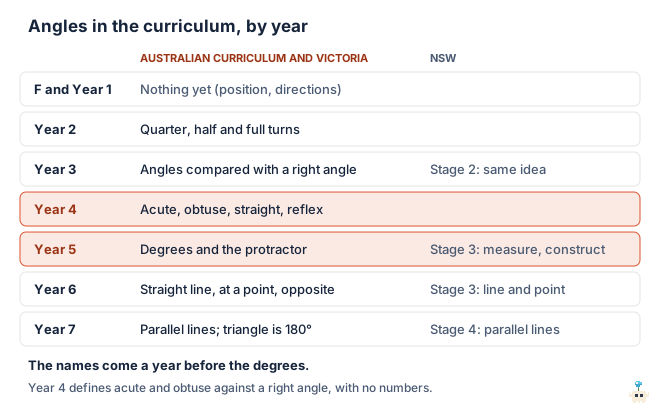
The Australian Curriculum descriptors, quoted from ACARA:
- Foundation and Year 1: no angles. Children describe position and follow directions, which is where turning left and right begins.
- Year 2, AC9M2M05: “identify, describe and demonstrate quarter, half, three-quarter and full measures of turn in everyday situations”. Turning a tap, a door handle, your body to face the back of the room.
- Year 3, AC9M3M05: “identify angles as measures of turn and compare angles with right angles in everyday situations”. The corner of a book becomes the measuring tool: bigger than this, or smaller?
- Year 4, AC9M4M04: “estimate and compare angles using angle names including acute, obtuse, straight angle, reflex and revolution, and recognise their relationship to a right angle”. Still no degrees: the names are defined against the right angle.
- Year 5, AC9M5M04: “estimate, construct and measure angles in degrees, using appropriate tools including a protractor, and relate these measures to angle names”. It is the only content description from Foundation to Year 10 that names a protractor.
- Year 6, AC9M6M04: “identify the relationships between angles on a straight line, angles at a point and vertically opposite angles; use these to determine unknown angles, communicating reasoning”. The first time a child works out an angle without measuring it.
- Year 7, AC9M7M04 and AC9M7M05: angles formed when parallel lines are crossed by another line, and “demonstrate that the interior angle sum of a triangle in the plane is 180° and apply this to determine the interior angle sum of other shapes and the size of unknown angles”. Trigonometry follows in Year 9.
Where Victoria differs (the VCAA wording is paraphrased here, not quoted). It does not, in any way a parent would notice. Levels 2 to 7 of the Victorian Curriculum 2.0 carry the same angle content at the same levels with the same code numbers (VC2M2M05 to VC2M7M05). Level 10A, the extension path, adds angle relationships in circles.
Where NSW differs (the NESA wording is paraphrased). In the NSW Mathematics K–10 Syllabus, the first outcome to name angles is in Stage 2 (Years 3 and 4), where students identify angles and classify them by comparing them to a right angle (MA2-GM-03). Stage 3 (Years 5 and 6) measures and constructs angles and works with angles on a straight line and at a point (MA3-GM-03), and Stage 4 applies angle relationships, including parallel lines (MA4-ANG-C-01). The order is the same as the national one, but Stage 3 bundles the protractor and the straight-line rule into one outcome, so a NSW child can meet both in Year 5.
Five wrong answers to listen for
1. “That one is bigger, its lines are longer” (Years 3 and 4)
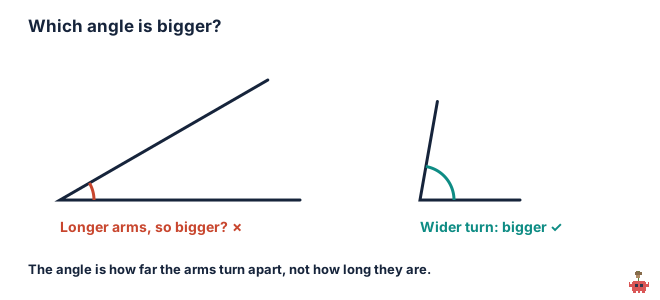
Shown a narrow angle with long arms and a wide angle with short arms, many children choose the long one as bigger. They are measuring the lines, because lines are the only thing they can see. This is the most important error to catch, because it survives into Year 5 as “the angle got bigger when I made the lines longer”. The fix is the AC9M3M05 idea of an angle as a turn: open two strips of card joined at one end, and show that sliding the strips longer changes nothing about how far they are turned apart.
2. Not recognising a tilted right angle (Years 3 and 4)
A child spots every right angle that sits like the corner of a page, then misses the same angle rotated 45°. For them, a right angle is a position (one line flat, one line up), not an amount of turn. Make a right-angle tester by folding a scrap of paper in half and in half again, and hunt for right angles around the house at every slant: the corner of a cushion lying crooked, a book on its side.
3. Reading the wrong scale on the protractor (Year 5)
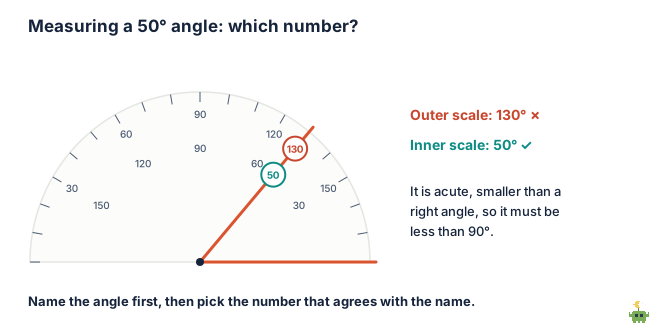
A protractor has two rows of numbers running in opposite directions, and the arm crosses both. A child who reads the wrong row writes 130° for an angle of 50°. The Year 4 names exist to prevent exactly this, which is why AC9M5M04 asks students to “relate these measures to angle names”. Before measuring, your child says whether the angle is acute or obtuse. Then they pick the reading that agrees. Our page on what a Year 5 student should know shows the same trap the other way round, an obtuse angle read as 50°.
4. Measuring the inside when the question asks for the reflex angle (Years 4 to 6)
Asked for the reflex angle between the hands of a clock, the child measures the small angle, say 120°, and writes that. A reflex angle is the one on the other side, more than a straight angle, so the answer is 360° − 120° = 240°. Most protractors only go to 180°, so this is a reasoning question, not a measuring one, and it is a good early taste of Year 6.
5. Using 360 for a straight line (Year 6)
Two angles sit on a straight line. One is 130°. The child writes 230° for the other, because they remember “360” and subtract from it. Angles on a straight line add to 180°; angles all the way round a point add to 360°. The quick check: a straight line is half a turn, and a full turn is 360°, so a straight line is half of that.
Four questions to find where your child is
You need a clock with hands (or a drawing of one) and, for the last two, a protractor. Stop at the first one that goes wrong; that is where to start.
- Year 3. Draw a long-armed narrow angle and a short-armed wide angle. “Which angle is bigger?” Right: the wide one. Choosing the long one is wrong answer 1.
- Year 4. “What kind of angle do the hands make at 3 o’clock? At 1 o’clock? At 5? At 6?” Right: a right angle, acute, obtuse, straight. A child who gets 3 o’clock but not the others knows the right angle and needs the names that are defined against it.
- Year 5. Draw an angle of about 50° and ask your child to measure it. Right: 50°, give or take a couple. 130° is wrong answer 3. Ask first: “Is it bigger or smaller than a right angle?”
- Year 6. “Two angles on a straight line. One is 130°. What is the other? And three angles meet at a point: 100°, 120°, and what?” Right: 50° and 140°. 230° for the first is wrong answer 5.
A Year 4 child who cannot measure with a protractor is not behind: degrees are Year 5. A Year 5 child who measures accurately but cannot do question 4 is not behind either; that is Year 6.
Want practice built around something your child loves? Sprout writes a lesson on AC9M4M04 or AC9M5M04 set in their world, from skateboard ramps to the angle of a footy kick. Try it free.
Twenty minutes with a paper plate
You need a paper plate (or a circle of card), two strips of card, a split pin or a drawing pin, and a pencil.
- Five minutes: turn your body. Stand up and face the door. Make a quarter turn, a half turn, a full turn. Then turn “less than a quarter” and “more than a quarter but less than a half”. Your child has just made acute and obtuse angles with their whole body.
- Five minutes: the angle maker. Pin the two strips together at one end. Open them to a right angle, then to an acute and an obtuse angle. Slide one strip so it sticks out further and ask whether the angle changed. (It did not. That is wrong answer 1, fixed.)
- Five minutes: the plate protractor. Fold the plate in half, then in quarters, then in eighths, and write 90 at the first quarter fold, 180 at the half, 45 at the first eighth. Now your child has a protractor they built, with only the marks they understand, and the real one is just a more detailed copy.
- Five minutes: name, then measure. Draw four angles. For each, your child names it first, estimates in degrees using the plate, and only then measures with a real protractor if they are in Year 5 or above.
What is not the problem
- No degrees in Year 3 or 4. The curriculum does not use them until Year 5. Comparing with a right angle is the Year 3 and 4 skill.
- A measurement a few degrees out. A protractor reading of 48° for a 50° angle is a steady hand, not a misconception. 130° is the misconception.
- Not knowing a triangle adds to 180° in primary school. That is Year 7.
Where this sits
Angles sit in the Measurement strand, next to area and perimeter by year and telling the time by year, which shares the clock with question 2. For the whole picture of a year level, see what a Year 4 student should know, and for every maths code in a year, the teacher-facing Year 5 maths codes page. If you are not sure which curriculum applies, start with which curriculum your state uses, and if you are worried more broadly, our guide to whether your child is behind in maths shows how to check the year first.
The short version
- Year 2: quarter, half and full turns. Year 3: angles compared with a right angle.
- Year 4: acute, obtuse, straight, reflex, revolution, still without degrees.
- Year 5: degrees and the protractor. Year 6: unknown angles on a line and at a point.
- Year 7: parallel lines, and a triangle’s angles add to 180°.
- NSW: angles first named in Stage 2; the protractor and straight-line rule share a Stage 3 outcome.
- The fix for most errors: name the angle before you measure it.
Sprout makes a lesson on the exact code your child is working on, with questions in their own interests and the right year’s method. Start free.
How this page was checked
The Australian Curriculum descriptors are quoted from our copy of version 9.0, which matches AC9M5M04 on the Australian Curriculum website. The Victorian codes are from the Victorian Curriculum F–10 version 2.0 and the NSW codes from the NSW Mathematics K–10 outcomes, both paraphrased. The NSW finding is at the level of outcomes: no Early Stage 1 or Stage 1 outcome names angles or turns, though Stage 1 content may still use turning language. Checked 20 October 2026.
Australian Curriculum content descriptions are © Australian Curriculum, Assessment and Reporting Authority (ACARA) 2010 to present, licensed under CC BY 4.0, and quoted here unmodified. ACARA does not endorse any product that uses the Australian Curriculum. Victorian Curriculum codes reference the Victorian Curriculum F–10 Version 2.0 © VCAA, paraphrased; the VCAA does not endorse this product. NSW outcome codes reference the NSW syllabuses © NSW Education Standards Authority (NESA) for and on behalf of the Crown in right of the State of New South Wales, paraphrased, available at curriculum.nsw.edu.au; NESA does not endorse this product.
FAQ
What year do kids learn angles in Australia?
In the Australian Curriculum and the Victorian Curriculum, Year 2 learns quarter, half and full turns (AC9M2M05), Year 3 compares angles with a right angle (AC9M3M05), Year 4 names acute, obtuse, straight, reflex and revolution angles (AC9M4M04), and Year 5 measures in degrees with a protractor (AC9M5M04). NSW first names angles in a Stage 2 outcome, in Years 3 and 4.
When do kids learn to use a protractor?
Year 5. AC9M5M04 asks students to estimate, construct and measure angles in degrees using a protractor, and to relate the measures to angle names. It is the only Australian Curriculum content description from Foundation to Year 10 that names a protractor. In NSW, measuring and constructing angles is Stage 3 (Years 5 and 6).
Why does my child read the wrong number on the protractor?
A protractor has two scales running in opposite directions, and the arm of the angle crosses both, so a 50 degree angle also lines up with 130. The fix is to name the angle first: if it is acute, smaller than a right angle, the answer must be under 90, so pick the number that agrees.
Do angles on a straight line add to 180 or 360?
Angles on a straight line add to 180 degrees, because a straight line is half a turn. Angles all the way around a point add to 360 degrees, a full turn. Both are Year 6 in the Australian Curriculum (AC9M6M04).
When do kids learn that a triangle adds to 180 degrees?
Year 7 in the Australian Curriculum and the Victorian Curriculum (AC9M7M05 and VC2M7M05), which ask students to demonstrate that the interior angles of a triangle add to 180 degrees and use it to find unknown angles. In primary school, not knowing this is expected.