
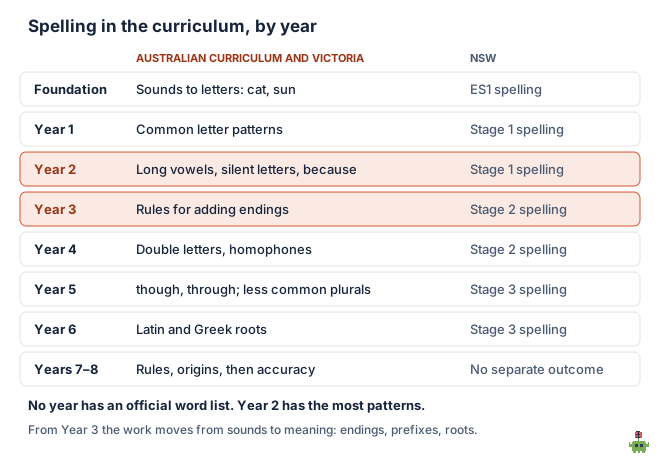
The Australian Curriculum does not give a spelling list for any year. It gives a sequence of patterns: sounds to letters in Foundation, common letter patterns in Year 1, long vowel patterns and tricky high-frequency words in Year 2, the rules for adding endings in Year 3, homophones and word origins in Year 4, and Latin and Greek roots in Year 6. Victoria follows the same order. NSW has one spelling outcome for each stage from Kindergarten to Year 6.
That matters for how you read your child’s spelling. A Year 2 child who writes “rane” for rain has heard every sound and chosen a real English pattern for the long a, just not the right one for this word. That is a Year 2 skill partway done, not a careless mistake. This page sets out what each year asks for, the five misspellings that tell you most about where your child is, a short dictation to find their level, and twenty minutes of practice that works better than copying a word out ten times.
What the curriculum asks for, year by year
The Australian Curriculum descriptors, quoted from ACARA:
- Foundation, AC9EFLY12 and AC9EFLY13: “write consonant–vowel–consonant (CVC) words by representing sounds with the appropriate letters”, and “use knowledge of letters and sounds to spell words”. Cat, sun, pig. A Foundation child who writes “kat” is doing exactly this.
- Year 1, AC9E1LY13: “spell one- and two-syllable words with common letter patterns”. Alongside it, AC9E1LY12 asks children to “understand that a letter can represent more than one sound and that a syllable must contain a vowel sound”, which is why a Year 1 teacher cares when “rabit” has a vowel in each part.
- Year 2, AC9E2LY10 and AC9E2LY11: vowel digraphs, “less common long vowel patterns, consonant clusters and silent letters”, and “words whose spelling is not completely predictable from their sounds, including high-frequency words”. This is the year of rain, light, knee and because. AC9E2LY12 adds “build morphemic word families using knowledge of prefixes and suffixes”: play, plays, played, playing, replay.
- Year 3, AC9E3LY10 and AC9E3LY11: “generalisations for adding a suffix to a base word” and “less common letter patterns to spell words”. The generalisations are the rules every adult half-remembers: drop the e (hope, hoping), double the last letter (hop, hopping), change y to i (try, tried).
- Year 4, AC9E4LY10 and AC9E4LY11: “letter patterns, including double letters, spelling generalisations, morphological word families, common prefixes and suffixes, and word origins”, and “high-frequency words including homophones and know how to use context to identify correct spelling”. Their, there, they’re is formally a Year 4 job.
- Year 5, AC9E5LY08 and AC9E5LY10: “words that share common letter patterns but have different pronunciations” (though, through, tough), and “less common plurals” (halves, potatoes, cacti).
- Year 6, AC9E6LY09: “word origins including some Latin and Greek roots, base words, prefixes, suffixes, letter patterns and spelling generalisations to spell new words including technical words”. Sign and signature, tele- and -graph.
- Years 7 to 10: Year 7 revisits rules and word origins (AC9E7LY08), Year 8 asks students to “apply learnt knowledge to spell accurately and to learn new words” (AC9E8LY08), and from Year 9 the spelling descriptors are about using non-standard spelling on purpose, for humour or an accent.
Two things follow. First, Years 1 and 2 are the heavy years: by the end of Year 2 a child is expected to handle most of the ways English writes its vowel sounds. Second, from Year 3 the work shifts from sounds to meaning. A child who still spells purely by sound in Year 4 will write “hoped” as “hopt”, because that is what it sounds like, and no amount of sounding out will fix it. What fixes it is knowing that -ed is a meaning unit that always marks the past, whatever it sounds like.
Where Victoria differs (the VCAA wording is paraphrased here, not quoted). Hardly at all. The Victorian Curriculum 2.0 spelling descriptions match the national ones level by level, from CVC words at Foundation (VC2EFLY05) to Latin and Greek roots at Level 6 (VC2E6LY04). The one addition worth knowing is that Victoria writes re-reading and editing for spelling into its own descriptions from Level 1 (VC2E1LY14) and Level 2 (VC2E2LY12): checking your own writing is part of the expectation, not an extra.
Where NSW differs (the NESA wording is paraphrased). The NSW English K–10 Syllabus has a separate Spelling outcome in each stage from Early Stage 1 to Stage 3: ENE-SPELL-01 in Kindergarten (taught familiar and high-frequency words), EN1-SPELL-01 for Years 1 and 2, EN2-SPELL-01 for Years 3 and 4 (which adds describing the strategy used) and EN3-SPELL-01 for Years 5 and 6 (applying the generalisations automatically and justifying how an unfamiliar word was spelt). From Stage 4 there is no standalone spelling outcome. The content underneath covers the same sounds, patterns and meaning units as the national sequence, but the NSW outcomes ask children to explain their choices earlier.
Five misspellings that tell you where your child is
1. “becos”, “wos”, “sed” (Years 1 and 2)
Every sound is there, written the most common way. This is a good sign: the child has the Foundation and Year 1 skill. These particular words are the ones AC9E2LY11 calls “not completely predictable from their sounds”, and they are learnt by noticing the odd part (because has an au where you hear an o) rather than by sounding out harder. Pick three a week, not twenty.
2. “rane” for rain, “lite” for light (Year 2)
The child knows the long vowel needs more than one letter and has picked a real pattern. The Year 2 work is learning which pattern goes where. A useful start: ai usually sits in the middle of a word (rain, train) and ay at the end (play, day). A word sort, below, teaches this faster than a list.
3. “hopeing”, “runing”, “hoping” for hopping (Year 3)
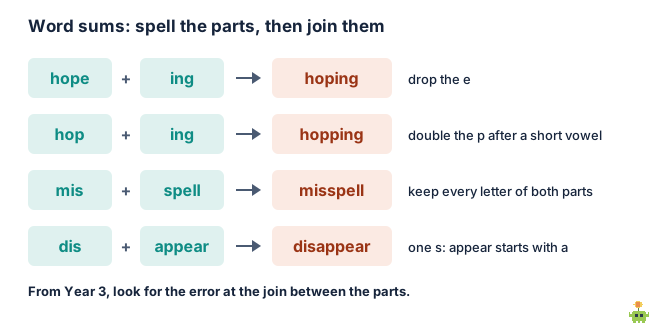
These are suffix errors, and they are Year 3 business (AC9E3LY10). The two rules that cover most of them: a word ending in a silent e drops it before an ending that starts with a vowel (hope + ing = hoping), and a short word with a short vowel and one final consonant doubles it (hop + ing = hopping). Mixing them up changes the word, which is a good way to show a child why the rule matters: hoping and hopping are different things.
4. “there” for their (Years 4 to 6)
Most adults still make this one when typing fast, so judge it on a piece of writing your child has checked, not a first draft. AC9E4LY11 asks for the use of context: the fix is a meaning hook for each word. Their has heir in it, a person who owns something. There has here in it, a place.
5. “mispell”, “dissappear” (Years 5 and 6)
The child is spelling the whole word by ear and the join between prefix and base word is where letters go missing or double up. Split the word into its parts: mis + spell keeps both s’s, dis + appear has only one, because appear does not start with s. This is the Year 5 and 6 move from sound to meaning, the “base words, prefixes, suffixes” of AC9E5LY09 and AC9E6LY09. The same idea explains a silent letter: the g in sign is the one you hear in signature.
A ten-word dictation to find the level
Say each word, then a short sentence with it, then the word again. Your child writes only the word. No practice first. The words are grouped by the year they belong to, so the first group with a wrong word is where to start.
- Foundation and Year 1: shop, jump. A child who writes “sop” for shop needs the digraph sh; “jup” for jump means the m in the blend is not being heard. Say it slowly together, tapping a finger for each sound.
- Year 2: rain, light, because. Wrong answers 1 and 2 above. Phonetic attempts here are expected early in Year 2 and should be fading by the end of it.
- Year 3: hoping, running. Wrong answer 3. Ask your child to write the base word first, then add the ending.
- Year 4: “The children put on their coats.” Wrong answer 4.
- Year 5 and 6: halves, misspell. “Halfs” is the less common plural not yet known; “mispell” is wrong answer 5.
A Year 2 child who spells shop and jump and attempts the rest by sound is where the curriculum expects them to be partway through Year 2. A Year 4 child who gets the Year 3 words wrong is not behind on everything; they are missing one rule, and it is a quick one to teach. If your child sat the Year 1 Phonics Check, its result lines up with the first two groups, and our guide to reading the Phonics Check score shows what each part tested.
Want spelling practice built around your child’s interests? Sprout writes a lesson on the exact code, such as AC9E3LY10 for adding endings, with the words drawn from the things they love. Try it free.
Twenty minutes that works better than copying words out
Writing a word ten times practises the hand, not the pattern. The curriculum describes spelling as knowing sounds, patterns and meaning units, so practise those.
- Five minutes: sort. Write eight words on cards that share a sound but not a spelling, for example rain, play, train, day, paint, stay, wait, tray. Your child sorts them into two piles and tells you the rule they notice (ai in the middle, ay at the end). Finding the rule sticks better than being told it.
- Five minutes: word sums. For Year 3 and up, write the parts and let your child build the word: hope + ing, hop + ing, un + help + ful. They say what happened at each join.
- Five minutes: the tricky part. For one tricky word, ask your child to find the part that does not sound the way it is spelt and underline it. In because that is au. Then they write it from memory, check, and write it again.
- Five minutes: use it. One sentence with three of the week’s words, read back aloud. Proofreading their own sentence is the habit Victoria writes into Level 1.
What is not the problem
- Invented spelling in Foundation and Year 1. “Kat” and “dinosor” show a child hearing sounds and writing them down, which is the skill. Correcting every one stops them writing.
- A low score on a school spelling list. Lists test memory for those words that week. The dictation above tests which pattern your child can use on a word they have not practised, which is what the curriculum describes.
- Poor spelling in a fast first draft. Look at what they fix when they re-read. If they find most of their own errors, the knowledge is there.
If spelling difficulties come with real trouble reading words aloud, at any age, talk to the school: the two share the same sound-letter knowledge, and our page on reading programs covers what good phonics teaching looks like. If the problem is that your child avoids writing altogether, see when a child hates writing.
Where this sits
Spelling sits in the Literacy strand of English, beside reading and writing. For the whole of a year level, see what a Year 3 student should know or Year 4; for every English code in a year, see the teacher-facing Year 3 English codes page. If you are not sure which curriculum your child’s school uses, start with which curriculum your state uses.
The short version
- No year has an official word list. Each year adds patterns and rules.
- Foundation: sounds to letters. Year 1: common patterns. Year 2: long vowels and tricky words.
- Year 3: the rules for adding endings. Year 4: homophones and word origins.
- Year 5: less common plurals. Year 6: Latin and Greek roots.
- NSW: one spelling outcome a stage, Kindergarten to Year 6, with more explaining.
- Practise patterns with sorts and word sums, not by copying a word ten times.
Sprout makes a lesson on the spelling code your child is working on, with words and sentences from their own interests. Start free.
How this page was checked
The Australian Curriculum descriptors are quoted from our copy of version 9.0, which matches the Year 4 English content descriptions on the Australian Curriculum website. The Victorian codes are from the Victorian Curriculum F–10 version 2.0 and the NSW codes from the NSW English K–10 outcomes, both paraphrased. The example words and the dictation are our own, chosen to match each descriptor. Checked 20 October 2026.
Australian Curriculum content descriptions are © Australian Curriculum, Assessment and Reporting Authority (ACARA) 2010 to present, licensed under CC BY 4.0, and quoted here unmodified. ACARA does not endorse any product that uses the Australian Curriculum. Victorian Curriculum codes reference the Victorian Curriculum F–10 Version 2.0 © VCAA, paraphrased; the VCAA does not endorse this product. NSW outcome codes reference the NSW syllabuses © NSW Education Standards Authority (NESA) for and on behalf of the Crown in right of the State of New South Wales, paraphrased, available at curriculum.nsw.edu.au; NESA does not endorse this product.
FAQ
Is there an official spelling list for each year in Australia?
No. The Australian Curriculum, the Victorian Curriculum and the NSW syllabus describe spelling patterns, rules and strategies for each year, not lists of words. Schools that send home weekly lists choose the words themselves, usually to practise that year's pattern.
What spelling should a Year 2 child know in Australia?
By the end of Year 2 the Australian Curriculum expects vowel digraphs, less common long vowel patterns, consonant clusters and silent letters (AC9E2LY10), plus words whose spelling is not predictable from their sounds, such as because (AC9E2LY11), and word families built with prefixes and suffixes (AC9E2LY12). Phonetic attempts such as rane for rain are normal early in the year.
When do kids learn spelling rules like drop the e or double the letter?
Year 3. AC9E3LY10 names the generalisations for adding a suffix to a base word: drop a silent e before an ending that starts with a vowel (hope, hoping), and double the final consonant after a short vowel (hop, hopping). Victoria teaches them at Level 3 as well.
Why does my child spell words the way they sound?
Because that is the first skill the curriculum teaches, in Foundation and Year 1. From Year 2 children learn the words that do not follow their sounds, and from Year 3 they learn to spell by meaning: endings such as -ed, prefixes and base words. A Year 4 child who still spells only by sound usually needs the meaning units, not more sounding out.
How do I check my child's spelling level at home?
Dictate ten words grouped by year: shop and jump (Foundation to Year 1), rain, light and because (Year 2), hoping and running (Year 3), their in a sentence (Year 4), and halves and misspell (Years 5 and 6). The first group with a wrong word is where to start practising.