
Tell them to talk, and you do the writing. Say you will be the secretary, ask the question, and write down exactly what comes out, without correcting anything. If a decent piece of writing appears, then your child does not hate writing. They hate handwriting, or spelling, or both, and those are a different problem with a different fix.
This is the most useful ten minutes you can spend on it, and it separates the two things that get confused. Composing is having something to say and putting it in an order. Transcription is getting it onto the page: letter formation, spelling, capital letters, periods. A child doing both at once, when one of them is not yet automatic, has nothing left over for the part that matters.
The standards keep them separate, and so should you
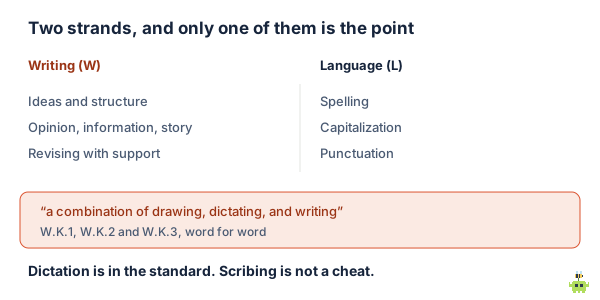
In Common Core, spelling and punctuation are not writing standards at all. They live in the Language strand, and the wording is identical from kindergarten to grade 4: “Demonstrate command of the conventions of standard English capitalization, punctuation, and spelling when writing.”
The Writing strand is a separate set, about opinion pieces, informative texts and narratives, about organization, and about revising. At grade 3 there are nine Writing standards and six Language standards, in different parts of the document.
Why this matters at your kitchen table: if every piece of writing your child produces comes back graded for spelling, you are assessing the Language strand and reporting it as writing. Do that for two years and a child concludes, reasonably, that writing is a thing they are bad at, when what they are actually bad at is spelling.
Dictation is in the standard
All three kindergarten writing standards begin the same way. W.K.1, W.K.2 and W.K.3 each ask the child to “use a combination of drawing, dictating, and writing” to compose an opinion piece, an informative text and a narrative respectively.
Dictating. Written into the standard, three times. Scribing for a child is not a crutch or a soft option, it is the named method for composing before transcription is automatic. The standards simply stop mentioning it after kindergarten, because most children no longer need it. If yours does, you are using an approach the curriculum itself specifies.
The same is true of help generally. The grade 3 organization standard opens “With guidance and support from adults”, and the grade 4 revision standard opens “With guidance and support from peers and adults”. Independent writing is not what is being asked for at that age.
Three tests, in order
- Scribe for them. If a good piece comes out when you write it down, the problem is transcription. Go to the transcription fixes below and stop treating this as a writing problem.
- Ask them to just talk about something they love. Not for writing, just talk. If they are fluent and interesting about their game or their animal or their sport, the ideas are there and the machinery works. If the talking is also thin, this is a knowledge problem rather than a writing one, and the fix is reading and talking about the subject first. The same logic applies as in reading without comprehension: you cannot write your way out of not knowing anything about the topic.
- Ask what happens after they finish a piece. If the answer is that it comes back covered in corrections, you have found the cause and no technique will help until that changes. A child who knows the piece will be graded is not writing, they are producing evidence against themselves.
If it is transcription
- Separate the two jobs in time. Compose first, by talking or scribing or typing badly. Fix spelling later, as a separate task, on a piece that already exists. Never in the same pass.
- Let them type. For a child whose handwriting is slow or effortful, a keyboard removes most of the load immediately. Handwriting is worth practicing on its own; it is not worth having as the tax on every idea.
- Allow invented spelling in a first draft. Tell them explicitly that spelling does not count in the draft. Some children need permission stated out loud before they believe it.
- Keep scribing for the hard pieces even past the age you think you should have stopped, and gradually hand over: they write the first sentence, you write the rest, then they write two.
If it is the blank page
- Never start from “write about X”. Start by talking about X for two minutes. The writing then begins from a conversation rather than from nothing, which is a completely different task.
- Write the first sentence for them. Starting is the expensive part; continuing is cheap. Handing over a started page removes almost all of the resistance.
- Make the piece short and real. Four sentences to an actual person beats a page for nobody. The routine writing standard asks for writing over both short and extended time frames, so short pieces are not a compromise, they are half the requirement.
If it is the red pen
- Stop correcting everything. Pick one thing per piece. Capital letters this week, nothing else, even when you can see three other errors.
- Respond to the content first, and mean it. Say something specific about what they wrote before mentioning anything else. Specific matters: “good job” does not land, “I did not know that about hammerhead sharks” does.
- Let some pieces go ungraded. Not everything is a draft toward a corrected final version. Revising is its own standard, applied to some pieces, not a thing done to all writing forever.
- Give it a real reader. A letter to a grandparent, a review posted somewhere, a set of instructions someone will follow. Writing that goes to a person behaves differently from writing that goes to a parent for grading.
What not to do
- Do not require more writing to fix hating writing. Volume works on a child who can already compose. On a child paying a transcription tax, it is more minutes of the thing that hurts.
- Do not fix spelling inside a first draft. Interrupting a composing child to spell a word throws away what they were holding, and it teaches them that the sentence they had matters less than the spelling of one word in it.
- Do not use writing as a punishment or a consequence. It is remarkably common and it is not recoverable in a single term.
- Do not accept “I do not know what to write” at face value. It is almost always either no starting point or fear of being wrong, and both have a fix. Ask them to tell you instead, and listen to what comes out.
The short version
Scribe for them. If a good piece appears when you hold the pen, your child does not hate writing, they hate transcription, and the two are separate strands in the standards for a reason: spelling and punctuation are Language standards, composing is a Writing standard.
Dictating is written into all three kindergarten writing standards, so scribing is the named method rather than a soft option. Compose first and fix spelling later, always as two passes. Start from a conversation rather than a blank page. Correct one thing per piece and respond to the content first.
And find a real reader. Almost every child who hates writing has only ever written for someone who was going to mark it.
Sprout Lessons builds writing tasks around whatever your child is already into, which solves the blank page before it starts. Start free.
Standard wording in this guide was taken from our copy of the Common Core dataset, accessed 2026-07-16, not written from memory. Read the official text at the Common Core English Language Arts standards. Common Core State Standards © 2010 National Governors Association Center for Best Practices and Council of Chief State School Officers. All rights reserved. This product is not endorsed by NGA/CCSSO. This page is about ordinary reluctance: persistent, severe difficulty with handwriting or spelling is worth raising with your doctor or school, because dysgraphia and dyslexia are real and diagnosable.
FAQ
How do I tell if my child hates writing or hates handwriting?
Scribe for them. Say you will be the secretary, ask the question and write down exactly what they say without correcting anything. If a decent piece appears, the ideas and the structure were never the problem and you are looking at transcription: letter formation, spelling, capital letters. A child doing both jobs at once, when one of them is not yet automatic, has nothing left over for the composing.
Is scribing for my child cheating?
No, and the standards say so directly. All three kindergarten writing standards ask the child to use a combination of drawing, dictating, and writing to compose their opinion pieces, informative texts and narratives. Dictating is written into the standard three times. The standards stop mentioning it after kindergarten because most children no longer need it, so if yours does, you are using the method the curriculum itself specifies.
Should I correct spelling in my child’s writing?
Not in a first draft, and not in the same pass as composing. In Common Core, spelling and punctuation are not writing standards at all: they sit in the Language strand, whose wording is identical from kindergarten to grade 4, demonstrate command of the conventions of standard English capitalization, punctuation, and spelling when writing. Composing is the separate Writing strand. If every piece comes back graded for spelling, you are assessing Language and reporting it as writing, and a child concludes they are bad at writing when they are bad at spelling.
Will more writing practice help?
Only for a child who can already compose. For a child paying a transcription tax, more writing is more minutes of the thing that hurts, and it is how reluctance becomes refusal. Fix what is actually blocking it first: separate the two jobs in time, let them type if handwriting is effortful, allow invented spelling in drafts, and keep scribing the hard pieces while gradually handing over a sentence at a time.
My child says they do not know what to write. Is that true?
Almost never at face value. It is usually either no starting point or fear of being wrong, and both have a fix. Ask them to tell you about it instead and listen to what comes out, because a child who is fluent in conversation and frozen on paper has a starting problem rather than an ideas problem. Talk for two minutes first, write the first sentence for them, and keep the piece short.
How much help am I allowed to give?
More than most parents assume. The grade 3 standard on producing organized writing opens with the words with guidance and support from adults, and the grade 4 revision standard opens with guidance and support from peers and adults. Independent writing is not what is being asked for at that age. Give a real reader too: a letter to a grandparent or a set of instructions someone will follow behaves completely differently from writing that goes to a parent for grading.