To teach a child to read at home in Australia, follow one systematic synthetic phonics sequence from Foundation to Year 2, use decodable books that match it, and keep the lesson to about 20 to 30 minutes a day. That is what the curriculum asks for, and since 2025 it is how Victorian government schools teach early reading too.
This page sets out what the Victorian Curriculum and the Australian Curriculum expect at each level, what a phonics sequence actually looks like at the kitchen table, the three wrong answers that tell you something has gone off track, where the Year 1 Phonics Check fits for a homeschooled child, what to look for in a reading program, and how to record progress for a VRQA learning plan.
What the curriculum expects for reading, Foundation to Level 2
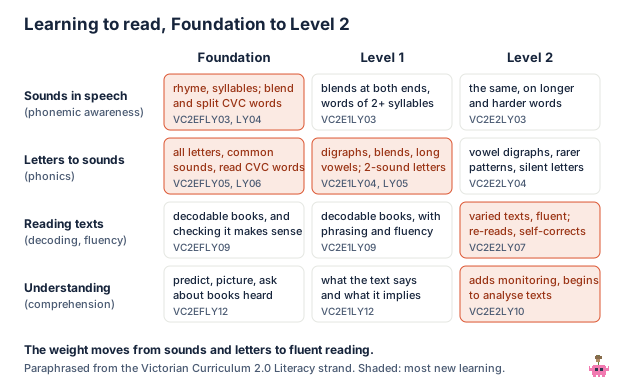
Victoria calls Years 1 and 2 “Level 1” and “Level 2” in the Victorian Curriculum 2.0, and Foundation is what most families know as Prep. Learning to read sits in the Literacy strand of English, which has 15 content descriptions at Foundation, 15 at Level 1 and 13 at Level 2. Not all of them are about reading (some cover speaking, writing and handwriting), but four threads run through all three levels, and they are the four things a home reading program has to cover.
Foundation (Prep)
- Sounds in speech. Hearing syllables, rhymes, alliteration and individual sounds in spoken words (VC2EFLY03), then blending, splitting and swapping the sounds in one-syllable words out loud (VC2EFLY04). No letters are involved yet: this is all done by ear.
- Letters to sounds. Knowing every upper- and lower-case letter and the most common sound each one makes (VC2EFLY06), and using that to read and spell consonant-vowel-consonant words such as sat, pin and mud (VC2EFLY05).
- Reading texts. Reading decodable and authentic books with the phonics the child has learnt so far, and checking that what they read makes sense (VC2EFLY09). A handful of high-frequency words are learnt alongside (VC2EFLY07).
- Understanding. Picturing, predicting, connecting, summarising and asking questions about books that are read to them, watched or read on their own (VC2EFLY12).
Level 1 (Year 1)
- Sounds in speech. Victoria puts blending, segmenting and manipulating into one code, VC2E1LY03, and stretches it to words with consonant blends at the start and end (stop, lamp) and words of more than one syllable.
- Letters to sounds. Short vowels, common long vowels, consonant blends and digraphs such as sh, ch and th in one- and two-syllable words (VC2E1LY04). The big idea of the year arrives in VC2E1LY05: one letter can stand for more than one sound, and every syllable needs a vowel sound.
- Reading texts. Decodable and authentic books again, but now with phrasing and fluency as well as accuracy (VC2E1LY09).
- Understanding. The same strategies as Foundation, now used to build both what the text says and what it implies (VC2E1LY12).
Level 2 (Year 2)
- Sounds in speech. Blending, segmenting and manipulating used on longer and harder words (VC2E2LY03).
- Letters to sounds. Vowel digraphs (ai, ee, oa), less common long vowel spellings, consonant blends and silent letters (VC2E2LY04), plus spelling patterns and word parts for words that do not sound the way they are spelt (VC2E2LY05).
- Reading texts. The word “decodable” drops out. Children read different kinds of texts with phrasing and fluency, and fix their own mistakes by re-reading (VC2E2LY07).
- Understanding. Monitoring is added to the strategy list, and children begin to analyse texts (VC2E2LY10).
The same expectations in the Australian Curriculum
Families registered outside Victoria work from the Australian Curriculum (AC9), and it lines up closely. The national wording, quoted directly, is a useful one-line test for each year. At Foundation, children “write consonant–vowel–consonant (CVC) words by representing sounds with the appropriate letters, and blend sounds associated with letters when reading CVC words” (AC9EFLY12). In Year 1 they “use short vowels, common long vowels, consonant blends and digraphs to write words, and blend these to read one- and two-syllable words” (AC9E1LY11). By Year 2 they “read texts with phrasing and fluency, using phonic and word knowledge, and monitoring meaning by re-reading and self-correcting” (AC9E2LY04).
The one structural difference worth knowing: AC9 splits Year 1 sound work into two codes, segmenting (AC9E1LY09) and adding, deleting and substituting sounds (AC9E1LY10), where Victoria keeps it as one. The teaching is the same. If you are matching a program to codes, our pages on every Foundation English code, Level 1 English and Level 2 English go through each one.
What systematic synthetic phonics means, and why the order matters
“Synthetic” means the child learns the sounds that letters and letter groups stand for, then synthesises (blends) them from left to right into a word: s, a, t, sat. “Systematic” means the letter-sound patterns are taught in a planned order, each one practised until it is secure, with earlier ones reviewed all the time, rather than picked up as they happen to appear in books.
This is no longer a fringe position. Since Term 1 2025, the Victorian Department of Education says, its government schools have taught early reading from Prep to Year 2 with a systematic synthetic phonics approach, with at least 25 minutes of daily phonics teaching, alongside explicit teaching of oral language, vocabulary, fluency and comprehension (Victorian teaching and learning: information for parents). The Australian Government’s Department of Education describes phonics as the most effective way, according to the studies it cites, of teaching children to read words accurately and fluently, while stressing it is one part of reading alongside phonemic awareness, vocabulary, fluency and comprehension.
At home, a typical sequence starts with a small group of letters that make lots of real words quickly (many programs begin with something like s, a, t, p, i, n, which already gives sat, tip, pan and nap), then adds the remaining single letters, then digraphs (sh, ch, th, ck), then blends, then long vowel spellings. The order matters because every book your child reads should use only patterns they have already been taught. That is what a decodable book is, and it is why the sequence and the readers have to belong together.
Three wrong answers worth recognising
- Reading the picture, not the word. The page says “The dog sat on the mat” and your child reads “The puppy sat on the rug”. The meaning is right and the letters were never looked at. Cover the picture, put a finger under the first letter of dog, and ask for the sounds. Decodable books exist so that sounding out always works, which is what makes looking at the letters worth it.
- Letter names instead of sounds. Your child says “see, ay, tee” and cannot get to cat, because the names do not blend. Teach the sound first and the name later; Foundation asks for both (VC2EFLY06), but only the sound reads.
- The extra “uh”. “Buh, a, tuh” blends to something like butter, not bat. Model clipped sounds (a short b with no vowel after it) and stretchable sounds held long (sssss, mmmmm), which are easier to blend.
In Year 1 a fourth one appears, and it is a sign of progress rather than a problem: a child who reads snow to rhyme with cow has learnt one sound for ow and not yet the second. That is VC2E1LY05 in action. Tell them it is a letter group with two sounds, try both, and pick the one that is a real word.
The Year 1 Phonics Check: what it is and which states use it
Checked 14 October 2026. The Year 1 Phonics Check is a short one-to-one assessment in which a child reads 40 words aloud: 20 real words and 20 made-up ones. The made-up words are the point. A child cannot have memorised vap or shug, so reading them shows whether they can actually decode. In Victoria it takes 5 to 7 minutes, runs in Weeks 4 to 6 of Term 3, and a score of 28 to 40 is “at or above expected level” (Victorian Year 1 Phonics Check). In the 2025 pilot, 84.9% of Victorian Year 1 students took part and 59.1% reached that level.
Where it stands, by state, as far as we could verify from each government’s own pages:
- Victoria: optional pilot in 2025; in 2026 all government schools are required to run it with Year 1, with an optional reassessment in Year 2.
- New South Wales: mandatory in public schools since 2021, according to the department’s own research reports.
- South Australia: introduced in 2018, after a 2017 trial.
- Tasmania: first statewide check in Term 3 2024, across government, Catholic and independent schools.
- Queensland: announced for Year 1 in July 2025.
- Western Australia, the ACT and the Northern Territory: we could not verify a current position in this check, so ask your local school or department.
Does a homeschooled child sit it? The Victorian requirement is written for government schools, and the Victorian pages say nothing about home education; we found nothing that requires a registered home-educated child to take it. You can still use it. The Australian Government’s free Year 1 Phonics Check sits on its Literacy Hub, and the department says families have a phonics check and a reading awareness check to do at home. Run it around the middle of Year 1 and it gives you an outside benchmark that no program’s own quizzes can.
Three questions before you move on
Use these at the end of each level, or whenever reading seems to stall:
- Say “What do you get if you say slip without the l?” No answer, or “lip”, means the sound work is not secure yet. Go back to oral games, with no letters, for a week before adding new spelling patterns.
- Show five made-up words from patterns already taught (dop, shem, blig). If your child turns them into real words (“drop”, “shell”), they are guessing from memory. Slow down and point under each letter group.
- Ask “What happened, and why?” after a short book. If the reading was accurate but the answer is blank, the decoding is fine and the gap is comprehension: spend more time reading aloud to them and talking about it, not more phonics.
Choosing a reading program for home
If you are choosing a homeschool curriculum in Australia, reading is the one area in the early years where a structured program usually earns its place, because writing your own phonics sequence from scratch is a lot of work to get right. You do not need a particular brand. You need a program that does these things:
- A published sequence you can see in full, listing which letter-sound pattern comes in which lesson.
- Decodable readers matched to that sequence, so every book uses only patterns already taught. If the books come from somewhere else, check each one against the sequence.
- Oral sound work (blending, segmenting, swapping sounds) built into each lesson, not saved for a separate unit.
- Short daily lessons with constant review, so old patterns come back every day.
- Spelling and handwriting tied to the same patterns, because reading and writing a pattern in the same week is how it sticks.
- Checkpoints that tell you when to move on and when to repeat.
A program can be excellent and still not suit your child, so judge it by your child after four weeks, not by the sample pages. Books built on repeated sentence patterns and picture cues are lovely for reading aloud together; for independent practice in Foundation and Level 1, pair any program with decodables.
Once the code is in place, practice works best on things your child cares about. Sprout Lessons builds an interactive lesson from a Victorian Curriculum or AC9 English code such as VC2E1LY04, wrapped around your child’s current obsession, with the code recorded in the footer for your records.
A 25-minute daily routine
Victorian schools give phonics at least 25 minutes a day, and that is a sensible ceiling at home too, split like this:
- Sound game, 3 minutes. Oral only: “Say fish. Now change the f to d.”
- Review, 4 minutes. Flash the letter cards for every pattern taught so far, oldest first.
- New pattern, 6 minutes. One new letter-sound pattern, modelled, then read in five or six words.
- Decodable book, 8 minutes. Your child reads; you point, wait and prompt with “sound it out”, never “look at the picture”.
- Dictation, 4 minutes. Say three words with today’s pattern for your child to write.
Then, separately and at any time of day, read aloud to your child from books well above what they can decode. That is where vocabulary and comprehension grow while decoding catches up.
When levels split. A homeschooled six-year-old decoding at Level 1 can easily be understanding stories at Level 2 or beyond. That is normal. Teach phonics where they are and comprehension where they are, and record each against its own code.
Recording progress for a VRQA learning plan
A Victorian home education learning plan has to cover eight learning areas, English among them; our guide to homeschool registration in Victoria covers the plan itself. For reading, a few things make the English section easy to write and easy to show:
- The sequence you follow, named in the plan, with the levels it covers.
- A dated log of patterns taught, each with its code: “sh, ch, th, VC2E1LY04, week of 12 May” says far more than “phonics”.
- A recording of your child reading aloud each term, from the same kind of book, so the growth in fluency is audible.
- Dictation samples and, in Year 1, the result of the Literacy Hub phonics check.
- A list of books read aloud to them, which is the comprehension and vocabulary half of the plan.
If you want the practice side handled, Sprout Lessons turns any Foundation, Level 1 or Level 2 English code into a ready-to-use lesson with the code already in the footer, so the log above partly writes itself. Try it free.
How this page was checked
Curriculum expectations were taken from the Victorian Curriculum F–10 Version 2.0 (paraphrased) and the Australian Curriculum Version 9.0 (quoted). The Victorian teaching approach and the Year 1 Phonics Check details were checked on 14 October 2026 against the Victorian Government’s Phonics Check page and information for parents, and the Australian Government’s Year 1 Phonics Check page. Other states’ positions come from their education departments’ own published reports and announcements, and can change; check with your state before relying on them.
Curriculum codes reference the Victorian Curriculum F–10 Version 2.0 © VCAA. The curriculum can be accessed directly at f10.vcaa.vic.edu.au. The VCAA does not endorse this product. Always verify against the current content descriptions and achievement standards.
© Australian Curriculum, Assessment and Reporting Authority (ACARA) 2010 to present, unless otherwise indicated. This material was downloaded from the Australian Curriculum website (accessed 2026-06-24) and was not modified. The material is licensed under CC BY 4.0. ACARA does not endorse any product that uses the Australian Curriculum.
FAQ
What is the best way to teach a child to read at home in Australia?
Follow one systematic synthetic phonics sequence, teach each letter-sound pattern in a planned order, and give your child decodable books that only use patterns already taught. Keep it to about 20 to 30 minutes a day, and read aloud to your child separately from harder books for vocabulary and comprehension. Victorian government schools have taught early reading this way from Prep to Year 2 since Term 1 2025, with at least 25 minutes of phonics a day.
What should a homeschool reading program include?
A published sequence you can see in full, decodable readers matched to that sequence, oral sound work (blending, segmenting and swapping sounds) in every lesson, short daily lessons with constant review, spelling and handwriting tied to the same patterns, and checkpoints that tell you when to move on. You do not need a particular brand.
Do homeschooled children have to do the Year 1 Phonics Check?
In Victoria the requirement is written for government schools, and as at 14 October 2026 we found nothing requiring a registered home-educated child to sit it. You can still use it: the Australian Government's Literacy Hub has a free phonics check that families can do at home, which makes a useful outside benchmark around the middle of Year 1.
Which states use the Year 1 Phonics Check?
As at 14 October 2026: South Australia since 2018, New South Wales public schools since 2021, Tasmania statewide since 2024, Victorian government schools as a requirement in 2026 after a 2025 pilot, and Queensland from an announcement in July 2025. We could not verify a current position for Western Australia, the ACT or the Northern Territory.
What should I record about reading for a VRQA learning plan?
Name the phonics sequence you follow, keep a dated log of the patterns taught with their Victorian Curriculum codes, record your child reading aloud once a term from the same kind of book, keep dictation samples and the Year 1 phonics check result, and list the books you read aloud to them.