Australian families choosing an online homeschool program are really choosing between six kinds of option: a government virtual school (which is school enrolment, not homeschooling), a full online program, a packaged curriculum, a tutoring service, the free curriculum plus your own resources, or a lesson tool like Sprout. They cost anything from nothing to several hundred dollars a child a year, and in Victoria all but the first can be named in the learning plan you lodge with the VRQA. This page compares them honestly, with every price checked on 14 October 2026, so you can pick one and move on.
If you have not yet settled which framework you plan against, start with choosing a homeschool curriculum in Australia. If you have not yet registered, read how to start homeschooling in Australia first. This page assumes you know you want to home educate and are now deciding what to buy, if anything.
First, decide whether you want home education or school at home
This is the distinction most comparison lists skip, and it changes everything downstream. When a parent searches for an online homeschool program, some of what comes back is a school.
Virtual School Victoria is the state’s government school for students who cannot attend a regular school, taught online and face to face. Its direct enrolment page says there are no enrolment fees for eligible students, and it is just as clear that “It is not possible to be both registered for home schooling and enrolled as a VSV student at the same time.” Enrolment is limited to set categories (medical, travel, elite sport or performance, distance, previous home schooler, young adult), and the previous home schooler category only opens at Year 10, for a child who has been registered with the VRQA for 12 months or more and is returning to a government school.
So if your child is eligible and you want teachers to set and mark the work, a virtual school may be the better answer, and it is free. But it is school. You are not homeschooling, you do not write a learning plan, and you do not choose the program. Every other option on this page is the opposite: you are the one registered, and the program is something you pick and name. Other states run their own government distance education schools with their own eligibility rules, and the same line applies to every one of them.
The five options that are actually homeschooling
1. A full online program (for example, Euka)
A full online program gives your child a complete daily program for a grade, delivered through a website, with the sequencing done for you. Euka is the best-known Australian example. Its own site says it runs from a preparatory program through to Grade 12, with curriculums aligned across all seven states.
What it costs. Euka’s Grade 1 page (the Western Australia version, which we checked on 14 October 2026) lists A$697 a year paid upfront, or A$237 a term. Its help centre says the price varies by grade, and that a Government Registration Service and Premium Reporting are optional extras on top. Their prices were not published on the pages we checked, so ask before you budget for them.
What it does better than everything else here. It removes the planning. If the thing keeping you awake is “what do we do on Monday”, a complete program across every learning area answers that, and the optional registration help is something none of the cheaper options offer.
Watch for: a program paced for a grade assumes your child sits in that grade in every subject, and a homeschooled child often does not. Check how it handles a child who is a year ahead in reading and a year behind in maths before you pay for a year.
2. A packaged curriculum (for example, My Homeschool)
A packaged curriculum is a graded set of books and plans for a year level, often with an online members’ area, that a parent teaches from. My Homeschool is an Australian example covering Foundation to Year 10.
What it costs. Its programs page listed Foundation to Year 4 at A$340 to A$750, Year 5 at A$340 to A$780, and Years 7 to 9 at A$440 to A$950, including GST, on 14 October 2026. The page does not say what separates the low and high ends of each range, so ask for the prospectus before comparing it with anything else.
What it does better: it is something physical you can hold, open on the table and teach from, with a community of families using the same books. For a parent who wants to teach rather than supervise a screen, that matters.
Watch for: it is the parent who delivers it, so it saves planning time but not teaching time.
3. A tutoring service (for example, Cluey)
A tutoring service puts a person in front of your child for a subject or two, usually online. Cluey is a large Australian example. Its pricing page covers Years 2 to 10 English and Maths, and Years 11 to 12 English, Maths, Chemistry, Biology and Physics, taught one to one.
What it costs. Cluey does not publish a fixed price. Its pricing page says the cost depends on what the student needs and the program it designs, and that you can start with two sessions without a long-term contract. Get a quote for your child.
What it does better: a human who notices things. If your child is stuck in a way you cannot diagnose, a good tutor is still the strongest option on this list.
Watch for: a tutor covers one or two learning areas, not a year. It is a supplement to a homeschool program, never the whole of it.
4. The free curriculum plus your own resources
The Victorian Curriculum and the Australian Curriculum are both published free online, in full. Download your child’s level, use it as a checklist, and fill the year with the library, museums, sport, excursions and free material. This is what a lot of experienced families end up doing after a first year on something paid.
What it costs: nothing for the curriculum. Our breakdown of what homeschooling costs in Australia covers the spending that turns up anyway.
What it does better: it fits your child exactly, because you build it around them. Watch for: all of the planning, sequencing and marking is yours.
5. A lesson tool (Sprout Lessons, which is ours)
We make one of these, so read this section with that in mind. Sprout Lessons is not a full program. It turns a topic, a year level and your child’s interests into an interactive lesson with worked examples and self-checking practice, and records the AC9, Victorian or NSW curriculum code the lesson covers in its footer. It fills the gap in options 2 and 4, where you have the plan but need the lesson for Tuesday.
What it costs. Every account gets 300 free credits a month, which is about 15 standard lessons. Paid plans are A$10, A$20 or A$30 a month for more. Victorian families also get Sprout Tutor, adaptive practice in English, Maths and Science for Years 1 to 10 of the Victorian Curriculum. It is in public beta, Victorian Curriculum only for now, and free on every plan, including the free one.
What it does not do: it does not plan your year, it covers three learning areas of eight in the tutor, and it is not a teacher. If you want the week planned for you, option 1 does that and we do not.
If the lesson-for-Tuesday gap is yours, try Sprout free: build one lesson for your child’s year level around something they love, and see whether the code in the footer is useful in your records.
The comparison in one table
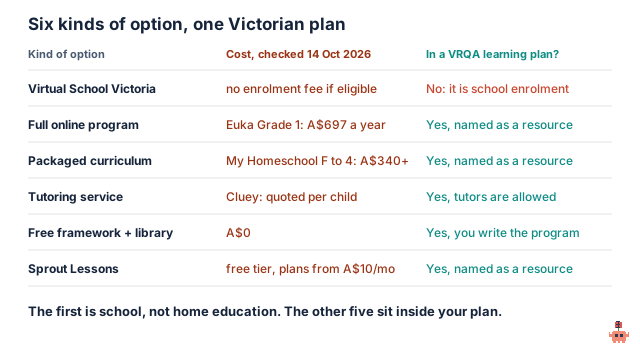
| Option | Example | Cost (checked 14 Oct 2026) | Who plans | Who teaches | In a VRQA learning plan? |
|---|---|---|---|---|---|
| Government virtual school | Virtual School Victoria | No enrolment fee if eligible | The school | The school | No, it is school enrolment |
| Full online program | Euka | A$697 a year or A$237 a term (Grade 1) | The program | The program, with you | Yes, named as a resource |
| Packaged curriculum | My Homeschool | A$340 to A$750 (Foundation to Year 4) | The program | You | Yes, named as a resource |
| Tutoring service | Cluey | Quoted per child | The tutor, for that subject | The tutor | Yes, tutors are allowed |
| Free framework | Victorian Curriculum | A$0 | You | You | Yes, you write it |
| Lesson tool | Sprout Lessons | Free tier; plans A$10 to A$30 a month | You | The lesson, with you | Yes, named as a resource |
Does it count for registration in Victoria?
The VRQA’s page on developing a home education learning plan (updated 8 September 2026) answers most of this directly:
- You do not have to follow the Victorian Curriculum or the Australian Curriculum, and you do not have to purchase a curriculum. No program on this page is required.
- “Doing online courses” is listed as an activity that can cover most key learning areas, so an online program is a legitimate part of a plan.
- If you engage a tutor for some subjects, you generally do not need an exemption for those learning areas.
- Resources must be named: “It is not enough to list resources as ‘books’ or ‘the internet’.” Write the program’s name and URL under each learning area it covers.
- “The VRQA do not endorse any commercial programs or curriculum.” No program can honestly claim to be VRQA approved, including ours.
The practical consequence is that no single product covers your plan on its own. The plan has to address all eight learning areas (English, Mathematics, Sciences, Humanities and Social Sciences, the Arts, Health and Physical Education, Languages, and Technology), and most products here cover a few of them well. We walk through how to write a product into Sections 2 and 4 of the plan in using apps and online programs in a Victorian learning plan, and the whole process, from the form to the one-in-ten review, is in homeschool registration in Victoria.
NSW and Queensland, briefly
New South Wales registers home schooling through the Department of Education (since 5 May 2025, not NESA), and your program is written against the NSW syllabuses. A program “aligned to the Australian Curriculum” still needs mapping to the NSW outcomes in your plan, so ask any provider how it handles NSW before you buy. See homeschool registration in NSW.
Queensland asks every registered family for a written report on the child’s progress each year, so the useful question there is what each program leaves behind that you can put in that report. See homeschool registration in Queensland.
How to choose, in five steps
- Rule the virtual school in or out. If your child is eligible for Virtual School Victoria and you want a school to carry the teaching, apply there and stop reading. If you want to home educate, carry on.
- Name the job you are hiring for. Planning the whole year (a full online program), a book to teach from (a packaged curriculum), one subject you cannot teach (a tutor), or lessons that fit a plan you already have (the free framework plus a lesson tool).
- Check the split-level case. Ask how the program handles a child working at different year levels across subjects, because that is the normal homeschool case and the one grade-paced products handle worst.
- Check what it leaves behind. For a Victorian review or a Queensland report, the useful program leaves dated work, results or records you can show, not just a login.
- Try before you pay for a year. Use a term plan, a trial session or a free tier first. The program your child will actually finish is worth more than the one that looked best on the website.
Most families end up blending two of these: a framework or packaged curriculum as the spine, and a tutor or lesson tool for the subjects that need more. That is a normal outcome, not a failure to choose.
The honest summary
If you want the planning done, a full online program is built for that. If you want to teach from books, buy a packaged curriculum. If one subject is the problem, hire a tutor for that subject. If money is tight, the free curriculum is a complete answer on its own. And if you have a plan and need the lesson, Sprout builds one in seconds, coded to the Victorian Curriculum, AC9 or NSW, with Sprout Tutor free in beta for Victorian families.
How this page was checked
Every price and provider fact on this page was checked against the provider’s own website on 14 October 2026: Euka’s Grade 1 (WA) page and help centre, My Homeschool’s programs page, and Cluey’s pricing page. The Virtual School Victoria rules are from its direct enrolment page, and the registration rules from the VRQA’s learning plan guidance linked above. Prices change; check the provider’s page before you pay. Sprout’s own prices are from our pricing at the same date.
FAQ
What online homeschool programs are there in Australia?
There are six kinds of option. Government virtual and distance education schools such as Virtual School Victoria, which are school enrolment rather than homeschooling. Full online programs such as Euka. Packaged curricula such as My Homeschool. Tutoring services such as Cluey. The free Victorian or Australian Curriculum plus your own resources. And lesson tools such as Sprout Lessons. Most families blend two of them.
Is Virtual School Victoria the same as homeschooling?
No. Virtual School Victoria is a government school, and its enrolment page says it is not possible to be both registered for home schooling and enrolled as a VSV student at the same time. It has no enrolment fee for eligible students, but enrolment is limited to set categories such as medical, travel, elite sport and distance, and the school sets and marks the work.
How much does an online homeschool program cost in Australia?
Checked on 14 October 2026: Euka listed Grade 1 at A$697 a year upfront or A$237 a term, with registration help as an optional extra. My Homeschool listed Foundation to Year 4 programs at A$340 to A$750. Cluey quotes tutoring per child. The Victorian and Australian Curriculum are free. Sprout Lessons has a free tier, with paid plans from A$10 a month.
Can I use an online program in my VRQA learning plan?
Yes. The VRQA lists doing online courses as an activity that can cover most key learning areas, and says engaging a tutor for some subjects generally needs no exemption. You must name each resource, not just write books or the internet, and the VRQA does not endorse any commercial program, so no product is VRQA approved.
Do I have to buy a homeschool curriculum in Victoria?
No. The VRQA says you do not have to follow the Victorian Curriculum or the Australian Curriculum, and you do not have to purchase a curriculum. Your learning plan has to address the eight learning areas, and it can do that with free resources, a paid program, or a mix of both.