
In six of Australia’s eight states and territories, a five-year-old doing the first year of school at home is still below compulsory school age, so you may not need to register at all until partway through the year. In Victoria that first year is called Foundation (or Prep), school becomes compulsory at 6, and you register with the VRQA from the start of the year your child turns 6, no later than the 6th birthday. Western Australia and Tasmania are the exceptions: there, the first year is already compulsory.
This page covers what each state calls the year, when the law starts to apply, what the curriculum actually expects of a five-year-old in English and maths, and what a first year at home looks like week to week, including how to write it into a Victorian learning plan. It is the first-year companion to choosing a homeschool curriculum in Australia.
Checked against the current rules as at 14 October 2026. Every age and registration rule below comes from the state’s own education department or regulator page, listed at the foot of this page.
What each state calls the first year, and when it becomes compulsory
Search for “homeschool kindergarten” in Australia and you will find American curriculum packages, because in the US kindergarten is the first year of school. Here the word means different things in different states. In New South Wales and the ACT, Kindergarten is the first year of primary school. In Victoria, “kinder” is the year before school, and the first school year is Foundation. Buying the wrong year is the most common first-year mistake, so start with the name your state uses.
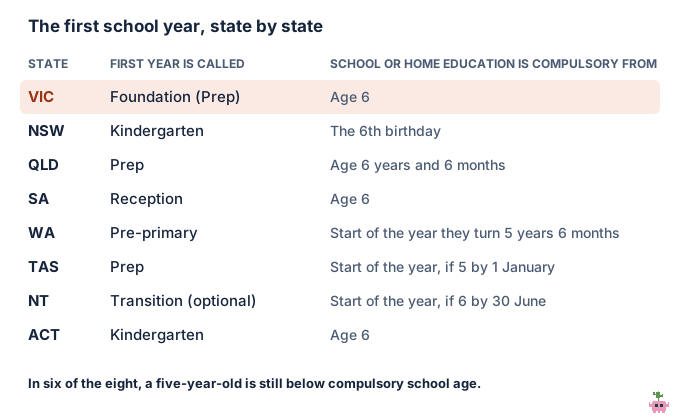
| State | First year | Compulsory from | Home education in the first year |
|---|---|---|---|
| Victoria | Foundation (Prep); starts if 5 by 30 April | Age 6 | Register with the VRQA from the start of the year your child turns 6, and by the 6th birthday. Assessment can take up to 28 days |
| NSW | Kindergarten; starts if 5 by 31 July | By the 6th birthday | You may register from the start of the year your child turns 5 (by 31 July); not required under 6 |
| Queensland | Prep; must be 5 by 30 June | 6 years and 6 months | Registration is open from 5 and a half |
| South Australia | Reception; term 1 if 5 before 1 May, term 3 if 5 between 1 May and 31 October | Age 6 | An exemption is only required from 6, and the child must already be enrolled at a school to apply |
| Western Australia | Pre-primary | Start of the year the child turns 5 years 6 months | Pre-primary is compulsory, so register with the Department of Education first |
| Tasmania | Prep | Start of the year, if 5 by 1 January | Prep is compulsory, so home education must be approved through the Education Registrar |
| Northern Territory | Transition (optional) | Start of the year, if 6 on or before 30 June | Transition is optional; from compulsory age you need approval first, the child stays enrolled until approved, and approval lasts one school year |
| ACT | Kindergarten; must be 5 by 30 April | Age 6 | Registration covers ages 6 to 17 |
Two rows need care. Western Australia’s department publishes the compulsory start but not a registration deadline on the page we checked, so ask your regional education office before you start (more in homeschooling in WA). And in South Australia home education is an exemption from attending a school your child is already enrolled at, so a Reception-age child is enrolled first and the exemption follows (see homeschooling in South Australia). For every state, the full process is on homeschooling requirements in Australia.
Victoria: when you actually have to register
The VRQA says you can start home education at the beginning of the year your child turns 6, or by their 6th birthday, and that children aged 6 to 17 must otherwise be enrolled at a school. Combine that with the Foundation entry rule (a child can start if they turn 5 by 30 April) and the birthday decides your first year, assuming your child starts Foundation at the earliest age they can:
- Birthday between 1 January and 30 April. Your child turns 5 early in the Foundation year and does not turn 6 until the next calendar year. The whole Foundation year at home sits below compulsory age. You register for the following year, when they turn 6.
- Birthday between 1 May and 31 December. Your child is too young to start Foundation in the year they turn 5, so they start the following year and turn 6 during it. You can register from 1 January of that year and must be registered by the 6th birthday.
Assessment can take up to 28 days, and the VRQA says children of compulsory age must stay enrolled at a school while it decides. Apply at least a month before the 6th birthday. The application, the learning plan and the review are all covered in registering to homeschool in Victoria.
Even in a year you do not have to register, write the year down as if you did. A first year that left dated work samples makes the first learning plan easier to write, because you are describing a child you have already taught rather than guessing.
What the curriculum expects in the first year
Victoria uses the Victorian Curriculum F–10 Version 2.0. Most other states teach the Australian Curriculum (Version 9), and NSW has its own syllabuses (if you are not sure which applies, see which curriculum your state uses). At Foundation the Victorian and national versions are close: both have 29 English content descriptions and 12 Maths content descriptions, and the codes line up one for one (VC2MFN04 matches AC9MFN04). The differences are small and specific, and they are listed below.
Maths: 12 descriptions, and half of them are number
Six of the 12 Victorian Foundation Maths descriptions are in Number, and they are the year. In plain terms, a Victorian child at the end of Foundation should be able to:
- name, show and put in order numbers from zero to at least 20, with objects and numerals (VC2MFN01)
- see how many are in a small group of up to 5 without counting (VC2MFN02)
- count collections to at least 20 to say how many and which has more, and explain how they know (VC2MFN03)
- split and join collections up to 10 and name the parts (VC2MFN04)
- act out adding and taking away with objects, including simple money situations (VC2MFN05)
- share fairly and make equal groups with objects (VC2MFN06)
The other six cover repeating patterns and following a short sequence of instructions (VC2MFA01), comparing length, capacity, mass and duration directly and ordering the days of the week and times of day (VC2MFM01, VC2MFM02), shapes and position (VC2MFSP01, VC2MFSP02), and sorting objects to answer a question with only two possible answers (VC2MFST01).
Three of those carry something the national version does not: the sequence of instructions in VC2MFA01, money in VC2MFN05, and the two-answer limit in VC2MFST01. For comparison, the Australian Curriculum’s subitising description reads, in full, “recognise and name the number of objects within a collection up to 5 using subitising” (AC9MFN02), and its part-part-whole description is “partition and combine collections up to 10 using part-part-whole relationships and subitising to recognise and name the parts” (AC9MFN04). The teacher-level detail for each code is on Foundation Maths in the Victorian Curriculum and Foundation Maths in the Australian Curriculum.
English: phonics carries the year
The 29 Victorian Foundation English descriptions split into 9 Language, 5 Literature and 15 Literacy. The Literacy strand is where most of a home week goes. Paraphrased, it asks a child to hear syllables, rhymes and the separate sounds in spoken words (VC2EFLY03), to blend and break apart one-syllable words out loud (VC2EFLY04), to name every upper- and lower-case letter and know its most common sound (VC2EFLY06), to read and spell simple three-sound words such as consonant-vowel-consonant words (VC2EFLY05), to read decodable books (VC2EFLY09) and to form most letters correctly (VC2EFLY15). Alongside that, a child retells stories through play, drawing and writing (VC2EFLE05) and learns that a capital letter starts a sentence and a punctuation mark ends it (VC2EFLA09).
The national version asks for the same skills in a different order. Its CVC description reads “write consonant–vowel–consonant (CVC) words by representing sounds with the appropriate letters, and blend sounds associated with letters when reading CVC words” (AC9EFLY12). The code-by-code guide is Foundation English in the Victorian Curriculum.
NSW Kindergarten: Early Stage 1
In NSW the first year is Early Stage 1, with 16 Maths outcomes and 11 English outcomes. The mathematics is close to the national version with two differences you will notice at home: Early Stage 1 asks children to read hour time on a clock, and to find half a length and the halfway point. Neither appears in the Foundation descriptions above. English is organised by skill (phonological awareness, phonic knowledge, handwriting, reading fluency and so on) rather than by strand. See Early Stage 1 Maths for the outcomes.
The three skills that decide how Year 1 goes
Most of the first year is play with a purpose, and most of it goes fine. Three skills do not, and each has a wrong answer you can recognise at the kitchen table.
- Seeing small numbers without counting (VC2MFN02). Roll a die and ask how many. A child who has it says “five” at once. A child who does not touches every dot, often counts the centre dot twice, and says “six”. The fix is short flashes: show a card of dots for two seconds, hide it, ask how many. Stay at 1 to 3 until the answer is instant, then add 4 and 5.
- Parts of a whole (VC2MFN04). Put 7 counters down, hide some under a cup, and show the 4 that are left. Ask how many are under the cup. A child without part-part-whole says “7”, or “4”, because they can only name a collection they can see. This is the foundation of subtraction in Year 1. Work with 5 first (five fingers, a five-frame), then 10.
- Blending sounds into a word (VC2EFLY04). Your child says “kuh”, “a”, “tuh” perfectly and then guesses “cake” from the picture. The extra “uh” on each sound is the problem: the word no longer sounds like cat. Model short, clipped sounds (“k”, not “kuh”), stretch the vowel (“caaat”), and cover the picture while they read.
A realistic first year at home
A Foundation child does not need a school day. Short, focused sessions with lots of play between them cover the curriculum above with time to spare, and a five-year-old’s attention, not the timetable, is the limit. This is the shape we suggest:
- Phonics, 10 to 15 minutes a day. One new letter-sound or blend, practice on the ones before it, then a decodable book read aloud.
- Maths, 10 to 15 minutes a day. One idea with objects: dot cards, a five-frame, sharing snacks fairly, a shop corner with real coins.
- Reading aloud, 15 to 20 minutes. Stories, poems and information books, talked about as you go. This covers most of the Literature strand.
- Handwriting, 5 minutes, three or four days a week. Letter formation, little and often.
- One longer project or outing a week. A garden bed, a library visit, a nature walk with a sorting question at the end. This is where science, the arts, HASS and health and physical education live.
That is under an hour of sit-down learning a day, four days a week. When something runs long (blending is the usual one), cut the new content, not the practice: a child who reaches the end of the year blending three-sound words confidently is in a better place than one who has “done” every letter team.
When your child is ahead in one subject. Home-educated children are often a year apart across subjects: reading like a Year 1 child and counting like a Foundation one. That is fine. Teach each subject at the level the child is at, and note it in the plan. The Foundation English codes and the Year 1 codes are both open to you.
If you want the lessons written for you, Sprout builds a ready-to-teach lesson from any Foundation code, such as VC2MFN04, themed around what your child already loves, with the code printed in the footer for your records. Try it free.
How to show a first year in a VRQA learning plan
When your child turns 6 you submit a learning plan with the registration. According to the VRQA’s own guidance, the plan needs to:
- outline the subject matter your child will cover across the eight learning areas, or name any area you want an exemption from, with a reason
- say where the education takes place, including regular outings
- say when it takes place; a brief sentence on the general timetable is enough
- say how you will record your child’s learning outcomes
- name specific resources; the VRQA says listing “books” or “the internet” is not enough
The VRQA’s sample plans are for children aged 7, 8, 10, 12 and 14, so there is no sample at age 6. For a first-year child, the week above translates directly. For English: “Daily systematic phonics using [named program], decodable readers, daily read-aloud and weekly library visits; handwriting practice three times a week.” For Mathematics: “Number to 20, subitising, part-part-whole to 10, patterns, measurement by direct comparison, shapes and position, using [named materials].” The schedule line can be as simple as “four mornings a week, with an outing on the fifth”. For records, name the method: a dated folder of work samples, photos of hands-on work, and reading logs.
A lesson that carries its curriculum code in the footer is exactly the kind of record that last line describes. For the rest of the setup, from deregistration to resources, see how to start homeschooling in Australia.
Sprout writes Foundation lessons from the Victorian or national code, personalised to your child’s interests, and keeps the code on every lesson so your learning plan evidence builds itself. Start free.
How this page was checked
Checked against the current rules as at 14 October 2026. Curriculum counts and descriptions were taken from our copies of the VCAA, ACARA and NESA datasets, not written from memory. Sources:
- Victoria: VRQA home education, VRQA learning plan guidance and Enrolling in Foundation (Prep)
- NSW: Starting school and home schooling requirements for registration
- Queensland: Enrolment age requirements and Home education
- South Australia: Primary school enrolment and the guide to home education in South Australia
- Western Australia: Education in WA
- Tasmania: When to enrol your child
- Northern Territory: Stages of schooling and Home education
- ACT: School age calculator and Home education
Rules change, and a department’s page beats this one. If anything here differs from your state’s current page, follow the state and tell us.
Victorian curriculum codes reference the Victorian Curriculum F–10 Version 2.0 © VCAA, paraphrased here. The curriculum can be accessed directly at f10.vcaa.vic.edu.au. The VCAA does not endorse this product.
© Australian Curriculum, Assessment and Reporting Authority (ACARA) 2010 to present, unless otherwise indicated. Quoted material was downloaded from the Australian Curriculum website (accessed 24 June 2026) and was not modified. The material is licensed under CC BY 4.0. ACARA does not endorse any product that uses the Australian Curriculum.
NSW outcome codes reference NSW syllabuses © NSW Education Standards Authority (NESA) for and on behalf of the Crown in right of the State of New South Wales, accessed via curriculum.nsw.edu.au. NESA does not endorse this product.
FAQ
Do I need to register to homeschool a five-year-old in Australia?
In most states, not yet. Victoria, NSW, South Australia and the ACT make school compulsory from 6, Queensland from 6 years and 6 months, and the Northern Territory from the start of the year a child is 6 by 30 June. Western Australia (Pre-primary) and Tasmania (Prep) are the exceptions: their first school year is compulsory, so you register before you start. Checked against each state's own pages on 14 October 2026.
When do I register to homeschool in Victoria?
The VRQA says you can start home education at the beginning of the year your child turns 6, or by their 6th birthday. Assessment can take up to 28 days and you submit a learning plan with the application, so apply at least a month before the 6th birthday. If your child's birthday falls between 1 January and 30 April, the whole Foundation year usually sits below compulsory age.
What is the first year of school called in each state?
Foundation (or Prep) in Victoria, Kindergarten in NSW and the ACT, Prep in Queensland and Tasmania, Reception in South Australia, Pre-primary in Western Australia and Transition in the Northern Territory. In Victoria, kinder means the year before school, which is why American "kindergarten" curriculum packages often do not match the year you are teaching.
What does the Foundation curriculum cover in maths and English?
Victorian Foundation Maths has 12 content descriptions, six of them in Number: numbers to at least 20, seeing up to 5 without counting, comparing collections, splitting and joining collections up to 10, adding and taking away with objects, and fair sharing. Foundation English has 29 descriptions, and most of the home week goes on phonics: letter sounds, blending and segmenting spoken words, reading and spelling consonant-vowel-consonant words, and decodable books.
How many hours a day should a Foundation child homeschool?
There is no set number of hours in the rules we checked. A workable pattern is under an hour of sit-down learning a day, four days a week: 10 to 15 minutes each of phonics and maths, 15 to 20 minutes of reading aloud, a few minutes of handwriting, plus one longer project or outing a week for science, the arts and HASS.