
In the Australian Curriculum, children learn to form letters in Foundation, write unjoined (print) letters in Years 1 and 2, and start joined writing, what most parents call cursive, in Year 3. Year 4 works on making joined writing fast and automatic, and then the national curriculum stops. Victoria carries handwriting on to Year 6. NSW teaches its own named style, NSW Foundation Style, and starts joining in Stage 2 (Years 3 and 4).
So a Year 2 child who still prints is right on time, and a Year 5 child who forms every letter correctly but slowly has a real gap, even though the national curriculum no longer mentions handwriting. This page sets out what each year asks for, the five habits that cause most of the trouble, four quick checks you can do at the kitchen table, and twenty minutes of practice built around letter families.
What the curriculum asks for, year by year
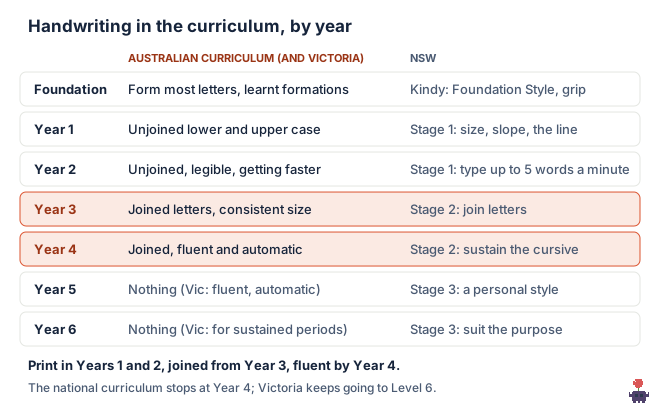
The Australian Curriculum content descriptions, quoted from ACARA:
- Foundation, AC9EFLY08: “form most lower-case and upper-case letters using learnt letter formations”. “Most” is deliberate: a Prep child who still muddles a few letters at the end of the year is meeting the standard.
- Year 1, AC9E1LY08: “write words using unjoined lower-case and upper-case letters”.
- Year 2, AC9E2LY08: “write words legibly and with growing fluency using unjoined upper-case and lower-case letters”. Still print. The new idea is speed without losing shape.
- Year 3, AC9E3LY08: “write words using joined letters that are clearly formed and consistent in size”. This is the cursive year.
- Year 4, AC9E4LY08: “write words using clearly formed joined letters, with developing fluency and automaticity”. Automaticity means writing without thinking about the letters, so all the thinking can go into what is being written.
- Years 5 and 6: no handwriting content description. Handwriting is not dropped in classrooms, but the national curriculum assumes it is done by the end of Year 4.
Where Victoria differs (the VCAA wording is paraphrased here, not quoted). Foundation to Level 4 match the national descriptions almost word for word (VC2EFLY15 to VC2E4LY12). The difference is at the top: the Victorian Curriculum 2.0 keeps going, asking Level 5 students to write legibly, fluently and automatically (VC2E5LY12) and Level 6 students to keep that up for sustained periods (VC2E6LY11). So in Victoria, a Year 5 or 6 child whose writing slows or falls apart over a page is working on a curriculum outcome, not a leftover. The curriculum does not name a letter style. Victorian schools generally teach Victorian Modern Cursive, the style the Victorian editions of school handwriting books follow; ask your school which it uses.
Where NSW differs (the NESA wording is paraphrased). The NSW English K–10 Syllabus is the most detailed of the three, and the only one that names a style:
- Kindergarten (Early Stage 1, ENE-HANDW-01): form every letter in NSW Foundation Style from the correct starting point and in the correct direction, with a stable posture (feet flat, writing arm on the table, the other hand holding the paper), a stable and relaxed pencil grasp, and the right pressure. Children also practise the strokes that make the letters: clockwise and anticlockwise ovals and a downward diagonal.
- Stage 1, Years 1 and 2 (EN1-HANDW-01): letters from memory with consistent size and slope, sitting correctly on the line with spaces between words, and typing: the syllabus asks Stage 1 children to type up to 5 familiar words per minute.
- Stage 2, Years 3 and 4 (EN2-HANDW-01): join letters, first in familiar words, then with consistent size and spacing, and sustain the NSW Foundation Style cursive across a whole text. Typing grows into using the keyboard to write whole texts.
- Stage 3, Years 5 and 6 (EN3-HANDW-01): a legible, fluent and personal style, adjusted to the purpose: neat for a final copy, quick for notes.
Five habits that cause most of the trouble
1. Starting letters in the wrong place (Foundation to Year 2)
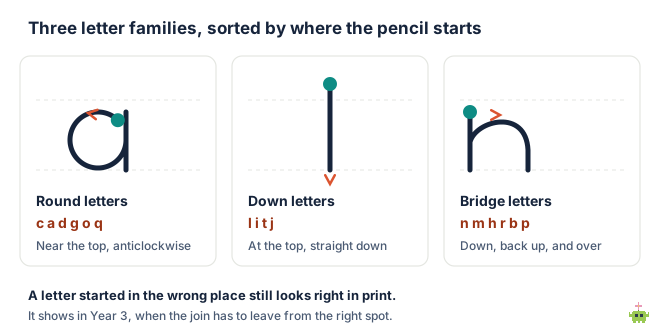
A child who draws an o from the bottom, or builds an a by drawing a circle and then a stick beside it, can produce a letter that looks fine. That is why the habit survives Years 1 and 2. It shows up in Year 3, when the join has to leave the letter from the right place: an a that ends at the bottom of a circle has nowhere to join from. Watch your child write, rather than looking at the finished page. The formation descriptor in Foundation (“learnt letter formations”) is about the movement, not the shape.
2. A fist grip or a white-knuckle grip (Foundation to Year 2)
NSW names it in Kindergarten: a grasp that is both stable and relaxed. A child who holds the pencil in a fist, or presses so hard that the paper tears and the hand aches after a few lines, will find speed impossible later. Short pencils, triangular pencils and pencil grips all help. If your child still cannot hold a pencil comfortably by the end of Year 1, mention it to the teacher, who may suggest an occupational therapy check.
3. Capitals in the middle of words (Years 1 and 2)
“My DoG is BiG.” The Year 1 description asks for lower-case and upper-case letters, which means knowing when to use each. Children often use a capital B and D because they are not yet sure which way the lower-case ones face. Fix the formation (the bridge family above for b, the round family for d) and the capitals usually disappear.
4. Letters that float, grow and shrink (Years 2 to 4)
Letters bouncing above the line, tall letters no taller than short ones, words run together. The Year 3 description asks for letters “consistent in size”, and NSW asks for correct position on the line and spaces between words from Stage 1. Dotted thirds paper (a middle band for small letters, with room above for tall ones and below for tails) does most of the work here.
5. Neat but slow (Years 4 to 6)
The child who writes beautifully for one sentence and then runs out of time, or whose writing collapses after half a page. This is the fluency and automaticity the Year 4 description names, and it is the hardest one to see because the work looks good. It matters, because a child spending effort on letters has less left for ideas. Our page on spelling by year makes the same point about spelling: the aim is that it stops needing attention.
Four checks to find where your child is
Do these by watching, not marking. Stop at the first one that goes wrong; that is where to start.
- Foundation and Year 1. “Write the alphabet in small letters.” Watch where the pencil starts for a, d, o and n. Right: a, d and o start near the top and go anticlockwise; n goes down first. Starting at the bottom is habit 1.
- Year 2. “Write your full name and address.” Right: lower-case letters with capitals only at the start of names, all sitting on the line. Capitals in the middle are habit 3.
- Year 3. “Write the, and and going, joined up.” Right: one continuous movement for each word, with a pen lift allowed where your school’s style has one. A child who joins some letters and breaks between others is normal early in Year 3.
- Year 4 and up. Ask your child to copy the same two sentences twice: once carefully, once as fast as they can. Right: the fast copy is a bit messier but every word is readable. If the fast copy falls apart, fluency (habit 5) is the gap.
A Year 2 child who cannot join is not behind: joined writing is Year 3. A Year 3 child who joins slowly is not behind either; fluency is Year 4.
Want writing practice they will actually want to do? Sprout writes a lesson set in your child’s world, from dinosaurs to the footy, on the exact Year 3 or Year 4 English description. Try it free.
Twenty minutes with letter families
You need lined paper (dotted thirds if you can print it), a pencil, and a whiteboard or a tray of sand for the first step.
- Three minutes: the strokes. Big anticlockwise ovals, straight downstrokes, and down-up-and-over bridges, on a whiteboard or in sand. These are the movements every letter is built from, and NSW teaches them in Kindergarten.
- Seven minutes: one family. Pick one family from the picture above and write each letter in it three times, saying the movement aloud: “start at the top, around, back up, and down” for a. One family a session, never the whole alphabet.
- Five minutes: one join (Year 3 and up). Practise one join until it is easy: in, an, un share the same bridge join; th, ch, sh share another. Joins come in families too.
- Five minutes: write something real. A shopping list, a note to a grandparent, a footy team. The point of handwriting is writing, and a child who only ever copies rows of letters learns to write rows of letters.
What is not the problem
- Printing in Year 2. Every curriculum keeps Year 2 unjoined. Joining early is not a goal.
- Left-handedness. Left-handers can meet every description. Tilt the paper the other way, hold the pencil a little higher, and sit them on the left of a right-hander.
- Typing. It is not instead of handwriting, and it is not cheating: NSW teaches it from Year 1.
- Messy rough drafts. Stage 3 in NSW explicitly asks children to adjust their handwriting to the purpose. Quick notes are allowed to look quick.
If you homeschool
Pick one style and stick to it from the start, because changing letter shapes in Year 3 costs more than learning either style. If your child may go back to school, the style your state’s schools use is the sensible choice. Handwriting samples dated across the year are also the simplest work samples there are for a homeschool portfolio.
Where this sits
Handwriting sits in the Literacy strand of English, next to spelling. Our page on spelling by year covers the other half of getting words onto paper. For the whole picture of a year level, see what a Year 3 student should know, and for every English code in a year, the teacher-facing Year 3 English Victorian codes page. If you are not sure which curriculum applies, start with which curriculum your state uses.
The short version
- Foundation: forming letters. Years 1 and 2: unjoined print, getting faster.
- Year 3: joined writing. Year 4: joined writing that is fluent and automatic.
- The Australian Curriculum stops at Year 4; Victoria continues to Level 6.
- NSW names NSW Foundation Style, joins in Stage 2 and teaches typing from Stage 1.
- Watch the starting point of each letter: it is what makes joining possible later.
Sprout makes a lesson on the exact description your child is working on, in their own interests. Start free.
How this page was checked
The Australian Curriculum descriptions are quoted from our copy of version 9.0, which matches AC9E3LY08 on the Australian Curriculum website; we checked every Foundation to Year 10 English description for handwriting and found none after Year 4. The Victorian codes are from the Victorian Curriculum F–10 version 2.0, and the NSW content from the NSW English K–10 handwriting content pages for Early Stage 1 to Stage 3, both paraphrased. Checked 20 October 2026.
Australian Curriculum content descriptions are © Australian Curriculum, Assessment and Reporting Authority (ACARA) 2010 to present, licensed under CC BY 4.0, and quoted here unmodified. ACARA does not endorse any product that uses the Australian Curriculum. Victorian Curriculum codes reference the Victorian Curriculum F–10 Version 2.0 © VCAA, paraphrased; the VCAA does not endorse this product. NSW outcome codes reference the NSW syllabuses © NSW Education Standards Authority (NESA) for and on behalf of the Crown in right of the State of New South Wales, paraphrased, available at curriculum.nsw.edu.au; NESA does not endorse this product.
FAQ
When do kids learn cursive in Australia?
In the Australian Curriculum and the Victorian Curriculum, joined writing starts in Year 3 (AC9E3LY08: joined letters that are clearly formed and consistent in size) and becomes fluent and automatic in Year 4. In NSW, joining letters is Stage 2 content, in Years 3 and 4. Years 1 and 2 use unjoined print.
What handwriting style is taught in Victorian schools?
The Victorian Curriculum does not name a style. Victorian schools generally teach Victorian Modern Cursive, which is the style the Victorian editions of school handwriting books follow. Ask your school which style it uses, so practice at home matches.
Is handwriting still taught in Year 5 and 6?
The Australian Curriculum has no handwriting content description after Year 4. The Victorian Curriculum continues: Level 5 asks students to write legibly, fluently and automatically, and Level 6 asks them to sustain it. NSW Stage 3 (Years 5 and 6) asks for a legible, fluent and personal style adjusted to the purpose.
Should my Year 2 child be doing joined writing?
No. Year 2 in every Australian curriculum is still unjoined: the Year 2 description asks for legible, increasingly fluent writing with unjoined letters. Joined writing starts in Year 3. What matters in Year 2 is that each letter starts in the right place, because that is what makes joining possible later.
Do kids learn typing at school in Australia?
In NSW, yes, from Stage 1: the English syllabus asks children in Years 1 and 2 to type up to 5 familiar words per minute, building to typing whole texts in Stage 2. Typing is taught alongside handwriting, not instead of it.