
Yes, a child can repeat a year in a Victorian government school, but only in exceptional circumstances and only if both the principal and the family agree. A school cannot make your child repeat without your consent, and asking does not mean it will happen: the principal must meet you, weigh the evidence and give you a decision. The rule is the same for Prep as for Year 5.
Term 4 is when this question comes up, because the report is coming and next year’s classes are being formed. Term 4 ends on Friday 18 December 2026, and students start the 2027 year on Thursday 28 January. This page sets out what the Department of Education’s Repeating a Year Level policy actually says, what the principal has to weigh, what the research it cites found, and the option most families have not been offered yet: keeping your child with their class while one subject is taught at the level they are really working at.
Who decides, in one picture
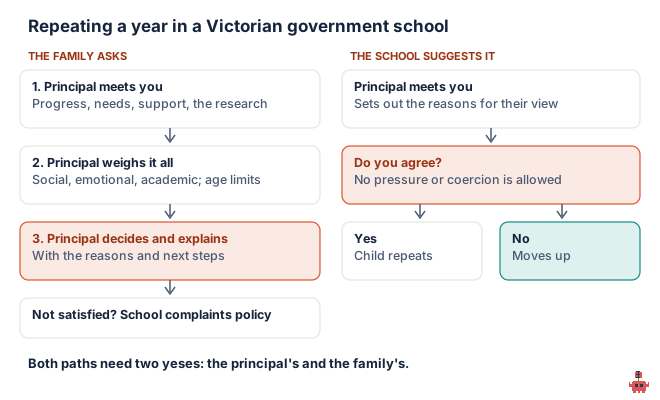
The policy starts from one default: students move up with their peer group. Repeating is the exception, and it has two locks on it. The principal has to judge that it is in your child’s best interest, and the family has to agree. Either side can stop it.
If you are the one asking
You can ask the school for your child to repeat. When you do, the principal (or someone they delegate, often an assistant principal or the wellbeing leader) has to follow three steps:
- Meet with you and talk through your child’s progress, their emotional and academic needs, the support they get now and could get, any documents you bring, and the Department’s summary of the research.
- Reach a decision after weighing all of that. Principals are encouraged to seek advice from their senior education improvement leader and from Student Support Services.
- Tell you the decision, with the reasons and the next steps to support your child, and tell your child too where that is appropriate.
If the answer is no and you are not satisfied with how the request was considered, you can make a complaint under the school’s complaints policy. The policy does not give parents the power to insist: it gives them the right to be heard properly.
If the school suggests it
A principal can also form the view, from staff advice or their own observation, that a student should repeat. They must meet you (and your child where appropriate) and explain why. Then the policy is blunt: if you do not agree, the principal cannot require your child to repeat, and must not pressure or coerce you into agreeing. Saying no is a complete answer. What you should ask for instead is in the next section but one.
What the principal has to weigh
The policy names three things a principal must consider:
- Your child’s social, emotional and academic needs, all three, not just the reading level.
- School age limits later on. An extra year early can matter at the far end, if it would stop a student finishing a senior secondary certificate at the school before they reach the maximum school age.
- The research on repeating, which the Department summarises for principals and for families.
That third point is why the default is so firm. The research summary the policy points to is not neutral about it.
What the research says, and who it hits hardest
The Department’s family information sheet summarises the studies it relies on, including the Evidence for Learning Teaching and Learning Toolkit, which pooled 71 studies. Children who repeat a year, on average:
- make about three months’ less progress over the year than similar children who moved up;
- are unlikely to catch up with peers of a similar level who moved on, even after the extra year;
- can lose confidence, come to dislike school, and show more challenging behaviour;
- are absent more, more likely to leave school early and less likely to go on to tertiary study.
The sheet also lists who loses most: children from disadvantaged backgrounds, children from culturally and linguistically diverse backgrounds, and children who are relatively young in their year group. That last group is the one that surprises parents, because “they are young for the year” is usually the reason given for repeating. In Victoria a child can start Prep if they turn five by 30 April, so the youngest in any class are the January to April birthdays. Our guide to whether your child is ready for Prep sets out what that means month by month, and it is the better point to make the decision: holding a child back a year before Prep is a choice families can make, repeating Prep afterwards is the exception the policy describes.
None of this says no child should ever repeat. The policy allows it in exceptional circumstances, and a long illness, a move from overseas mid-year, or a major event in the family are the kinds of situation where a school may agree. What the evidence says is that “behind in reading” on its own is rarely fixed by doing the whole year again.
The option to ask for first: one subject at a different level
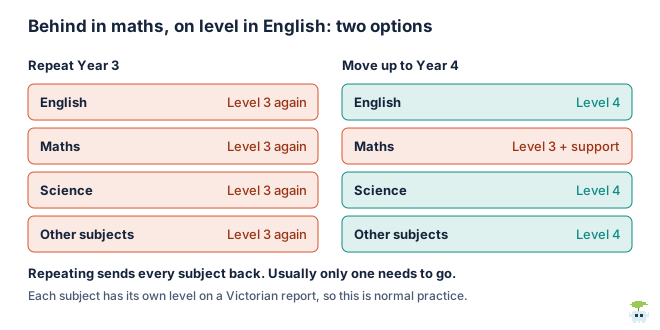
Repeating a year sends every subject back, including the ones your child is fine in. The Victorian Curriculum does not work that way. It is written as levels, Foundation to 10, not as years, so a Year 4 class can teach a child Level 3 maths while they do Level 4 English with everyone else. The school report already shows this: each subject gets its own level score, and our guide to reading a Victorian school report explains what a score half a level below “expected” means. Teaching at a different level is normal practice, and our page on working at a different level in the Victorian Curriculum shows how it looks in a classroom.
So before (or instead of) asking for a repeat, ask the school for the targeted version:
- which subject, which strand, and which level your child is working at in each;
- what extra support they will get in that subject next year, how often and with whom;
- whether an Individual Education Plan would help, which the policy lists alongside it, so the goals are written down and reviewed;
- for a child with a disability or suspected learning difficulty, whether the school has referred them to Student Support Services for assessment.
Six questions to take to the meeting
Whether you are asking or the school is, the meeting the policy requires is your chance to get specifics. Bring your child’s last two reports and any work samples you have.
- “Which subjects are you worried about, and at what level is my child working in each?” If the answer is one subject, repeating the whole year is a big tool for a small job.
- “Is this about learning, wellbeing, or both?” The policy requires the principal to weigh social and emotional needs, not just academic ones. A child who is anxious or isolated needs a wellbeing plan whichever year they are in.
- “What support has been tried this year, and what would be different next year?” Repeating with the same support tends to produce the same result.
- “What would the extra year mean at the other end of school?” The principal must consider school age limits for finishing a senior certificate.
- “If we decide not to repeat, what is the plan?” Get it in writing, with a date to review it. An IEP is one way.
- “When will you tell us the decision?” The policy requires the principal to communicate it to you. Ask for it before the end of Term 4, so you know your child’s class before the holidays.
Moving schools to repeat
Some families try a different route: change schools and start the new one a year lower. The policy covers that too. When a child moves from one government school to another with the aim of repeating, the principal of the new school decides which year level they are enrolled in, after talking with you and, where appropriate, your child. With your consent, they may also talk to the current principal. Moving does not get around the policy: the same principal judgement applies at the other end.
Senior secondary: spreading the VCE instead
In senior secondary school the question changes shape. The policy notes that most students complete the VCE through 16 to 20 units over two years, but that units can be accumulated over any number of years. So a Year 11 or 12 student who is struggling, for health or any other reason, may not need to repeat a year at all: spreading their units over a longer time can do the same job. If that is your situation, talk to the school’s VCE coordinator as well as the principal.
Catholic, independent and homeschooled children
The Repeating a Year Level policy applies to Victorian government schools. Catholic and independent schools set their own policies, and most also start from moving students up with their peers. Ask the school for its policy in writing before the meeting.
If you homeschool, there is no year to repeat: you register with the VRQA and teach at the level your child is ready for, subject by subject. If you are bringing a child back to school and wondering where they will be placed, our guide to returning to school after homeschooling covers what schools look at.
What to do over the summer, whatever is decided
Whether your child repeats or moves up, the work is the same: find the one precise skill in the subject that worried the school and practise it a little, often. For maths, our guide to whether your child is behind in maths shows how to find the exact gap, and learning over the Victorian summer holidays has a plan that fits around a real family summer.
Want practice at the level your child is really working at? Sprout writes lessons on any Victorian Curriculum level, set in the things your child already loves. Try it free.
The short version
- Students move up with their class unless there are exceptional circumstances.
- Repeating needs the principal and the family to agree. The school cannot require it.
- If you ask, the principal must meet you, weigh the evidence and tell you the decision.
- The research the policy cites finds about three months’ less progress on average, with the worst effects for children young in their year.
- Ask first for one subject at a different level, with support and a written plan.
- Moving to a new government school to repeat: the new principal decides the year level.
How this page was checked
The rules on this page were checked on 20 October 2026 against the Department of Education’s Repeating a Year Level policy in the Policy and Advisory Library (last updated 6 October 2025), its resources page and the family information sheet, which the resources page also offers in Easy English and 34 other languages. Term dates are from vic.gov.au. Policies change, so check with your school before relying on a detail.
Policy requirements are paraphrased from the Department of Education’s Policy and Advisory Library, © State of Victoria (Department of Education), at www2.education.vic.gov.au (accessed 2026-10-20). Curriculum levels refer to the Victorian Curriculum F–10 Version 2.0 © VCAA. Neither the Department nor the VCAA endorses this product.
FAQ
Can my child repeat a year in Victoria?
In a Victorian government school, yes, but only in exceptional circumstances and only when the principal and the family both agree that repeating is in the student's best interest. The Department of Education's Repeating a Year Level policy says students should otherwise move up with their peer group.
Can a school make my child repeat a year?
No. If a principal thinks a student should repeat, they must meet the family and explain why, but if the parent or carer does not agree, the principal cannot require the student to repeat, and must not pressure or coerce the family into agreeing.
How do I ask for my child to repeat Prep or another year?
Ask the school. The principal or their delegate must meet with you to discuss your child's progress, needs and support, consider the research on repeating, then tell you the decision and the next steps. If you are not satisfied with how your request was considered, you can complain under the school's complaints policy.
Does repeating a year help a child catch up?
On average, no. The research the Department summarises, including a review of 71 studies, found that students who repeat make about three months less progress over the year than similar students who move up, and are unlikely to catch up. The effects are worst for children who are young in their year group.
What can we do instead of repeating a year?
Ask for the subject your child is behind in to be taught at the level they are working at, with extra support and a written plan such as an Individual Education Plan. The Victorian Curriculum is written as levels, and each subject gets its own level on the report, so a child can move up with their class and still work at an earlier level in one subject.