
To start Prep at a Victorian government school in 2027, your child must turn 5 by 30 April 2027, and school is compulsory from age 6. Your child does not need to read, write or know their letters first: those are what the Foundation year itself teaches, by the end of the year. The only real choice about timing is for children born between January and April.
Most “is my child ready for Prep” lists are written as if there were an entry test. There is not. What the school receives instead is a transition statement from your child’s kinder, and what the teacher works to is the Victorian Curriculum for Foundation, which describes where children should be in December, not in January. This page sets out the age rule as a table of birth months, what Prep actually teaches, what the teacher sees about your child before day one (including the part you write), which checks come in Prep and Year 1, and a short list of games for the summer that line up with the first things Prep teaches.
The age rule, by birth month
The Victorian Government’s Foundation (Prep) enrolment page gives two dates: a child must turn 5 by 30 April of the year they start, and school is compulsory once a child has turned 6. The state’s starting-school guide adds that exemptions to the age policy exist but are very rare. Put those two rules against a calendar and every Prep class in 2027 is made of children born between 1 May 2021 and 30 April 2022, plus any January to April 2021 children whose families waited a year.
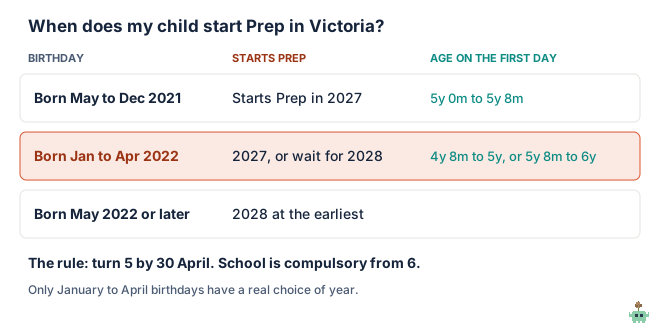
Three things follow that the enrolment page does not spell out:
- A Prep class spans a whole year of age. The child born on 30 April 2022 starts at 4 years 8 months; the child born on 1 May 2021 starts at 5 years 8 months and turns 6 in Term 2. At this age a year is a fifth of a lifetime, so much of the gap you see between children at drop-off is birthdays, not ability.
- The choice only really exists for January to April birthdays. A child born later in the year who waited would turn 6, the age school becomes compulsory, before the next school year began. A January to April child can start at 4 years 8 months to 5, or a year later at close to 6.
- Waiting is not the same as repeating. A child who starts in 2028 is simply in the 2028 Foundation class. Their reports will be compared with the curriculum for Foundation, like everyone else’s.
If you are weighing it up for an early-year birthday, the kinder teacher who knows your child is the best person to ask, and the school can tell you how its Prep program runs. Our honest view is that the curriculum gives no reason to hold back a child because they cannot yet read, since reading is the job of the year.
Not enrolled yet? It is not too late
The statewide timeline asked families to apply by Friday 31 July 2026, with offers in August. That date was for the coordinated round, not a cut-off: the enrolment page says applications after 31 July are processed by the school as they are received, and your child has a right to a place at their local government school, decided by your permanent home address. Find your zoned school on the Find My School site, then call it. You will need evidence of your child’s identity and date of birth (a birth certificate or passport), their Immunisation History Statement, and contact, emergency and health details.
What Prep teaches, so your child does not need it on day one
Victorian government schools teach the Victorian Curriculum F–10, version 2.0. Its Foundation level has 29 content descriptions in English and 12 in Mathematics. These describe what children learn during Prep. Here they are in plain English (the VCAA wording is paraphrased, not quoted), each with its code so you can match it to a report or a teacher’s note.
Reading and writing, by the end of Prep:
- Hear the parts of spoken words: clap syllables, spot rhymes and words that start the same way, and pick out single sounds (VC2EFLY03). Then blend sounds into a word, split a word into its sounds, and swap one sound for another, all out loud (VC2EFLY04).
- Know every capital and lower-case letter by name, and the most common sound each letter or letter group makes (VC2EFLY06).
- Use those sounds to read and spell three-sound words like cat, sun and pig (VC2EFLY05), and read and write a few high-frequency words (VC2EFLY07).
- Read decodable books and some ordinary books, checking that what they read makes sense (VC2EFLY09).
- Write most letters using the formation the school teaches (VC2EFLY15), and write short pieces about ideas and events (VC2EFLY13), knowing that names and sentences start with a capital and sentences end with a full stop (VC2EFLA09).
Maths, by the end of Prep:
- Say, show and order numbers from zero to at least 20 (VC2MFN01), and count and compare collections to at least 20 (VC2MFN03).
- See how many there are in a group of up to 5 without counting, which teachers call subitising (VC2MFN02), and split and join groups up to 10, such as 7 as 5 and 2 (VC2MFN04).
- Act out adding, taking away and simple money situations with real objects (VC2MFN05), and share things out equally (VC2MFN06).
- Compare which is longer, holds more, is heavier or takes longer, by putting things side by side (VC2MFM01), and order the days of the week and the parts of a day (VC2MFM02).
- Copy and continue patterns, and name and sort familiar shapes (VC2MFA01, VC2MFSP01).
Read that list again with January in mind. Naming every letter, reading cat, writing a sentence with a full stop, counting a pile of 18 counters: these are the outcomes of the year. A child who arrives able to do some of them is ahead; a child who arrives able to do none of them is exactly where the curriculum expects to start. Our Foundation English and Foundation maths pages list every code in full, and the Victorian Curriculum explained covers how the levels work after Prep.
What the teacher sees before day one: the transition statement
If your child is at a funded kindergarten, their kinder teacher writes a Transition Learning and Development Statement (TLDS) in the second half of the kinder year. Every child going to school from a funded kinder program must have one. It is what the Prep teacher reads about your child before they meet, and parents mostly hear about it in a single line of a newsletter. What is worth knowing:
- It is not a report card. The Department describes it as a summary of your child’s learning, interests and ways of learning, written in a strength-based way, to help the Prep teacher plan.
- One section is yours. Educators write Section 1, your child completes Section 2 with an adult’s help, and the family writes Section 3. This is your one formal chance to tell the school something before term starts.
- You can see it and you can say no to sharing it. The kinder must give you the secure link to the finished statement and the chance to opt out of it going to the school. Most families share it, because it helps the teacher.
- There is a section for extra needs, and no diagnosis is required. Section 1.2 records other professionals working with your child and any reports, for children with a disability or developmental delay. It can be written earlier in the year so that the school can plan ahead.
What to put in Section 3: the things a stranger could not know in a week. What calms your child down, what they are obsessed with this month, which words they use for the toilet, whether they freeze or chatter when they are anxious, and anything that has changed at home. A teacher meeting a whole class of new children reads these closely in the first fortnight, and a child’s interest is the quickest way into their trust.
The checks your child will meet in Prep and Year 1
From the Department’s assessment policy, as it stood when we checked it:
- Prep, Term 1 2027: the optional Foundation literacy assessment becomes the Reading Assessment F–8. Schools can use it to check the early parts of reading and track progress; the policy does not make it compulsory, so ask your school whether it uses it.
- Prep, mid-year and end of year: written reports. The policy sets two formal reports a year as the minimum. Our guide to the Victorian school report explains what “at expected level” means for a Foundation child.
- Year 1, Term 3 (weeks 4 to 6): the compulsory Year 1 Phonics Check, 40 words read aloud to the teacher. It tests exactly the sound-letter work that Prep begins.
- Year 1: the Year 1 Numeracy Check, compulsory in government primary schools from 2027, so a child starting Prep in 2027 can expect to sit it the following year.
None of these needs preparing for in Prep. They are screens, built so that a child who is not picking up sounds or numbers gets help early. The best preparation for both Year 1 checks is a good Prep year.
Six summer games that line up with the start of Prep
If you want to do something over the holidays, skip worksheets and tracing books. These take five minutes, need nothing you do not already own, and each one practises a Foundation outcome from the lists above. Do them while walking, cooking or in the bath.
- Rhyme ping-pong. You say cat, they say hat, you say mat, until someone runs out. Nonsense words count. (VC2EFLY03)
- Robot talk. Say a short word in separate sounds, s-u-n, and ask what word the robot means. Later, swap: they talk robot to you. This is blending and segmenting, the core of the Phonics Check, done out loud. (VC2EFLY04)
- Their name, everywhere. Point out the first letter of their name on signs and packets. Knowing one letter well beats chanting all 26. (VC2EFLY06)
- Dice flash. Roll one die, cover it after a second, and ask how many dots. Seeing 4 without counting is subitising. (VC2MFN02)
- How many more to make 5? Hold up 3 fingers on one hand: how many fingers are down? Then do it with 10 fingers. (VC2MFN04)
- Which cup holds more? Pour water between two different-shaped cups in the bath and ask which holds more, then test it. (VC2MFM01)
If your child would rather do something else, let them. The point is talk and play, not a head start, and a child who arrives curious and rested is ready in the way that matters.
Want a short practice page on your child’s favourite thing? Sprout builds a Foundation lesson around any interest, from diggers to dinosaurs, tied to the exact Victorian Curriculum code. Try it free.
Questions worth asking at Prep orientation
- What does the first week look like? The state guide warns that the first week is often shorter days, and that before and after school care may not run in it. Find out now so you can plan work around it.
- Has my child’s transition statement arrived? If you opted in and the school has not seen it, the kinder can resend it.
- How do you teach reading in Prep? Ask how sounds and letters are taught and when decodable books come home, so you can read them the same way.
- Do you use the Reading Assessment in Term 1, and will you share the results?
- Who do I talk to if something is not working? The guide’s advice is to start with the teacher, and to keep in regular contact through the year.
Once term starts, Sprout can turn whatever your child is into this week into a short lesson on the Foundation code their teacher is working on. Start free.
How this page was checked
Checked against the current rules as at 18 October 2026. The age rule, the 2027 enrolment timeline, documents and late applications come from the Victorian Government’s Foundation (Prep) enrolment page and its Starting primary school in Victoria guide (updated 20 August 2026). The transition statement details come from the Department’s TLDS page (updated 24 August 2026). The Reading Assessment, Phonics Check timing, Numeracy Check and reporting minimum come from the Department’s Assessment of Student Achievement and Progress Foundation to 10 policy (last updated 13 October 2026). The ages in the table are our own arithmetic from the 30 April rule, to a first day of Thursday 28 January 2027 (the government school term dates, as published by Virtual School Victoria). These pages describe government schools; Catholic and independent schools set their own enrolment processes, so check with the school.
Curriculum codes reference the Victorian Curriculum F–10 Version 2.0 © VCAA. The Victorian Curriculum F–10 and related content can be accessed directly at the VCAA website. The VCAA does not endorse this product.
FAQ
What age does my child need to be to start Prep in Victoria?
To start Foundation (Prep) at a Victorian government school in 2027, a child must turn 5 by 30 April 2027. School is compulsory once a child turns 6. Exemptions to the age policy exist but the Victorian Government describes them as very rare. Checked against vic.gov.au on 18 October 2026.
Should I hold my child back from Prep?
The choice only really exists for children born between January and April, who can start at 4 years 8 months to 5, or a year later at close to 6. A child born later in the year who waited would turn 6, the age school becomes compulsory, before the next year began. Talk to the kinder teacher who knows your child. The curriculum gives no reason to wait just because a child cannot read yet, since reading is taught during Prep.
Does my child need to know the alphabet or read before Prep?
No. In the Victorian Curriculum, naming all the letters, knowing their common sounds, reading three-sound words like cat, writing short sentences, and counting collections to 20 are all outcomes for the end of the Foundation year. A child who arrives knowing some of them is ahead; a child who knows none is where the curriculum expects to start.
What is a Transition Learning and Development Statement?
A TLDS is a summary of your child's learning, interests and ways of learning, written by their kinder teacher and passed to the primary school so the Prep teacher can plan. It is not a report card. Every child moving to school from a funded kindergarten program has one. Your child completes one section with help, your family writes Section 3, you receive a link to the finished statement, and you can opt out of it being shared with the school.
Is it too late to enrol my child in Prep for 2027?
No. The statewide timeline asked for applications by 31 July 2026, but applications after that are processed by the school as they arrive, and every child has a right to a place at their local government school, based on your permanent home address. Find your zoned school on the Find My School website and contact it directly.