
The Year 1 Numeracy Check is a short maths screen that every Victorian government primary school must run with Year 1 students from 2027. Your child does an online task on their own, then has a short interview with their teacher, taking at most 15 minutes. It looks for early number difficulties, and it checks speed as well as accuracy.
If your child is in Foundation (Prep) now, they will be among the first Year 1 students to sit it statewide. Some Year 1 students already sat a pilot version in Term 2 or Term 3 this year. This page sets out what the Department of Education has confirmed, what it has not published yet, what a Year 1 number screen looks for, and a ten-minute check you can run at home that shows where your child is now, without rehearsing anything.
What has been confirmed
Checked 16 October 2026 against the Department of Education’s Year 1 Numeracy Check page on Arc (updated 3 June 2026), its assessment policy (updated 13 October 2026) and the Premier’s release of 11 June 2026:
- Who: from 2027, every Year 1 student in a Victorian government primary school. Specialist schools can choose to use it, for Year 1 students or students at the same stage of learning.
- What happens: your child completes an online assessment independently, then has a short interview with their teacher.
- How long: designed to take no more than 15 minutes per student.
- What it looks at: “key numeracy skills that enable successful mathematics learning”, with insight into students’ accuracy and fluency.
- What it is for: a screen that helps teachers find students at risk of difficulty with maths early, so extra support can start. Results feed into the school’s tiered support for students who need more help.
- Who built it: the pilot tool was developed by the Australian Council for Educational Research (ACER) and runs on ACER’s online assessment platform. Teachers see a report as soon as each student finishes.
- The pilot: schools that put their hand up ran it in Term 2 or Term 3 of 2026. In June the Premier’s office said more than 400 schools would take part in Term 3. A student absent during the pilot window did not have to make it up.
What has not been published yet
Arc says more information on the statewide rollout will come once the pilot is finished. As at 16 October 2026, we could not find:
- the questions, or even the list of skills, in the 2027 version;
- when in the 2027 school year it will be held;
- whether there will be a cut-off score like the Phonics Check’s 28 out of 40;
- how and when results will be shared with parents.
We will update this page when the Department publishes them. Until then, be wary of anything sold as “Numeracy Check practice”: nobody outside the pilot has seen the items.
Why Victoria is checking maths in Year 1
Early maths knowledge is one of the strongest signals of later school success. A study of six large longitudinal datasets by Greg Duncan and colleagues, published in Developmental Psychology in 2007, found that maths skills at school entry predicted later achievement more strongly than early reading or attention, as the American Psychological Association’s summary sets out. Counting and number sense in the first two years matter that much because almost everything later in primary maths is built on them.
It is also a national commitment. When it funded the Check in May 2025, the Victorian Government said it was part of the Better and Fairer Schools Agreement, under which the states and the Commonwealth are working towards an early years numeracy check nationally by 2028. The Check sits beside the Year 1 Phonics Check, which became compulsory in 2026: one screen for early reading, one for early number.
What a Year 1 number screen looks for
Victoria has not listed its skills yet, but New South Wales, which trialled its own Year 1 number screening check in 150 public schools in 2025, has. The NSW Government’s announcement describes three areas: knowing whole numbers (seeing 13 and saying “thirteen”), how numbers relate (5 comes before 6), and how numbers come apart and go back together (2 and 4 make 6). That is a fair picture of what any early number screen is after, and it lines up closely with the Victorian Curriculum for Foundation and Level 1.
The word to notice on the Victorian page is fluency. A screen that only marks right and wrong would miss the most common Year 1 maths gap, which is a child who gets the right answer the slow way:
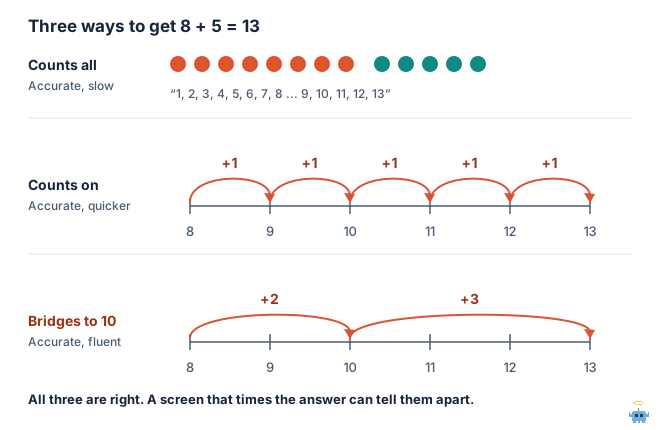
Counting all is where most children start in Foundation: make 8, make 5, then count every object from 1. Counting on starts at 8 and counts five more. It is a real step forward, and many children are still here at the end of Year 1. Bridging through 10 uses a known fact (8 and 2 make 10) to jump, and it is what the Victorian Curriculum is reaching for when Level 1 asks children to add within 20 using what they know about the parts of 10. A child who still counts all from 1 in the second half of Year 1 will usually get small sums right and still struggle, because the method does not scale to 38 + 5. If your child counts on their fingers a lot, our page on a child who still counts on fingers covers when that is fine and when it is a sign.
Where this sits in the Victorian Curriculum
These are the number skills a child is expected to have by the end of Year 1, in plain terms (the VCAA wording is paraphrased here, not quoted):
- Foundation, VC2MFN01 and VC2MFN03: name, order and compare numbers to at least 20, and count collections to at least 20.
- Foundation, VC2MFN02: see how many are in a group of up to 5 without counting (“subitising”).
- Foundation, VC2MFN04: split and join collections up to 10, and name the parts: 7 is 5 and 2, or 4 and 3.
- Level 1, VC2M1N01 and VC2M1N02: numbers to at least 120, and two-digit numbers split into tens and ones.
- Level 1, VC2M1N04: add and subtract within 20, using what they know about the parts of 10 and a range of strategies.
- Level 1, VC2M1A01: skip count by twos, fives and tens, including with Australian coins.
So a Year 1 check run partway through the year lands while Level 1 is still being taught. It is checking whether the Foundation building blocks are secure and the Level 1 ones are on their way, not whether everything is finished.
A ten-minute check you can do at home
You do not need the Check’s questions. These are our own, one per skill, in roughly the order schools teach them. Ask each one casually, and watch how your child answers, not just whether they are right. Stop at the first two rows that go wrong.
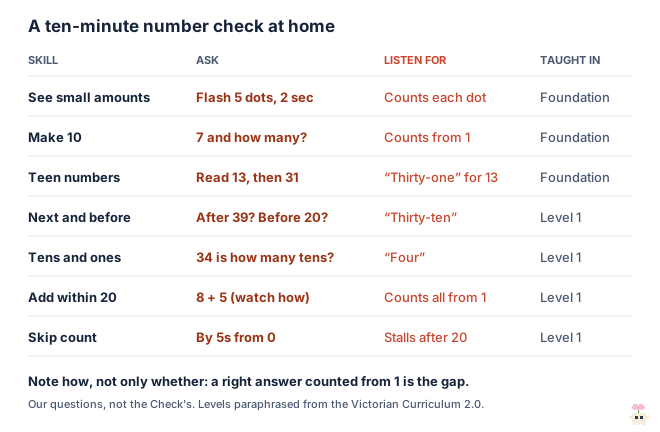
What each wrong answer tells you, and the fix:
- Counts each of the 5 dots: small amounts are not yet seen as a whole. Play with dice and dot cards, flashing them for two seconds. Seeing 5 at a glance is what lets a child later see 8 as “5 and 3”.
- Counts from 1 to find what goes with 7 to make 10: the pairs that make 10 are not known yet. These are the single most useful facts in Year 1, so they get the most time (below).
- Reads 13 as “thirty-one”: the teen numbers are said backwards in English (thir-teen puts the 3 first), so many children write and read them the wrong way round. Build 13 as a ten and three, and say “ten and three, thirteen”.
- Says “thirty-ten” after 39: the count is a list of words, not a pattern of tens yet. Count bundles: three bundles of ten straws and nine loose ones, add one, and make a new bundle.
- Says “four” for the tens in 34: digits are being read left to right without their place. Our place value by year page has the sequence and a short reteach.
- Counts all from 1 for 8 + 5: the answer may be right, but the method will not carry them into Year 2. Teach counting on from the bigger number first, then bridging through 10.
- Stalls after 20 counting by fives: fine early in Year 1, worth some work by the end of it. Count 5-cent and 10-cent coins together.
If every row is fine and quick, your child is where they need to be for the Check. If two or more early rows go wrong, start with the activities below and mention it to the teacher. That is exactly the information the Check is designed to give the school, and they will be glad to have it early.
Want practice on the exact skill? Sprout builds a Foundation or Level 1 maths lesson from the Victorian Curriculum code (making 10, teen numbers, counting on), set around whatever your child is into, with the code on every page. Try it free.
Fifteen minutes a day, not worksheets
Early number gaps close with short, frequent, hands-on practice. For the next few weeks, pick the first row that went wrong and use two or three of these:
- Ten-frame flash (3 minutes). Draw a two-by-five grid, put counters in it, show it for two seconds. “How many? How many more to make 10?” This builds subitising and the pairs to 10 at once.
- Make 10 (5 minutes). Take the picture cards out of a deck and play snap or memory where a pair is two cards that make 10. Once it is quick, play “make 20”.
- Count on from the bigger number (3 minutes). Hide 8 counters under a cup, show 5 more. “Don’t lift the cup. How many altogether?” The cup stops counting from 1.
- Bundle tens (5 minutes, twice a week). Straws or icy-pole sticks in rubber bands. Build numbers like 34 and 43, and say each as tens and ones.
- Counting in the car. Forwards and backwards from any number (“start at 37, go back to 29”), and by twos, fives and tens.
Keep it playful. A five-year-old or six-year-old who dreads maths time learns less than one who plays two minutes of “make 10” at the dinner table. Avoid timed drills at this age: fluency comes from knowing the facts, not from racing.
Questions to ask the school
- “Did my child’s class do the pilot this year?” If so, the teacher already has a report and can tell you what it showed.
- “When will Year 1 do the Check next year, and how will we hear about it?” The Department has not published this yet, so the school is the first place it will be known.
- “Which number skills are you most watching in Foundation?” The answer usually maps straight onto the home check rows.
- “If the Check shows a gap, what does the extra help look like?” Ask in minutes per week, and whether it is small-group.
Your school may also use the Mathematics Online Interview, a longer one-to-one maths interview that many Victorian schools already run in the early years. Arc lists it alongside the Numeracy Check as a separate tool, so a result from one does not replace the other. Maths results also turn up on the end-of-year report, and our guide to reading a Victorian school report explains what the score and the rating mean.
Catholic, independent and homeschooled children
The 2027 requirement is written for Victorian government primary schools. Catholic and independent schools decide their own assessments, so ask the school whether it plans to use the Check or something like it. Home-educated children do not sit it. If you homeschool, the home check above gives you a dated record of where your child is in number, which is useful evidence for a VRQA learning plan.
The short version
From 2027 every Year 1 student in a Victorian government primary school sits a Numeracy Check: an online task and a short teacher interview, 15 minutes at most, looking at accuracy and fluency in early number. The questions, timing and any cut-off are not public yet.
You cannot rehearse it and should not try. Run the ten-minute home check, watch how your child gets each answer, and put fifteen playful minutes a day into the first skill that is not secure: seeing small amounts, the pairs that make 10, teen numbers, tens and ones, or counting on.
How this page was checked
The Check’s format, length, purpose, developer, pilot and 2027 requirement were checked on 16 October 2026 against the Department of Education’s Year 1 Numeracy Check page on Arc (updated 3 June 2026), its Assessment of Student Achievement and Progress Foundation to 10 policy (updated 13 October 2026), and the Premier’s releases of 22 May 2025 and 11 June 2026. The NSW comparison is from the NSW Government’s release of 4 March 2025. Curriculum descriptions are from the VCAA’s Victorian Curriculum Mathematics Version 2.0. The home check questions are our own and are not taken from the Check. Details of the 2027 Check may change once the pilot is evaluated, so check with your school.
Curriculum codes reference the Victorian Curriculum F–10 Version 2.0 © VCAA. The descriptions above are paraphrased, not reproduced. The Victorian Curriculum F–10 and related content can be accessed directly at f10.vcaa.vic.edu.au (accessed 2026-07-13). The VCAA does not endorse this product.
FAQ
What is the Year 1 Numeracy Check in Victoria?
It is a short screening assessment of early number skills. Students do an online task on their own, then have a short interview with their teacher, taking no more than 15 minutes. It gives teachers information on accuracy and fluency so that students who may struggle with maths get help early. Checked against the Department of Education's Arc page on 16 October 2026.
When does the Year 1 Numeracy Check start?
It was piloted in volunteer Victorian government schools in Terms 2 and 3 of 2026 and becomes mandatory for all Victorian government primary schools from 2027. Specialist schools can choose to use it. As at 16 October 2026 the Department had not said when in the 2027 school year it will be held.
How can I prepare my child for the Year 1 Numeracy Check?
Do not try to rehearse it: the questions are not public and it is a screen, not a test to pass. Build the skills it looks for instead: seeing small amounts at a glance, the pairs that make 10, reading teen numbers, tens and ones, and counting on rather than counting from 1. Fifteen playful minutes a day with dice, cards and counters is enough.
What maths should my child know by the end of Year 1 in Victoria?
In the Victorian Curriculum, by the end of Level 1 a child should read and order numbers to at least 120, split two-digit numbers into tens and ones, add and subtract within 20 using what they know about the parts of 10, and skip count by twos, fives and tens. Foundation adds seeing up to 5 without counting and splitting collections up to 10.
Do Catholic and independent schools do the Year 1 Numeracy Check?
The 2027 requirement is written for Victorian government primary schools. Catholic and independent schools choose their own assessments, so ask the school what it plans to use. Home-educated children do not sit the Check.