
“Below level” on an Essential Assessment report is a position on a line, in one strand, on one day. It is not a verdict on your child. Before you change anything at home, find out three things: which strand it is, whether it was the pre-test or the post-test, and how far below. Then spend this week getting the one thing the report cannot give you, which is what your child actually got wrong.
This page is the plan. It does not repeat the explainer on what the report is and who it is for, including its list of five things to ask the school, so read that first if the platform itself is new to you. The wording on reports varies from school to school, so if yours does not use the exact phrase “below level”, read this as being about whatever it uses to say your child sits under their year.
What “below level” means on a continuum curriculum
Victoria does not write its curriculum as a list of years. The Victorian Curriculum F–10 Version 2.0 is written as Levels on a continuum, and a Level is a point on that line. Level 4 is roughly what most Year 4 children are learning, which is why people say “Year 4”, but the document was built to describe children who are spread along the line, not stacked on one rung. The separate page on Victoria’s Levels covers the Foundation Levels A to D at one end and Level 10A at the other.
Three things follow from that, and each one changes how worried to be.
- A child has a Level per strand, not one Level for maths. Number, Algebra, Measurement, Space, Statistics and Probability are different parts of the line. A child can sit at one Level in Number and a different one in Measurement, and a single flagged strand is a much smaller statement than “below level in maths”.
- A pre-test taken before a unit is taught is low by design. Essential Assessment’s own site describes a pre and post assessment within each strand or sub-strand, with growth reported between the two. If the class has not been taught fractions yet, a pre-test that shows a gap in fractions is the instrument working. The question to ask is what the post says after the unit.
- How far below matters more than whether. One Level under the year in one strand sits inside the ordinary spread of a class. Several Levels under, across several strands, and still there after the unit was taught, is a reason to have a proper conversation with the school sooner rather than later. That is our reading, not a rule from the VCAA or from Essential Assessment.
The platform also lists printable My Numeracy and My Literacy resources, differentiated by the assessment result, among its outputs. If your child has come home with one, it is a good clue to which strand the report is about, and a fair thing to ask the teacher about.
Why one measurement cannot tell you what to do on Tuesday night
A Level tells you where your child sits. It does not tell you why, and “why” is what you need at 6pm. Picture two children both placed at the same Level in Number. One regroups wrongly in subtraction. The other has never made the times tables stick. The report is identical, and the Tuesday night is completely different.
That is not a flaw in the platform. A pre and post pair is built to answer whether a unit of teaching worked across a class, and Essential Assessment does that well, along with the whole-school view a leader needs. The thing that closes the gap between a Level and a plan is the platform’s question-level analysis, which shows which specific items were missed. It belongs to the teacher, and it is the single most useful thing you can ask to see.
A four-week plan, with the school
Nothing here assumes the school is holding anything back. A teacher has a whole class’s data in front of them and is rarely asked this exact question. Asking it is a favour to both of you, not an accusation.
- This week, days one and two: write down what the report says. The strand, the date, whether it was a pre or a post, and the exact wording used for the Level. Do not buy a workbook or start a programme yet. You are collecting facts, and a flurry of new activity now muddles what you learn later.
- This week, day two or three: send one short message to the teacher. Ask for three things and nothing else: which strand this is about, whether you can see the question-level analysis for your child, and what one thing the teacher would like you to do at home. Something like: “Thanks for the report. Could you tell me which strand this is about, whether I can see which questions Mia missed, and the one thing you would suggest we practise at home?” One specific ask is far easier to answer in two minutes than a general worry.
- This week, the weekend: watch your child do five questions from that strand. Sit beside them and do not help. Ask them to say their thinking out loud, and write down where they stall. You are looking for a pattern, such as the same step going wrong each time, not for a score.
- Week two: short, regular, on one thing. Pick the single topic the teacher named, or the pattern you saw, and do ten to fifteen minutes on it on four days. Stay on that one topic for the whole week. Helping your child with maths at home without a tutor covers how to run those minutes without turning them into a fight.
- Week three: go back to the school with something specific. Share what you saw and what you practised, and ask what the teacher is seeing in class on the same strand. If the unit has now been taught, ask when the post-assessment is and whether it will show movement in this strand.
- Week four: decide, with the post-test or the teacher’s view in hand. If the strand has moved, keep going and stop worrying. If it has not, ask whether your child has been placed in a support tier and what that involves at your school, and look at the catch-up path for a child who is falling behind. Four weeks of focused work on one strand is long enough to learn something, and short enough that you have not committed to anything big.
If you want the Victorian Curriculum itself rather than the report’s summary of it, the guide to the Victorian Curriculum explains how the strands and Levels fit together.
Want a record to bring to the week-three conversation? Sprout Tutor is in public beta for the Victorian Curriculum and is free on every plan while it runs. It keeps a log of every question your child answers, so you can show the teacher the actual questions. Create a free account.
How Sprout Tutor handles exactly this case
We build this, so treat what follows as an interested account and check it against the mechanism rather than the adjectives. Every number below is read from the tutor’s source code, which is deterministic: the AI writes the questions, but plain rules decide where your child is placed.
Two Years, kept apart
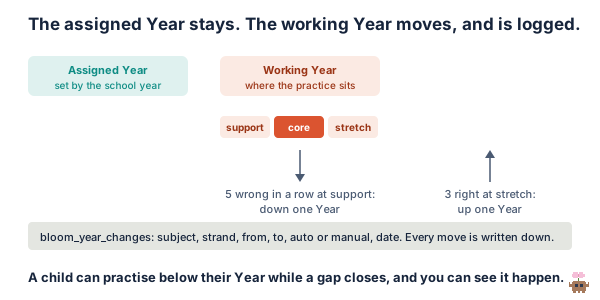
Sprout Tutor holds an assigned Year, which is the school’s year and is set by the adult, and a working Year, which is where the child is currently practising. When they differ, the parent’s card reads something like “Assigned Year 5, practising Year 4”. An automatic move changes only the working Year. Your child is still a Year 5 student on the page, and nothing quietly relabels them.
The exact rules for moving down and back up
- Three tiers. The tiers are called support, core and stretch. A child starts at core.
- Five wrong in a row moves one tier down. A revealed answer counts as wrong, so revealing cannot be used to make the work easier.
- Five wrong in a row at the easiest tier moves the working Year down by one. The child lands at the hardest tier of the Year below, not its easiest, because struggling at the bottom of this Year maps to the top of the Year underneath it. A right answer at the easiest tier resets that count, so it has to be five in a row.
- Three right answers at the hardest tier moves the working Year back up by one, landing at core. Because a drop lands at the hardest tier, a child who has recovered can climb back quickly.
- It is per strand. A strand chosen for a sitting keeps a working Year of its own, so a drop in Number does not drag Measurement down with it. That is the same shape as the continuum above: a Level per strand.
Starting at core, the quickest a working Year can drop is ten wrong answers in a row: five to reach the easiest tier, then five more there. The rules are written as pure functions, with no AI involved in deciding a move. The source also labels these thresholds as deliberately conservative starting points rather than final decisions, so they may change, and we say so in the fuller write-up of how it decides what comes next.
Every move is logged, and you can overrule it
Each automatic move writes a row to the bloom_year_changes table: the subject, the strand, the Year it moved from and to, the direction, the date, and whether the system or a person made it. The application code only ever inserts rows into that table; none of it edits or deletes one. If you disagree with a move, you can change the assigned Year, and that change is logged as yours.
What you can see as the parent
The student page in your dashboard has a Subjects view plus three more, and the three answer your Tuesday question:
- Level changes lists the moves described above, with the strand, the direction and whether it was the system or you.
- Needs a hand lists the curriculum codes your child has got wrong at least once, up to eight, each with the plain-English topic, the code itself and a count of right, wrong and revealed. Each row also links to creating a lesson on that topic.
- Recent questions shows the latest hundred answers, and you can open any one to see the literal question your child saw, the options with the right one marked, which they picked, and the hint.
When a child has worked in three or more strands, a chart also sets each strand against grade level. This is the record you take to the week-three conversation: not “she struggles with maths” but “these four questions on this code, and here is what she picked”.
What it does not do
Sprout Tutor knows nothing about your child’s class. It cannot tell you how the cohort is tracking, it has no whole-school view and no support-tier placement, and it will not notice that your child has had a terrible week. Five wrong in a row can be tiredness. A move down is a prompt to look at the questions and to talk to the teacher, not a diagnosis. It also covers the Victorian Curriculum only, and it is in public beta.
Essential Assessment and the teacher hold the class-level picture and the professional judgement. A practice record holds the detail of what happened on Tuesday. The useful thing is to put the two next to each other.
The short version
“Below level” is a position on a continuum, in one strand, at one moment, and a pre-test taken before a unit is taught is low by design. Find out the strand, whether it was a pre or a post, and how far below. Then run four weeks: collect the facts, ask the school for the strand, the question-level analysis and one thing to do at home, practise one topic in short bursts, and go back with something specific.
Sprout Tutor keeps your child’s assigned Year as the school’s year and moves a separate working Year by fixed rules, logs every move, and shows you the actual questions and the codes behind them. Start free.
Essential Assessment facts on this page (the pre and post mechanic, question-level analysis, MTSS placement, and the My Numeracy and My Literacy resources) come from our check of their homepage and Victorian Curriculum page on 26 September 2026, recorded on the companion page, and were not re-fetched for this one. What any school shares with families is a school decision and varies. The tutor’s thresholds, tier names, change log and parent views were read from its source code on 5 October 2026. We build competing software and say so above. Victorian Curriculum F–10 Version 2.0 © VCAA, which does not endorse this product; the curriculum is available at f10.vcaa.vic.edu.au.
FAQ
What does below level mean on an Essential Assessment report?
It places your child at a point on the Victorian Curriculum continuum that sits under their school year, in one strand. A Level is a position on a line, not a pass mark, and a child can sit at one Level in Number and another in Measurement. Essential Assessment describes reporting growth against the achievement standards, and the wording on what a school sends home varies, so check the strand, whether it was a pre or a post, and how far below it is.
Is my child behind if the pre-test shows below level?
Not necessarily. A pre-assessment is taken before a unit is taught, so a low result there is the instrument working as designed. It is also a single snapshot, and a bad morning looks the same in the data as a genuine gap. The post-assessment after the unit is the better signal, and one Level below the year in a single strand sits inside the ordinary spread of a class.
What should I ask the school this week?
Three things. Which strand the result is about, whether you can see the question-level analysis for your child, and the one thing the teacher would like you to practise at home. The question-level analysis shows which specific items were missed, which is what turns a Level into a plan, and a teacher can usually name a topic quickly once asked.
How does Sprout Tutor decide my child is working below their year?
Sprout Tutor keeps the assigned Year as the school's year and moves a separate working Year by fixed rules, with no AI involved in the decision. Five wrong answers in a row at the easiest tier move the working Year down one, landing at the hardest tier of the Year below. Three right answers at the hardest tier move it back up. A revealed answer counts as wrong, every move is logged, and the parent can see the literal questions and the codes the child struggled with.
Which Years does Sprout Tutor cover?
Sprout Tutor covers Years 1 to 10 of the Victorian Curriculum. It follows the Victorian Curriculum F-10 Version 2.0 only, in English, maths and science, and it went into public beta on 22 September 2026. While it is in beta it is free on every Sprout plan, including the free one.