
The curriculum follows the school, not the house. A child who lives in Wodonga and goes to school in Albury learns from the NSW syllabuses; a child who lives in Albury and crosses to a Wodonga school learns the Victorian Curriculum. In most of Australia that sentence is trivia. On the Murray it decides what the report card says, what the maths is called, which week the holidays start, and which practice tools match what the teacher is doing. This page is the translation.
Which side is your child’s school on?
On the Wodonga side, government secondary schooling is split in two. Wodonga Middle Years College describes itself as a specialist Years 7 to 9 setting, on its Felltimber and Huon campuses, and Wodonga Senior Secondary College takes Years 10 to 12. Both teach the Victorian Curriculum F–10 and then the VCE. On the Albury side, Albury High School and its neighbours run Years 7 to 12 on NSW syllabuses and finish with the HSC. The primary schools on each bank follow the same split.
Families do cross. The NSW Department of Education’s own border notices during the 2020 closures were written for “students residing within the Victorian border zone and travelling to attend a school within the NSW border zone”, which is as plain an admission as you will get that the traffic is normal. What neither department publishes is a rule for it. Victoria’s enrolment policy gives every child a guaranteed place at the designated neighbourhood school for their permanent residential address, and says nothing about an address in another state. NSW’s online enrolment form requires the child to be a NSW resident, and sends everyone else to the school’s own out-of-area process, where the school decides on its published non-local criteria if it has room. So a Wodonga family wanting an Albury school, or the reverse, is applying as an out-of-zone family, and the answer depends on that school’s capacity that year. Ask early, and ask the school rather than the department.
Same maths, different map
Take a Year 4 child. On the Wodonga side the maths they are taught is Level 4 of the Victorian Curriculum: 25 content descriptions, one year’s worth, split across six strands (Number 10, Algebra 2, Measurement 4, Space 4, Statistics 3, Probability 2). On the Albury side the same child is in Stage 2, which is Years 3 and 4 together: 20 outcomes, each written to span the two years, grouped under focus areas with names like Multiplicative relations, Partitioned fractions and Representing numbers using place value.
That is the first thing to translate. A Victorian content description is a one-year statement and a NSW outcome is a two-year one, so “working at Level 4” and “working towards Stage 2 outcomes” describe roughly the same child, and neither number is bigger or harder than the other. The mathematics underneath is very close. Where it differs is in the order and the labels:
- Times tables. Victoria splits them: Level 3 asks for the 3s, 4s, 5s and 10s (VC2M3A03), and Level 4 asks for every fact up to 10 × 10 with the related division facts (VC2M4A02). NSW writes one Stage 2 outcome for the structure of multiplication to 10 × 10 (MA2-MR-01) and lets the school sequence it across the two years. A child who moves across the river in Year 4 may find the 7s and 8s already assumed, or not yet started.
- Decimals. Both sides introduce tenths and hundredths in this band, Victoria at Level 4 (VC2M4N01) and NSW within Stage 2 (MA2-RN-02, decimals to two places). This one lines up.
- Fractions. Victoria names halves, thirds, quarters, fifths and tenths as unit fractions at Level 3 (VC2M3N03), then equivalent fractions and the link to decimals at Level 4 (VC2M4N03, VC2M4N04). NSW’s Stage 2 outcome puts halves, quarters, thirds and fifths on a number line and adds eighths, sixths and tenths by halving (MA2-PF-01). Same pieces, slightly different year.
The pattern holds across the whole of primary: nothing is missing from either side, but a child who changes banks mid-primary can meet a topic twice or skip it once. The full lists are on Year 4 maths in the Victorian Curriculum and Stage 2 maths in NSW, and the wider picture of which framework each state uses is on which curriculum does my state use.
Two report cards
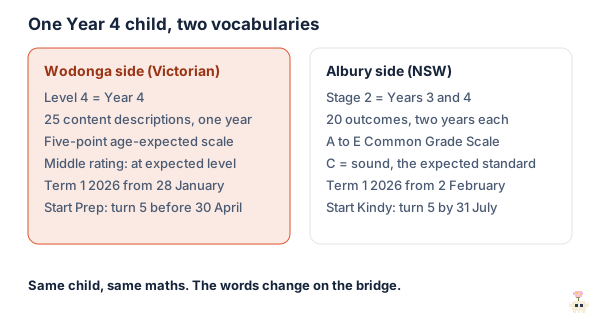
In Albury the report uses letters. NESA’s Common Grade Scale for Years 1 to 10 runs A to E, and the authority’s reporting guidance describes a C as sound knowledge and understanding of the main content and an adequate level of competence in the skills, measured against the syllabus outcomes for the stage. Teachers are not limited to set numbers of each grade. A C is the expected standard, not a middling one.
In Wodonga the report uses a five-point scale around “at expected level”. The Victorian Department of Education’s reporting policy (updated 4 August 2026) requires schools to report directly against the Victorian Curriculum achievement standards, with a teacher judgement given as a score along the continuum, such as Level 3.5, and an age-expected five-point scale that is mandatory for English, maths and science. A “C” across the river and “at expected level” on this side are the same message. How to read the Victorian version against NAPLAN and against the class is on behind, or just in a strong class.
NAPLAN is the one ruler both banks share. It is national, sat in March of Years 3, 5, 7 and 9 on both sides, and reported on the same proficiency levels, so it is the only document where an Albury child and a Wodonga child can be read side by side without translation.
The calendar does not line up either
For a family with children on both sides, the practical irritation is the dates. The 2026 Victorian dates and the 2026 NSW dates put students back on 28 January and 2 February respectively; Term 2 starts 20 April in Victoria and 22 April in NSW; Term 3 starts 13 July and 21 July; Term 4 starts 5 October and 13 October. The gap is a week at the start of Terms 3 and 4, and the NSW year ends a day earlier, on 17 December. One child on holiday while the other is at school is the normal state of a two-school border family, and it is worth knowing before booking anything.
The starting age differs too. Victoria’s enrolment factsheet says a child can start Foundation if they turn 5 before 30 April of that year; NSW says a child can start Kindergarten if they turn 5 on or before 31 July. A child born in June can start school a year earlier in Albury than in Wodonga, and both states make schooling compulsory from the sixth birthday. It is the one border decision that families can genuinely make either way.
Practice that matches the school
Every tutoring option in the twin cities, a centre, a private tutor or an app, is implicitly built on one of the two frameworks, and the question to ask before paying is simply which one. A Stage 2 workbook given to a Wodonga Year 3 is not wrong, but it is a year wide, and the child will spend time on things their class reaches next year. The reverse is a year narrow.
Sprout Lessons builds a lesson on either side. It holds the Victorian Curriculum and the NSW syllabuses as separate datasets, so you choose the framework your child’s school teaches and then the code or outcome, VC2M4A02 for a Wodonga Year 4 or MA2-MR-01 for an Albury one, and the lesson carries that code in its footer. It takes about thirty seconds. Start free.
Sprout Tutor, our guided practice, is Wodonga-side only for now. It follows the Victorian Curriculum for Years 1 to 10 in maths, English and science, which covers a Wodonga primary child, the whole of Wodonga Middle Years College and Year 10 on the Victorian side, and it does not yet cover the NSW syllabuses, so an Albury-school child cannot use it for school-matched practice. It is in public beta and free on every plan while it is in beta, including the free one. A few things it does that matter on a border:
- Each subject sits at its own Level. A child who arrived from a NSW school with the 7s and 8s not yet met can practise Level 3 multiplication while staying at Level 4 in everything else, and the change is recorded. See working at a different level in the Victorian Curriculum.
- The moves follow fixed rules, three right answers at stretch to go up a Year, five consecutive wrong at support to go down, and every change is logged where you can read it. The rules are in how Sprout Tutor decides what comes next.
- Sessions come in Classic, Footy, Netball or Animals. The footy and netball themes are generic by design, with no real clubs or players, so a Border league family will not find the wrong colours in a maths question.
In Sprout Lessons the personalisation is finer: you pick from a curated list of interests that includes fishing, camping, horse riding, 4WD adventures, farm life and footy, and each new lesson is built around one of them in turn while the code stays fixed. A Murray cod counted in groups of seven is still VC2M4A02. The method is in teaching maths through interests.
What none of this replaces is a teacher who knows which bank your child’s class is actually up to this week. The evidence for personalised-learning chatbots improving outcomes is thin, because very few rigorous studies exist. Use the software for the practice, and keep the people for the judgement.
A plan for a border family
- Confirm the framework in one question: “Does the school teach the Victorian Curriculum or the NSW syllabuses?” Then ask what the report’s scale means, because a C and “at expected level” are the same thing wearing different clothes.
- Translate the level words. Stage 2 is Years 3 and 4 together; Level 4 is Year 4. “Working towards” a stage outcome in Year 3 is not a warning.
- If your child is changing banks, ask the new school which topics the class has already covered this year, and check the three on this page: times tables, decimals and fractions. Practise the gap, not the whole year.
- Match the practice to the school, not to the postcode. Set the framework before the first lesson, and keep it set.
- Put both term calendars on the fridge in January. The weeks that do not overlap are the ones a Wodonga child can use for the quiet twenty minutes a day that helping with maths at home without a tutor describes.
The short version
In Albury-Wodonga the curriculum goes with the school, so find out which one your child’s school teaches and read everything through it. The Year 4 maths is nearly the same on both banks, but Victoria writes it as 25 one-year content descriptions at Level 4 and NSW as 20 two-year outcomes across Stage 2, the reports use different scales for the same message, the terms start up to a week apart, and the school starting age is 30 April on one side and 31 July on the other. Match the practice tool to the school. Sprout Lessons covers both frameworks; Sprout Tutor covers the Victorian one, Years 1 to 10, free while in beta. Start free.
Checked 5 October 2026. Content description and outcome counts were read from our copies of the Victorian Curriculum 2.0 and NSW K–10 mathematics datasets, and the descriptions above are paraphrased rather than quoted. Term dates are from the Victorian Government and NSW Department of Education 2026 calendars; the starting-age rules from the Victorian department’s 2027 primary enrolment factsheet and the NSW Government’s starting primary school page; the report scales from NESA’s reporting guidance and the Victorian department’s reporting policy. Victorian Curriculum F–10 Version 2.0 © VCAA, which does not endorse this product; the curriculum is available at f10.vcaa.vic.edu.au. Outcome codes reference NSW syllabuses © NSW Education Standards Authority (NESA) for and on behalf of the Crown in right of the State of New South Wales, accessed via curriculum.nsw.edu.au; NESA does not endorse this product.
FAQ
If we live in Wodonga but our child goes to school in Albury, which curriculum do they learn?
The NSW syllabuses, because the curriculum follows the school rather than the home address. Albury schools teach NSW syllabuses and finish with the HSC; Wodonga schools teach the Victorian Curriculum F-10 and finish with the VCE. Neither department publishes a specific rule for border families: Victoria guarantees a place at the school zoned for your permanent address, and NSW treats a non-resident as an out-of-area applicant assessed on the school's own criteria if it has room.
Is Year 4 maths different in Victoria and NSW?
The mathematics is nearly the same, but it is written differently. Victoria describes Year 4 as Level 4, with 25 one-year content descriptions across six strands. NSW places Year 4 in Stage 2, which covers Years 3 and 4 together with 20 outcomes written to span both years. Times tables are the clearest difference: Victoria asks for the 3s, 4s, 5s and 10s at Level 3 and every fact to 10 x 10 at Level 4, while NSW writes one Stage 2 outcome for multiplication to 10 x 10 and lets the school sequence it.
What does a C mean on a NSW report compared with a Victorian report?
A C on the NSW Common Grade Scale means sound knowledge and understanding of the main content and an adequate level of competence in the skills, measured against the syllabus outcomes for the stage. It is the expected standard. Victorian reports use a five-point scale around at expected level, with a teacher judgement given as a score along the curriculum continuum. A C in Albury and at expected level in Wodonga carry the same message.
Do NSW and Victorian school terms start on the same day?
No. In 2026 Victorian students return on 28 January and NSW students on 2 February. Term 2 starts 20 April in Victoria and 22 April in NSW, Term 3 starts 13 July and 21 July, and Term 4 starts 5 October and 13 October. The NSW year ends on 17 December and the Victorian year on 18 December.
Does Sprout Tutor work for a child at an Albury school?
Not yet. Sprout Tutor follows the Victorian Curriculum for Years 1 to 10 in maths, English and science, so it matches a Wodonga primary school, Wodonga Middle Years College and Year 10 on the Victorian side, and it does not cover the NSW syllabuses. Sprout Lessons, the lesson builder, holds both frameworks, so it can build a lesson on a Victorian code or a NSW outcome. Sprout Tutor is in public beta and free on every plan while it is in beta.