
In Bendigo’s government system, Year 10 is the last year at one school and Year 11 is the first at another. The maths decision that matters most, whether a child does the optional Level 10A content and which VCE maths they pick for Year 11, is therefore made at a school the child is about to leave, for a school they have not yet joined. This page is about that handover: what 10A is, what the VCE study design actually says it assumes, which Year 11 choice keeps the most doors open, and what to ask each school.
How Bendigo is built
Bendigo has four government secondary colleges that run Years 7 to 10: Bendigo South East College, Crusoe College, Eaglehawk Secondary College and Weeroona College Bendigo. At the end of Year 10 their students move to Bendigo Senior Secondary College, a Years 11 and 12 school in the centre of town that dates from 1907 and had about 1,750 students in the most recent public count. Weeroona’s own description is the clearest statement of the arrangement: around 780 Year 7 to 10 students, and a transition to the senior college for Years 11 and 12.
That structure is unusual, and it changes the maths conversation in one specific way. In a Years 7 to 12 school, the teacher who taught Year 10 is down the corridor from the one who will teach Methods, and the subject-selection advice is internal. In Bendigo the Year 10 teacher knows the child and the Year 11 teacher knows the course, and they work in different buildings. Subject selection for Year 11 happens during Year 10, so a parent is the person holding both halves of the conversation. Not every Bendigo school is built this way; if yours runs through to Year 12 the choice is made inside one building, but it is still made in Year 10, and the rest of this page applies.
What Year 10 maths contains, and what 10A adds
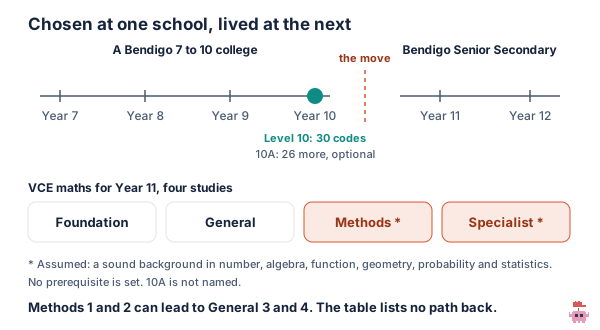
In the Victorian Curriculum 2.0, Level 10 maths has 30 content descriptions, and 16 of them are Algebra. That is the year a child factorises monic quadratics (VC2M10A04), solves quadratic equations using the null factor law (VC2M10A13), solves simultaneous linear equations (VC2M10A09), solves simple exponential equations (VC2M10A14), and explores how quadratics, reciprocals, circles and exponentials look as graphs (VC2M10A11). The full list is on Year 10 maths in the Victorian Curriculum.
Level 10A is a further 26 content descriptions that the VCAA describes as opportunities for students to extend their mathematics and continue with it. Ten are Algebra: polynomials with the factor and remainder theorems (VC2M10AA01), factorising non-monic quadratics (VC2M10AA07), function notation (VC2M10AA08), sketching parabolas, hyperbolas, circles and exponentials and their transformations (VC2M10AA05), and the inverse relationship between exponentials and logarithms (VC2M10AA04). Six are Space, including the sine and cosine rules (VC2M10ASP02) and the unit-circle definitions of sin, cos and tan as functions (VC2M10ASP03). Number adds surds and fractional indices (VC2M10AN01, VC2M10AN02). Statistics adds standard deviation (VC2M10AST01).
Read that list against the VCE and the purpose is obvious. The VCE Mathematics Study Design (accredited 2023 to 2027) describes Mathematical Methods Units 1 to 4 as the study of simple elementary functions, transformations and combinations of those functions, algebra, calculus, probability and statistics. Function notation, transformations of graphs, polynomials, surds, indices and logarithms are the 10A content, almost item for item. A school that runs 10A is running the Methods on-ramp.
What the study design actually assumes
This is the part worth quoting precisely, because schools paraphrase it in different directions. The study design’s entry section says there are no prerequisites for Units 1, 2 and 3 of any VCE maths study. In the same sentence it says students taking Mathematical Methods Units 1 and 2 or Specialist Mathematics Units 1 and 2 are assumed to have a sound background in number, algebra, function, geometry, probability and statistics. Nothing in the document names Level 10A, and nothing makes it a condition. So a child who did not do 10A can enrol in Methods, and the senior college cannot cite the VCAA to say otherwise. What the college can say, truthfully, is that the assumed background is easier to have if 10A was done, and that Methods moves fast.
The second thing the study design settles is which Year 11 choice keeps the most open. Its table of allowed unit combinations lists Methods Units 1 and 2 leading to either Methods Units 3 and 4 or General Mathematics Units 3 and 4, and notes that a student who did only Methods 1 and 2 has had access to the assumed knowledge for General 3 and 4 but may need some supplementary study. The table has no row from General 1 and 2 to Methods 3 and 4. In plain terms: choosing Methods in Year 11 leaves General available in Year 12; choosing General in Year 11 does not leave Methods available, short of a special arrangement with the school. A family that is unsure should know the asymmetry before the form is signed. Specialist Units 3 and 4 assume Methods 3 and 4 alongside or before, and the first exam in both Methods and Specialist is done without technology.
Three questions for the kitchen table
These are the Year 10 skills that Methods leans on hardest, with the wrong answer each one produces when it is not secure. Ask them cold, without a warm-up.
- “Factorise 2x² + 7x + 3.” The wrong answer is (2x + 3)(x + 1), because 3 × 1 gives the 3 and the 2 is in front of an x, so it looks right. Expanding it gives 2x² + 5x + 3. The correct factorisation is (2x + 1)(x + 3). A child who can only factorise when the x² has no coefficient is at Level 10 (VC2M10A04) and not yet at 10A (VC2M10AA07), which is exactly the line Methods crosses in its first weeks.
- “What is √(9 + 16)?” The wrong answer is 7: the square root has been split over the addition, 3 + 4. The right answer is 5, because the sum inside is 25. This is the surd rule that fails (VC2M10AN01), and it reappears in every Pythagoras and distance question in Methods.
- “What is 2 to the power of negative 1?” The wrong answer is −2; the right one is a half. A negative index means a reciprocal, not a sign change (VC2M10A02). Exponential and logarithmic work in 10A (VC2M10AA04) and in Methods assumes this is automatic.
Two of three right, with the third fixable in a fortnight, is a reasonable base for Methods. None of three right in August of Year 10 is a reason to ask the senior college a direct question about the pace of Methods Unit 1 rather than a reason to rule it out.
Sprout builds a lesson on any one of these codes in about thirty seconds, with the code printed on it, and it covers Level 10 and 10A: VC2M10AA07 for the non-monic factorising, VC2M10AN01 for surds, VC2M10A02 for the index laws. Start free.
Where the tutor fits, and where it stops
Sprout Tutor, our guided practice, follows the Victorian Curriculum for Years 1 to 10 in maths, English and science, so it covers a Bendigo child through Years 7 to 10 at their college, and a Year 10 pathway includes Level 10, the Levels 9 to 10 science band and the optional 10A codes. Year 10 was added on 5 October 2026, so if you read this page before then the range has changed. What it does across those years:
- Level 9 algebra is where the 10A habits start. Expanding binomials and factorising monic quadratics (VC2M9A02) is the Year 9 code that both the Level 10 and the 10A work build on, and the tutor practises it at three tiers until the stretch tier is secure. The whole Level 9 list is on Year 9 maths in the Victorian Curriculum.
- A child who is strong moves up on fixed rules, three right answers at the stretch tier, and the move is logged where you can read it, so by the end of Year 9 you have a record of which Level 9 topics were mastered and which were not. How the rules work is in how Sprout Tutor decides what comes next.
- It is in public beta and free on every plan while it is in beta, including the free one.
For Year 10 itself, Sprout Lessons is the tool, because it holds the Level 10 and 10A codes. The personalisation works the same way at 16 as at 8: you choose from a curated list of interests, footy, motor racing, horses, music, money and business among them, and each lesson is built around one of them while the code stays fixed. A compound interest question about saving for a first car is still VC2M10A15. The method is in teaching maths through interests.
What software will not do is tell you whether your child wants Methods or is being told to want it. The senior college’s course counsellor and the Year 10 teacher between them can, and the honest state of the evidence is that personalised-learning chatbots have not been shown to move outcomes, because very few rigorous studies exist. Use the practice. Keep the people.
A plan across two schools
- In Term 1 of Year 10, ask the 7 to 10 college whether it runs 10A as a separate class, as extension within the class, or not at all, and how a child gets into it. The answer differs by college and by year.
- In Term 2, ask the senior college what it advises for Methods Units 1 and 2 and whether it runs any bridging work for students who did not do 10A. The study design assumes a sound background; the college decides what that means locally.
- Run the three kitchen-table questions in Term 2 and again in Term 3. A gap that closes between the two is a gap that was practice, not ability.
- If it is a coin toss, choose Methods for Year 11, because the study design lets Methods 1 and 2 lead to General 3 and 4 and does not list the reverse. The exit is cheaper from the harder side.
- Over the summer, keep the three skills warm: ten minutes, three times a week. What survives January is what was learned. For the shape of that routine, see helping with maths at home without a tutor.
The other Victorian place where Year 10 means a new school is Melbourne’s west, where the P-9 colleges hand over a year earlier, at the end of Year 9; that version of the problem is on Point Cook’s P-9 colleges and Year 10 maths.
The short version
Bendigo’s four government 7 to 10 colleges hand every student to Bendigo Senior Secondary College for Years 11 and 12, so the 10A and Methods decision is made at one school and lived at another. Level 10 maths is 30 content descriptions, 10A adds 26, and the 10A list reads like the first term of Methods. The VCE study design sets no prerequisite for Methods Units 1 and 2 but assumes a sound background in number, algebra, function, geometry, probability and statistics, and it allows Methods 1 and 2 to lead to General 3 and 4 while listing no route the other way. Ask the 7 to 10 college about 10A in Term 1, the senior college about Methods in Term 2, and run the three questions at home in between.
Sprout builds Level 10 and 10A lessons around your child’s interests with the code on every page, and Sprout Tutor covers Years 1 to 10, free on every plan while it is in beta. Start free.
Checked 5 October 2026. Content description counts and codes were read from our copy of the Victorian Curriculum 2.0 mathematics dataset, and the descriptions above are paraphrased rather than quoted. The VCE Mathematics Study Design 2023–2027 (version 1.1) was read for the entry conditions, the unit combinations table and the study descriptions. School structures are from Weeroona College Bendigo’s about page and public listings for Bendigo Senior Secondary College, whose own site does not state its year range on the pages we could check. Victorian Curriculum F–10 Version 2.0 © VCAA, which does not endorse this product; the curriculum is available at f10.vcaa.vic.edu.au.
FAQ
Where do Bendigo students go for Years 11 and 12?
Bendigo has four government secondary colleges that run Years 7 to 10: Bendigo South East College, Crusoe College, Eaglehawk Secondary College and Weeroona College Bendigo. At the end of Year 10 their students move to Bendigo Senior Secondary College, a Years 11 and 12 school in the centre of town, so Year 11 subject selection is done while the child is still at the 7 to 10 college.
What is Level 10A in the Victorian Curriculum?
Level 10A is 26 additional maths content descriptions sitting beside the 30 at Level 10, which the VCAA describes as opportunities for students to extend their mathematics and continue with it. Ten are Algebra, including polynomials, non-monic quadratics, function notation, sketching transformations of graphs, and logarithms. It also adds surds and fractional indices, the sine and cosine rules, the unit circle, and standard deviation. The content matches what VCE Mathematical Methods builds on.
Is 10A required for Mathematical Methods?
No. The VCE Mathematics Study Design 2023 to 2027 says there are no prerequisites for Units 1, 2 and 3 of any VCE maths study. It also says students taking Mathematical Methods Units 1 and 2 or Specialist Mathematics Units 1 and 2 are assumed to have a sound background in number, algebra, function, geometry, probability and statistics. It does not name Level 10A. Schools can advise that 10A makes that background easier to have, but cannot cite the VCAA to make it a condition.
Should my child choose General Maths or Methods for Year 11 if we are not sure?
The study design’s table of unit combinations lists Mathematical Methods Units 1 and 2 leading to either Methods Units 3 and 4 or General Mathematics Units 3 and 4, with some supplementary study for the General route. It lists no combination from General Units 1 and 2 to Methods Units 3 and 4. So choosing Methods in Year 11 keeps General available in Year 12, while choosing General in Year 11 does not keep Methods available without a special arrangement with the school.
Does Sprout Tutor cover Year 10 in Bendigo?
Yes, since 5 October 2026. Sprout Tutor follows the Victorian Curriculum for Years 1 to 10 in maths, English and science, so it covers Years 7 to 10 at a Bendigo college, and a Year 10 pathway includes the Level 10 codes, the Levels 9 to 10 science band and the optional 10A codes. Sprout Lessons, the lesson builder, also covers Level 10 and 10A codes, including VC2M10AA07 for non-monic factorising, VC2M10AN01 for surds and VC2M10A02 for index laws. Sprout Tutor is in public beta and free on every plan while it is in beta.