
A composite class does not change the Level your child is taught or assessed at. The Victorian Curriculum is written in Levels rather than year levels on purpose, and the report gives each child a Level score of their own whatever room they sit in. The real question in a 3/4 class is a smaller one: which Level is this piece of work pitched at, and is my child doing it because that is where they are, or because that is where the room is? This page is how to tell, with the four questions that answer it at the kitchen table.
The small schools around Ballarat
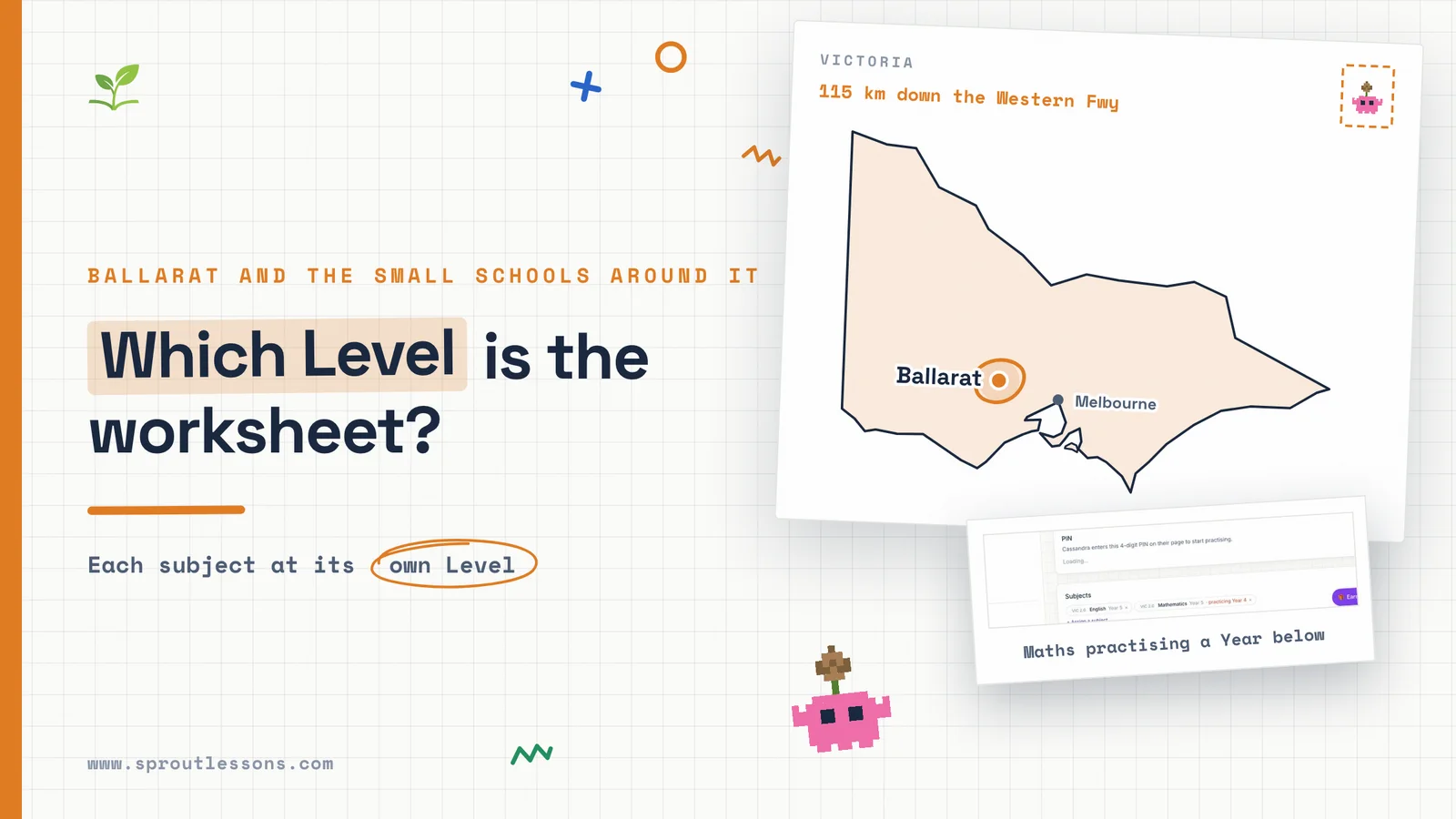
Drive twenty minutes out of Ballarat in any direction and the schools get small quickly. Glen Park Primary School, in the hills to the north-east, describes itself as a one-teacher rural school, started 2025 with nine students, and takes children from across the wider Ballarat area as well as its own road. Napoleons Primary School to the south has 94 students. Haddon Primary is 15 km out in Golden Plains Shire; Newlyn Primary is a small farming-community school on the Midland Highway towards Daylesford. None of these is unusual. The ring of towns around a regional city is a ring of small schools, and in a small school a composite class is not a policy choice but arithmetic: 94 children across seven year levels cannot be seven single-year classes, and in a one-teacher school the whole school is one class.
The large Ballarat primaries form composites too, when a year group comes out an awkward size, but they can usually un-form them the next year. In the small schools the composite is permanent, which is why parents there think about it more, and why the question deserves a better answer than “the teacher differentiates”.
The curriculum was written for this
The thing that makes a composite class workable in Victoria is a design decision most parents never hear about. The VCAA’s own description of the curriculum’s structure says the levels do not represent discrete years of schooling, and that the levelled continuum exists so teachers can build programs around a child’s actual learning rather than an assumed age-based level. The maths your Year 3 child is doing is not “Year 3 maths”. It is whichever Level they are at, and the Year 4 at the next desk is at whichever Level they are at, and the teacher of a 3/4 room is doing in the open what the teacher of a straight Year 3 does quietly.
The report then makes the Level visible. The Victorian Department of Education’s reporting policy (updated 4 August 2026) requires schools to report directly against the Victorian Curriculum achievement standards, with a teacher judgement given as a score along the continuum, such as Level 3.5, plus a five-point age-expected rating that is mandatory for English, maths and science. That score is the answer to “which Level is my child at”, and it is the same number whether the child is in a 3/4 room, a 2/3/4 room or a single class. The age-expected rating compares them with the standard for their own year, not with the room. How to read the two together is on behind, or just in a strong class, and the background on Levels is on the Victorian Curriculum explained.
One worksheet, two Levels
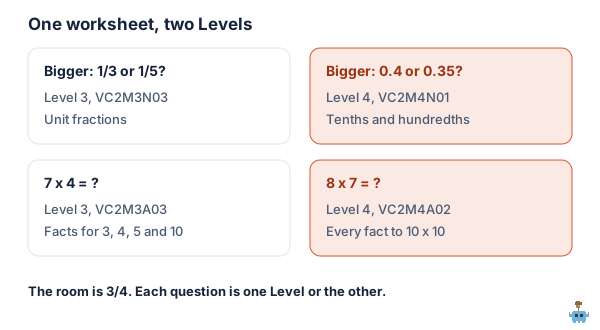
Level 3 maths has 24 content descriptions and Level 4 has 25, and in several strands the two Levels are the same topic a step apart, which is exactly what a 3/4 teacher works with. The pairs worth knowing:
- Times tables. Level 3 asks for recall of the 3s, 4s, 5s and 10s and the related division facts (VC2M3A03). Level 4 asks for every fact up to 10 × 10, with the patterns explained (VC2M4A02). So “7 × 4” is a Level 3 question and “8 × 7” is a Level 4 one, and a sheet that mixes them is a two-Level sheet.
- Fractions. Level 3 is unit fractions, halves, thirds, quarters, fifths and tenths, and putting same-denominator pieces together to make a whole (VC2M3N03). Level 4 is equivalent fractions, counting by quarters, halves and thirds past one, and the link to decimals (VC2M4N03, VC2M4N04).
- Place value. Level 3 extends whole numbers beyond 10 000 (VC2M3N02). Level 4 goes the other way, into tenths and hundredths and decimal notation (VC2M4N01).
- Time and angles. Level 3 reads the clock to the nearest minute (VC2M3M04) and compares angles against a right angle (VC2M3M05). Level 4 handles am and pm and converts between units of time (VC2M4M03), and names acute, obtuse, straight and reflex angles (VC2M4M04).
The full lists are on Year 3 maths and Year 4 maths in the Victorian Curriculum.
Four questions, and what each wrong answer means. Ask them cold, one at a time, and write down the answer rather than correcting it.
- “Which is bigger, a third or a fifth?” The Level 3 question. The wrong answer is a fifth, because 5 is bigger than 3. The child is reading the denominator as a size. The reteach is a strip of paper folded into thirds and then another into fifths, every day for a week, until “more pieces means smaller pieces” is said unprompted.
- “7 × 4?” Level 3. Twenty-eight is right, but watch how it arrives. Counting up by fours on fingers is a Level 2 strategy standing in for Level 3 recall, and it will not survive the Level 4 sheet, where every fact is needed quickly.
- “Which is bigger, 0.4 or 0.35?” The Level 4 question. The wrong answer is 0.35, because 35 is bigger than 4. The child is reading the decimal as a whole number with a dot in front. The reteach is to write both as hundredths, 40 and 35, on a hundred grid, before any rule about “adding zeros”.
- “8 × 7?” Level 4. Fifty-six, from memory, is the standard. A child who gets 54, or who works it out from 8 × 5 and 8 × 2, is doing the right mathematics at the Level 3 edge of it.
A Year 3 who gets the first two is at Level in those two topics, whichever room they are in. A Year 4 who misses the first two is working below Level in those topics, and the composite room is not the reason; it is, if anything, the place where it is easiest to fix, because the Level 3 teaching is happening a few desks away.
What the research says, briefly
Parents often arrive at this page worried that the composite itself is a handicap. The reviews of the evidence, going back decades and summarised in a 2015 piece on mixed-grade classes, find no consistent difference in achievement between composite and single-grade classes. What the studies do find is that the planning load on the teacher is higher, and that parents in schools where every class is composite tend to be comfortable with it, because there is nothing to compare it with. The practical reading is that the room is not the variable. The Level of the work is.
Practice at the child’s Level, not the room’s
Sprout Tutor is built the way a composite class is run. It follows the Victorian Curriculum for Years 1 to 10 in maths, English and science, and each subject sits at its own Level independently of the others: a Year 4 can practise Level 3 fractions while staying at Level 4 in everything else, and the two numbers are recorded separately rather than averaged into a year. The mechanics are on working at a different level in the Victorian Curriculum. A few specifics, since this is our product:
- The Level moves on fixed rules. Three right answers at the stretch tier moves a subject up a Year; five consecutive wrong answers at the support tier moves it down. Every change is logged with the date, so you can see when the fractions caught up. See how Sprout Tutor decides what comes next.
- The parent view shows the Level per subject, plus each question as it was asked and whether a hint was opened. What it shows and what it does not is on what the parent dashboard shows.
- It is in public beta and free on every plan while it is in beta, including the free one.
If the school uses Essential Assessment, its report also gives a Level, in its own format; what the Essential Assessment report means translates it.
Sprout Lessons builds a single lesson on one code, VC2M3N03 for the thirds and fifths or VC2M4N01 for the decimals, in about thirty seconds, around an interest you choose from a curated list that includes horses, farm life, tractors, footy, netball and chickens. Thirds and fifths of a paddock are still VC2M3N03. The method is in teaching maths through interests. Start free.
None of this replaces the teacher, who in a small school knows your child better than any larger-school teacher could, and the evidence that personalised-learning software improves outcomes is thin, because very few rigorous studies exist. Use it for the practice at the right Level. The judgement about which Level is a conversation with a person.
A plan for a composite-class family
- Ask the teacher for two numbers, the Level score in maths and in English, in the middle of the term rather than waiting for the report. In a small school this is a two-minute conversation at pick-up.
- Ask which Level the current unit is pitched at for your child’s group. A good 3/4 teacher has an answer for each child, and the answer may differ between the fraction unit and the measurement unit.
- Run the four questions at home, cold, and keep the sheet. Repeat it a term later. The gap that closed is the one that was practice.
- Practise the lower-Level gap first, twenty minutes most days for three weeks, using the school’s method. Thirds before decimals; the 4s before the 7s.
- At the next report, read the score and the age-expected rating, not the class name. “Level 3.5, at expected level” for a Year 3 in a 3/4 room is a child exactly where they should be.
The short version
The schools around Ballarat run composite classes because they are small, and the Victorian Curriculum was built in Levels rather than year levels so that this works. Your child’s Level in each subject is reported as a score of its own, and that number, not the room, is what to watch. Level 3 and Level 4 maths sit a step apart in times tables, fractions, place value, time and angles; four kitchen-table questions tell you which step your child is on. Practise at that Level, per subject, and ask the teacher for the two numbers rather than the class name.
Sprout Tutor keeps each subject at its own Level with every move logged, for Years 1 to 10, free on every plan while it is in beta, and Sprout Lessons builds a one-code lesson around a horse or a tractor in thirty seconds. Start free.
Checked 5 October 2026. Content description counts and codes were read from our copy of the Victorian Curriculum 2.0 mathematics dataset, and the descriptions above are paraphrased rather than quoted. The design statements are paraphrased from the VCAA’s curriculum design pages and the reporting requirements from the Victorian Department of Education’s reporting policy. School details are from each school’s own website; enrolment figures are the schools’ own and will have moved. Victorian Curriculum F–10 Version 2.0 © VCAA, which does not endorse this product; the curriculum is available at f10.vcaa.vic.edu.au.
FAQ
Is a composite class bad for my child’s maths?
The research reviews find no consistent difference in achievement between composite and single-grade classes. What differs is the planning load on the teacher. In Victoria the curriculum is written in Levels rather than year levels, and the VCAA says the levels do not represent discrete years of schooling, so a 3/4 class teaches each child at their Level in the same way a single-year class is supposed to. The variable to watch is the Level of the work, not the composition of the room.
How do I find out which Level my child is working at?
Victorian government schools must report directly against the Victorian Curriculum achievement standards, with a teacher judgement given as a score along the continuum, such as Level 3.5, and an age-expected five-point rating that is mandatory for English, maths and science. That score is your child’s Level in each subject, and it is the same number whatever class they are in. You can also ask the teacher for it mid-term.
What is the difference between Level 3 and Level 4 maths in the Victorian Curriculum?
Level 3 has 24 content descriptions and Level 4 has 25. Level 3 asks for recall of the 3, 4, 5 and 10 times tables, unit fractions such as thirds and fifths, whole numbers beyond 10 000, time to the nearest minute and angles compared with a right angle. Level 4 asks for every multiplication fact to 10 by 10, equivalent fractions and their link to decimals, tenths and hundredths, am and pm with time conversions, and acute, obtuse, straight and reflex angles.
Which schools around Ballarat have composite classes?
Almost all of the small ones, because a school of under a hundred students across seven year levels cannot run seven single-year classes. Glen Park Primary School describes itself as a one-teacher rural school and started 2025 with nine students; Napoleons Primary School has 94 students; Haddon Primary is 15 km out in Golden Plains Shire; Newlyn Primary is a small farming-community school on the Midland Highway. Larger Ballarat primaries form composites when a year group is an awkward size.
Can Sprout Tutor practise at a different Level in one subject?
Yes. Sprout Tutor follows the Victorian Curriculum for Years 1 to 10 in maths, English and science, and each subject sits at its own Level independently: a Year 4 can practise Level 3 fractions while staying at Level 4 elsewhere. A subject moves up a Year after three right answers at the stretch tier and down after five consecutive wrong answers at the support tier, and every change is logged. It is in public beta and free on every plan while it is in beta.