
In a small country secondary school, the person teaching your child’s Year 8 maths class may be a trained science, PE or humanities teacher doing their best with a subject outside their training. Australia’s maths societies say this is common everywhere and worst in regional and remote schools. You do not need to know who is qualified in what. You need to know which Level your child is working at, whether the four hard ideas of Year 8 are landing, and what to ask the school if they are not. This page is written for families around Ouyen and the Mallee, but it applies to any small secondary school in the state.
Why small schools are where this happens
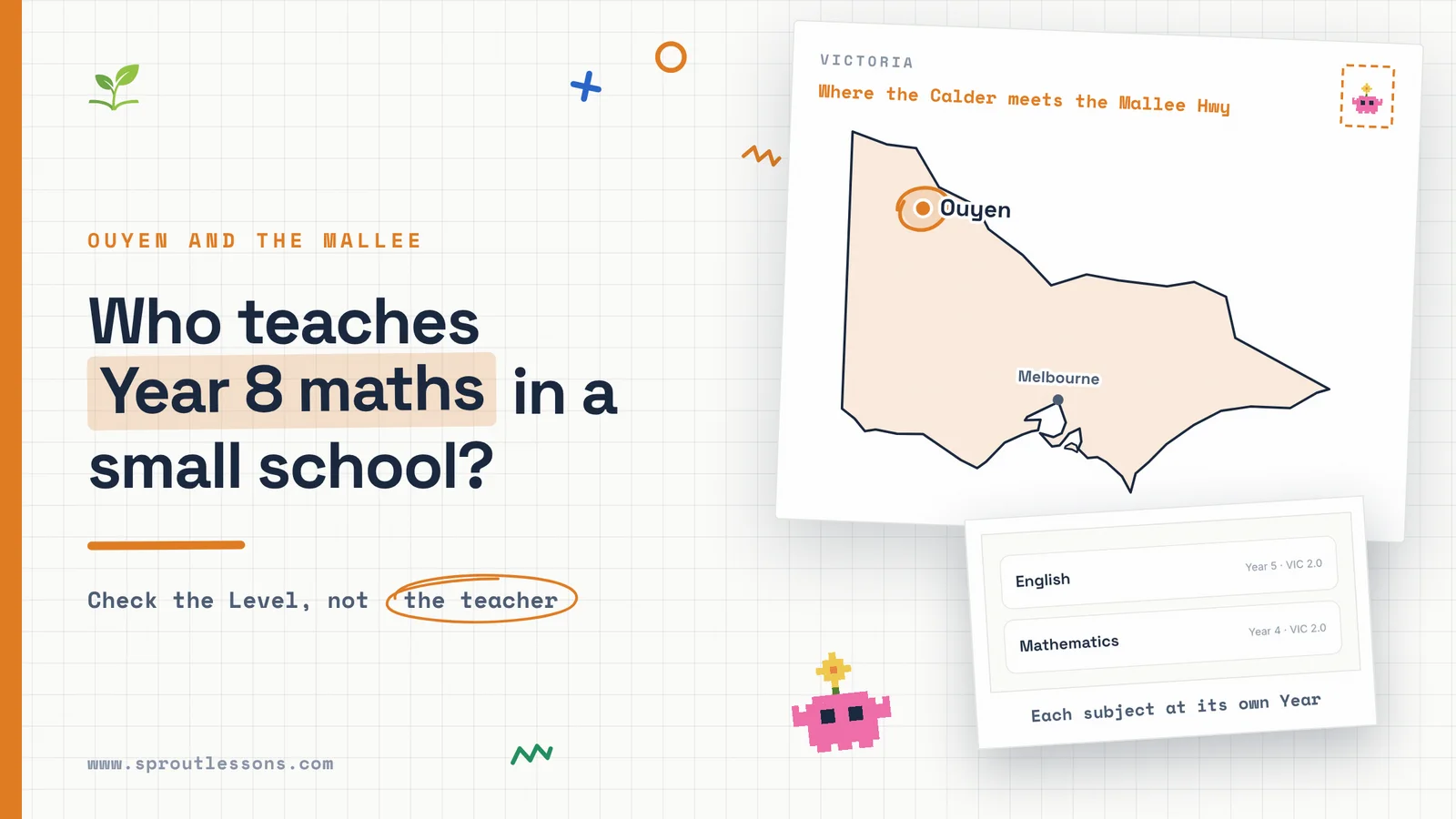
Ouyen sits where the Calder Highway meets the Mallee Highway, and Ouyen P-12 College describes itself as catering for students from Prep to Year 12, in north-western Victoria close to both the South Australian and New South Wales borders, with VCE, VET and school-based apprenticeship pathways. It also tells prospective staff that teacher housing is available, which is what a school says when recruiting is hard. Sea Lake, Murrayville and many other Mallee towns are in the same position.
The arithmetic is simple. A large Melbourne secondary school with ten Year 8 classes can give every one of them to a maths-trained teacher, and needs several. A small P–12 school may have one Year 7 class, one Year 8 class and one Year 9 class, and a handful of secondary staff to cover every subject in all of them. If the school has one maths-trained teacher, they are usually needed in the senior years, where VCE Mathematical Methods and Specialist Mathematics cannot be taught by anyone else. Years 7 to 9 maths then goes to whoever has room on their timetable. That is not a failing of any school or teacher. It is a staffing shortage that lands hardest where the staff rooms are smallest.
What the research says, and how big the numbers are
In 2024 the Australian Mathematical Sciences Institute, the Australian Mathematical Society, the Actuaries Institute, the Statistical Society and the Mathematics Education Research Group of Australasia published a joint position paper on out-of-field maths teaching. An out-of-field teacher, in their definition, is qualified to teach other subjects but not trained in maths content or in how to teach maths. The paper says the problem is severe in outer suburban, low-income, regional and remote schools, and that it reduces the maths subjects those schools can offer.
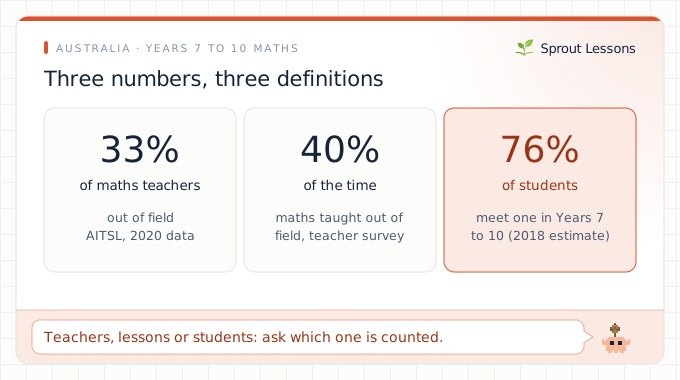
It quotes three national figures, and they look inconsistent until you notice they count different things:
- 33% of the people teaching maths were out of field, from 2020 data published by the national teaching institute, AITSL.
- Maths was taught out of field 40% of the time, from AITSL’s teacher workforce survey, which counted a teacher as in field after a single semester of maths study. The paper argues that bar is low and both figures underestimate the problem.
- 76% of students are estimated to be taught maths by an out-of-field teacher at some point between Years 7 and 10 (Prince and O’Connor, 2018).
None of these is a figure for any one school, and we do not know the staffing of any school named on this page. The paper also cites TIMSS 2019: Australian Year 8 students taught by fully qualified maths teachers scored significantly higher than students taught by teachers with neither maths content nor maths teaching training. The honest reading is that the teacher matters, the shortage is real, and a parent in a small school has more reason than most to keep an eye on where the maths is up to.
What to look at instead of the teacher
You cannot fix the staffing, and asking a teacher about their degree at parent-teacher interviews will not help your child. What you can see is the maths itself. Three places to look:
- The Level on the report. Victorian government schools report maths as a Level score against the Victorian Curriculum, plus a five-point rating against the standard for the year. At the end of Year 8, a score of 8 or 7.5 is the expected window. Two reports in a row below it, in maths only, is the signal worth acting on. How to read it is on the Victorian school report explained.
- The exercise book. Ask to see it once a term. Worked steps, corrections and new topics every few weeks are good signs. A term of the same page of exercises, or worksheets with no working shown, is a question to ask.
- Four questions at the kitchen table, below. They sit on the four Year 8 ideas that most often go wrong, and each wrong answer tells you exactly what was missed.
Four Year 8 questions, and what each wrong answer means
Level 8 maths in the Victorian Curriculum has 29 content descriptions, read from our copy of the dataset. All are listed on Year 8 maths in the Victorian Curriculum. These four are the ones where a gap at Year 8 turns into a wall in Year 9 and 10. Ask them cold, on paper, and keep the sheet.
- “What is −3 − (−5)?” Integers with all four operations (VC2M8N04). The common wrong answer is −8: the child has seen two negatives and added them. The answer is 2. Subtracting a negative moves you up the number line, and a vertical number line drawn on the side of the page fixes it faster than any rule about “two negatives make a positive”, which is the rule that caused the error.
- “Expand 3(x + 4).” Linear expressions and the distributive property (VC2M8A01). The common wrong answer is 3x + 4: the 3 has multiplied the first thing in the bracket and stopped. The answer is 3x + 12. The reteach is an area diagram, a rectangle 3 high split into widths x and 4, so both parts are visibly multiplied.
- “A right-angled triangle has short sides 6 cm and 8 cm. How long is the longest side?” Pythagoras’ theorem (VC2M8M06). The wrong answers are 14 (the sides added) and about 3.7 (the square root of 6 + 8). The answer is 10, because 36 + 64 = 100. If the child writes the formula correctly and still gets 14, the gap is not Pythagoras but squaring.
- “A $80 jacket goes up 25%, then the new price comes down 25%. What does it cost now?” Percentage increase and decrease (VC2M8N05). The confident wrong answer is $80. It is $75: up to $100, then down by a quarter of $100. The child is treating a percentage as an amount rather than a share of whatever it is taken from.
A Year 8 who gets all four in Term 4 is where they should be in the parts of Year 8 that matter most for what comes next. A child who misses two or more is worth a conversation with the school, whoever the teacher is.
What to ask the school, politely
In a small school you will probably know the principal by name, which makes this easier, not harder. Questions that get useful answers without putting a teacher on the spot:
- “Who plans the Year 7 to 9 maths program?” In many small schools one maths-trained teacher writes the program and others teach it. A good plan in an out-of-field teacher’s hands is a very different thing from no plan.
- “Is there support for the maths teachers?” The 2024 paper argues that upskilling the teachers already in schools is the fastest fix, and teachers who are out of field are often keen for it.
- “What Level is my child working at in maths, and in which topics?” Mid-term, not at report time. You want the topic, not just the number.
- “What maths will be offered in Year 11?” Ask this in Year 9, not Year 10. If Methods depends on enough students choosing it, or on an online arrangement, you need to know early. The Year 10 choice itself is on Year 10 maths: 10 or 10A.
Practice that does not depend on who is teaching
Sprout Tutor follows the Victorian Curriculum for Foundation to Year 10 in maths, English and science, so a Year 8 in Ouyen practises the same Level 8 content descriptions as a Year 8 anywhere in the state. Since this is our product, the specifics:
- Each topic starts with a short teaching deck, then ten questions at three tiers, so a child meets the explanation before the practice, from the same curriculum code the school is working from.
- Each subject sits at its own Year. If the integers gap is really a Level 7 gap, maths can drop back while English stays put. Three right answers at the stretch tier moves a subject up a Year, five wrong in a row at the support tier moves it down, and every change is logged. See how Sprout Tutor decides what comes next.
- You see every question and answer on the parent dashboard, which is the view of the maths a small-school parent rarely gets. Three wrong in a topic offers a help lesson, which uses lesson credits.
- It is in public beta and free on every plan while it is in beta, including the free one, and it covers Victoria only for now.
Sprout Lessons builds one lesson on one code in about thirty seconds, VC2M8M06 for Pythagoras or VC2M8A01 for expanding brackets, set around an interest such as farm life, footy or motorbikes. Start free.
Software is not a maths teacher, and the evidence that personalised-learning tools improve outcomes is thin, because very few rigorous studies exist. Use it for practice at the right Level, and keep talking to the school. If your child has fallen well behind, the plan on catching up when a child falls behind is the place to start.
The short version
In a small secondary school like Ouyen’s, Years 7 to 9 maths is often taught by a teacher trained in another subject, because the one maths specialist is needed for VCE. The 2024 position paper from Australia’s maths societies says this is common nationally and worst in regional and remote schools, with estimates from 33% of maths teachers to 76% of students depending on what is counted. Watch the Level on the report, look at the exercise book, try the four questions on integers, brackets, Pythagoras and percentages, and ask who plans the program and what Year 11 maths will run.
Sprout Tutor follows the Victorian Curriculum from Foundation to Year 10, with each subject at its own Year and every answer visible to you, free on every plan while it is in beta. Start free.
How this page was checked
Checked 7 November 2026. The national figures and definitions are from the 2024 position paper “Out-of-field teaching of secondary school mathematics in Australia”, which cites AITSL (2021, 2023), Prince and O’Connor (2018) and Thomson et al. (2021) for TIMSS 2019. The school details are from Ouyen P-12 College’s own website. We make no claim about the staffing of any named school. Content description counts and codes were read from our copy of the Victorian Curriculum 2.0 mathematics dataset, and the descriptions above are paraphrased rather than quoted. Victorian Curriculum F–10 Version 2.0 © VCAA, which does not endorse this product; the curriculum is available at f10.vcaa.vic.edu.au.
FAQ
What is an out-of-field maths teacher?
A teacher who is qualified to teach other subjects but is not trained in maths content or in how to teach maths, and has been assigned a maths class. The 2024 position paper from Australia’s maths societies says this is common nationally and severe in outer suburban, low-income, regional and remote schools. It is a staffing shortage, not a judgement on the teacher, who is often doing their best with a subject outside their training.
How common is out-of-field maths teaching in Australia?
It depends on what is counted. AITSL’s 2020 data put 33% of the people teaching maths as out of field; its teacher survey found maths taught out of field 40% of the time, using a low bar of one semester of study; and a 2018 estimate found 76% of students meet an out-of-field maths teacher at some point in Years 7 to 10. The position paper argues all of these underestimate the problem.
How can I tell if my child’s Year 8 maths is on track?
Read the Level score on the school report, where 7.5 or 8 is the expected window at the end of Year 8, look at the exercise book once a term, and try four questions cold: −3 − (−5), expand 3(x + 4), the long side of a right-angled triangle with short sides 6 and 8, and an $80 price raised then lowered by 25%. The answers are 2, 3x + 12, 10 and $75, and each common wrong answer points to a specific gap.
Should I ask the school whether my child’s maths teacher is qualified?
Questions about the program get better answers than questions about a person. Ask who plans the Year 7 to 9 maths program, whether the maths teachers have support, which Level and topics your child is working on mid-term, and in Year 9, which maths subjects will run in Year 11. In a small school these are short conversations with someone you probably already know.
Can Sprout Tutor help with Year 8 maths in Victoria?
Yes. Sprout Tutor follows the Victorian Curriculum for Foundation to Year 10 in maths, English and science, so it covers the Level 8 maths content descriptions. Each topic opens with a short teaching deck and then ten questions, each subject sits at its own Year, and every question and answer shows on the parent dashboard. It is in public beta and free on every plan while it is in beta.