
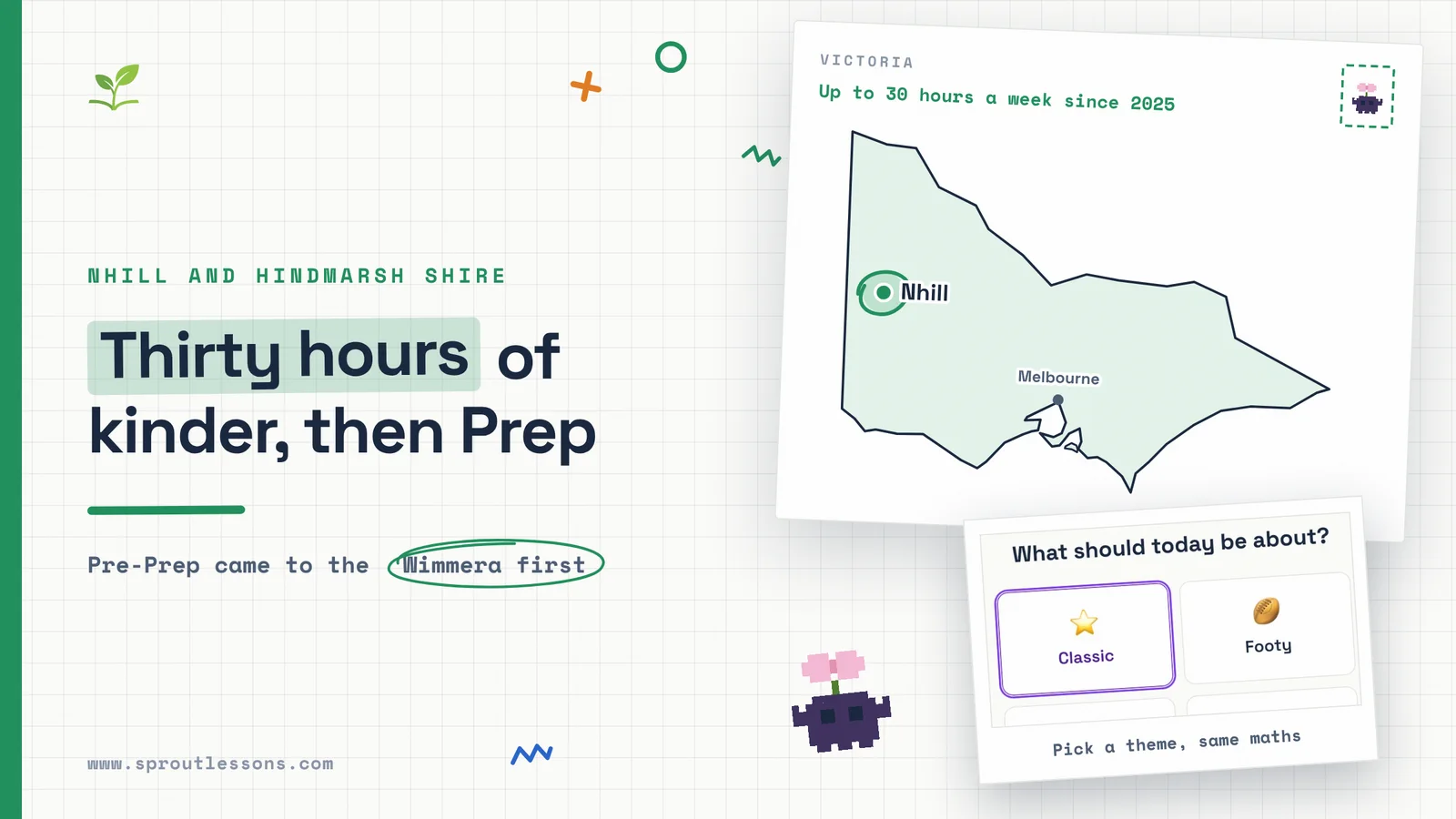
If your child is at kinder in Nhill, Dimboola, Jeparit or Rainbow, they are in one of the first six shires in Victoria to get Pre-Prep: up to 30 hours of kinder a week instead of 15, a full year before most of the state. That is a lot more time to learn through play, and it means a full school week in Prep is less of a jump. It does not mean your child has started the Prep curriculum, and the school will not expect them to have. This page sets out what Hindmarsh actually has, what the extra hours are for, what Prep asks for by December, and what is worth doing at home between now and the first day.
Why a Wimmera shire got it first
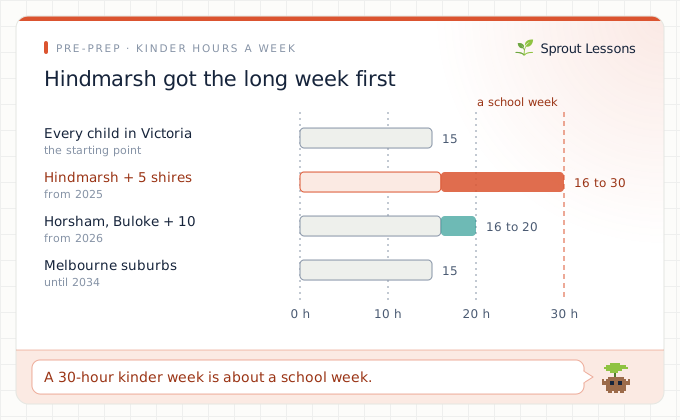
Pre-Prep is the Victorian Government’s name for more hours of four-year-old kinder. Every child in the state can already get 15 hours a week in the year before school. Pre-Prep lifts that, area by area, towards 30. The roll-out schedule (updated 31 August 2026) starts in the country and finishes in Melbourne:
- 2025: six shires, 16 to 30 hours a week. Ararat, Gannawarra, Hindmarsh, Murrindindi, Northern Grampians and Yarriambiack.
- 2026: twelve more, 16 to 20 hours, rising to 25 hours from 2029 and 30 from 2031. These include Buloke, Horsham, Loddon and East Gippsland.
- 2027 and 2028: the rest of regional Victoria, on the same 16 to 20 hour start. West Wimmera, next door to Hindmarsh, starts in 2027.
- Ballarat, Bendigo and Geelong in 2032, and the rest of Melbourne in 2034, with up to 30 hours everywhere from 2036.
So a four-year-old in Nhill can have had a long kinder week since 2025, and a four-year-old in Melbourne’s suburbs will not have one until the mid 2030s. If you have moved to the Wimmera from the city, or have cousins at kinder elsewhere, that is why your experience and theirs do not match.
In Hindmarsh Shire the kinders are run by Emerge Early Years Services in partnership with the council. The council’s early years page lists Pre-Prep at Nhill College Kindergarten and Nhill Early Learning Centre (both on Whitehead Avenue), Dimboola Early Learning Centre and Dimboola Primary School Kindergarten, Jeparit Kindergarten and Rainbow Kindergarten. The exact hours a service offers sit inside the 16 to 30 range and are set by the service, so the place to ask is Emerge, not the school.
What Pre-Prep is, and what it is not
The Department describes Pre-Prep as teacher-led, play-based learning that follows the Victorian Early Years Learning and Development Framework, the framework for birth to eight, and the extra hours are part of Free Kinder. The stated purpose is more time to learn through play and to build the social and emotional skills for school.
The thing it is not is the Foundation curriculum. Prep teaches the Victorian Curriculum for Foundation, and kinder, however many hours, teaches to the early years framework. A Nhill child who has had 30 hours a week of kinder has had a great deal more practice at the things kinder does well (playing alongside other children, waiting a turn, following a routine, talking about what they made) and no formal instruction in reading, spelling or written number. That is by design, and the Prep teacher is not expecting it.
Where the hours do show is in the day itself. A 30-hour kinder week is roughly five six-hour days, which is about the length of a school week. For a child coming from 15 hours, the first month of Prep is often less about the learning than about the tiredness: a full day, five days in a row, with a bus or a drive either side. A child who has already done long kinder days has done that part. It is one less thing to adjust to in February, not a head start on the curriculum.
What Prep asks for by December
The Foundation curriculum describes where a child should be at the end of Prep, not at the start. Read from our copy of the Victorian Curriculum 2.0, Foundation maths has 12 content descriptions and Foundation English has 29. Paraphrased, the ones parents ask about most are:
- Numbers to at least 20, named, ordered and shown with objects (VC2MFN01), and counting collections to 20 to compare them (VC2MFN03).
- Seeing up to 5 without counting, the skill teachers call subitising (VC2MFN02), and splitting collections up to 10 into parts (VC2MFN04).
- Repeating patterns, copied, continued and made up (VC2MFA01), and comparing length, capacity, mass and duration directly (VC2MFM01).
- Every letter, upper and lower case, with its most common sound (VC2EFLY06), and using those sounds to read and spell three-letter words such as cat and dog (VC2EFLY05).
- Hearing the sounds inside words, rhyme and syllables (VC2EFLY03) and blending and splitting the sounds of a one-syllable word out loud (VC2EFLY04).
All five are taught in Prep. A child who arrives knowing some letters is welcome; a child who arrives knowing none is normal. The full lists, with the teaching order, are on Foundation maths in the Victorian Curriculum and Foundation English, and what a child should have by the end of the year is on what your child should know by the end of Prep.
The handover in a small town
Every child moving from a funded kinder program to school has a Transition Learning and Development Statement, written by the kinder teacher in the second half of the year, with a section for you to fill in. How it works, and why your section matters, is on is my child ready for Prep. In Hindmarsh it is worth adding two questions that a city family would not need to ask.
- “How many hours did my child actually do?” The range is 16 to 30, attendance varies, and the Prep teacher reading the statement may not know which. Put the number in your section, along with how your child coped with the long days. It is a fact the teacher can use for the first fortnight.
- “Does the kinder teacher talk to the Prep teacher?” Nhill College Kindergarten is on the same street as Nhill College, which takes children from Prep to Year 12, and Dimboola has a kinder at the primary school. In a town that size the two teachers often know each other, and a ten-minute conversation in Term 4 is worth more than the form. Ask whether it is happening rather than assuming it is.
From Prep in 2027 schools can use the Reading Assessment F–8, and Year 1 brings the phonics check and the numeracy check. None of them needs preparing for in kinder or over the summer. They are screens, built so that a child who is not picking up sounds or numbers gets help early.
At home: the summer before Prep
The case the Department makes for longer kinder is about play, and the best home version of the summer is the same. Three games that line up with the first things Prep teaches, none of them on a screen:
- “How many, without counting?” Hold up a hand of 3 or 4 eggs, sheep on a picture book page or dots on dice, for a second, and ask how many. That is subitising (VC2MFN02). Keep it to 5 and keep it quick.
- “I spy, with sounds.” “I spy something that starts with mmm”, using the sound and not the letter name. It is the phonemic awareness Prep builds on (VC2EFLY04), and it works in the car on the Western Highway.
- Patterns from the yard. Gum leaf, stick, gum leaf, stick: what comes next? Then let your child make one for you to finish (VC2MFA01).
If your child already reads a few words, enjoy it, and do not push for more. If they do not, nothing is behind. The parent-practice version of this, for once school starts, is on helping with maths at home without a tutor.
Once Prep starts: where Sprout fits
We would not put a four-year-old in Pre-Prep on a screen to practise school work, and we do not suggest it here. Once your child is in Prep, two of our products can help, and both are honest about what they are.
- Sprout Tutor reads to a Foundation child. A Prep child cannot yet read a question by themselves, so for a child working at Foundation each question has a small listen button that reads the question aloud. It reads the question only, never the answer choices, so a reading question (“Which word is cat?”) stays a reading question. The teaching slides before the questions are read aloud too. The voice is a recorded American voice, as we do not yet have an Australian one.
- It follows the Victorian Curriculum for Foundation to Year 10 in maths, English and science, in short topics of ten questions, and you can see every question and answer on the parent dashboard. It is in public beta and free on every plan while it is in beta, including the free one. How the whole thing works is on how Sprout Tutor works.
- Sprout Lessons builds one lesson on one Foundation code, VC2MFN02 for seeing up to 5 or VC2EFLY05 for three-letter words, in about thirty seconds, around an interest your child has: farm life, tractors, chickens, horses and footy are all on the list. The method is on teaching maths through interests. Start free.
The evidence that personalised-learning software improves outcomes is thin, because very few rigorous studies exist. For a Prep child, ten minutes on the tutor is a small extra. The talking, reading together and playing are the main thing, and in Hindmarsh your child has had more of that already than almost anyone in the state.
The short version
Hindmarsh Shire was one of six Victorian shires to get Pre-Prep first, in 2025, with 16 to 30 hours of kinder a week against the 15 the rest of the state started with. It is play-based and teacher-led, and it is not early Prep: the Foundation curriculum (12 maths and 29 English content descriptions) is taught in Prep and describes where a child should be in December. What the long kinder week does change is stamina for a full school week. Put your child’s real hours in the transition statement, ask whether the kinder and Prep teachers are talking, and spend the summer on games rather than worksheets.
Once your child is in Prep, Sprout Tutor reads Foundation questions aloud and follows the Victorian Curriculum, free on every plan while it is in beta. Start free.
How this page was checked
Checked 7 November 2026. The roll-out years, shires and hours are from the Victorian Government’s Pre-Prep roll-out schedule (updated 31 August 2026) and its Pre-Prep pages; the Hindmarsh kinders are from Hindmarsh Shire Council’s early years page. Hours at a particular service vary inside the published range, so check with the service. Content description counts and codes were read from our copy of the Victorian Curriculum 2.0 dataset, and the descriptions above are paraphrased rather than quoted. Victorian Curriculum F–10 Version 2.0 © VCAA, which does not endorse this product; the curriculum is available at f10.vcaa.vic.edu.au.
FAQ
What is Pre-Prep in Victoria?
Pre-Prep is the Victorian Government’s name for more hours of four-year-old kinder, the year before school. Every child can get 15 hours a week; Pre-Prep lifts that towards 30 hours, area by area. It is teacher-led, play-based learning under the Victorian Early Years Learning and Development Framework, and the extra hours are part of Free Kinder.
When did Pre-Prep start in Hindmarsh Shire?
In 2025. Hindmarsh was one of six local government areas in the first year, with Ararat, Gannawarra, Murrindindi, Northern Grampians and Yarriambiack, and services there can offer 16 to 30 hours a week. Twelve more regional areas, including Horsham and Buloke, started in 2026 at 16 to 20 hours, and Melbourne’s suburbs follow from 2034, with up to 30 hours everywhere from 2036.
Does Pre-Prep mean my child will be ahead in Prep?
Not in the curriculum. Pre-Prep is play-based kinder, not early Prep, and the Foundation curriculum for reading, writing and number is taught in Prep itself. What a long kinder week does change is stamina: 30 hours is about the length of a school week, so a full five days of Prep is less of a jump for a child who has done long kinder days.
Where can I get Pre-Prep in Nhill, Dimboola, Jeparit or Rainbow?
Hindmarsh Shire Council lists Pre-Prep at Nhill College Kindergarten and Nhill Early Learning Centre on Whitehead Avenue, Dimboola Early Learning Centre, Dimboola Primary School Kindergarten, Jeparit Kindergarten and Rainbow Kindergarten. They are run by Emerge Early Years Services with the council, and Emerge handles enrolments and can tell you the hours each service offers.
Can Sprout Tutor help a child in Prep?
Yes, once they are in Prep. Sprout Tutor follows the Victorian Curriculum for Foundation to Year 10, and for a child working at Foundation each question has a listen button that reads the question aloud, but never the answer choices, so reading questions stay reading questions. It is in public beta and free on every plan while it is in beta. We do not suggest screen practice for a child still in kinder.