
By the end of Prep in Victoria, the curriculum expects a child to name every letter, know the common sound for each, read and spell most three-sound words like cat, sun and pig, read some common words by sight, and write a short idea with a capital letter and a full stop. In maths, they count and order numbers to at least 20, see small groups without counting, split numbers up to 10 into parts, and compare which thing is longer, heavier or holds more. On the end-of-year report, “at expected level” covers Foundation and the half-step just under it.
That last point matters more than it looks. The Prep report is the first one with a full year behind it, and a C rating can mean your child has met the whole Foundation standard or is still a little short of it. This page sets out what the Victorian Curriculum asks for by December in plain words, what it does not ask for yet (several things parents worry about are Year 1 or Year 2 work), how to read the Prep report, a ten-minute check you can do at home, and what Year 1 brings in 2027, including the first statewide Numeracy Check.
What Prep is meant to cover in English
Prep is called Foundation in the Victorian Curriculum. The Foundation English standard splits into speaking and listening, reading and viewing, and writing. In plain terms (the VCAA wording is paraphrased here, not quoted), by the end of the year a child should be able to:
- Hear the sounds in words. Clap syllables, pick rhyming words, and say the separate sounds in a short word: c-a-t. Then do it the other way, blending sounds into a word, and swap one sound for another (cat to hat). This is phonemic awareness, VC2EFLY03 and VC2EFLY04, and it is done out loud, before any reading.
- Know every letter. Name all the upper-case and lower-case letters, and know the most common sound each one makes (VC2EFLY06).
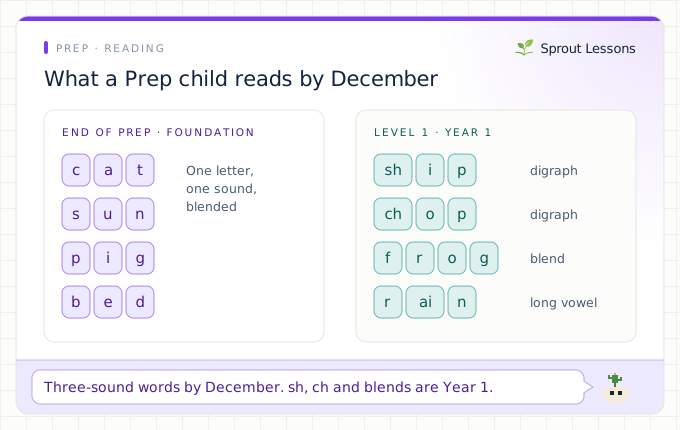
- Read and spell three-sound words. Consonant, vowel, consonant: cat, sun, pig, hot, bed (VC2EFLY05). The standard says children spell most of these words, not all.
- Read some sight words. Some high-frequency words such as the, is and was, and other familiar words (VC2EFLY07). The curriculum does not set a number.
- Read a decodable book using the sounds they know, and notice when it stops making sense (VC2EFLY09). A decodable book uses only the letters and sounds already taught.
- Talk about a story. Name the characters, the setting and what happened, connect it to their own life, and predict what comes next (VC2EFLE03, VC2EFLY12).
- Write a short text to retell a story or report something that happened, using familiar words and pictures (VC2EFLY13), with capital letters and full stops in the right places (VC2EFLA09).
- Form most letters correctly, upper and lower case (VC2EFLY15).
- Speak to a group for a short time, such as a news or show-and-tell turn, and listen while others speak (VC2EFLY01, VC2EFLY02).
What Prep is meant to cover in maths
The Foundation maths standard, again paraphrased, asks that by the end of the year a child can:
- Count, read and order numbers to at least 20, and connect the spoken name, the written numeral and where it sits in the counting sequence (VC2MFN01).
- See small groups without counting. Glance at up to five dots or objects and say how many (VC2MFN02). This is called subitising, and it is the skill dot dice and dominoes train.
- Compare collections to 20 by counting, and explain which has more (VC2MFN03).
- Split numbers up to 10 into parts. Seven is five and two, or four and three (VC2MFN04). This part-part-whole idea is the most important piece of Prep maths, because Year 1 addition and subtraction is built on it.
- Act out adding, taking away and sharing with real objects, including simple money situations, using counting or subitising (VC2MFN05, VC2MFN06). With objects, not on paper.
- Copy, continue and make repeating patterns (red, blue, red, blue) and follow a short sequence of instructions (VC2MFA01).
- Compare length, mass, capacity and time directly: which pencil is longer, which bag is heavier, which cup holds more, by putting them side by side or pouring (VC2MFM01). No rulers, scales or units yet.
- Order the days of the week and the parts of a day, morning, lunchtime, afternoon, night (VC2MFM02).
- Name and sort familiar shapes, find them in the world around them, and describe where things are: behind, next to, under (VC2MFSP01, VC2MFSP02).
- Sort and compare simple data in answer to a yes-or-no question, such as how many in the class have a pet (VC2MFST01).
What Prep does not ask for yet
Much of the worry at the end of Prep comes from things the Victorian Curriculum puts in Level 1 or Level 2. Your child is not behind if they cannot yet:
- Read words with sh, ch, th or blends like fr and st. Digraphs, consonant blends and long vowels are named at Level 1 (VC2E1LY04). Plenty of Prep classes start them, but the Foundation standard stops at three-sound words.
- Spell every word correctly in their writing. A Prep child who writes “I wnt to the pak” has heard most of the sounds and written a letter for each, which is exactly the stage. Spelling one- and two-syllable words with common patterns is Level 1 (VC2E1LY06).
- Count to 100. Level 1 takes counting and ordering to at least 120 (VC2M1N01). Foundation asks for 20.
- Add and subtract in their head or on paper. Adding and subtracting within 20, with strategies, is Level 1 (VC2M1N04). In Prep it is done with objects.
- Tell the time on a clock. Reading an analogue clock to the hour, half-hour and quarter-hour is Level 2 (VC2M2M04). Prep orders the parts of the day.
- Read a chapter book on their own. Nothing in Foundation asks for it. A child reading decodable readers fluently in December is doing well.
How to read the Prep report
Victorian government schools report twice a year, and for English, Mathematics and Science the report must use an age-expected five-point scale (A to E). The teacher gives a score on the Victorian Curriculum, and the rating is looked up from that score in a matrix the Department of Education publishes. Our guide to the Victorian school report explains the scores for every year. Here is the Foundation row, which that page does not show in full.
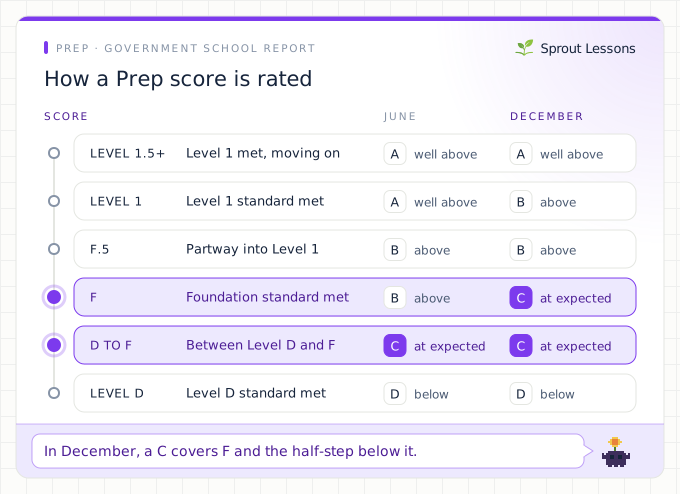
Three things follow from that row:
- A C in December does not always mean the standard is met. A score of Foundation is a C, and so is the half-step under it. Look at the score, not only the letter. If the score sits below F, ask the teacher which parts of the standard are not consistent yet.
- A B in June and a C in December can be the same child making a year of progress. A score of Foundation is rated B at mid-year and C at the end, because the expectation moves. Compare the two scores, not the two letters.
- Above expected starts at F.5. A child who is partway into Level 1 by December is rated B, and a child at Level 1.5 or higher is rated A. Below expected (D) is a score of Level D, one of the four levels (A to D) that sit before Foundation.
These are government school rules. Catholic and independent schools set their own reporting, so the letters on their reports may not mean the same thing.
A ten-minute end-of-Prep check
You need paper, a pencil and a handful of small objects. Do it on a calm afternoon, stop at the first thing that is hard, and do not practise the items first, or you will learn what your child can rehearse rather than what they know.
- Sounds, out loud. Say “What sounds are in mop?” (m-o-p). Then “What word is s-u-n?” (sun).
- Letters. Write ten lower-case letters in a jumble, including b, d, g and y, and ask for the sound of each.
- Read five three-sound words: pig, hen, rug, top, cat. Most of them, sounded out and blended, is on track.
- Write a sentence. “Tell me one thing you did today, then write it.” Look for a capital letter at the start, a full stop at the end, and a letter for most of the sounds.
- Numbers. Point to 14, 17 and 20 written on paper and ask what they are. Then ask what comes after 15, and before 11.
- Quick look. Show four objects for two seconds, then cover them. “How many?” A child who can say four without counting is subitising.
- Parts of seven. Put out seven objects, hide some under your hand, and ask how many are hiding. Repeat with a different split.
- Compare. Two cups of different shapes: “Which holds more? How could we find out?” Pouring one into the other is a good answer.
If questions 1 and 3 or questions 6 and 7 are hard, those are the two things to work on over summer, in that order, because they are what Year 1 reading and Year 1 maths build on. Our Victorian summer holidays plan fits both around a real family summer.
Want practice set in their world? Sprout builds a Foundation maths or English lesson from the exact Victorian code, around what your child loves, from dinosaurs to footy. Try it free.
What Year 1 brings in 2027
A child in Prep this year meets two statewide checks in Year 1 at a Victorian government school.
- The Year 1 Phonics Check, in weeks 4 to 6 of Term 3. It is 40 words, half of them made up, and the benchmark is 28. Children who miss it can be reassessed in Year 2. Our guide to Year 1 Phonics Check results explains what a score means.
- The Year 1 Numeracy Check, which was piloted in 2026 and is mandatory in every government primary school from 2027, so this year’s Prep children are the first full cohort. Our page on the Year 1 Numeracy Check has what the Department has published.
- A new Reading Assessment F–8, which schools can choose to use from Term 1 2027. It replaces the optional Foundation literacy assessment.
The phonics check tests exactly the Foundation and Level 1 decoding above, and the numeracy check leans hard on part-part-whole and quick recognition of small numbers. A summer of reading three-sound words and playing with parts of ten is the best preparation for both, and it does not involve a single practice test.
If the report says “below expected”
A D rating at the end of Prep means a score of Level D. It is worth a conversation, not a panic: the youngest children in a Victorian Prep class turned five by 30 April, some of their classmates are close to a year older, and a year of age is a big gap at five. Ask these at the parent-teacher meeting or by email before the holidays:
- Which parts of the Foundation standard are not consistent yet, in reading, writing and number?
- Which letter sounds does my child still mix up, and which words can they read?
- Did they do the Foundation literacy assessment this year, and can I see the results?
- What will Year 1 do in Term 1 for children who have not met the standard?
- What one thing should we practise over summer?
If repeating Prep comes up, read what the Victorian policy on repeating a year says before you agree to anything. And if your child is working well above Foundation, the page on working at a different level covers what the school can do.
The short version
- English: every letter and its sound, read and spell most three-sound words, some sight words, a short sentence with a capital and full stop.
- Maths: numbers to 20, see up to five at a glance, split numbers to 10 into parts, compare length, mass and capacity side by side.
- Not yet: sh and ch words, accurate spelling, counting to 100, written sums, clocks. Those are Year 1 and 2.
- Report: in December, a C covers Foundation and the half-step below. Check the score, not just the letter.
- Year 1 in 2027: the Phonics Check in Term 3 and the first statewide Numeracy Check.
Sprout makes a lesson on the exact Foundation code your child is working on, with examples from their own interests. Start free.
How this page was checked
The curriculum content is from the Foundation achievement standards and content descriptions of the Victorian Curriculum F–10 version 2.0 for English and Mathematics, read on 28 October 2026 and paraphrased. The report ratings are from the Department of Education’s Student reporting VC lookup matrix, read for the Foundation columns, and the Reporting Student Achievement and Progress policy (updated 4 August 2026). The Year 1 checks and the Reading Assessment are from the Assessment of Student Achievement and Progress policy (updated 8 October 2026). Checked 28 October 2026. Rules can change, so check with your school before relying on a detail.
Victorian Curriculum codes reference the Victorian Curriculum F–10 Version 2.0 © VCAA, paraphrased; the VCAA does not endorse this product. Reporting and assessment requirements are paraphrased from the Department of Education’s Policy and Advisory Library, © State of Victoria (Department of Education).
FAQ
What should a Prep child know by the end of the year in Victoria?
In English: the name and common sound of every letter, how to read and spell most consonant-vowel-consonant words like cat and sun, some high-frequency words, and how to write a short sentence with a capital letter and a full stop. In maths: counting and ordering numbers to at least 20, recognising up to five objects without counting, splitting numbers up to 10 into parts, and comparing length, mass and capacity directly.
What does "at expected level" mean on a Prep report in Victoria?
Government school reports rate English, Mathematics and Science on an age-expected A to E scale looked up from the teacher's score. On the December report, a score of Foundation and the half-step below it are both rated C, at expected level. F.5 and Level 1 are B (above), Level 1.5 or higher is A, and Level D is D (below).
Should my Prep child be able to read words like ship and chop?
Not yet. The Victorian Curriculum names consonant-vowel-consonant words such as cat and pig at Foundation, and digraphs (sh, ch, th), consonant blends and long vowels at Level 1. Many Prep classes start them, but a child who reads three-sound words by December is on track.
Does my Prep child need to count to 100?
No. The Foundation standard is numbers to at least 20. Counting and ordering numbers to at least 120 is Level 1 content (VC2M1N01), and adding and subtracting within 20 using strategies is also Level 1.
What checks happen in Year 1 in Victoria?
Victorian government schools run the Year 1 Phonics Check in weeks 4 to 6 of Term 3, with a benchmark of 28 out of 40, and from 2027 the Year 1 Numeracy Check is mandatory in every government primary school. Schools can also use a new Reading Assessment F to 8 from Term 1 2027.