
The Victorian High-Ability Program (VHAP) is a free, 10-week online extension course in English or maths for students in Years 5 to 8 at Victorian government schools. You cannot apply for it. Each term the Department of Education picks students from NAPLAN results and teacher judgement, your child’s school reviews the list, and you give consent. A school can also nominate a student it thinks was missed.
So if another family at the gate mentions a VHAP letter and you have never heard of it, nothing has gone wrong with your paperwork. There is no form to fill in. This page sets out how a child actually gets a place, what the course is, what not being picked does and does not mean, the five questions worth asking the school, and the other free programs for high-ability children from Foundation to Year 12. The program is part of the Student Excellence Program, which the 2026/27 State Budget funds until the end of 2029, so none of this is about to disappear.
How a child gets a place
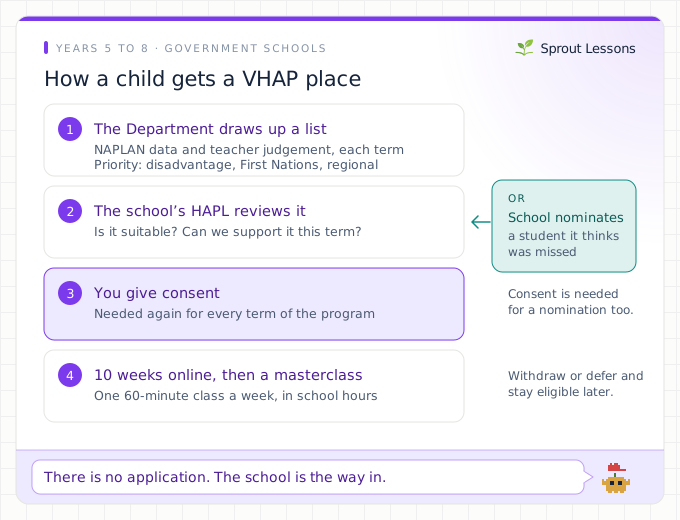
The Department’s Supporting High-Ability Students policy sets out the process, and it has four steps.
- The Department draws up a list. It identifies students “based on a combination of NAPLAN data and teacher judgement data”. Priority goes to high-ability students who experience socio-economic disadvantage, who are Aboriginal or Torres Strait Islander, or who live in a regional or rural area.
- The school reviews it. Every funded government school has a high ability practice leader (the policy calls them a HAPL). Each term the selection list is uploaded to Virtual School Victoria’s portal, and the HAPL checks each name for suitability and for whether the school can support that student’s participation that term.
- You give consent. The school must ask a parent or carer, and the place is not secured until consent is recorded. Consent is needed for each term your child takes part.
- Your child does the course. More on that below.
The second way in is nomination. A school can nominate a high-ability student who is not on the Department’s list, again with parent or carer consent. This is the route that matters if you think your child has been missed, and it runs through the same person, the HAPL. A student can also be withdrawn or deferred and stays eligible for future selection, so saying “not this term” does not close the door.
What the course actually is
- Four courses: primary English, primary maths, secondary English and secondary maths. A student can do each course once, so a child picked in Year 5 for primary maths could still do secondary maths in Year 7 or 8.
- One 60-minute live online class a week, for 10 weeks, taught by Virtual School Victoria during school hours. Your child joins from their own school, supervised by their school, and can work through the course material online outside class time.
- Then a masterclass: a face-to-face session with high-ability students from other schools in your area, run by the schools together.
- Free classes, possible transport cost. There is no fee for the online classes. A school can ask you to pay for or arrange transport to the masterclass, under the Department’s Parent Payments policy.
Virtual School Victoria describes the English course as exploring the links between reality and fiction, and the maths course as being about the “why” of maths rather than the “what”. In other words, it goes deeper rather than further ahead: it is not a way of racing through next year’s content.
My child was not picked. What does that mean?
Less than it feels like. Four things decide the list, and only one of them is your child’s ability.
- Which NAPLAN result was used. NAPLAN is sat in Years 3, 5, 7 and 9, so for a child in Years 5 to 8 the most recent result can be well over a year old. A child who took off after Year 3 may not show it in the data yet. Our Year 3 NAPLAN page covers what that test does and does not measure.
- Teacher judgement. This is the other half of the selection data, and it depends on what your child shows in class. That leads to the next point.
- Priority cohorts. Places go first to the three groups named above, which is a deliberate policy choice, not a judgement of your child.
- What the school can support that term. The HAPL reviews the list against the school’s capacity, so timing can matter.
Some capable children hide. The policy is unusually frank about this. It says research shows up to half of high-ability students do not reach their potential, and it names four kinds of underachiever. The one parents most often miss is the child who “flies under the radar”: gets good marks, does what is needed and no more, avoids academic risk, and so never looks like they need anything. Another is the selective underachiever, who works hard only in subjects (or for teachers) they like.
And some have a disability that masks the ability. The policy calls these students twice-exceptional: high ability together with a disability such as ADHD, autism or a learning difficulty. It describes three ways the two hide each other. Ability can mask the disability (the child performs at the expected level, but below what they could do), the disability can mask the ability (the child is below level and all the attention goes to catching up), or the two cancel out and the child sits at expected level with neither extension nor support. If your child has a diagnosis and a teacher has never mentioned extension, this is worth raising.
Five questions to ask the school
Ask for the high ability practice leader by that title. Every school receiving Student Excellence Program funding must have one, and coordinating VHAP is part of the job.
- Was my child on the Department’s VHAP list this year? If they were and did not take part, ask why: it may have been the school’s capacity that term, which is worth knowing.
- Would the school consider nominating them? Bring something concrete: work they did at home, a result from outside school, or a subject where they are clearly ahead.
- Which Victorian Challenge and Enrichment Series activities suit them? These are free and run from Foundation, so they are open well before VHAP is.
- What does extension look like in their class day to day? The policy expects schools to plan for it in ordinary lessons, for example by compacting content a student has already mastered and giving harder application tasks.
- Would one subject at a higher level help? Acceleration in a single subject is one of the options the policy lists, and it is far smaller than skipping a year.
Working ahead at home already? Sprout Tutor follows the Victorian Curriculum from Foundation to Year 10 and moves a strand up a Year when your child is ready, with every move logged for you. It is free during the beta. Try it free.
The other free programs, by year
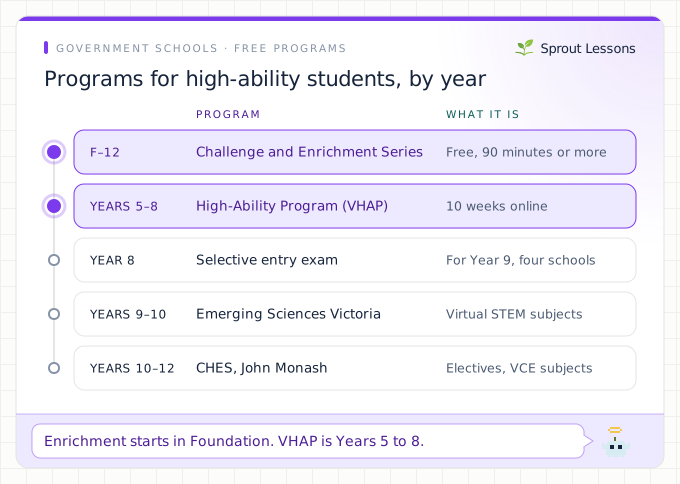
- Victorian Challenge and Enrichment Series (Foundation to Year 12). Workshops, lectures, competitions and excursions run by universities, specialist centres, tech schools and not-for-profits, linked to the Victorian Curriculum. Every activity is free, runs at least 90 minutes and is done in a group. For activities in school hours, the school nominates and registers students. For activities after school, on weekends or in the holidays, families can register their child directly with the provider, so ask the school which ones it would suggest. A child can do these and VHAP.
- Selective entry high schools (entry at Year 9). Mac.Robertson Girls’, Melbourne High, Nossal and Suzanne Cory take students from Year 9 through a central entrance exam, with a few places at Years 10 and 11 managed by the schools. Our selective entry exam page covers the timing and what the exam body says about preparation.
- Emerging Sciences Victoria (Years 9 and 10). Specialised STEM subjects in a virtual classroom, hosted by John Monash Science School.
- Centre for Higher Education Studies (Years 10 to 12). A government school that offers high-achieving students in government schools Year 10 enrichment electives and some VCE subjects, partly online and partly in person.
- Specialist schools with their own enrolment: John Monash Science School (Years 10 to 12), Elizabeth Blackburn Sciences (Years 11 and 12), the Victorian College of the Arts Secondary School (Years 7 to 12), Maribyrnong Sports Academy and the Flying Fruit Fly Circus.
Moving up a year: acceleration
The policy treats acceleration the same way as repeating a year: it is mostly at the school’s discretion, and the principal decides. It lists several forms, from small to large:
- material above the student’s current year, and compacting out content already mastered
- accelerating in one subject or a few
- skipping a whole year level
- early entry to primary school, secondary school or a higher education course.
Early entry to Prep is the one case that needs more than the principal: a child who has not turned 5 by 30 April of their first year needs the regional director’s approval too (our starting Prep page covers the age rule). For everything else, the principal should talk with your child, with you and with any professionals involved, and weigh the social and emotional side as well as the academic. The questions the policy suggests schools ask include what the achievement data and any assessments say, how ready the child is to work with older students, and how progress and wellbeing will be watched afterwards. Expect to be asked the same things, and bring your answers.
For most children the right first step is the smallest one. Because the Victorian Curriculum is written in levels rather than years, a child working at Level 6 in maths while in Year 4 is something the document already allows for, and the school report shows it. Our pages on working at a different level and the Victorian school report explain how that is recorded.
What helps at home
The policy’s wellbeing advice is written for teachers, but three of its points carry straight into the kitchen.
- Watch for perfectionism. The warning signs it lists are high anxiety, self-criticism, a focus on mistakes and a reluctance to try new things. Praise the effort and the method, not just the result.
- Expect uneven development. A child can understand Year 7 ideas and still have the emotional reach of a ten-year-old. The policy calls this asynchronous development, and it is normal.
- Find like-minded peers. The policy recommends time with children of similar ability, which is half the point of the VHAP masterclass and the enrichment series. A club built around their interest does the same job.
For the learning itself, go deeper before going faster: an open problem with several answers does more for a strong Year 5 than a page of Year 6 sums. Building it around what your child already loves helps, and our page on teaching maths through interests shows how. When they really are ahead, Sprout Tutor moves each maths strand up a Year after three right answers at its hardest tier, so a child can practise Level 6 Number while staying at Level 4 Space, and the dashboard shows every move.
Catholic, independent and homeschooled children
VHAP and the Student Excellence Program are for Victorian government schools. Catholic and independent schools run their own programs for able students, which we have not checked, so ask your school directly. A child registered for home education with the VRQA is not enrolled at a government school, and we found no route into VHAP for them; see homeschooling in Victoria for how registration works.
The short version
- VHAP: free, 10 weeks online, English or maths, Years 5 to 8, government schools only.
- No application. The Department picks from NAPLAN and teacher judgement, the school reviews, you consent each term.
- Schools can nominate students who were missed. Ask the high ability practice leader.
- Not being picked often reflects old NAPLAN data, priority places or a child who hides their ability.
- The Challenge and Enrichment Series is free from Foundation, and families can register for after-hours activities.
- Acceleration is the principal’s call. One subject at a higher level is the smallest step.
Sprout Tutor practises the Victorian Curriculum at the level your child is really at, above their year as well as below it, and it is free during the beta. Start free.
How this page was checked
The process on this page was checked on 27 October 2026 against the Department of Education’s Supporting High-Ability Students policy in the Policy and Advisory Library (last updated 24 April 2026) and all of its guidance chapters, the Student Excellence Program page on vic.gov.au (updated 17 August 2026), which carries the funding to 2029, and Virtual School Victoria’s VHAP page. Policies change, so check with your school before relying on a detail.
Policy requirements are paraphrased from the Department of Education’s Policy and Advisory Library, © State of Victoria (Department of Education), at www2.education.vic.gov.au (accessed 2026-10-27). Curriculum levels refer to the Victorian Curriculum F–10 Version 2.0 © VCAA. Neither the Department nor the VCAA endorses this product.
FAQ
What is the Victorian High-Ability Program?
VHAP is a free 10-week online extension course in English or maths for high-ability students in Years 5 to 8 at Victorian government schools. Virtual School Victoria teaches one 60-minute live class a week in school hours, followed by a face-to-face masterclass with students from nearby schools. There are four courses (primary English, primary maths, secondary English, secondary maths) and a student can do each once.
How are students selected for VHAP?
Each term the Department of Education identifies students from a combination of NAPLAN data and teacher judgement, with priority for students experiencing socio-economic disadvantage, First Nations students and students in regional or rural areas. The school's high ability practice leader reviews the list, and a parent or carer must consent for every term. Schools can also nominate a student, with consent.
Can I apply for VHAP for my child?
No. There is no parent application. If you think your child was missed, ask the school's high ability practice leader whether they were on the Department's list and whether the school would nominate them. A student who is withdrawn or deferred stays eligible for future selection.
Why was my child not picked for VHAP?
Selection uses NAPLAN, which is sat in Years 3, 5, 7 and 9, so the result used can be over a year old, plus teacher judgement of what your child shows in class. Places go first to priority cohorts, and the school reviews the list against what it can support that term. The Department's policy also notes that some high-ability students underachieve or have a disability that masks their ability.
Can my child skip a year in a Victorian government school?
Acceleration is mostly at the principal's discretion, after talking with the student, the family and any professionals involved. The policy lists smaller options too: work above the current year, compacting content already mastered, or acceleration in one subject. Early entry to Prep for a child who has not turned 5 by 30 April also needs the regional director's approval.