
ACARA, the body that runs NAPLAN, says on its own parent page that “students are not expected to study for NAPLAN” and that it “does not recommend excessive preparation for NAPLAN or the use of services by coaching providers”. That is an unusual thing for an assessment authority to say about its own assessment, and it is the most useful sentence a Year 3 parent can read.
This page is the specific version: the four things it tests, the one format detail that changes how you should think about practice tests, what the results actually mean, and what genuinely helps.
The four domains, and nothing else
NAPLAN runs for Years 3, 5, 7 and 9, in March. It assesses four things:
- Reading.
- Writing.
- Conventions of language, which is spelling, grammar and punctuation.
- Numeracy.
That is the whole list. No science, no history, no general knowledge. ACARA describes it as assessing “literacy and numeracy skills that students are learning through their regular school curriculum”, which is the other half of why cramming makes little sense: there is nothing separate to cram.
One Year 3 format detail worth knowing. Every test is online except the Year 3 writing test, which is done on paper and scheduled on the first day. If your child has only ever drafted on a screen, ten minutes of handwriting practice is a more sensible preparation than any practice test.
The thing that makes practice tests misleading
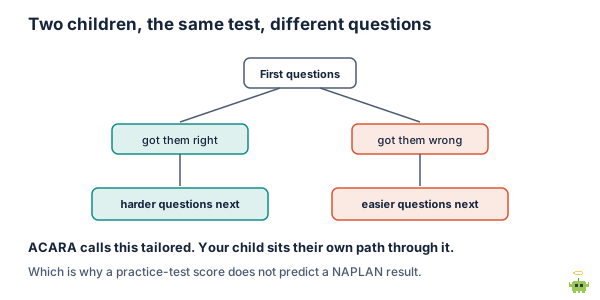
The online tests are tailored, which is ACARA’s word. In their description, “each test presents questions that may be more or less difficult depending on a student’s responses”. Answer the early ones well and the test hands you harder ones; struggle and it hands you easier ones. ACARA says this “allows a wide range of student abilities to be assessed and measures student achievement more precisely”.
The consequence for parents is the part nobody explains. A fixed practice test from a book or a website is not the test your child will sit, and a score on it does not map onto a NAPLAN result. A child can get most of a practice paper right and land in a middle band, because the real test would have escalated. A child can find the real test hard the whole way through and still do well, because it kept escalating.
So practice papers are fine for removing unfamiliarity with the format. They are close to useless as a predictor, and treating the number they produce as a forecast is how a nine-year-old ends up anxious about an assessment they were not supposed to study for.
What the results actually say
Since the 2023 reset, achievement is reported against four proficiency levels: Exceeding, Strong, Developing, and Needs additional support. These are not the old decile bands, and they are not a mark out of a hundred.
Three things worth holding in mind when the report arrives:
- Year 3 NAPLAN largely measures Foundation to Year 2. The test is in March. Your child has had roughly one term of Year 3 teaching. Whatever the report says, it is mostly a summary of the three years before this one.
- It is four domains, on two or three mornings, months ago. It is a snapshot, and it is a thin one next to a teacher who has watched your child work every day for a year.
- “Developing” is not a failure grade. It means the skills are on their way. If you want a second opinion on where your child sits, the curriculum itself is a better yardstick than a band label.
What actually helps, if you want to do something
None of this is NAPLAN preparation. That is rather the point.
- Read with them, and talk about what you read. Reading and conventions of language are half the test and they are built over years, not weeks. A child who reads is prepared.
- Practise the Year 3 maths the curriculum actually names. The 3, 4, 5 and 10 times tables and the related division facts, unit fractions, reading a clock to the minute, numbers beyond 10 000. The full Year 3 list is here.
- Do a little handwriting. Specific to Year 3, because the writing test is on paper while the rest of their schooling increasingly is not.
- Show them the format once, then stop. Knowing what the screen looks like removes a real source of stress. Doing six practice papers adds one.
- Do not tell them it matters. It does not, for them. It is a system-level measure. A relaxed child performs closer to their actual ability, which is the only outcome you should want from a diagnostic.
The wider piece on preparing without making it a thing goes further on the household side of this.
What not to do
- Do not buy a coaching package on the strength of a practice score. ACARA names coaching providers specifically in its own guidance, which is worth weighing.
- Do not treat a band as a diagnosis. If you genuinely want to know where the gaps are, check against the year’s content descriptions. How to tell whether a child is actually behind is a more useful exercise and you can do it in an afternoon.
- Do not compare siblings’ results across years. The test is adaptive and the scale was reset in 2023. It does not mean what a like-for-like comparison would need it to mean.
The short version
NAPLAN tests four things: reading, writing, conventions of language, and numeracy. It runs in March for Years 3, 5, 7 and 9. Year 3 does the writing test on paper, on day one; everything else is online.
The online tests are tailored, so two children sitting the same NAPLAN answer different questions. That is why a practice-test score is not a prediction, and why the main thing a stack of practice papers buys is anxiety.
Results come back as Exceeding, Strong, Developing or Needs additional support. A Year 3 result is mostly a summary of Foundation to Year 2, because the test happens one term into the year.
And ACARA itself says students are not expected to study for it. Read with your child, practise the maths the curriculum actually names for their year, do a little handwriting, show them the format once, and leave it there.
Sprout Lessons builds curriculum-aligned lessons for Foundation to Year 10, with the code on every lesson. Start free. If you are in Victoria, Sprout Tutor is in public beta for Years 1 to 9 and free on every tier while it is in beta.
Checked 25 September 2026 against ACARA’s own parent and carer guidance at nap.edu.au, which is the source of the four domains, the four proficiency levels, the description of the tests as tailored, and both quoted statements about preparation and coaching providers. Test windows and the paper-based Year 3 writing arrangement are from the NAPLAN test window material published on the same site. Dates and arrangements change year to year: confirm the current window with your school rather than relying on this page.
FAQ
What does NAPLAN test in Year 3?
Four domains: reading, writing, conventions of language which covers spelling, grammar and punctuation, and numeracy. That is the whole list, with no science, history or general knowledge. ACARA describes it as assessing literacy and numeracy skills that students are learning through their regular school curriculum.
Are NAPLAN practice tests useful?
For removing unfamiliarity with the format, yes. As a predictor, no. The online tests are tailored, which ACARA defines as presenting questions that may be more or less difficult depending on a student’s responses. A fixed practice paper cannot do that, so a child can score well on one and land in a middle band, or find the real test hard throughout and still do well, because it kept escalating.
Should my child study for NAPLAN?
ACARA’s own guidance says students are not expected to study for NAPLAN, and that it does not recommend excessive preparation for NAPLAN or the use of services by coaching providers. That is an unusual position for an assessment authority to take about its own assessment, and it is worth weighing before buying a coaching package on the strength of a practice score.
Is the Year 3 NAPLAN writing test on a computer?
No. Every NAPLAN test is online except the Year 3 writing test, which is completed on paper and scheduled on day one of the test window. It is the one format detail specific to Year 3, and it is the reason a little handwriting practice is more useful than a practice paper for that domain.
What do the NAPLAN proficiency levels mean?
Achievement is reported against four levels: Exceeding, Strong, Developing, and Needs additional support. They are not the old decile bands and not a mark out of a hundred. Developing is not a failure grade, it means the skills are on their way. Because the scale was reset in 2023 and the test is adaptive, comparing siblings’ results across different years does not mean what a like-for-like comparison would need it to mean.
Why does a Year 3 NAPLAN result feel like it measures the wrong year?
Because it largely does. The test runs in March, so a Year 3 student sits it after roughly one term of Year 3 teaching. Whatever the report says, it is mostly a summary of Foundation to Year 2. It is also four domains across two or three mornings, months before the report arrives, which is a thin snapshot next to a teacher who has watched your child work every day.