
Year 3 has one thing in the whole maths curriculum worded as a recall requirement, and it is not all the times tables. It is four of them. AC9M3A03 asks students to “recall and demonstrate proficiency with multiplication facts for 3, 4, 5 and 10”, and to extend those to the related division facts. That is the year in one line, and it is a much smaller ask than most parents assume.
The rest of this page is what Version 9 actually asks of a Year 3 student across maths, English and science, a five-minute check you can run at the kitchen table, and the list of things people expect in Year 3 that are not Year 3 at all.
The tables, drawn
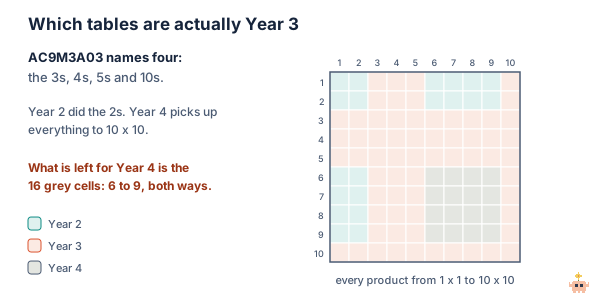
This is worth showing a worried parent, because the four tables Year 3 names knock out a surprising share of the grid once you count both directions. Seven times five is in the set, because five is. What is actually left for Year 4 is the sixteen products where both numbers are 6 to 9, and even then a few of those are squares a child often picks up early.
The full year-by-year breakdown of the tables is its own page, including why 10 x 10 is the ceiling and the elevens and twelves are not in the curriculum at all.
Year 3 by the numbers
Three learning areas, three counts, read from the curriculum rather than estimated. These are content descriptions, which is the unit a teacher plans from.
- Maths: 23 content descriptions. Number 7, Measurement 6, Algebra 3, Statistics 3, Probability 2, Space 2. Measurement being six is the surprise, and it is bigger in Year 3 than in Year 4 or Year 6.
- English: 28. Literacy 12, Language 11, Literature 5. English carries more content descriptions than maths, which is true in every primary year and still surprises people.
- Science: 12. Science Inquiry 6, Science Understanding 4, Science as a Human Endeavour 2. Half of Year 3 science is about how you find things out rather than what is known.
Seven things a Year 3 student should manage by December
- Recall the 3, 4, 5 and 10 times tables, and the division facts with them. AC9M3A03. The division half is the one that gets skipped: knowing 4 x 6 is 24 is supposed to make 24 divided by 4 immediate.
- Recognise and represent unit fractions. AC9M3N02 names exactly five: one half, one third, one quarter, one fifth and one tenth, plus their multiples, and combining fractions with the same denominator to complete the whole. This is the year thirds appear, because they are the first fraction that cannot be reached by halving.
- Read, write and order numbers beyond 10 000. AC9M3N01.
- Add and subtract two- and three-digit numbers by partitioning, without a calculator. AC9M3N03. The method named is place value, not a written algorithm.
- Multiply and divide one- and two-digit numbers using number sentences, diagrams and arrays. AC9M3N04.
- Read an analog clock to the nearest minute. AC9M3M04, which also asks them to describe the relationship between the hours and the minutes on analog and digital clocks. If the clock itself is the problem, that is a specific and very fixable thing.
- Estimate, and use the estimate to check. AC9M3N05 asks students to make estimates when solving problems to determine the reasonableness of calculations. Estimating is a requirement in its own right, not a shortcut for children who cannot calculate.
Two more worth knowing: dollars and cents (AC9M3M06) and angles as measures of turn, compared against a right angle (AC9M3M05).
What is not Year 3
The reassuring half, and it is long.
- The 6, 7, 8 and 9 times tables. Year 4, at AC9M4A02, which sets the ceiling at 10 x 10.
- Decimals. Year 4, at AC9M4N01.
- Equivalent fractions. Year 4, at AC9M4N03, and even then only with related denominators. That restriction runs until Year 6.
- Adding and subtracting fractions. Year 5.
- Division with remainders. Year 5. Year 4 is explicitly limited to division “where there is no remainder”.
- Percentages. Year 5. Negative numbers and the area formula. Year 6.
- Any formal written algorithm. Not mandated in any year, for any operation. What the curriculum actually says about long division is considerably less than almost everyone assumes.
If your Year 3 child cannot do the things on this list, they are not behind. They are on schedule, and in several cases three years early.
The five-minute check
Four questions, in this order. You are listening to the reasoning rather than marking the answer.
- “What is 4 times 6?” In the Year 3 set, because the 4s are. By December this should be quick. Rebuilding it from 4 x 5 plus 4 is fine and is the right kind of thinking; counting on fingers is the thing to fix.
- “And 24 divided by 4?” Straight afterwards. The descriptor pairs them deliberately and this is where a chanted table falls apart.
- Set a clock to something awkward and ask the time. Not o’clock, not half past. Nearest minute is the Year 3 standard.
- “Show me one third of this.” A strip of paper, folded. Thirds are new this year and they are the ones that break the halving habit.
Year 3 is a NAPLAN year
Which is most of why parents go looking for a page like this one. NAPLAN runs in March for Years 3, 5, 7 and 9, and for Year 3 it arrives with barely a term of Year 3 teaching behind it, so it largely measures Foundation to Year 2.
ACARA’s own position is that “students are not expected to study for NAPLAN”. What the test actually contains, and why a practice-test score does not predict a result, is its own page.
If something is missing
- Fix recall before anything that depends on it. Year 4 asks for all the tables and for multiplying by multiples of ten, and neither is reachable while 4 x 6 is being counted out.
- Practise the division facts as facts. Say them in pairs out loud: four sixes are twenty-four, twenty-four divided by four is six. The descriptor treats them as one thing.
- Fold paper for fractions. Thirds cannot be folded by halving, which is exactly why they are the Year 3 fraction and exactly why they need materials rather than a rule.
- Do not accelerate into Year 4 to get ahead. The order is load-bearing, and a child who has the 6s, 7s, 8s and 9s drilled before the 3s, 4s, 5s and 10s are automatic ends up with a hundred facts and no structure.
- Short and often beats a weekend blitz. The plan for doing this at home without a tutor is its own page.
A note on which curriculum applies to you
Everything above is Version 9 of the Australian Curriculum, which most states and territories use. Victoria does not. Victorian schools follow the Victorian Curriculum F–10 Version 2.0, a separate document with its own codes, and the differences are set out here. New South Wales runs its own K–10 syllabuses organised by stage, so a Year 3 student there is in Stage 2, covered in our NSW explainer.
Where to go next
- Year 3 maths, all 23 content descriptions
- Year 3 English, all 28
- Year 3 science, all 12
- The same page for Year 4, Year 5 and Year 6
- How to tell whether your child is actually behind
The short version
Year 3 is 23 maths content descriptions, 28 English and 12 science. The one recall requirement is AC9M3A03: the 3, 4, 5 and 10 times tables and the related division facts. Thirds arrive, numbers go beyond 10 000, clocks are read to the nearest minute, and estimating becomes a requirement rather than a fallback.
Check four things. Four times six. Twenty-four divided by four, straight afterwards. An awkward time on an analog clock. And one third of a strip of paper.
Then check the other list. The 6s to 9s, decimals and equivalent fractions are Year 4. Adding fractions, remainders and percentages are Year 5. Negative numbers and the area formula are Year 6. No written algorithm is required in any year at all.
Sprout Lessons builds curriculum-aligned lessons for Foundation to Year 10, with the code on every lesson, around whatever your child is actually into. Start free. If you are in Victoria, Sprout Tutor is in public beta for Years 1 to 9 and free on every tier while it is in beta.
Codes, counts and descriptor wording checked 25 September 2026 against our copy of the Machine Readable Australian Curriculum Version 9, accessed 2026-06-24, not written from memory. Read the official text at the Australian Curriculum Year 3 mathematics page. Australian Curriculum content © ACARA, licensed under CC BY 4.0. Counts are of content descriptions and exclude achievement standards and elaborations. Victoria and New South Wales run their own documents: check the one that applies to you.
FAQ
Which times tables should a Year 3 student know?
Four of them. AC9M3A03 names the 3s, 4s, 5s and 10s, along with the related division facts. Year 2 covered the 2s and Year 4 picks up everything to 10 x 10. Counting both directions, those four tables cover most of the grid: what is genuinely left for Year 4 is the sixteen products where both numbers are 6 to 9. The elevens and twelves are not in the Australian Curriculum at all.
What should a Year 3 student know in maths?
Year 3 is 23 maths content descriptions: Number 7, Measurement 6, Algebra 3, Statistics 3, Probability 2, Space 2. By December a Year 3 student should recall the 3, 4, 5 and 10 tables and their division facts, recognise and represent unit fractions, read and order numbers beyond 10 000, add and subtract two- and three-digit numbers by partitioning without a calculator, multiply and divide one- and two-digit numbers using arrays and diagrams, read an analog clock to the nearest minute, and make estimates to check whether a calculation is reasonable.
Which fractions are taught in Year 3?
AC9M3N02 names five unit fractions: one half, one third, one quarter, one fifth and one tenth, together with their multiples, and combining fractions with the same denominator to complete the whole. Thirds are the significant addition, because they are the first fraction that cannot be reached by repeated halving. Equivalent fractions do not arrive until Year 4, and then only with related denominators.
How many content descriptions does Year 3 have?
Maths 23, English 28 and science 12. English carries more than maths, which is true in every primary year. The surprise inside maths is Measurement at six descriptions, which is larger in Year 3 than in Year 4 or Year 6, covering metric units, duration, reading clocks to the minute, angles as measures of turn, and dollars and cents.
Does NAPLAN in Year 3 mean I should be doing extra maths?
Not in the way most people assume. NAPLAN runs in March, so a Year 3 result arrives after roughly one term of Year 3 teaching and largely measures Foundation to Year 2. ACARA states that students are not expected to study for NAPLAN and that it does not recommend excessive preparation or coaching providers. Practising the maths the curriculum actually names for the year is more useful than practice papers.
Does this apply in Victoria and New South Wales?
Not directly. Victoria follows the Victorian Curriculum F-10 Version 2.0, a separate document derived from the Australian Curriculum with its own codes. New South Wales runs its own K-10 syllabuses organised by stage rather than year, so a Year 3 student there is in Stage 2. The sequence is broadly similar but the codes and exact wording differ.