
Year 6 is the last year of primary, and most of what parents are bracing for is not in it. Letters standing for numbers, ratios, indices, circles, square roots, multiplying fractions: all Year 7. The Australian Curriculum keeps Year 6 recognisably primary and puts the step up exactly where the name changes.
What does change is smaller and more interesting. Year 6 is where zero stops being the left-hand end of the number line. Integers arrive, the Cartesian plane opens out to four quadrants, and a Year 6 student is asked to critique statistics in the media.
The change that actually matters
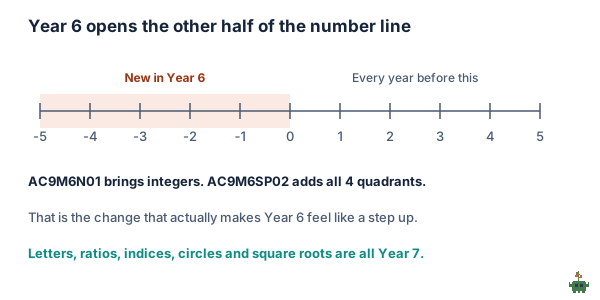
AC9M6N01 asks students to recognise situations, including financial contexts, that use integers, and to locate and represent them on a number line and as coordinates on the Cartesian plane. AC9M6SP02 follows it up by asking them to locate points in the 4 quadrants and describe what happens to the coordinates when a point moves.
Temperature and money are the two contexts that make this land. A bank balance of minus $30 and a morning of minus 3 degrees are both things a child has already met, which is why the descriptor names financial contexts rather than leaving it abstract.
Year 6 by the numbers
Three learning areas, three counts, read from Version 9 rather than estimated. These are content descriptions, which is the unit a teacher plans from.
- Maths: 24 content descriptions. Number 9, Measurement 4, Algebra 3, Space 3, Statistics 3, Probability 2.
- English: 23. Language 9, Literacy 9, Literature 5. Worth noticing: English shrinks across primary, from 28 content descriptions in Year 4 to 24 in Year 5 and 23 here. The descriptors get longer and more demanding as the count falls.
- Science: 12. Science Inquiry 6, Science Understanding 4, Science as a Human Endeavour 2. The same shape as Year 4 and Year 5, and half of it is still about how you find things out.
Seven things a Year 6 student should manage by December
- Use integers, and locate them on a number line and the Cartesian plane. AC9M6N01, with AC9M6SP02 for the four quadrants.
- Add and subtract fractions using equivalence, with no denominator limit. AC9M6N05. Years 4 and 5 restricted this to the same or related denominators, and Year 6 is where that restriction lifts. One third plus one quarter is Year 6 work.
- Find a fraction, decimal or percentage of a quantity, including discounts. AC9M6N07. This is the descriptor that makes percentages useful rather than just named.
- Describe prime, composite and square numbers, and use them to simplify calculations. AC9M6N02. The second half is the point: knowing 36 is 6 squared should make a calculation shorter.
- Establish the formula for the area of a rectangle and use it. AC9M6M02. Yes, Year 6. Year 4 approximated area with formal and informal units and Year 5 solved practical area problems in metric units; the formula itself is established here, which surprises almost every parent.
- Interpret and use timetables and itineraries. AC9M6M03, including working out the duration of events and journeys. It is one of the most directly useful descriptors in primary maths.
- Critique statistics in the media. AC9M6ST02 asks students to identify statistically informed arguments in traditional and digital media and to discuss and critique the methods, the data representations and the conclusions. That is a media literacy standard sitting inside maths, at age eleven, and it is the most modern thing in the year.
What is Year 7, not Year 6
The reassuring half, and for Year 6 it is unusually long because the high school anxiety starts about now.
- Letters standing for numbers. AC9M7A01 to A03 bring variables, algebraic expressions and one-variable linear equations. Year 6 algebra is three descriptors about patterns, unknown values in numerical equations, and algorithms. No letters.
- Multiplying and dividing fractions. AC9M7N06. There is no primary content description for either.
- Ratios. AC9M7N08 and AC9M7M06. Nothing in Year 6.
- Indices and square roots. AC9M7N02 and AC9M7N01. Year 6 describes square numbers; it does not use exponent notation or take roots.
- Pi and circles. AC9M7M03.
- Area of triangles and parallelograms, and volume of prisms. AC9M7M01 and AC9M7M02. Year 6 does rectangles.
The counts say the same thing. Maths goes from 24 content descriptions in Year 6 to 30 in Year 7, and science from 12 to 18. Year 7 is a genuine step up, and it is the one your child has not had yet.
The five-minute check
Four questions. You are listening to the reasoning rather than marking the answer.
- “Which is colder, minus 7 or minus 3?” Minus 7. If the answer is minus 3 because 3 is the smaller number, the ordering idea has not landed, and it is the same shape of error as thinking 0.45 is bigger than 0.5.
- “What is one third plus one quarter?” Seven twelfths, and this is the year for it. Two sevenths means the tops and bottoms were added, which points back to fraction equivalence rather than to Year 6.
- “A $60 jacket is 25% off. What do you pay?” AC9M6N07, discounts named in the descriptor. Forty-five dollars. Listen for whether they find 25% and subtract or go straight to 75%.
- Show them a headline with a percentage in it and ask what is missing. AC9M6ST02. There is no right answer, and that is the point: how many people, compared with what, over what period. A Year 6 student is supposed to be able to ask those.
If something is missing
- Fix fraction equivalence before Year 6 fraction arithmetic. AC9M6N05 is built on knowing how to turn thirds and quarters into twelfths, and if that is a trick rather than an idea, the arithmetic will be too.
- Teach integers with a thermometer and a bank balance. Both are in the descriptor's spirit and both are things your child already understands. Abstract negatives come after, not before.
- Do the timetable descriptor for real. Plan an actual trip with an actual timetable. It is the rare piece of primary maths that is indistinguishable from the adult version of the task.
- Do not pre-teach Year 7 to get ahead. Letters, ratios and indices all assume Year 6 number sense. Starting them early usually produces a student with procedures and no estimate, which makes Year 7 harder rather than easier.
- Short and often beats a holiday blitz. The plan for doing this at home without a tutor is its own page.
A note on which curriculum applies to you
Everything above is Version 9 of the Australian Curriculum, which most states and territories use. Victoria does not. Victorian schools follow the Victorian Curriculum F–10 Version 2.0, a separate document with its own codes, and the differences are set out here. New South Wales runs its own K–10 syllabuses organised by stage, so a Year 6 student there is in Stage 3, covered in our NSW explainer. Check your state before you check your child.
Where to go next
- Year 6 maths, all 24 content descriptions
- Year 6 English, all 23
- Year 6 science, all 12
- Year 7 maths, if you want to see what is coming
- The same page for Year 4
The short version
Year 6 is 24 maths content descriptions, 23 English and 12 science. The real change is integers: zero stops being the left-hand end of the number line, and the Cartesian plane opens to four quadrants. The restriction on fraction denominators lifts, percentages become something you find of a quantity, and the formula for the area of a rectangle is finally established.
The most modern descriptor in the year is AC9M6ST02, which asks eleven-year-olds to critique statistically informed arguments in the media, including the methods and the conclusions.
Check four things: which is colder out of minus 7 and minus 3, one third plus one quarter, 25% off a $60 jacket, and what is missing from a headline with a percentage in it.
Then stop worrying about high school for one more year. Letters, ratios, indices, square roots, circles, triangle area and fraction multiplication are all Year 7, and the counts agree: maths goes from 24 descriptions to 30 and science from 12 to 18.
Sprout Lessons builds curriculum-aligned lessons for Foundation to Year 10, with the code on every lesson. Start free.
Codes, counts and descriptor wording checked 21 September 2026 against our copy of the Machine Readable Australian Curriculum Version 9, accessed 2026-06-24, not written from memory. Read the official text at the Australian Curriculum Year 6 mathematics page. Australian Curriculum content © ACARA, licensed under CC BY 4.0. Counts are of content descriptions and exclude achievement standards and elaborations. Victoria and New South Wales run their own documents: check the one that applies to you.
FAQ
What should a Year 6 student know in maths?
Year 6 is 24 maths content descriptions in Version 9: Number 9, Measurement 4, Algebra 3, Space 3, Statistics 3, Probability 2. By December a Year 6 student should use integers and locate them on a number line and the Cartesian plane, add and subtract fractions using equivalence with no denominator limit, find a fraction, decimal or percentage of a quantity including discounts, describe prime, composite and square numbers and use them to simplify calculations, establish and use the formula for the area of a rectangle, interpret timetables and itineraries, and critique statistically informed arguments in the media.
When do Australian students learn negative numbers?
Year 6. AC9M6N01 asks students to recognise situations, including financial contexts, that use integers and to locate and represent them on a number line and as coordinates on the Cartesian plane, and AC9M6SP02 asks them to locate points in the 4 quadrants and describe what happens to the coordinates when a point moves. Until Year 6 every number a student met lived to the right of zero, which is why this is the change that makes Year 6 feel like a step up.
Is my Year 6 child ready for high school maths?
Most of what parents brace for is Year 7 rather than Year 6. Letters standing for numbers arrive at AC9M7A01 to A03, multiplying and dividing fractions at AC9M7N06, ratios at AC9M7N08, indices and square roots at AC9M7N02 and AC9M7N01, pi and circles at AC9M7M03, and the area of triangles and the volume of prisms at AC9M7M01 and AC9M7M02. Year 6 algebra is three descriptors about patterns, unknown values in numerical equations and algorithms, with no letters at all. The counts agree: maths goes from 24 descriptions to 30 and science from 12 to 18.
When is the formula for the area of a rectangle taught in Australia?
Year 6, at AC9M6M02, which asks students to establish the formula for the area of a rectangle and use it to solve practical problems. Year 4 recognises ways of measuring and approximating perimeter and area using formal and informal units, and Year 5 solves practical perimeter and area problems in metric units. Length times width as a formula being Year 6 surprises almost every parent.
How many content descriptions does Year 6 have?
Maths 24, English 23 and science 12. English shrinks across primary, from 28 content descriptions in Year 4 to 24 in Year 5 and 23 in Year 6, while the descriptors themselves get longer and more demanding. Science keeps the same shape all through: Science Inquiry 6, Science Understanding 4 and Science as a Human Endeavour 2.
Does this apply in Victoria and New South Wales?
Not directly. Victoria follows the Victorian Curriculum F-10 Version 2.0, which is derived from the Australian Curriculum but is a separate document with its own codes. New South Wales runs its own K-10 syllabuses organised by stage rather than by year, so a Year 6 student there is in Stage 3. The sequence is broadly similar in both, but the codes and the exact wording differ, so check the document that applies to your state.