
A good NAPLAN result is Strong or Exceeding. ACARA defines Strong as meeting “challenging but reasonable expectations at the time of testing”, and in 2026 about two in three Australian students reached it in reading, writing and numeracy. Developing is not a fail: it means working towards those expectations, and NAPLAN has no pass mark at all. Needs additional support, about one student in ten, is the only level that says your child needs more help than usual. The rest of the report is a dot on a coloured bar, and where that dot sits says more than the label.
Parents of children in Years 3, 5, 7 and 9 received their 2026 reports from the start of Term 3. This page explains what is on one, using ACARA’s own scale cut points and its 2026 national results, and covers the three things the report does not explain: why a child can grow and still drop a level between Year 5 and Year 7, how to compare this report with the last one, and what to ask the school, which holds far more detail than you were sent.
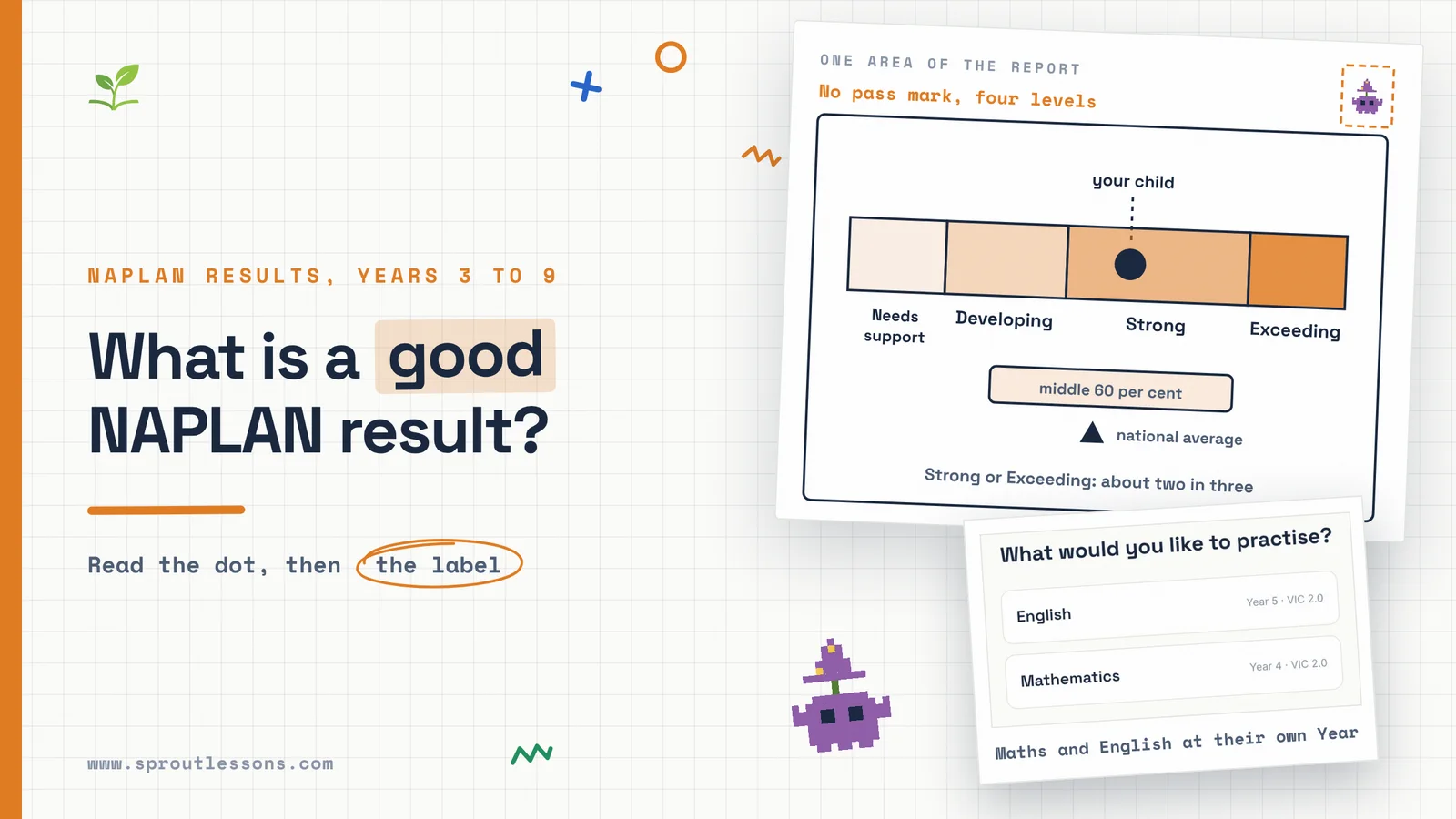
How to read the bar
Pages 2 and 3 of the report have one bar for each of the five areas tested: reading, writing, spelling, grammar and punctuation, and numeracy. Each bar is split into the four proficiency levels, and carries three marks:
- A black dot is your child’s result.
- A black triangle is the national average for students in the same year.
- A light shaded box is the range of the middle 60 per cent of students in that year across Australia. Some states and territories also mark the school’s average.
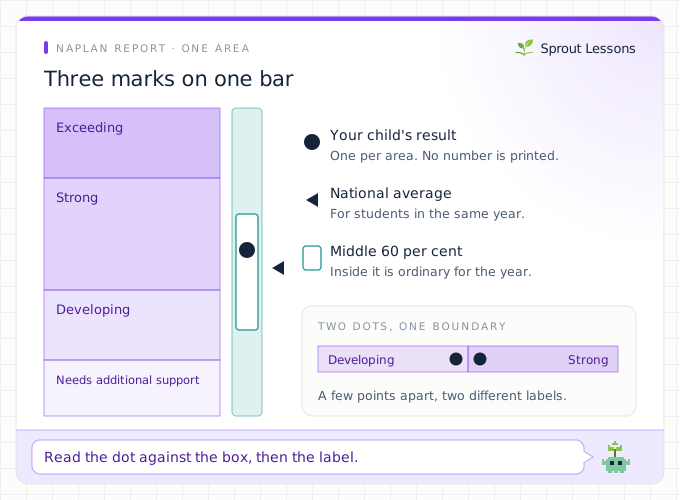
The report does not print a score as a number, so the dot’s position is the most precise thing you have. Look at it against the shaded box before you look at the label. A dot inside the box is in the middle 60 per cent of Australian students, whatever level it falls in. A dot near the top of Developing and a dot near the bottom of Strong can be a handful of points apart, while two dots both labelled Strong can be a hundred points apart. The final page describes what students at each level can typically do, and the longer proficiency level descriptions are on the NAP website.
What the four levels mean, and how many children land in each
ACARA’s definitions, and the share of Australian students in each level in 2026 reading:
| Level | ACARA’s meaning | Year 3 | Year 5 | Year 7 | Year 9 |
|---|---|---|---|---|---|
| Exceeding | Exceeds expectations at the time of testing | 19.4% | 17.6% | 20.6% | 16.3% |
| Strong | Meets challenging but reasonable expectations | 46.2% | 53.4% | 46.2% | 45.7% |
| Developing | Working towards expectations | 21.0% | 19.5% | 20.9% | 25.1% |
| Needs additional support | Not achieving the expected outcomes; likely to need extra support | 11.3% | 7.7% | 10.7% | 11.1% |
The rows do not add to 100 because a small share of students are exempt. Two things stand out. Developing is common: one Year 9 reader in four is in it. And Strong is a wide band that most children land in, not a thin line they have to clear. The standards are set, in ACARA’s words, to be “challenging, but still reasonable”, which means a child in Developing is behind a deliberately ambitious bar, not behind the class.
Victorian children do a little better than the national figures. In 2026, 71.5 per cent of Victorian Year 3 students were Strong or Exceeding in reading, against 65.6 per cent nationally, and 7.2 per cent needed additional support, against 11.3. So if your child is in Developing in a Victorian school, the share of classmates in the same spot is likely a little smaller than the national table suggests.
Where the levels sit on the NAPLAN scale
Behind the bar is a single NAPLAN scale for each area that runs from Year 3 to Year 9. ACARA publishes the exact cut points between levels. For reading and numeracy:
| Area | Year | Developing from | Strong from | Exceeding from | 2026 national average |
|---|---|---|---|---|---|
| Reading | 3 | 282 | 368 | 481 | 402.5 |
| Reading | 5 | 377 | 448 | 555 | 487.5 |
| Reading | 7 | 430 | 500 | 603 | 535.1 |
| Reading | 9 | 464 | 539 | 639 | 562.2 |
| Numeracy | 3 | 311 | 378 | 493 | 402.6 |
| Numeracy | 5 | 386 | 451 | 577 | 493.7 |
| Numeracy | 7 | 431 | 500 | 632 | 547.9 |
| Numeracy | 9 | 463 | 536 | 673 | 573.9 |
In Year 3 reading, Strong runs from 368 to 480: more than 110 points wide. The national average, 402.5, sits inside it. This is why the label alone tells you so little: Strong covers children who only just reached it and children close to Exceeding.
Why a child can grow and still drop a level
This is the part no report explains, and it catches a lot of families out between Year 5 and Year 7. The bar for Strong rises every NAPLAN year, because the skills expected rise. The question is whether children grow faster than the bar does. ACARA’s 2026 results follow the same students across two years (the Year 3 class of 2024 sat again in Year 5 in 2026, and so on), so the two can be put side by side:
| Reading | Strong cut rises by | Average student grew by |
|---|---|---|
| Year 3 to Year 5 | 80 points | 83.4 points |
| Year 5 to Year 7 | 52 points | 43.0 points |
| Year 7 to Year 9 | 39 points | 27.1 points |
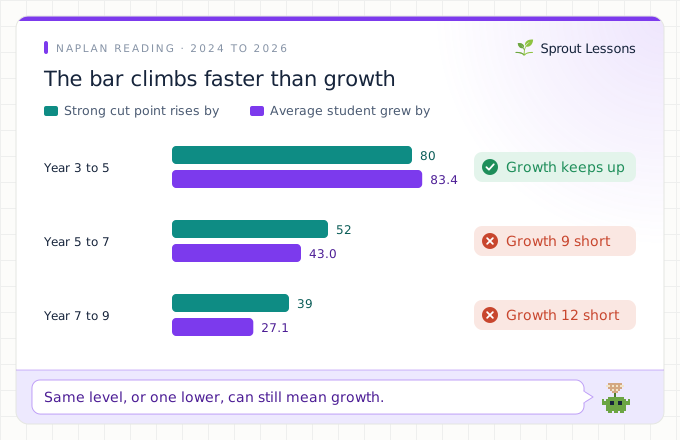
From Year 3 to Year 5 the average child keeps pace. After that, in reading, the bar climbs faster. A child who was only just Strong in Year 5 and grew by exactly the national average would land about 9 points short of Strong in Year 7. They read better than they did two years earlier, and the report says Developing. In numeracy the gap is smaller (the average student grew 58.9 points from Year 5 to Year 7, against a 49-point rise in the cut), so this mainly affects reading.
ACARA’s parent information says the same thing from the other direction: “A student who achieves the same proficiency level in successive years, such as Year 3 and Year 5, may still be making progress.” So staying at Strong is growth, and a step down from Strong to Developing between Year 5 and Year 7 is worth a conversation, not alarm. Check where the dot sits against the shaded box both times. If it held its place against other children, your child kept pace with their year.
Want to see the questions behind a level? Start free and give your child short Sprout Tutor sessions in English or maths on the Victorian Curriculum. Every answer lands on your dashboard, and it is free while in beta.
Comparing this report with the last one
- Only compare 2023 onwards. NAPLAN moved to March and to a new scale in 2023, and ACARA says results from 2023 on cannot be directly compared with 2008 to 2022. A 2022 band number and a 2024 level are different measures.
- Compare positions, not labels. ACARA says you can compare your child’s result against the national average and the middle 60 per cent across 2024 and 2026. That is the fair comparison.
- Treat 2026 writing with care in Years 5, 7 and 9. A platform fault on the first morning of testing, 11 March 2026, disrupted the online writing test for some students, and every report for those years carries a caveat saying so. Year 3 writes on paper and was unaffected. If your child’s writing result is out of line with the rest of the report, the disruption is a reasonable first explanation to raise with the school.
- Remember what Year 3 covers. ACARA says the questions are based mostly on what students learnt in previous years, with a few from the current year. A Year 3 child in March is being tested largely on Foundation to Year 2. Our page on what NAPLAN Year 3 actually tests goes through it.
What to ask the school
You were sent four pages. The school was sent much more. Its student and school summary report places every question your child answered on the same NAPLAN scale, links each one to an Australian Curriculum content code, and has an exception filter that flags the questions a student got wrong that sat below their own score. That list is the most useful thing NAPLAN produces for a parent, and you have to ask for it.
- Where did my child’s dot sit against the middle 60 per cent, this time and last time?
- Which questions did they miss that were below their score, and which curriculum content were they on?
- Does this match what you see in class? If not, which do you trust?
- If the result is Needs additional support, what support is planned, and when will we review it?
Question three matters most. ACARA’s own line is that NAPLAN “cannot replace the extensive, ongoing assessments made by teachers”, and a test sat on one March morning can be off for reasons that have nothing to do with learning. If you have a PAT Reading or PAT Maths result from the same year, expect it to disagree a little: they are different tests on different scales, and the teacher’s view of daily work is the tiebreaker.
What not to do
- Do not treat Developing as a fail. There is no pass mark, and Developing is where one child in five lands.
- Do not buy practice papers for next time. The tests are tailored, so each child sees a different path of questions, and ACARA does not recommend coaching. Our page on NAPLAN without the stress covers what does help.
- Do not use it as an entrance exam. ACARA says plainly that NAPLAN “is not designed to be a school admission test”, although some schools ask for reports.
What to do at home with a result
If the result fits what the teacher sees, nothing changes. If the school names a gap, work on that one thing in short, regular sessions and let the classroom and the next school report confirm it. A NAPLAN result is already nine months old by December, so what your child does now matters more than what they did in March.
Sprout Tutor, which we build, is one way to do it for a Victorian child. It follows the Victorian Curriculum in English, maths and science from Foundation to Year 10, adjusts the difficulty by fixed rules, and your parent dashboard shows each question your child saw and the answer they gave, which is the detail a NAPLAN report leaves out. It is not a NAPLAN predictor and does not try to be one, and like all personalised-learning software its effectiveness has not been independently established. For how the Victorian report you get in December relates to all this, see how to read a Victorian school report.
How this page was checked
Checked 3 November 2026 against ACARA’s NAPLAN results and reports page (the proficiency definitions, the report key and the scale cut points table), the 2026 individual student report information for parents and carers, the 2026 example Year 5 report, How to interpret the SSSR (15 April 2026), ACARA’s media release of 21 July 2026 on reports reaching families from Term 3, and the 2026 NAPLAN national results (released 5 August 2026; the percentages, averages and two-year cohort gains above are taken from ACARA’s downloadable dataset, and the comparisons with the cut points are our arithmetic). We are not affiliated with ACARA, and ACARA has not reviewed this page. Sprout Tutor is in public beta, follows the Victorian Curriculum only, and is free on every plan while in beta.
Got a NAPLAN report and a gap the school named? Start free and practise it in ten-question Victorian Curriculum sessions this week.
FAQ
What is a good NAPLAN result?
Strong or Exceeding. ACARA defines Strong as meeting challenging but reasonable expectations at the time of testing, and Exceeding as going beyond them. In the 2026 national results about two in three Australian students were Strong or Exceeding in reading, writing and numeracy. NAPLAN has no pass mark.
Is Developing on NAPLAN bad?
No. Developing means the student is working towards expectations that ACARA deliberately sets to be challenging. Around one student in five lands there in each year, and one Year 9 reader in four did in 2026. Needs additional support, about one student in ten, is the only level that signals a child is likely to need extra help.
What is a good NAPLAN score for Year 3?
The report does not print a score as a number. Behind it, the Year 3 reading cut point for Strong is 368 on the NAPLAN scale and for Exceeding 481, and the 2026 national average was 402.5. For Year 3 numeracy the cuts are 378 and 493, with a national average of 402.6. A dot inside the shaded box on the report means your child is in the middle 60 per cent of Australian Year 3 students.
Why did my child go from Strong in Year 5 to Developing in Year 7?
Often because the bar rose faster than average growth. In reading, the Strong cut point rises 52 points from Year 5 to Year 7, but ACARA's 2026 results show the average student grew by 43 points over those two years. A child who was only just Strong in Year 5 and grew by the national average would fall about 9 points short in Year 7, despite reading better. Compare where the dot sits against the shaded middle 60 per cent both times.
Can I compare my child's NAPLAN results with earlier years?
Only from 2023 onwards. NAPLAN moved to March and to a new scale in 2023, so earlier band results cannot be directly compared. ACARA says reports from 2024 and 2026 can be compared, including your child's position against the national average and the middle 60 per cent. Treat the 2026 writing result for Years 5, 7 and 9 with care because of a platform disruption on the first day of testing.