
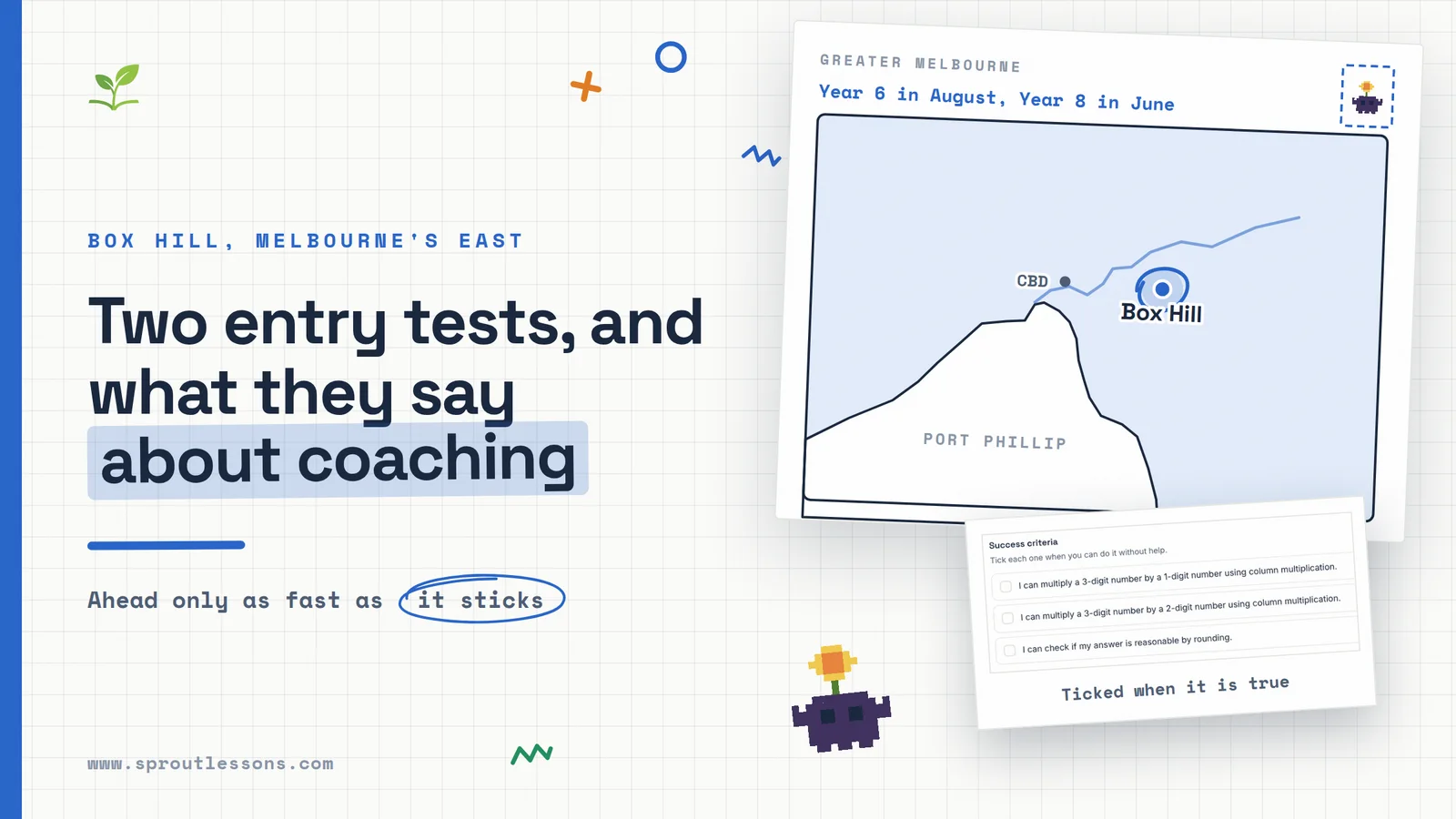
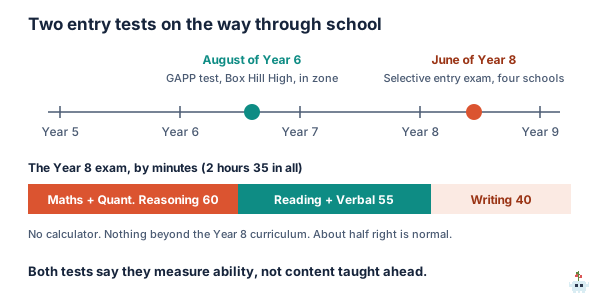
A child growing up in Box Hill can meet two academic entry tests before Year 9: Box Hill High School’s accelerated program test in August of Year 6, and the state’s selective entry exam in June of Year 8. Both say, in their own words, that they measure ability rather than content taught ahead. The exam body for the second one goes further and tells parents there is no need to practise or revise at all. That changes what preparation is worth paying for.
This page covers what each test actually is, what the organisations running them say about preparation, the one part of the Year 8 exam where steady practice clearly does help, and where a tool like ours fits and does not.
Test one: GAPP at Box Hill High, in Year 6
Box Hill High School has run a select entry accelerated learning program since 1994. It calls it GAPP, the Gifted Academic Potential Program, and it condenses four years of learning into three: Year 7 GAPP classes work at the Year 7 and 8 curriculum level, Year 8 classes at Year 9, and Year 9 classes at Year 10.
Three facts from the school’s own page decide whether it is relevant to you:
- It is for families in the zone. A child must first be offered a place at the school, and the school says places in the program are only offered to students who meet the zone requirement. For 2027 the school’s entry criteria are living in the zone, a sibling at the school, or compassionate grounds. Check your address on the state’s Find my School map before anything else.
- The test is a Saturday morning in August of Year 6, at the school, booked through the school website from July. The school lists four parts: Mathematical Reasoning, Reading Comprehension, Abstract Reading and Written Expression, and short-listed children are interviewed with a parent.
- The school says the test is designed to test ability rather than existing knowledge, and individual results are not given to parents afterwards. There is also a later entry point, with a test in Term 4 of Year 8.
Test two: the selective entry exam, in Year 8
Victoria has four selective entry government high schools, all taking students from Year 9: Melbourne High School, The Mac.Robertson Girls’ High School, Nossal High School in Berwick and Suzanne Cory High School in Werribee. One exam, run by ACER for the Department of Education, decides entry to all four. In 2026 it was held on Saturday 20 June, with applications open from 2 March to 24 April and first-round offers on 3 August.
The exam takes 2 hours 35 minutes of working time: Mathematics and Quantitative Reasoning for 60 minutes, Reading and Verbal Reasoning for 55, and two writing tasks in 40. Calculators are not allowed in the room. Any Year 8 student who meets the citizenship or visa rules can apply, at government and non-government schools, and so can home-schooled children registered with the VRQA. The application fee in 2026 was $175, waived for families with a health care or pensioner concession card and for First Nations families.
What the exam body actually says about coaching
This is the part most parents never read, because it is on ACER’s preparation page rather than in a coaching brochure. Quoted directly from ACER’s page for parents:
- “There is no need for your child to practice or revise for the exam.” ACER does publish sample questions, so a child can see the format before the day.
- “The required knowledge in any section will not exceed that found in the Year 8 curriculum.” Content taught beyond Year 8 is not what is being scored.
- “It is not unusual for candidates to only answer half the questions correctly and many do not finish.” The exam is built to spread out a strong field, so a practice paper that comes back at 50% is not a sign of failure.
ACER also lists “discussing exam content with tutoring companies, coaching colleges, or other candidates” as misconduct, which can see an application cancelled. That rule is about leaking questions, not about going to a coaching class, but it tells you how seriously the exam guards against anyone claiming to teach its actual content.
None of this means coaching does nothing. Familiarity with the question styles and practice at working against a clock are real, and a child who has never seen a verbal reasoning item will lose time on the day. It does mean that years of coaching from Year 4 is a choice families make, not something the exam asks for, and that a child learning Year 9 or 10 content early is not gaining marks on a test capped at Year 8.
Where steady practice does pay: Year 8 maths, without a calculator
The Victorian Curriculum often adds “with and without digital tools” to its number codes. The exam keeps only the second half. So the practice that clearly carries into the room is the boring kind: the Level 8 number work, done by hand, until it is quick.
- VC2M8N04: the four operations with integers and rational numbers, with mental and written strategies and estimates.
- VC2M8N05: percentages, including percentage increases and decreases.
- VC2M8A01 and VC2M8A02: expanding, factorising and rearranging linear expressions, and solving linear equations, checked by substitution.
One question tells you a lot. A $50 jacket is marked up 20%, and then the new price is discounted by 20%. What does it cost now? The common answer is $50, because “up 20, down 20” sounds like it cancels. It does not: $50 goes up to $60, and 20% off $60 is $12, so the jacket costs $48. The second 20% is a percentage of a bigger number. A child who answers $50 has a fluency gap in VC2M8N05 that no amount of reasoning practice fixes, and it is exactly the kind of thing that costs a minute they do not have.
The reteach is to write each change as a multiplier: up 20% is × 1.2, down 20% is × 0.8, and 1.2 × 0.8 is 0.96. Once a child sees the 0.96, they never answer $50 again.
Sprout builds a lesson on any Victorian Curriculum code, VC2M8N05 included, in about thirty seconds, with the code on the lesson. Start free and have tonight’s percentage practice ready before dinner.
What the rest of the exam rewards
ACER says the skills it measures “can be developed over time through exposure to a culture of learning”: varied, age-appropriate reading, being encouraged to think deeply and talk about what they learn. For a parent that translates into three habits that cost nothing:
- Reading well beyond the school list, including non-fiction and argument, because the reading section asks children to interpret and evaluate ideas, not just find them.
- Writing to a time limit. Two tasks in 40 minutes is about 20 minutes each, planning included. A child who has only ever written untimed drafts will run out of clock.
- Talking about how they solved something, not just whether it was right. That is the closest home version of a reasoning test.
One local detail: the cap on any one school
The department caps how many offers can go to students from a single school. Its selection policy says no more than 4% of students from one source school receive standard or principal discretion offers, rising to 10% for schools that run only from Prep to Year 9. A source school is the one your child is enrolled at in Year 8. Equity places, for families with a concession card or who are First Nations, sit outside the cap. If your child is at a large, high-achieving Year 7 to 12 school, that 4% is a real ceiling and worth knowing about before you build a family plan around one exam.
Where Sprout fits, and where it does not
Straight facts, since this is our product:
- Sprout is not selective entry preparation. It does not write verbal or quantitative reasoning items, and we would not claim it helps with them.
- It does the curriculum part. Sprout Lessons builds a lesson on the exact Level 7 or Level 8 code your child needs, wrapped around one of their interests, with the code in the footer.
- Sprout Tutor, in public beta, only moves a child ahead when they show it. It follows the Victorian Curriculum for Years 1 to 10 in maths, English and science, and a child moves up a Year after three right answers at the hardest of three difficulty tiers, one Year at a time, with every move logged. It stops at Year 10. That is ahead with evidence, which is the only kind of ahead that survives a test like this one. How it decides what comes next has the full rules.
- While it is in beta it is free on every plan, including the free one. It is not on the pricing page, so there is no price to quote.
The honest caveat applies here as everywhere: the effectiveness of personalised-learning chatbots has not been independently established, and very few rigorous studies of them exist. And no software notices that a twelve-year-old is anxious about an exam their whole friendship group is sitting. That part is yours.
A plan by year
- Years 4 and 5: keep maths secure at the year level, read widely, and leave the entry tests alone. Neither one is testing content from these years in a way coaching changes.
- Year 6, if you are in Box Hill High’s zone: book the GAPP test from July if your child is keen. Treat it as a look at the program, not a verdict.
- Year 7: make Level 7 number and algebra solid, by hand. Check the Year 7 maths codes for anything shaky.
- Year 8, Term 1: apply between early March and late April, look at ACER’s sample questions together once, and keep practising the Level 8 number codes without a calculator.
- Year 8, June: sleep, breakfast, and realistic expectations. ACER’s own advice to parents is not to place unnecessary pressure on them.
If the real question underneath is whether your child is behind rather than ahead, start with is my child behind in maths?, and if you are weighing a tutor at all, what maths tutoring in Melbourne costs has the arithmetic.
The short version
Box Hill children can meet two entry tests: Box Hill High’s GAPP test in August of Year 6, for families in the zone, and the selective entry exam in June of Year 8, for four schools. Both say they test ability rather than content taught ahead, ACER says no practice or revision is needed, and the exam’s knowledge stops at the Year 8 curriculum. The part practice clearly helps is Year 8 number work done without a calculator.
Sprout builds Victorian Curriculum lessons on the exact code around your child’s interests, and Sprout Tutor is in public beta for Years 1 to 10 and free on every plan while it is in beta. Start free.
Checked 3 October 2026. Exam format, dates, fees, eligibility and the quoted preparation advice are from ACER’s Victorian Selective Entry High Schools pages; the source-school cap and the four schools are from the Victorian Government’s selective entry page; GAPP details are from Box Hill High School’s own program and enrolment pages. Dates for the 2027 exam were not yet published. Codes are paraphrased from the Victorian Curriculum F–10 Version 2.0, © VCAA, licensed under CC BY-NC 3.0 AU; see f10.vcaa.vic.edu.au. VCAA does not endorse this page. We build competing software and say so above.
FAQ
Does my child need coaching for the selective entry exam?
ACER, which runs the exam for the Victorian Department of Education, says on its preparation page that there is no need for your child to practise or revise for the exam, and that the required knowledge in any section will not exceed the Year 8 curriculum. It publishes sample questions so a child can see the format. Coaching can build familiarity with question styles and timing, but years of it are a family choice, not something the exam asks for.
What is in the Victorian selective entry exam?
In 2026 the exam took 2 hours 35 minutes of working time: Mathematics and Quantitative Reasoning for 60 minutes, Reading and Verbal Reasoning for 55, and two writing tasks in 40. Calculators are not allowed. It decides Year 9 entry to Melbourne High School, The Mac.Robertson Girls’ High School, Nossal High School and Suzanne Cory High School, and was held on Saturday 20 June 2026.
What is GAPP at Box Hill High School?
GAPP, the Gifted Academic Potential Program, is Box Hill High School’s select entry accelerated learning program, run since 1994. It condenses four years of learning into three. Entry for Year 7 is by a test on a Saturday in August of Year 6, covering mathematical reasoning, reading comprehension, abstract reading and written expression, followed by an interview. Places are only offered to students who meet the school zone requirement.
Is there a limit on offers from one school?
Yes. No more than 4% of students from a single source school receive standard or principal discretion offers to the selective entry high schools, and a 10% cap applies to schools that run only from Prep to Year 9. The source school is the one a student attends in Year 8. Equity category places sit outside the cap.
Can Sprout help with selective entry preparation?
Not with the reasoning sections: Sprout does not write verbal or quantitative reasoning items. It helps with the curriculum part, building lessons on exact Victorian Curriculum codes such as Level 8 percentages, and Sprout Tutor only moves a child up a Year after three right answers at its hardest tier. Sprout Tutor covers Years 1 to 10, is in public beta and is free on every plan while it is in beta.