
The number nobody puts on the website is the annual one. A weekly session across the school year is forty sessions, which at Melbourne rates is somewhere between about $1,600 and $4,800. That is a real decision, and it deserves a clearer set of numbers than the industry generally provides.
This page has what the main options actually publish, what forty hours a year does and does not buy, and the four situations where a tutor is the wrong purchase even though it feels like the right one.
What the main options publish
- Kip McGrath. Their Australian pricing page states “RRP $78 per session”, with the note that “prices may vary by location”. A session covers English or maths, not both, and is described as “a combination of computer activities and written work”. The page does not publish the session length, so ask your centre.
- Cluey Learning. Publishes no price at all. Their pricing page says “it depends on what the student needs and the individualised learning programme that we design” and routes you to a Learning Advisor. That is worth knowing before you book the call, because it means the number arrives after a sales conversation rather than before one.
- Private tutors. On the marketplaces, advertised Melbourne maths rates cluster around $35 to $50 an hour, with the wider Australian market for one-to-one maths generally quoted at $55 to $85, and experienced classroom teachers and VCE specialists asking $95 to $140 and up.
Treat those last figures as advertised rates rather than quotes. They come from tutor marketplaces and industry guides, not from a single authority, and primary-level tutoring generally sits at the lower end because the content is less specialised than VCE.
What a year of it actually buys
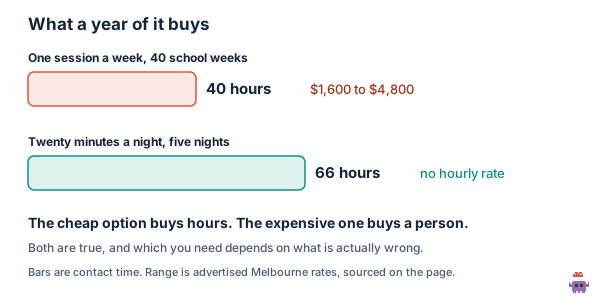
Forty hours a year is not very much, and that is not a criticism of tutoring. It is the arithmetic of one hour a week. Twenty minutes a night, five nights a week, across the same forty weeks, is sixty-six hours.
So if your problem is volume of practice, a tutor is an expensive way to buy it. If your problem is that nobody has worked out what is actually wrong, a good tutor is the fastest way to find out, and sixty-six hours of the wrong practice is worse than useless. The question is which problem you have.
What a human tutor does that nothing else does
We build software, so treat this section as coming from an interested party. It is still true.
- They notice. A tutor sees that your child has gone quiet, or is guessing to get it over with, or is fine with the maths and terrified of being wrong in front of someone. No software notices any of that, and it is frequently the actual problem.
- They can teach the thing underneath. A child stuck on fractions might actually be stuck on division, or on reading the question. A person can abandon the plan mid-session and go three years back. A program follows its pathway.
- They are a relationship. Turning up for someone is a motivator that no points system replicates, and for a child who has decided they are bad at maths, having one adult who visibly thinks otherwise can be the whole intervention.
- They can answer the question your child did not know how to ask. This is the thing bounded software is worst at, by design.
The longer comparison of AI and human tutoring goes further on where each one wins.
Four times a tutor is the wrong purchase
- When the gap has a name and it is one topic. If you already know it is equivalent fractions, forty hours of general maths tutoring is a very expensive way to fix twenty minutes of content. Find the code, practise the code. How to work out whether there is a gap at all takes an afternoon and costs nothing.
- When the topic has not been taught yet. Parents book tutors for Year 4 children who cannot do division with remainders, which is Year 5 content, and for Year 6 children who cannot do algebra, which is Year 7. A tutor will happily teach it. Your child was not behind.
- When it is a reading problem wearing a maths costume. A great deal of Year 3 to 6 maths difficulty is comprehension. If your child can do 24 divided by 4 and cannot do the word problem containing it, a maths tutor is treating the wrong subject.
- When the real issue is that practice is not happening. One supervised hour a week does not fix six unsupervised days. That is a different problem with a different fix.
What to ask before you sign anything
- “How long is a session, and is it one to one?” Centre-based tutoring is often small-group with a tutor circulating. That can be fine and it is not the same product as one to one, so know which you are buying.
- “What will you assess first, and will I see it?” A good answer names a diagnostic and offers you the output. A vague answer about getting to know your child is a month of your money.
- “Which curriculum content are you working on?” You want a strand and ideally a code, not “fractions”. Victorian schools run the Victorian Curriculum 2.0, so the tutor should be able to name where your child sits in it.
- “What should we do between sessions?” If the answer is nothing, you are buying forty hours and hoping. The between-sessions question has its own page.
- “What would make you tell me to stop?” The best answer any tutor ever gives. Someone who has a version of “when your child no longer needs me” is worth more than someone who does not.
Talk to the teacher first, because it is free
Before any of the above. Your child’s classroom teacher sees thirty children of the same age every day, which is a comparison you cannot make and they can. They will tell you which strand, whether it is one topic or general, and whether they think it is a maths issue at all.
Every tutor you contact will ask you for exactly that information. Getting it from the school costs nothing and makes the first paid session useful instead of introductory.
Where we sit, declared
We make lesson software, so weigh this accordingly. Sprout Tutor is in public beta as of 22 September 2026, covers the Victorian Curriculum only, Years 1 to 9, and is free on every tier while it is in beta. It is not on the pricing page and there is nothing to buy.
It is not a replacement for a tutor and we would not sell it as one. It has no open text box, it cannot notice that your child is having a bad week, and it cannot abandon the pathway to teach the thing underneath. What it does is the volume problem: curriculum-coded questions with the VC2 code on each one, a record of every answer including hints and reveals, and fixed rules rather than a model deciding what comes next. If you are paying for a tutor, that is the six days they are not there.
The short version
Kip McGrath publishes an RRP of $78 a session. Cluey publishes no price and routes you to a Learning Advisor. Private Melbourne maths tutors advertise around $35 to $50 an hour, with the wider market at $55 to $85 and specialists well above that.
A weekly session is forty hours across a school year, which is somewhere between about $1,600 and $4,800. Twenty minutes a night is sixty-six hours. If you need volume, a tutor is an expensive way to buy it; if you need someone to work out what is wrong, it is the fastest way there is.
Do not book one when the gap has a name and is one topic, when the content is not due until next year, when the difficulty is reading rather than maths, or when the real problem is that nothing happens on the other six days. Ask the classroom teacher first, because they have the answer every tutor will ask you for and they will give it to you free.
Sprout Lessons builds curriculum-aligned lessons for Foundation to Year 10, with the code on every lesson. Start free. If you are in Victoria, Sprout Tutor is in public beta for Years 1 to 9 and free on every tier while it is in beta.
Checked 26 September 2026. The Kip McGrath figure and session description are quoted from their own Australian pricing page, which states RRP $78 per session and that prices vary by location. The Cluey position is quoted from their own pricing page, which publishes no figures. Private-tutor rates are advertised rates from tutor marketplaces including Superprof Melbourne, plus industry pricing guides, and are ranges rather than quotes. Prices change: confirm directly with any provider before deciding. We make competing software and say so above.
FAQ
How much does maths tutoring cost in Melbourne?
Kip McGrath’s Australian pricing page states RRP $78 per session, noting prices may vary by location, with a session covering English or maths rather than both. Cluey Learning publishes no price and routes you to a Learning Advisor. Private tutors advertise around $35 to $50 an hour on the Melbourne marketplaces, with the wider Australian market for one-to-one maths generally quoted at $55 to $85 and experienced teachers and VCE specialists at $95 to $140 and up. Treat the hourly figures as advertised rates rather than quotes.
How much is a year of weekly tutoring?
Forty sessions across a school year, which comes to roughly $1,600 to $4,800 depending on which end of the market you are in. That buys about forty hours of contact time. For comparison, twenty minutes a night, five nights a week, across the same forty weeks is sixty-six hours.
Is a maths tutor worth it?
It depends which problem you have. A tutor notices things software cannot, such as a child guessing to get it over with or being fine with the maths and frightened of being wrong in front of someone. They can abandon the plan mid-session and teach the thing underneath, and they are a relationship, which for a child who has decided they are bad at maths can be the whole intervention. What they are not is a cheap way to buy practice volume.
When should I not hire a tutor?
Four situations. When you already know the gap is one named topic, because a code you can name is twenty minutes of content rather than forty hours of general tutoring. When the content is not due until next year, which is common: division with remainders is Year 5 and algebra with letters is Year 7. When the difficulty is reading comprehension rather than maths. And when the real problem is that no practice happens on the other six days.
What should I ask a tutor before signing up?
How long a session is and whether it is genuinely one to one rather than small-group. What they will assess first and whether you will see the result. Which curriculum strand or code they are working on, since Victorian schools run the Victorian Curriculum 2.0. What you should do between sessions. And what would make them tell you to stop, because a tutor with an answer to that is worth more than one without.
Can software replace a tutor?
No, and we build software and would not claim it. Sprout Tutor has no open text box, cannot notice that your child is having a bad week, and cannot abandon its pathway to teach the thing underneath. What it addresses is the volume problem on the six days a tutor is not there: curriculum-coded questions with the code on each one and a record of every answer including hints and reveals. It is in public beta, covers the Victorian Curriculum only for Years 1 to 9, and is free on every tier while in beta.