
The first thing to know about Essential Assessment is that you are not its customer. Your child’s school is. The school buys the subscription, the teacher runs the assessments, and you see whatever report the school chooses to send home. There is no parent login, because there is no parent product.
That is not a criticism. It is a school assessment platform doing exactly what a school assessment platform is for. But it explains why the report you received answers questions you did not ask and stays quiet on the one you did, which is what to actually do about it.
What it is
Essential Assessment is an Australian online assessment platform for primary maths and English. Its own site says it is “trusted by more than 2,800 schools across Australia since 2015” and describes itself as providing “curriculum-aligned assessments for continuous whole-school improvement and reporting in primary maths and English”.
For Victorian schools it aligns to the Victorian Curriculum 2.0 and to VTLM 2.0. The core mechanic is a pre and post assessment within each strand or sub-strand: the class sits an assessment before a unit and another after it, and the platform reports the growth between them against the achievement standards.
What the school gets out of it, in the platform’s own words:
- Question-level analysis, so a teacher can see which specific items a student, group or class got wrong.
- Strand Overview and growth tracking against the achievement standards.
- MTSS placement, which is the multi-tiered system of supports framework schools use to decide who needs intervention.
- Whole-school dashboards, and printable My Numeracy and My Literacy resources differentiated by the assessment result.
- “Automated reports to share with families & school leaders”, which is the sentence that produced the document on your kitchen table.
What it does better than anything we build
Worth saying plainly, because we make software that overlaps at the edges. Essential Assessment answers a question about a cohort, and it answers it well.
A school leader can see which strands a whole year level has moved on, which classes have not, and which students need placing in a tier of support. It generates the evidence a school needs for its own reporting obligations. Nothing designed for one child at a kitchen table does any of that, and nothing we make tries to.
The question-level analysis is genuinely good too. A teacher can see that eleven children in the class missed the same item, which is a teaching signal you cannot get from a single score.
What the instrument is, and is not
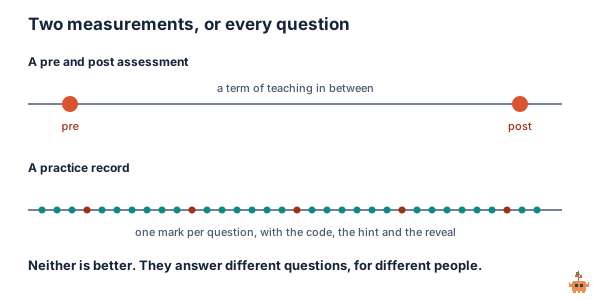
Two measurements, a term apart. That is a good design for the question “did this unit of teaching work”. It is a poor design for “what should we do tonight”, and it was never meant to answer that.
Three consequences worth holding in mind when you read the report:
- It is a snapshot, twice. A bad morning lands in the data the same as a genuine gap. A single pre-test result is not a diagnosis.
- You almost certainly cannot see the questions. The question-level analysis exists, and it belongs to the teacher. Unless your school shares it, the report tells you a level and a strand rather than what your child actually got wrong.
- Growth is measured against the achievement standard, not against last week. Which is the right choice for a school and an unfamiliar one for a parent who wants to know whether the last month helped.
Five things to ask the school
All of these are reasonable, all of them are answerable, and none of them requires a login you do not have.
- “Which strand or sub-strand is this about?” Number, Algebra, Measurement, Space, Statistics or Probability. “Maths” is not an answer you can act on.
- “Can I see the question-level analysis for my child?” It exists. Whether you get it is a school decision, and a lot of schools will simply say yes.
- “Was this the pre or the post?” It changes the meaning entirely. A low pre-test before a unit is the platform working as intended.
- “Has this placed my child in a support tier?” MTSS placement is one of the platform’s outputs, and if the answer is yes you want to know what that means in practice at your school.
- “What would you like us to do at home?” The teacher has the question-level data. They can name a topic in ten seconds if you ask.
Reading a level without panicking
The report will place your child somewhere against the Victorian Curriculum achievement standards, and that placement may not be their year level. The Victorian Curriculum is written as Levels on a continuum precisely because students are expected to be spread along it, and a child can sit at one Level in Number and another in Measurement. What a Level below the year actually means is its own page.
Before concluding anything, it is also worth checking whether the content was due yet. A surprising amount of parental worry is about topics a year or more early.
What a home practice record does differently
We build one, so this is an interested comparison rather than a neutral one. The difference is the instrument rather than the quality.
Sprout Tutor is in public beta as of 22 September 2026, covers the Victorian Curriculum only, Years 1 to 9, and is free on every tier while in beta. Because it is bought by a parent rather than a school, the record is yours: every question stored against its VC2 code with the answer given, whether a hint was used and whether the answer was revealed. The answer key is stripped on the server before the question reaches the screen, and a revealed answer can never be recorded as correct.
That is a continuous, per-question record for one child. It will not tell you how the Year 4 cohort is tracking, it produces no whole-school dashboard, and it has no MTSS placement. Essential Assessment will not tell you which question your child got wrong last night. Both statements are fine, because they are different tools.
The short version
Essential Assessment is a school platform, used by more than 2,800 Australian schools since 2015, aligned in Victoria to the Victorian Curriculum 2.0. It pre-assesses and post-assesses each strand and reports growth against the achievement standards, with question-level analysis, MTSS placement and whole-school dashboards for the school.
You are not the customer, so you see the automated report the school chooses to send. That report is two measurements a term apart, which is the right instrument for “did the unit work” and the wrong one for “what do we do tonight”.
Ask which strand, whether it was the pre or the post, whether you can see the question-level analysis, whether it triggered a support tier, and what the teacher would like you to do at home. All five are answerable and the last one is the useful one.
Sprout Lessons builds curriculum-aligned lessons for Foundation to Year 10, with the code on every lesson, so a strand the school names becomes a lesson you can teach tonight. Start free.
Checked 26 September 2026 against Essential Assessment’s own public pages, including their homepage and their Victorian Curriculum page, which are the source of the school count, the alignment to Victorian Curriculum 2.0 and VTLM 2.0, the pre and post mechanic, and the list of outputs including question-level analysis, Strand Overview, MTSS placement and whole-school dashboards. Their parent-facing help article sits behind a login and is not quoted here. We build competing software and say so above. What any individual school shares with families is a school decision and varies: ask yours.
FAQ
What is Essential Assessment?
An Australian online assessment platform for primary maths and English, used by more than 2,800 schools across Australia since 2015 according to its own site. In Victoria it aligns to the Victorian Curriculum 2.0 and VTLM 2.0. It pre-assesses and post-assesses students within each strand or sub-strand and reports growth against the achievement standards, producing question-level analysis, Strand Overview, MTSS placement, learning goals, growth tracking and whole-school dashboards for the school.
Can parents log in to Essential Assessment?
No. The school buys the subscription and there is no parent product. Its own site mentions families once, in the context of helping teachers show families how a child is progressing, and lists automated reports to share with families and school leaders among its outputs. What you receive is whatever report your school chooses to send, which is a school decision and varies between schools.
Does a low Essential Assessment result mean my child is behind?
Not necessarily, and the first thing to check is whether you are looking at a pre-test. A pre-assessment sits before the unit is taught, so a low result there is the instrument doing its job. It is also a snapshot: a bad morning lands in the data the same way a genuine gap does. And the placement is against Victorian Curriculum achievement standards rather than year level, and a Level below the year in one strand is what a continuum-based curriculum expects.
What does Essential Assessment do better than a home practice tool?
It answers a question about a cohort, and answers it well. A school leader can see which strands a whole year level has moved on, which classes have not, and which students need placing in a tier of support, and it produces the evidence a school needs for its own reporting. The question-level analysis also lets a teacher see that eleven children missed the same item, which is a teaching signal no single score gives. Nothing designed for one child at a kitchen table does any of that.
What does the report not tell me?
What to do tonight. It is two measurements a term apart, designed to answer whether a unit of teaching worked. You almost certainly cannot see the questions unless the school shares the question-level analysis, growth is measured against the achievement standard rather than against last week, and a single result is a snapshot rather than a diagnosis.
What is MTSS placement?
The multi-tiered system of supports framework schools use to decide which students need intervention and at what intensity. It is one of Essential Assessment’s outputs. If your child’s results have placed them in a tier, that is worth asking about directly, because what a tier means in practice differs between schools.